

Search results
Search for "chemistry" in Full Text gives 1165 result(s) in Beilstein Journal of Nanotechnology. Showing first 200.
Quercetin- and caffeic acid-functionalized chitosan-capped colloidal silver nanoparticles: one-pot synthesis, characterization, and anticancer and antibacterial activities
Beilstein J. Nanotechnol. 2023, 14, 362–376, doi:10.3762/bjnano.14.31

- Akif Hakan Kurt Elif Berna Olutas Fatma Avcioglu Hamza Karakus Mehmet Ali Sungur Cansu Kara Oztabag Muhammet Yildirim Department of Medicinal Pharmacology, Faculty of Medicine, Bolu Abant Izzet Baysal University, 14030 Bolu, Türkiye Department of Chemistry, Faculty of Arts and Sciences, Bolu Abant


Polymer nanoparticles from low-energy nanoemulsions for biomedical applications
Beilstein J. Nanotechnol. 2023, 14, 339–350, doi:10.3762/bjnano.14.29
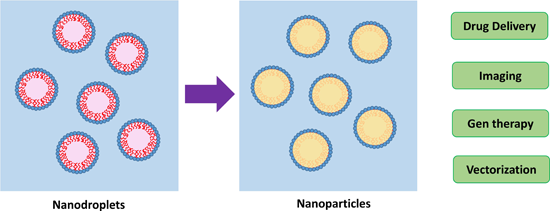
- by TEM) were surface-decorated with carbosilane cationic dendrons via carbodiimide chemistry [54] for conjugation with antisense oligonucleotides (ASO). The conjugated nanoparticles with a hydrodynamic diameter between 80 and 160 nm (depending on dendron generation) showed high colloidal stability
- wt % PLGA in ethyl acetate/ethanol) (O) system were functionalized with a cell-penetrating peptide (Tat) using carbodiimide chemistry [57]. The hydrodynamic diameter ranged from 48 to 65 nm depending on the Tat fraction. The functionalized nanoparticles showed dose-dependent cytotoxicity on Hela and
- permission of The Royal Society of Chemistry from [58] (“Electrolytes as a tuning parameter to control nanoemulsion and nanoparticle size” by C. Fornaguera et al., RSC Advances, vol.6, issue 63, © 2016); permission conveyed through Copyright Clearance Center, Inc. This content is not subject to CC BY 4.0




Bismuth-based nanostructured photocatalysts for the remediation of antibiotics and organic dyes
Beilstein J. Nanotechnol. 2023, 14, 291–321, doi:10.3762/bjnano.14.26
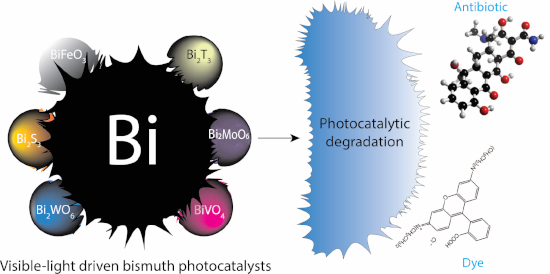
- Akeem Adeyemi Oladipo Faisal Suleiman Mustafa Polymeric Materials Research Laboratory, Chemistry Department, Faculty of Arts and Science, Eastern Mediterranean University, TR North Cyprus, Famagusta, via Mersin 10, Turkey 10.3762/bjnano.14.26 Abstract A serious threat to human health and the
- dimensions of less than 100 nm, where one of the phases has different properties due to differences in chemistry and structure. Following the formation of the nanocomposite, its properties are often enhanced and significantly different from those of the components. Fascinatingly, nanocomposite photocatalysts


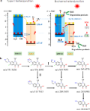
Biocatalytic synthesis and ordered self-assembly of silica nanoparticles via a silica-binding peptide
Beilstein J. Nanotechnol. 2023, 14, 280–290, doi:10.3762/bjnano.14.25

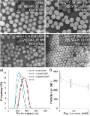
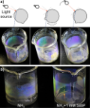
- synthesis and assembly of SiO2 nanoparticles into gels or opal-like ordered structures. Experimental Synthesis of the peptide The SiBP was commercially synthesized (Genscript, NJ, USA) at <98% purity via 9-fluorenylmethoxycarbonyl (F-moc) chemistry methods. The amino acid sequence and physicochemical




Nanotechnology – a robust tool for fighting the challenges of drug resistance in non-small cell lung cancer
Beilstein J. Nanotechnol. 2023, 14, 240–261, doi:10.3762/bjnano.14.23
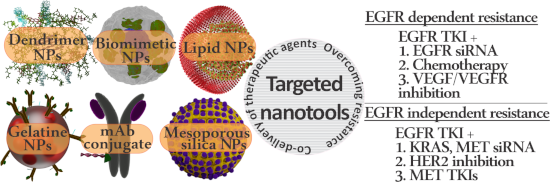
- can be subsequently modified using thiolene chemistry to introduce positive charges [−NH2 (cysteamine, ENT)], negative charges [−COOH (3-mercaptopropionic acid, ECT)], and active targeting ligands [thiogalactose residues (EGT)] for fine-tuning the charges in the shell in different biological


Cyclodextrins as eminent constituents in nanoarchitectonics for drug delivery systems
Beilstein J. Nanotechnol. 2023, 14, 218–232, doi:10.3762/bjnano.14.21
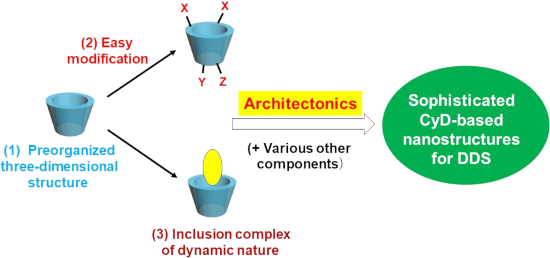
- inclusion complexes with β-CyD. Figure 2 was reproduced from [50] (“Supramolecular hydrogels constructed by red-light-responsive host–guest interactions for photo-controlled protein release in deep tissue“ by D. Wang et al., © The Royal Society of Chemistry 2015, distributed under the terms of the Creative
- form. Figure 3b was used with permission of The Royal Society of Chemistry from [53] (“Light-responsive arylazopyrazole-based hydrogels: their applications as shape-memory materials, self-healing matrices and controlled drug release systems” by G. Davidson-Rozenfeld et al., Polym. Chem., vol. 10, issue
- , azobenzene isomerizes from the trans form to the cis form, decomposing the composite to release the siRNA cargo. Figure 4 was adapted with permission of The Royal Society of Chemistry from [66] (“Highly efficient photocontrolled targeted delivery of siRNA by a cyclodextrin-based supramolecular nanoassembly




A novel approach to pulsed laser deposition of platinum catalyst on carbon particles for use in polymer electrolyte membrane fuel cells
Beilstein J. Nanotechnol. 2023, 14, 190–204, doi:10.3762/bjnano.14.19
- Boguslaw Budner Wojciech Tokarz Slawomir Dyjak Andrzej Czerwinski Bartosz Bartosewicz Bartlomiej Jankiewicz Institute of Optoelectronics, Military University of Technology, 2 Kaliskiego Str., 00-908 Warsaw, Poland Łukasiewicz Research Network - Mościcki Industrial Chemistry Research Institute
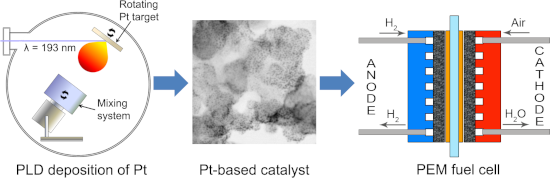
- (ICRI), 8 Rydygiera Str., 01-793 Warsaw, Poland Institute of Chemistry, Military University of Technology, 2 Kaliskiego Str., 00-908 Warsaw, Poland Faculty of Chemistry, University of Warsaw, 1 Pasteura Str., 02-093 Warsaw, Poland 10.3762/bjnano.14.19 Abstract The research undertaken aimed to develop
- Chemistry Research Institute (ICRI) in Warsaw. In the first stage, the efficiency of electrochemical oxygen reduction was measured using the rotating disc-ring electrode (RRDE) technique. The measurements were conducted in a four-electrode electrochemical cell using a RRDE (Pine Instruments, United States



Structural, optical, and bioimaging characterization of carbon quantum dots solvothermally synthesized from o-phenylenediamine
Beilstein J. Nanotechnol. 2023, 14, 165–174, doi:10.3762/bjnano.14.17
- Belgrade, Serbia Polymer Institute, Slovak Academy of Sciences, Dubravska cesta 9, 84 541 Bratislava, Slovakia J. Heyrovsky Institute of Physical Chemistry, Academy of Sciences of the Czech Republic, Dolejškova 3, 182 23, Praha 8, Czech Republic Faculty of Agriculture, University of Belgrade, Nemanjina 6
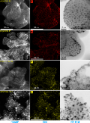
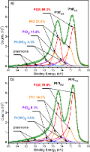
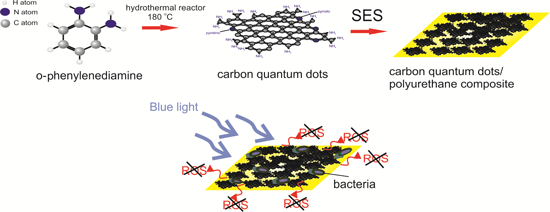
- different effectiveness on bacteria and tested cells (adenocarcinomic human alveolar basal epithelial cells-A549 and mouse embryonic fibroblast cell line-NIH/3T3) [18]. By comparing the results of these two investigations, we concluded that the surface chemistry of the encapsulated CQDs in polymer


Combining physical vapor deposition structuration with dealloying for the creation of a highly efficient SERS platform
Beilstein J. Nanotechnol. 2023, 14, 83–94, doi:10.3762/bjnano.14.10

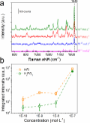
- Adrien Chauvin Walter Puglisi Damien Thiry Cristina Satriano Rony Snyders Carla Bittencourt Plasma-Surface Interaction Chemistry, University of Mons, 23 Place du Parc, 7000 Mons, Belgium Chemistry of Surfaces, Interfaces and Nanomaterials, Faculty of Sciences, Université libre de Bruxelles, 50




Solvent-induced assembly of mono- and divalent silica nanoparticles
Beilstein J. Nanotechnol. 2023, 14, 52–60, doi:10.3762/bjnano.14.6

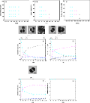
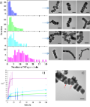
- Bin Liu Etienne Duguet Serge Ravaine Univ. Bordeaux, CNRS, CRPP, UMR 5031, 33600 Pessac, France School of Chemistry and Chemical Engineering, Liaocheng University, Liaocheng 252059, P. R. China Univ. Bordeaux, CNRS, Bordeaux INP, ICMCB, UMR 5026, 33600 Pessac, France 10.3762/bjnano.14.6 Abstract



Gap-directed chemical lift-off lithographic nanoarchitectonics for arbitrary sub-micrometer patterning
Beilstein J. Nanotechnol. 2023, 14, 34–44, doi:10.3762/bjnano.14.4
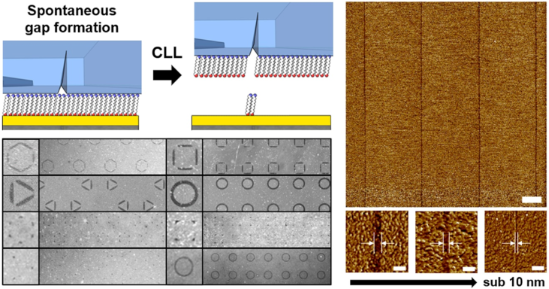
- Chang-Ming Wang Hong-Sheng Chan Chia-Li Liao Che-Wei Chang Wei-Ssu Liao Department of Chemistry, National Taiwan University, Taipei 10617, Taiwan 10.3762/bjnano.14.4 Abstract We introduce a unique soft lithographic operation that exploits stamp roof collapse-induced gaps to selectively remove an


Two-step single-reactor synthesis of oleic acid- or undecylenic acid-stabilized magnetic nanoparticles by thermal decomposition
Beilstein J. Nanotechnol. 2023, 14, 11–22, doi:10.3762/bjnano.14.2

- Mykhailo Nahorniak Pamela Pasetto Jean-Marc Greneche Volodymyr Samaryk Sandy Auguste Anthony Rousseau Nataliya Nosova Serhii Varvarenko Organic Chemistry department, Lviv Polytechnic National University, Bandera street 12, 79013, Lviv, Ukraine Institute of Macromolecular Chemistry, Czech Academy
- of a given amount of a higher acid (OA or UA) in 1-octadecene. Supporting Information Supporting Information File 44: Additional figures. Acknowledgements Dr. Małgorzata Świętek (Institute of macromolecular chemistry CAS, Prague, Czech Republic) is gratefully acknowledged for the language revision


Electrical and optical enhancement of ITO/Mo bilayer thin films via laser annealing
Beilstein J. Nanotechnol. 2022, 13, 1589–1595, doi:10.3762/bjnano.13.133
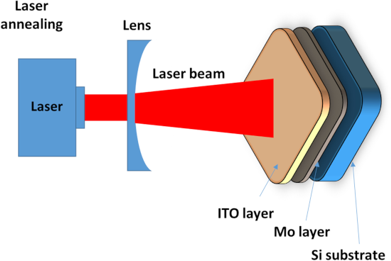
- Abdelbaki Hacini Ahmad Hadi Ali Nurul Nadia Adnan Nafarizal Nayan Laser and Semiconductor Technology Research Group, COR PDSR, Department of Physics and Chemistry, Faculty of Applied Sciences and Technology, Pagoh Educational Hub, Universiti Tun Hussein Onn Malaysia, 84600 Pagoh, Johor, Malaysia


Single-step extraction of small-diameter single-walled carbon nanotubes in the presence of riboflavin
Beilstein J. Nanotechnol. 2022, 13, 1564–1571, doi:10.3762/bjnano.13.130
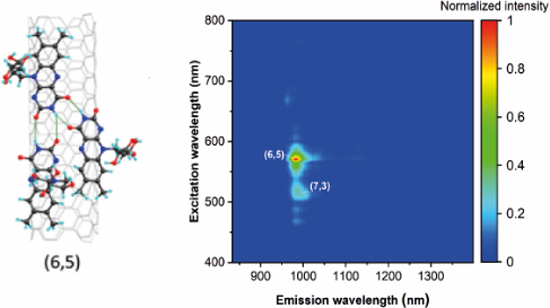
- University School of Chemical Engineering, Kemistintie 1, 02015, Espoo, Finland A. M. Prokhorov General Physics Institute of RAS, 38 Vavilov Street, Moscow, 119991, Russia Moscow Institute of Physics and Technology, 9 Institutskiy per., Dolgoprudny, 141701, Russia Department of Chemistry, M.V.Lomonosov


Non-stoichiometric magnetite as catalyst for the photocatalytic degradation of phenol and 2,6-dibromo-4-methylphenol – a new approach in water treatment
Beilstein J. Nanotechnol. 2022, 13, 1531–1540, doi:10.3762/bjnano.13.126

- , ozonation, Fenton chemistry, and photocatalysis have been successfully used to remove persistent organic pollutants (POPs) or as a pre-treatment in conventional or biological methods [10]. Ozonation is an AOP technique that has been widely used to remove organic compounds such as drugs, pesticides


Structural studies and selected physical investigations of LiCoO2 obtained by combustion synthesis
Beilstein J. Nanotechnol. 2022, 13, 1473–1482, doi:10.3762/bjnano.13.121

- Monika Michalska Pawel Lawniczak Tomasz Strachowski Adam Ostrowski Waldemar Bednarski Department of Chemistry and Physico-Chemical Processes, Faculty of Materials Science and Technology, VŠB-Technical University of Ostrava, 17. listopadu 15/2172, 708 00 Ostrava-Poruba, Czech Republic Łukasiewicz




Rapid and sensitive detection of box turtles using an electrochemical DNA biosensor based on a gold/graphene nanocomposite
Beilstein J. Nanotechnol. 2022, 13, 1458–1472, doi:10.3762/bjnano.13.120

- Biotechnology, Ganakbari, Ashulia, Savar, Dhaka-1349, Bangladesh Department of Chemistry, Jagannath University, Dhaka-1100, Bangladesh Department of Microbiology, Institute of Biological Sciences, Faculty of Sciences, University of Malaya, 50603, Kuala Lumpur, Malaysia 10.3762/bjnano.13.120 Abstract The



Facile preparation of Au- and BODIPY-grafted lipid nanoparticles for synergized photothermal therapy
Beilstein J. Nanotechnol. 2022, 13, 1432–1444, doi:10.3762/bjnano.13.118

- Yuran Wang Xudong Li Haijun Chen Yu Gao Cancer Metastasis Alert and Prevention Centre, College of Chemistry and Fujian Provincial Key Laboratory of Cancer Metastasis Chemoprevention and Chemotherapy, Fuzhou University, Fuzhou 350108, Fujian, China College of Chemistry, Key Laboratory of Molecule




Dry under water: air retaining properties of large-scale elastomer foils covered with mushroom-shaped surface microstructures
Beilstein J. Nanotechnol. 2022, 13, 1370–1379, doi:10.3762/bjnano.13.113

- chemistry of the hierarchically structured surfaces water cannot penetrate and air remains trapped in between the structures [1], which is indicated by a silvery shine of the submerged surface (See Figure 1a). For technical applications, the Salvinia effect bears an immense potential, as air layers kept


Straight roads into nowhere – obvious and not-so-obvious biological models for ferrophobic surfaces
Beilstein J. Nanotechnol. 2022, 13, 1345–1360, doi:10.3762/bjnano.13.111
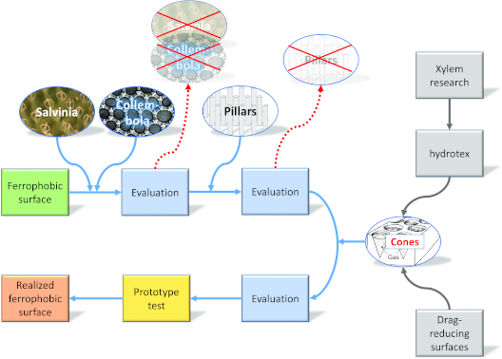
- from OpenStax, Blast Furnace Reactions, CC BY 4.0). Centre, right: a novel tuyère and a tuyère after a few weeks of usage; the lower parts extend into the blast furnace. (Figure 1a was reproduced from [16]. Accessible for free at https://openstax.org/books/chemistry-2e/pages/1-introduction (© 2019 P


Recent trends in Bi-based nanomaterials: challenges, fabrication, enhancement techniques, and environmental applications
Beilstein J. Nanotechnol. 2022, 13, 1316–1336, doi:10.3762/bjnano.13.109
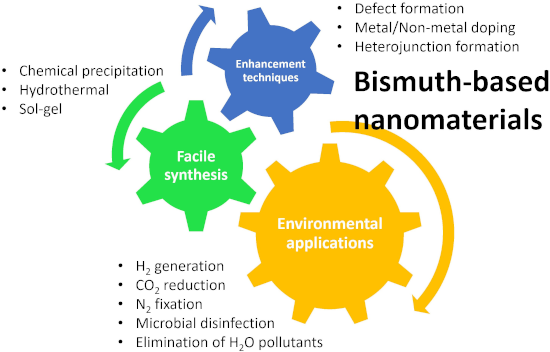
- of Bi-based photocatalysts. Keywords: bismuth-based nanomaterials; environmental remediation; heterojunction formation; photocatalysis; Introduction Nanomaterials photocatalysis is a “green” integrative technique that combines physics, chemistry, and materials science with chemical engineering to




Studies of probe tip materials by atomic force microscopy: a review
Beilstein J. Nanotechnol. 2022, 13, 1256–1267, doi:10.3762/bjnano.13.104
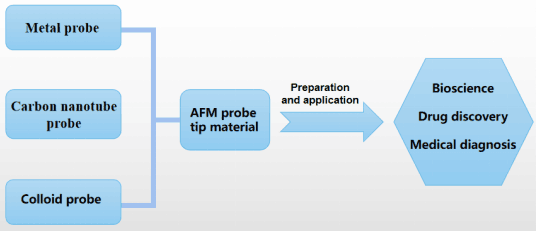
- studies will give further impetus to the application of CPs in spectral dynamics. Conclusion and Outlook Probe technology has been applied in physics, chemistry, biology, and nanotechnology in the past few years, and outstanding results have been achieved. Metal, carbon nanotube, and colloidal probes have
Role of titanium and organic precursors in molecular layer deposition of “titanicone” hybrid materials
Beilstein J. Nanotechnol. 2022, 13, 1240–1255, doi:10.3762/bjnano.13.103
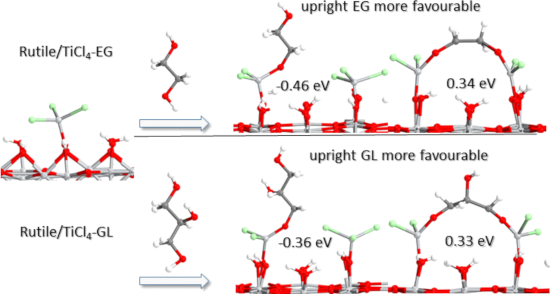
- , known as “titanicones”. We investigate in detail the chemistry between the most common Ti precursors, namely titanium tetrachloride (TiCl4) and tetrakis(dimethylamido)titanium (Ti(DMA)4), and ethylene glycol (EG) and glycerol (GL) as the organic precursors. We analyse the impact of the substrate on the
- growth could be achieved. Keywords: density functional theory (DFT) studies; double reactions; surface chemistry; titanicone; Introduction Molecular layer deposition (MLD), a thin film deposition technique, has attracted significant attention in recent years as a suitable approach for the deposition of
- ALD, in MLD the deposition chemistry can be extended by including organic precursors, leading to the deposition of hybrid organic–inorganic MLD films [3][9]. Two organic precursors can also be employed to deposit pure organic MLD films, such as polymers [10][11][12]. Similar to ALD, MLD enables the


Design of surface nanostructures for chirality sensing based on quartz crystal microbalance
Beilstein J. Nanotechnol. 2022, 13, 1201–1219, doi:10.3762/bjnano.13.100
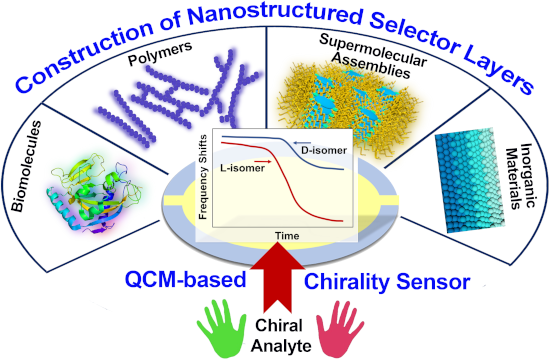
- several pregnant women causing fetal malformation [7], owing to the trace presence of teratogenic (S)-thalidomide in sedative (R)-thalidomide [8]. Hence, chirality detection keeps attracting much attention in the fields of chemistry, biology, and medicine. Especially for the pharmaceutical and food
- generated by polypyrrole (PPy) and Trp [127]. Intrinsic chiral metal crystals Until relatively recently, metals were ignored as potential substrates for asymmetric surface chemistry since metals always show highly symmetric and achiral bulk structures with unexposed chiral surfaces [128][129]. Sykes and co


Application of nanoarchitectonics in moist-electric generation
Beilstein J. Nanotechnol. 2022, 13, 1185–1200, doi:10.3762/bjnano.13.99
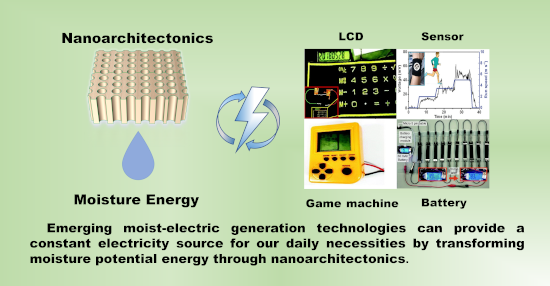
- from [55] (“Towards Watt-scale hydroelectric energy harvesting by Ti3C2Tx-based transpiration-driven electrokinetic power generators“, © 2022 J. Bae et al., published by Royal Society of Chemistry, distributed under the terms of the Creative Commons Attribution-NonCommercial 3.0 Unported License, https
- ://creativecommons.org/licenses/by-nc/3.0/). This content is not subject to CC BY 4.0. (a) Cross-sectional SEM image of GO’s nanoscale network structure. Figure 5a was republished with permission of The Royal Society of Chemistry from [63] (“Electric power generation via asymmetric moisturizing of graphene oxide for
- ) pushing/releasing type, and (c) dipping type (c) of water motion active transducers. Figure 6a–c were republished with permission of The Royal Society of Chemistry from [75] (“An effective energy harvesting method from a natural water motion active transducer” by Kwon, Soon-Hyung et al., Energy Environ