
Search results
Search for "conductance" in Full Text gives 215 result(s) in Beilstein Journal of Nanotechnology. Showing first 200.
Integration of ZnO and CuO nanowires into a thermoelectric module
Beilstein J. Nanotechnol. 2014, 5, 927–936, doi:10.3762/bjnano.5.106

- conductance comes from the electrical conductivity along the axis of the nanowires. As-grown nanowires do not show any particular alignment respect to the substrate surface, as a result of combined growth mechanism and mechanical stress. Some degree of vertical alignment would not have improved the overall


An analytical approach to evaluate the performance of graphene and carbon nanotubes for NH3 gas sensor applications
Beilstein J. Nanotechnol. 2014, 5, 726–734, doi:10.3762/bjnano.5.85

- structure of these allotropes. A mathematical model is proposed with a clear purpose to acquire an analytical understanding of the field-effect-transistor (FET) based gas detection mechanism. The conductance change in the CNT/graphene channel resulting from the chemical reaction between the gas and channel
- compared with the experimental data. A satisfactory agreement, within the uncertainties of the experiments, is obtained. Graphene-based gas sensor exhibits higher conductivity compared to that of CNT-based counterpart for similar ambient conditions. Keywords: carbon nanotube (CNT); conductance; FET-based
- and its applications to quantum transport. In a recent paper [14], Chin et. al show how nanoelectronic parameters can be extracted from quantum conductance. In the next section, we advance these thoughts as we design the sensor made out of graphene and CNT. Carbon nanotubes and graphene CNTs were


The role of surface corrugation and tip oscillation in single-molecule manipulation with a non-contact atomic force microscope
Beilstein J. Nanotechnol. 2014, 5, 202–209, doi:10.3762/bjnano.5.22
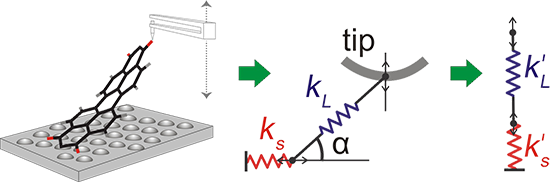
- the structure and to measure the forces that act in the junction during the manipulation. Although, in principle, the conductance measured with the STM could also be used to control the structure during the manipulation of a molecule, the relation between the conductance and the structure of single
- oxygen atoms and is moved further towards the surface until a sudden increase in junction conductance and change in Δf occurs (cf. Figure 1a). The conductance increases due to the snap-up of the oxygen atom to the tip, which marks the formation of a chemical tip–molecule bond [23]. Once the contact to

Charge and spin transport in mesoscopic superconductors
Beilstein J. Nanotechnol. 2014, 5, 180–185, doi:10.3762/bjnano.5.18

- and 1980s, mostly in the vicinity of the critical temperature. Much less attention has been paid to low temperatures and the role of the quasiparticle spin. Results: We report here on nonlocal transport in superconductor hybrid structures at very low temperatures. By comparing the nonlocal conductance
- current Iinj flowing into the junction is measured to determine the local differential conductance gloc = dIinj/dVinj. Simultaneously, the current Idet flowing out of a nearby detector junction is measured to obtain the nonlocal conductance gnl = dIdet/dVinj. The nonlocal conductance was measured for
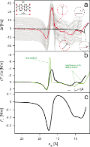
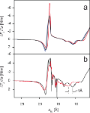
- , the effect of the applied field is mostly orbital pair breaking, and the Zeeman splitting of the density of states does not play a significant role. In Figure 2a, we show the nonlocal conductance gnl of a pair of contacts at low temperature and for bias voltages above the energy gap Δ ≈ 200 μeV of the


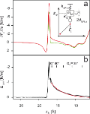
![[Graphic 6]](/bjnano/content/inline/2190-4286-5-18-i9.png?max-width=637&scale=1.18182) at a bias voltage of about 2Δ (a) and spin diffusion length λS (b) for di...
at a bias voltage of about 2Δ (a) and spin diffusion length λS (b) for di...

Many-body effects in semiconducting single-wall silicon nanotubes
Beilstein J. Nanotechnol. 2014, 5, 19–25, doi:10.3762/bjnano.5.2

- band structures show direct band gaps of 0.28 and 0.05 eV (50 meV), respectively. In (10,0) SiNT, the vanishingly narrow gap appears at the Γ point. However, there are still controversies with respect to the dependence of the conductance (semiconducting or metallic) on the chirality and/or diameter of


STM tip-assisted engineering of molecular nanostructures: PTCDA islands on Ge(001):H surfaces
Beilstein J. Nanotechnol. 2013, 4, 927–932, doi:10.3762/bjnano.4.104

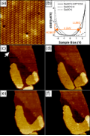
- . The differential tunneling conductance (dI/dV) as a function of the sample bias V was obtained numerically from the I–V curves. (a) High resolution STM image on top of a PTCDA island, 25 nm × 25 nm, showing the herringbone structure. (b) STS curves for Ge(001), Ge(001):H and PTCDA molecular island. (c

In situ growth optimization in focused electron-beam induced deposition
Beilstein J. Nanotechnol. 2013, 4, 919–926, doi:10.3762/bjnano.4.103

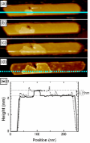
- nanostructures that are prepared by focused electron-beam-induced deposition (FEBID). It allows us to tune the properties of the deposits towards the highest conductivity by using the time gradient of the measured in situ rate of change of conductance as the fitness parameter for the algorithm. The effectiveness
- state of the metal are also important but a-priori unknown quantities [4][8]. From this, one can conclude that the optimization of any FEBID process towards the largest possible conductivity should ideally monitor the conductance as the growth proceeds [10] and use this information in adaptively
- measured in situ conductance as a fitness parameter for the GA we are able to tune the properties of the deposits towards highest conductivity. In order to demonstrate the efficiency of this method, we chose W(CO)6. Our study reveals that an increase of conductivity by one order of magnitude can be


Evolution of microstructure and related optical properties of ZnO grown by atomic layer deposition
Beilstein J. Nanotechnol. 2013, 4, 690–698, doi:10.3762/bjnano.4.78
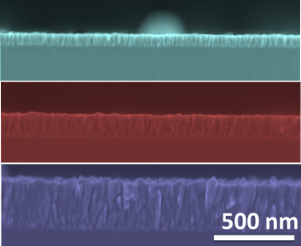
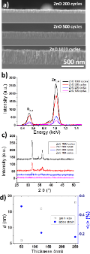
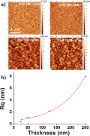
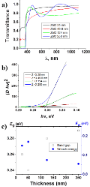
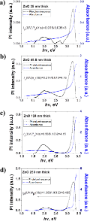
- the band edge is an exponential function of the photon energy as described by the Urbach law [37]: where E0 is the Urbach energy interpreted as the width of the tail of the states localized close to the conductance band in the forbidden zone. Numerical calculations show a decrease of the Urbach energy

Characterization of electroforming-free titanium dioxide memristors
Beilstein J. Nanotechnol. 2013, 4, 467–473, doi:10.3762/bjnano.4.55
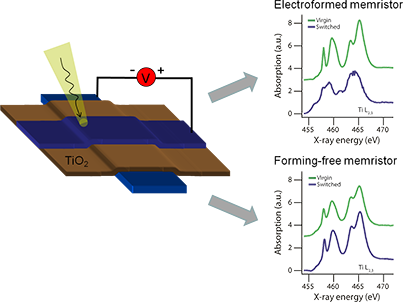
- regained, even after going to the high conductance state (ON). These three properties can be used to define a so called “forming-free” device. Results and Discussion Device characterization by X-ray spectromicroscopy To probe any switching-induced material changes in the devices, characterization was



Micro- and nanoscale electrical characterization of large-area graphene transferred to functional substrates
Beilstein J. Nanotechnol. 2013, 4, 234–242, doi:10.3762/bjnano.4.24
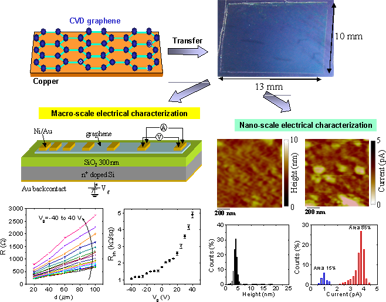
- than in the case of the same nickel–gold contacts on graphene exfoliated onto SiO2 [25]. The hole conductance σ = 1 / Rsh in graphene is related to the hole mobility μp and density p by the following relation where p has been expressed as the sum of p0, i.e., the doping at Vg = 0, and of the doping
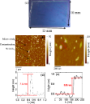
- different Vg values from −40 to 40 V. Extracted specific contact resistance ρc (c) and sheet resistance Rsh (d) versus Vg. The insert in (d) displays the linear fit of the conductance data to extract the hole density and mobility in graphene. TRCAFM of Graphene on SiO2: (a) morphology and (c) the related



Functionalization of vertically aligned carbon nanotubes
Beilstein J. Nanotechnol. 2013, 4, 129–152, doi:10.3762/bjnano.4.14
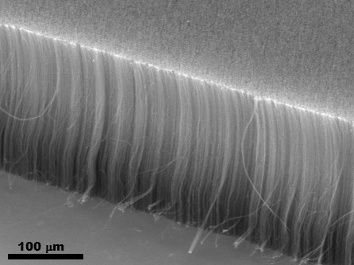
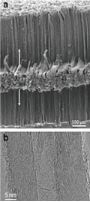
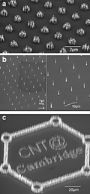
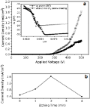
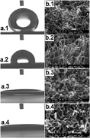
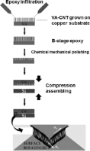
- of carbon exhibits exceptional morphological, physical and chemical properties: high aspect ratio (a length-to-diameter ratio greater than 10 000 and as high as 132 000 000) [5], an extremely high conductance [6], a high structural flexibility [7], and a high thermal conductance [8]. With a high








Electronic and transport properties of kinked graphene
Beilstein J. Nanotechnol. 2013, 4, 103–110, doi:10.3762/bjnano.4.12

- atomic and electronic structures we subsequently use the TranSIESTA [31] method to calculate the electronic conductance per unit-cell width transverse to the bend. To this end we attach semi-infinite flat graphene electrodes to each side of the selected kinks, i.e., replace sections S1 and S2 in Figure
- 1b by semi-infinite electrodes in order to calculate the transmission through the single kink separating S1 and S2. In the conductance calculations we employ a dense transverse k-point grid of 400 points. Results and Discussion Adsorption barrier Adsorption of hydrogen on graphene involves a reaction


Nanostructure-directed chemical sensing: The IHSAB principle and the dynamics of acid/base-interface interaction
Beilstein J. Nanotechnol. 2013, 4, 20–31, doi:10.3762/bjnano.4.3
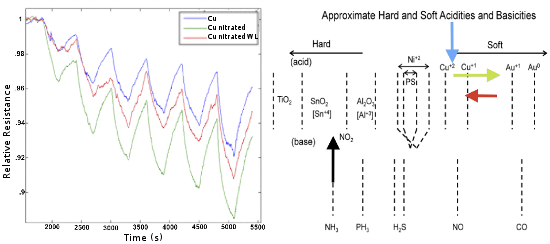
- electrons, decreases the conductometric resistance and increases conductance. The removal of electrons, as would occur with an acidic analyte, decreases the majority charge carrier concentration and the conductance and increases resistance. The opposite behavior will be observed for a p-type semiconductor
- the nanostructure deposited to the PS surface. TiO2, as a strong acid, enhances the capture of electrons, transferring these electrons to increase conductance (decrease resistance) relative to the undecorated interface. The more basic oxinitride does not facilitate electron transduction as efficiently
- and the sensor response corresponds to a conductance decrease relative to the untreated interface. Note also that the in situ nitridation of TiO2 shifts the nature of this metal oxide nanostructure toward the soft acid side of Figure 2, closer to ammonia. The IHSAB principle dictates [3][6][7][8][24


Sub-10 nm colloidal lithography for circuit-integrated spin-photo-electronic devices
Beilstein J. Nanotechnol. 2012, 3, 884–892, doi:10.3762/bjnano.3.98

- -type changes in the current–voltage characteristics of our fully enclosed optical resonator. Such threshold-type excitations, of giant magnitude, are indeed observed in the device resistance (conductance changes of a factor of 2), as shown in Figure 5c. This demonstration opens the way to explore a new


Pure hydrogen low-temperature plasma exposure of HOPG and graphene: Graphane formation?
Beilstein J. Nanotechnol. 2012, 3, 852–859, doi:10.3762/bjnano.3.96

- probe microscopy were employed for characterization. However, due to the insufficient electrical conductance, it was not possible to use photoelectron spectroscopy and scanning tunneling microscopy techniques for graphene on SiO2. In contrast to plasma treatments in previous works [5][21], mixing of a



Current–voltage characteristics of single-molecule diarylethene junctions measured with adjustable gold electrodes in solution
Beilstein J. Nanotechnol. 2012, 3, 798–808, doi:10.3762/bjnano.3.89

- , Germany Chemistry Department, University of Konstanz, D-78457 Konstanz, Germany 10.3762/bjnano.3.89 Abstract We report on an experimental analysis of the charge transport through sulfur-free photochromic molecular junctions. The conductance of individual molecules contacted with gold electrodes and the
- end-groups designed for providing the mechanical and electrical contact to the gold electrodes. We perform a detailed analysis of the transport properties of TSC in its open and closed states. We find rather broad distributions of conductance values in both states. The analysis, based on the
- switched open or close by irradiation with photons of two distinct wavelengths. Upon this ring-opening/ring-closure reaction the conjugation of the electronic π-system and therefore the conductance is supposed to be strongly affected as well. This ring-opening/ring-closure reaction is accompanied by only a


The memory effect of nanoscale memristors investigated by conducting scanning probe microscopy methods
Beilstein J. Nanotechnol. 2012, 3, 722–730, doi:10.3762/bjnano.3.82

- is set to the reading area. The tip is biased at Vrd, and topography and current images are simultaneously acquired to characterize the conductance state of the surface. The scan range is reduced to the writing area. The Vtip is set to a given positive value, and topography and current images are
- (Stanford Systems) was used to gain access to a wide range of compliance currents (1 pA to 1 mA). Resistance-switching sequence: Writing and reading of local conductance modifications made on the LSMO surface. The transition between low-resistive (LR) and high-resistive (HR) states is performed by writing




Revealing thermal effects in the electronic transport through irradiated atomic metal point contacts
Beilstein J. Nanotechnol. 2012, 3, 703–711, doi:10.3762/bjnano.3.80

- nanoscale is one of the central topics in nanoscience. As the size of a contact between two leads is reduced to atomic dimensions, quantum phenomena become relevant in metallic point contacts [1][2][3][4], and it has even become possible to determine the conductance of individual molecules attached between
- two metallic tips both theoretically [4][5][6][7] and experimentally [4][8][9][10][11]. Furthermore the influence of the environment on the conductance of single-molecule junctions [12] has been revealed. In a next step towards molecular electronics, one would like to see such molecules exhibiting
- , in which the influence of light on the conductance behaviour of nanocontacts has been studied, and various mechanisms for such an influence have been suggested [14][15]. In complementary experimental studies it was shown that the conductance of electrical point contacts in a range of one to several





Influence of the diameter of single-walled carbon nanotube bundles on the optoelectronic performance of dry-deposited thin films
Beilstein J. Nanotechnol. 2012, 3, 692–702, doi:10.3762/bjnano.3.79

- ]. Since the network resistance scales linearly with the number of contacts, conductance thus scales linearly with the average bundle length. The absorbance (A) and conductance (σDC) can be linked by the so-called figure of merit K [6] where Rs is the sheet resistance and T(λ) (later simply T) the
- than the intratube (or intrabundle) resistance, RI, that is, RJ >> RI. Thus, the conductance of a film (σDC) is expected to depend on the geometric parameters, both because shorter bundles will result in more high-resistance junctions per unit length, and possibly because the bundle geometry alters the
- small. At the edge of the threshold, the conductivity of the network rapidly collapses. Provided Lbundle strictly dictates the geometric scaling of conductance and dbundle the geometric scaling of absorbance, the normalized values should lie on a vertical line, KNORM = constant. Indeed, besides the


Zeolites as nanoporous, gas-sensitive materials for in situ monitoring of DeNOx-SCR
Beilstein J. Nanotechnol. 2012, 3, 667–673, doi:10.3762/bjnano.3.76

- ′(νres) was subsequently determined and plotted in the form of an Arrhenius diagram (Figure 2). In this expression C0 is the geometric capacitance of the empty IDE. The relationship between the imaginary part of the modulus M″ and the conductance G is shown in Equation 2. For the Fe-loaded sample, the
- conductivity was too low to gain clear modulus plots in the temperature range of 110–150 °C. Thus, we used the spectral plot of the phase angle φ (Equation 3) to determine the resonance frequency νres in this temperature region. The relationship between the phase angle φ and the conductance G is shown in


Focused electron beam induced deposition: A perspective
Beilstein J. Nanotechnol. 2012, 3, 597–619, doi:10.3762/bjnano.3.70

- (VRH) conductance mechanism in the presence of electronic correlation effects [12], namely For all other samples either a VRH behavior in three dimensions (3-D) according to Mott (a = 1/4) [32] or some intermediate behavior is apparent. The observed correlated VRH behavior observed for the samples with
- the Hall voltage are shown in Figure 10 for sample B (Figure 10a and Figure 10c) and B' (Figure 10b and Figure 10d). The as-grown sample exhibits a roughly linear temperature dependence of the conductivity down to about 12 K, which is followed by a quite sudden drop to a very small conductance level
- conductance below 12 K, a glassy transition from a superparamagnetic state to a super-spin-glass [47] state may be assumed. However, further work on the low-temperature magnetic state of these deposits is needed before a definite statement can be made. More importantly, the conductivity of the postgrowth





Strong spin-filtering and spin-valve effects in a molecular V–C60–V contact
Beilstein J. Nanotechnol. 2012, 3, 589–596, doi:10.3762/bjnano.3.69

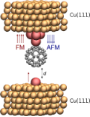
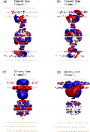
- mainly majority-spin electrons to pass (>95%). Moreover, we find a significant change in the conductance between parallel and anti-parallel spin polarizations in the junction (86%) which suggests that STM experiments should be able to characterize the magnetism and spin coupling for these systems
- in a vanishing transmission. The rotational symmetric m = 0 channels appear as resonances in the channel transmissions above EF and thus play a minor role. In typical STM experiments the conductance is probed from the tunnel-regime to contact. We have performed transport calculations as the tip is
- approaching the surface adatom until the tip–molecule distance (d shown in Figure 1) approximately reaches the equilibrium distance discussed above. In Figure 4 we display the conductance along with the corresponding TSP as a function of the tip distance. As can be seen, there is a trend of an increasing



A facile approach to nanoarchitectured three-dimensional graphene-based Li–Mn–O composite as high-power cathodes for Li-ion batteries
Beilstein J. Nanotechnol. 2012, 3, 513–523, doi:10.3762/bjnano.3.59

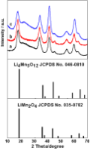
- /G electrodes, and thereby indicates a poorer charge-transfer conductance [29]. The diameters of the semicircles are also smaller for samples with lower ILMO:G values, which suggests that the graphene sheets serve as the 3D conducting scaffold to improve the Li storage performance of the hybrid




P-wave Cooper pair splitting
Beilstein J. Nanotechnol. 2012, 3, 493–500, doi:10.3762/bjnano.3.56

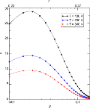
- function of charge transfer. As a first step, we discuss characteristics of the conductance for crossed Andreev reflection in superconductor–ferromagnet beam splitters with s-wave and p-wave superconductors and no spin-active scattering. In a second step, we consider spin-active scattering and show how to
- realize p-wave splitting using only an s-wave superconductor, through the process of spin-flipped crossed Andreev reflection. We present results for the conductance and cross correlations. Conclusion: Spin-activity of interfaces in Cooper pair splitters allows for new features in ordinary s-wave Cooper
- ]. Results and Discussion Superconductor–ferromagnet beam splitters Splitting of spin-polarized p-wave Cooper pairs can easily be identified in the conductance. From the result in [27] we find the generalization of Beenakker’s formula [34] for the zero-bias conductance of a beam splitter realized by a


![[Graphic 23]](/bjnano/content/inline/2190-4286-3-56-i36.png?max-width=637&scale=1.18182) according to Equation 13 is cal...
according to Equation 13 is cal...
Functionalised zinc oxide nanowire gas sensors: Enhanced NO2 gas sensor response by chemical modification of nanowire surfaces
Beilstein J. Nanotechnol. 2012, 3, 368–377, doi:10.3762/bjnano.3.43
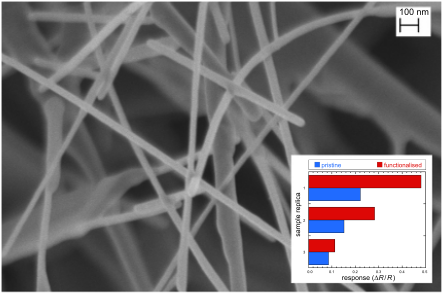
- thiol (confirmed by FTIR) raised the conductivity of each individual sensor above the measurement range of our instrument (which corresponds to a minimum conductance value of Gmax = 10 mS). We conclude from this that chemisorption of the thiol significantly increased the density of electrons present in
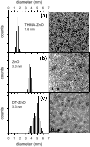
- inset). Looking at the overall results obtained with all the sensor replicas, as shown in Table 1, the more effective baseline conductance increase obtained after coating with THMA-ZnO nanoparticles compared to the THMA-coating, can be explained in terms of a preferential charge-carrier injection from
- electrical resistance and conductance of the sample. Sensor response was measured at 190 °C operating temperature. We established through the TG measurements of functionalised ZnO samples, that the degradation of the organic capping layer of the nanowires and nanoparticles at this operating temperature was