


Search results
Search for "dielectric constant" in Full Text gives 185 result(s) in Beilstein Journal of Nanotechnology.
Focused electron beam induced deposition: A perspective
Beilstein J. Nanotechnol. 2012, 3, 597–619, doi:10.3762/bjnano.3.70





Macromolecular shape and interactions in layer-by-layer assemblies within cylindrical nanopores
Beilstein J. Nanotechnol. 2012, 3, 475–484, doi:10.3762/bjnano.3.54

- to the experimentally observed changes of the dielectric constant, providing an average adlayer thickness on the inner pore walls (see Experimental) [22][23]. Layer-by-layer growth The influence of the geometric confinement on the LbL process was elucidated by comparing the deposition of different
- and within AAO nanopores of 65 nm diameter, is shown as a function of the number of added layers for both, linear-PEs (εlinear-PEs = 2.15) [36] and proteins (εproteins = 2.10) [22]. The estimation of toptical was made using the same value of dielectric constant for each of the LbL species, in both the
- the incidence angle (θ) was varied. At specific θ values determined by the thickness and the dielectric constant of AAO (εAAO), the laser was coupled into the AAO film and these waveguide modes were recorded as sharp minima in a reflectivity, R, versus θ scan. Transverse electric (TE) and transverse




An NC-AFM and KPFM study of the adsorption of a triphenylene derivative on KBr(001)
Beilstein J. Nanotechnol. 2012, 3, 221–229, doi:10.3762/bjnano.3.25
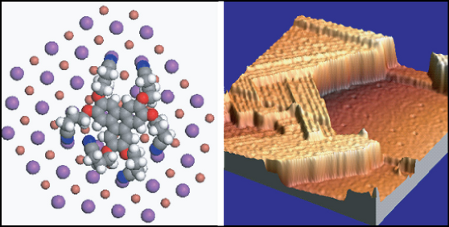
- is imposed on the metallic plate that supports the sample, which is some millimeters away. Then, the potential drops in the insulator in a way that depends not only on the dielectric constant of the material and the tip–surface distance, but also on the tip radius. The effective potential applied to




Transmission eigenvalue distributions in highly conductive molecular junctions
Beilstein J. Nanotechnol. 2012, 3, 40–51, doi:10.3762/bjnano.3.5
- characterizes the interaction of two quadrupoles and is a dielectric constant included to account for the polarizability of the core and σ electrons. Here i, j, k, and l are the Cartesian indices of the foregoing tensors and vectors. Altogether, this provides an expression for the interaction energy that is
- correct up to fifth order in the interatomic distance. Benzene The adjustable parameters in our Hamiltonian for gas-phase benzene are the nearest-neighbor tight-binding matrix element t, the on-site repulsion U, the dielectric constant , and the π-orbital quadrupole moment Q. These were renormalized by


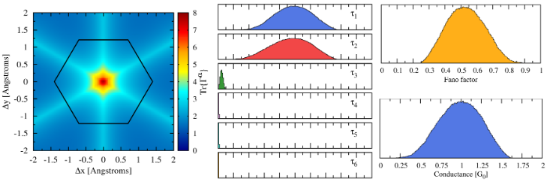
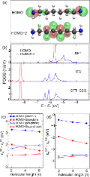
![[Graphic 39]](/bjnano/content/inline/2190-4286-3-5-i64.png?max-width=637&scale=1.18182) (top panel) and Tr{Γ} (bottom panel) over the ensemble describ...
(top panel) and Tr{Γ} (bottom panel) over the ensemble describ...


When “small” terms matter: Coupled interference features in the transport properties of cross-conjugated molecules
Beilstein J. Nanotechnol. 2011, 2, 862–871, doi:10.3762/bjnano.2.95

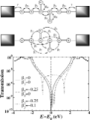
- and m in angstroms. Here we use U0 = 8.9 eV and ε = 1.28 [38]. The phenomenological dielectric constant ε accounts for screening due to both the σ-electrons and any environmental considerations, such as nonevaporated solvent [38]. Calculations presented here were performed by using a chosen basis with




Self-assembled monolayers and titanium dioxide: From surface patterning to potential applications
Beilstein J. Nanotechnol. 2011, 2, 845–861, doi:10.3762/bjnano.2.94

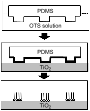
- utilization of systems comprising SAMs and TiO2 for a variety of applications. The following section discusses the main applications presented so far. TiO2-SAMs in electronic devices The large dielectric constant k of TiO2 (25 < k < 30) compared with that of silica (k = 3.9), as well as its refractory
- properties, suggest its use in MOSFET technology [91]. In that respect, it is interesting to mention that the dielectric constant of amorphous TiO2 grown on patterned OTS from titanic acid (H2TiO3) [92] was estimated to be 63 at 100 kHz, significantly larger than the reported values of 22 measured for
- in the dielectric constant as a function of frequency (from k = 160 at 1 kHz to k = 23 at 1 mHz) [92]. These were explained by the presence of interface states and impurities such as OH– and H2O in the film. Still, well-behaved MOSFET transistors with a TiO2 gate oxide were demonstrated already in



Template-assisted formation of microsized nanocrystalline CeO2 tubes and their catalytic performance in the carboxylation of methanol
Beilstein J. Nanotechnol. 2011, 2, 776–784, doi:10.3762/bjnano.2.86
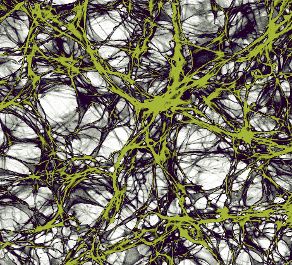
- diesel fuel (for particle emission decrease), and also a solvent [6][25][26][27]. Owing to its low toxicity, versatile reactivity and high dielectric constant, DMC also attracts interest as an electrolyte in lithium-ion batteries [28]. The formation of DMC by direct methanol carboxylation, however, is


Towards quantitative accuracy in first-principles transport calculations: The GW method applied to alkane/gold junctions
Beilstein J. Nanotechnol. 2011, 2, 746–754, doi:10.3762/bjnano.2.82

- general depends on the dielectric constant of the surface material and the local geometrical shape of the surface. Here we model the Au electrodes as perfect metals. The image potential for a point charge halfway between two metal surfaces separated by a distance L is ≈ 10.0/L (eV·Å) [64]. This predicts



Dynamics of capillary infiltration of liquids into a highly aligned multi-walled carbon nanotube film
Beilstein J. Nanotechnol. 2011, 2, 311–317, doi:10.3762/bjnano.2.36

- infiltration of the HACNT film by three different aqueous solutions, characterised by various dielectric constant, namely distilled water (as a reference) (left), saturated saline (centre) and saturated sucrose solution (right). Water and saline solution both formed droplets that slide on the highly


Defects in oxide surfaces studied by atomic force and scanning tunneling microscopy
Beilstein J. Nanotechnol. 2011, 2, 1–14, doi:10.3762/bjnano.2.1
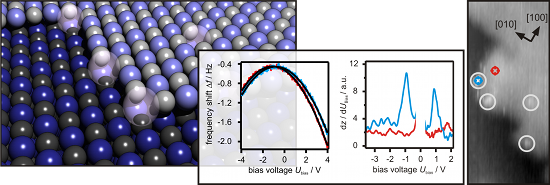
- relative permittivity or dielectric constant of the medium and z the distance between the charges. The Coulomb force FCoulomb is given by It is well known [12] that for very small amplitudes, the shift of the resonance frequency Δf corresponds to the derivative of the tip-sample forces with respect to z





