


Search results
Search for "disorder" in Full Text gives 196 result(s) in Beilstein Journal of Nanotechnology.
Photoelectrochemical and Raman characterization of In2O3 mesoporous films sensitized by CdS nanoparticles
Beilstein J. Nanotechnol. 2013, 4, 255–261, doi:10.3762/bjnano.4.27

- these peaks in the Raman spectra can testify to the fact that the samples studied contain not only In2O3 and CdS, but also some additional phases formed during the SILAR process. High values of the FWHM of the LO phonon peak can point to both a significant degree of CdS nanocrystal disorder and size


Influence of diffusion on space-charge-limited current measurements in organic semiconductors
Beilstein J. Nanotechnol. 2013, 4, 180–188, doi:10.3762/bjnano.4.18

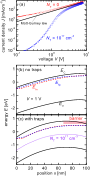
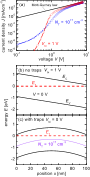
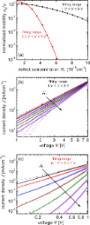
- are generally disordered materials, it is important to investigate the effects of energetic disorder on the results of our simulations. In order to take the effect of disorder into account, a multiple trapping model together with exponential band tails is used in some simulations (Figure 3 and Figure


Functionalization of vertically aligned carbon nanotubes
Beilstein J. Nanotechnol. 2013, 4, 129–152, doi:10.3762/bjnano.4.14
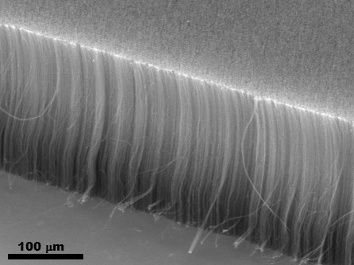
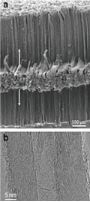
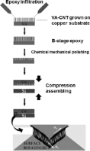
- membrane. Feng et al. [140] opted for a polyaniline (PANI) matrix. This material is one of the most conducting polymers (Figure 18). Synthesis and characterization of conducting polymer polyaniline nanofibers was reported by Huang [141]. The major issue related to great disorder of the functionalized








Pure hydrogen low-temperature plasma exposure of HOPG and graphene: Graphane formation?
Beilstein J. Nanotechnol. 2012, 3, 852–859, doi:10.3762/bjnano.3.96

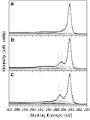
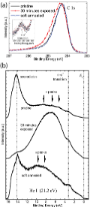
- intervalley double-resonance Raman process that is initiated only by a deviation from the defectless two-dimensional character [23][24][26]. On account of this, both hydrogenation and any kind of disorder manifest themselves as the rise of this peak, and a distinction between these two phenomena is not



Focused electron beam induced deposition: A perspective
Beilstein J. Nanotechnol. 2012, 3, 597–619, doi:10.3762/bjnano.3.70

- theory is not applicable since disorder does not simply cause scattering but must be included in the theoretical analysis from the beginning. A recent theoretical review on the electronic transport properties of granular metals can be found in [12]. The electrical transport within the metallic grains can





P-wave Cooper pair splitting
Beilstein J. Nanotechnol. 2012, 3, 493–500, doi:10.3762/bjnano.3.56

- . Disorder for the case of tunnel contacts was considered by using the Keldysh–Usadel formalism in [65], [66] and [67]. Additionally we want to point out that the description of spin-active scattering used here and in [63] and [29] is different: In the previous works the spin-mixing angle is introduced as a
- level considered here, are present and have a characteristic location and width associated with interactions. Therefore the general scenario should be robust. However, one should bear in mind that for more extended quantum dots or nanowires disorder could play an important role as mentioned in [65] and


![[Graphic 23]](/bjnano/content/inline/2190-4286-3-56-i36.png?max-width=637&scale=1.18182) according to Equation 13 is cal...
according to Equation 13 is cal...
Mapping mechanical properties of organic thin films by force-modulation microscopy in aqueous media
Beilstein J. Nanotechnol. 2012, 3, 464–474, doi:10.3762/bjnano.3.53
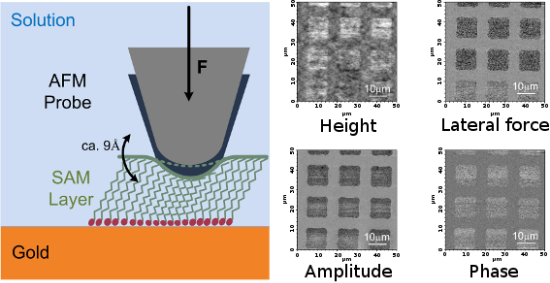
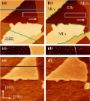
- , which suggests that the thiol molecules are not close-packed, and have some disorder in their arrangement on the surface. The contrast in the lateral-force image shows a friction difference between the gold surface and the EG3 patterns that can be attributed to the surface-energy difference between the



Nano-FTIR chemical mapping of minerals in biological materials
Beilstein J. Nanotechnol. 2012, 3, 312–323, doi:10.3762/bjnano.3.35

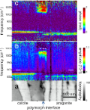
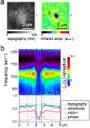
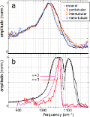
- -FTIR sensitively responds to structural disorder it is well suited for the study of biomineral formation and aging. Generally, nano-FTIR is suitable for the analysis and identification of composite materials in any discipline, from testing during nanofabrication to even the clinical investigation of
- ) their near-field resonance line shape is asymmetric, with the steep high-frequency edge (Figure 4) typical of strong oscillators [6][46]. Disorder in a crystal would strongly reduce the amplitude, as has been shown systematically [47]. Amorphous materials have a reduced, broadened resonance [3], while





Junction formation of Cu3BiS3 investigated by Kelvin probe force microscopy and surface photovoltage measurements
Beilstein J. Nanotechnol. 2012, 3, 277–284, doi:10.3762/bjnano.3.31

- deep defect states vanishes at frequencies above 1 kHz for the Cu3BiS3/In2S3 samples. Disorder in the material leads to states in the band gap close to the band edges, resulting in an exponential decay of the SPV. The characteristic energy of these exponential tails can be estimated at about 40 meV for


An NC-AFM and KPFM study of the adsorption of a triphenylene derivative on KBr(001)
Beilstein J. Nanotechnol. 2012, 3, 221–229, doi:10.3762/bjnano.3.25
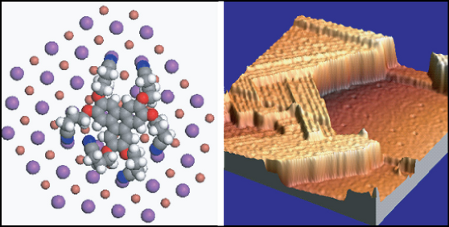
- molecules in relatively strong interaction. Note that, as remarked before, the Kelvin map (Figure 8b) is very heterogeneous, with values of the Kelvin voltage varying between −0.5 and +1.2 V. This dispersion is indicative of a certain degree of disorder as is also observable in the topography image of




Size-dependent phase diagrams of metallic alloys: A Monte Carlo simulation study on order–disorder transitions in Pt–Rh nanoparticles
Beilstein J. Nanotechnol. 2012, 3, 1–11, doi:10.3762/bjnano.3.1

- and low platinum concentration. A decrease of platinum surface segregation with increasing global platinum concentration was observed, when a second, ordered phase is formed inside the core of the particle. The order–disorder transitions were analyzed in terms of the Warren–Cowley short-range order
- question of how to interpret a two-phase equilibrium in the particle, and the effects related to surface segregation are examined. Furthermore, we evaluate the Warren–Cowley short-range order (WC-SRO) parameters in order to investigate the order–disorder phase transitions in the particles. These parameters
- surface phase emerges at low concentrations of the segregating element. We conclude from the simulations that these features are likely to be found in ordering systems with a surface segregation tendency of one element. Short-range order and order–disorder transitions We calculated the short-range order


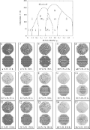


![[Graphic 37]](/bjnano/content/inline/2190-4286-3-1-i43.png?max-width=637&scale=1.18182) up to 8th neighbors for a Pt...
up to 8th neighbors for a Pt...

![[Graphic 28]](/bjnano/content/inline/2190-4286-3-1-i34.png?max-width=637&scale=1.18182) (lower points) and
(lower points) and ![[Graphic 29]](/bjnano/content/inline/2190-4286-3-1-i35.png?max-width=637&scale=1.18182) (upper points) WC-order parameters versus temperature for di...
(upper points) WC-order parameters versus temperature for di...


![[Graphic 31]](/bjnano/content/inline/2190-4286-3-1-i37.png?max-width=637&scale=1.18182) (lower points) and
(lower points) and ![[Graphic 32]](/bjnano/content/inline/2190-4286-3-1-i38.png?max-width=637&scale=1.18182) (upper points). The Pt concentration is ...
(upper points). The Pt concentration is ...

![[Graphic 33]](/bjnano/content/inline/2190-4286-3-1-i39.png?max-width=637&scale=1.18182) (lower points) and
(lower points) and ![[Graphic 34]](/bjnano/content/inline/2190-4286-3-1-i40.png?max-width=637&scale=1.18182) (upper points) constrained to a core region...
(upper points) constrained to a core region...

![[Graphic 39]](/bjnano/content/inline/2190-4286-3-1-i45.png?max-width=637&scale=1.18182) and
and ![[Graphic 38]](/bjnano/content/inline/2190-4286-3-1-i44.png?max-width=637&scale=1.18182) of three different particle sizes and bulk material a...
of three different particle sizes and bulk material a...

Self-assembled monolayers and titanium dioxide: From surface patterning to potential applications
Beilstein J. Nanotechnol. 2011, 2, 845–861, doi:10.3762/bjnano.2.94

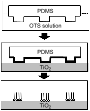
- disorder–order change for alkanephosphate SAMs on TiO2 supported the validity of the uniform growth mechanism, i.e., strong chemisorption of single molecules that once chemisorbed are incapable of surface diffusion. The dichroic ratio of the methylene antisymmetric stretching band, defined as the intensity



Direct monitoring of opto-mechanical switching of self-assembled monolayer films containing the azobenzene group
Beilstein J. Nanotechnol. 2011, 2, 834–844, doi:10.3762/bjnano.2.93
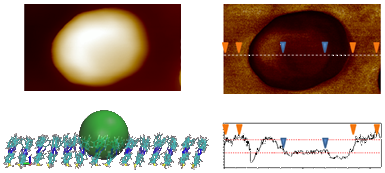
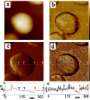
- hindrance requires close packing, thus some slight disorder in the film could be an enabling condition for the isomerization [11]. Molecular packing also governs the excitonic coupling between chromophores, which can strongly influence the conversion efficiency [12]. A variety of methods to monitor the cis



Dynamics of capillary infiltration of liquids into a highly aligned multi-walled carbon nanotube film
Beilstein J. Nanotechnol. 2011, 2, 311–317, doi:10.3762/bjnano.2.36

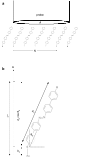
- . It is worth noting that the spread convolutes variations in graphitic quality at the atomic scale, with overall variations in CNT orientation, and more complex diffraction effects are observed as disorder increases [22]. The mean outer and inner diameters of CNTs as measured by TEM were 60 ± 25 and


Extended X-ray absorption fine structure of bimetallic nanoparticles
Beilstein J. Nanotechnol. 2011, 2, 237–251, doi:10.3762/bjnano.2.28
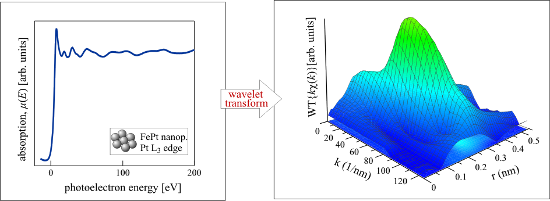
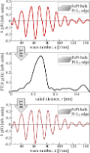
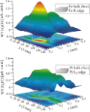
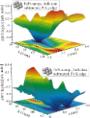
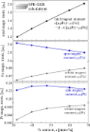
- distribution function (PDF) of atoms around the absorber atom. To account for thermal or configurational disorder, the complex wavenumber p is introduced and should be used instead of k. The imaginary part of p represents losses of photoelectron coherence, which includes the mean free path and core-hole



Structural and magnetic properties of ternary Fe1–xMnxPt nanoalloys from first principles
Beilstein J. Nanotechnol. 2011, 2, 162–172, doi:10.3762/bjnano.2.20
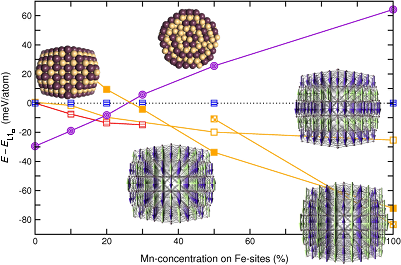
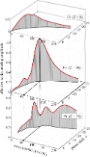
- significant percentage of surface atoms with diameters of a few nanometers. Several authors have therefore argued that at small particle sizes ordering is suppressed due to surface-induced disorder and segregation [21][24]. Both effects can be related to a change in the effective pair interactions between the
- arrangement in the surface layers. Onion-ring and hybrid morphologies have been considered for other alloys [59][60][61] as well as for Fe–Pt in the context of surface induced disorder [24][62][63][64]. This has been verified very recently in a combined ab initio and Monte Carlo approach [65], while
- configuration the most favorable L10-type structure in this concentration range. However, as discussed above, for binary Fe–Pt such a configuration will effectively be suppressed by a small amount of disorder in the system, due to Fe or Mn occupying a Pt site and mediating an effective ferromagnetic interlayer


Superhydrophobicity in perfection: the outstanding properties of the lotus leaf
Beilstein J. Nanotechnol. 2011, 2, 152–161, doi:10.3762/bjnano.2.19
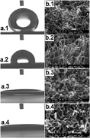
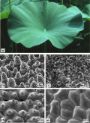
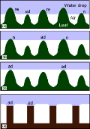
- lotus wax. The ‘long spacing’ peaks indicate a layer structure which is common in aliphatic waxes. The broad ‘short spacing’ peak at 2θ = 27° indicates a strong disorder in the lateral package of the molecules. Model of a wax tubule composed of layers of nonacosan-10-ol and nonacosanediol molecules. The







Pore structure and surface area of silica SBA-15: influence of washing and scale-up
Beilstein J. Nanotechnol. 2011, 2, 110–118, doi:10.3762/bjnano.2.13

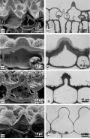
- all samples to exclude it as source for the observed disorder. Importantly, it was found that under the chosen conditions only the amount of solvent used in the washing process had a significant influence on the shape of the isotherm of the final product (Figure 4). To gain insight into the influence
- extent depends on the degree of modification, in particular, the number of narrowed sections created during washing. The height of the bulge in the desorption branch may therefore be used to estimate qualitatively the degree of disorder created by combinational washing with plenty of solvent. However


Kinetic lattice Monte-Carlo simulations on the ordering kinetics of free and supported FePt L10-nanoparticles
Beilstein J. Nanotechnol. 2011, 2, 40–46, doi:10.3762/bjnano.2.5

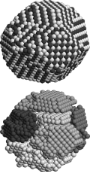
- correct stacking sequence. In this paper, we present lattice-based kinetic Monte-Carlo simulations of FePt nanoparticles that reveal the influence of free surfaces, bulk vacancies and interaction with a substrate on the disorder–order transition. After describing the methodology, the case of a free
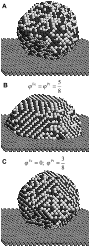
- , however, no single domain particles are obtained and an elimination of the antiphase boundaries could not be observed within the time scales accessible by the simulations. Simulations including a crystalline support show that, even if strong interface segregation is assumed, no influence on the disorder




Review and outlook: from single nanoparticles to self-assembled monolayers and granular GMR sensors
Beilstein J. Nanotechnol. 2010, 1, 75–93, doi:10.3762/bjnano.1.10




Flash laser annealing for controlling size and shape of magnetic alloy nanoparticles
Beilstein J. Nanotechnol. 2010, 1, 55–59, doi:10.3762/bjnano.1.7

- gives an unprecedented opportunity to control the size and the shape of bimetallic nanoparticles without changing their composition. The mechanisms involved in the complete reshaping of the nanoparticle thin films are discussed and it is also shown that order-disorder phase transformations occur under
- ; nanosecond pulsed laser annealing; order-disorder transformation; Introduction Future high-density recording systems require 10 nm magnetic grains with a high magnetic anisotropy (Ku) to insure their thermal stability [1]. CoPt and FePt nanoparticles (NPs) in the chemically ordered L10 structure [2] are





