Search results
Search for "lead" in Full Text gives 1346 result(s) in Beilstein Journal of Nanotechnology. Showing first 200.
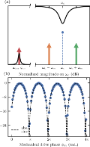
Design, fabrication, and characterization of kinetic-inductive force sensors for scanning probe applications
Beilstein J. Nanotechnol. 2024, 15, 242–255, doi:10.3762/bjnano.15.23
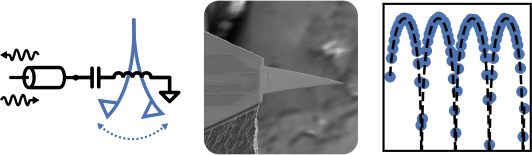
- with a mask consisting of a 190 nm thick layer of Cr and PMMA. After the release, we strip the PMMA and Cr layers, while taking care to not break the cantilevers. The difficulties associated with using KOH lead us to prefer the dry-etch described above in step (h). Tip deposition In scanning probe



Quantitative wear evaluation of tips based on sharp structures
Beilstein J. Nanotechnol. 2024, 15, 230–241, doi:10.3762/bjnano.15.22
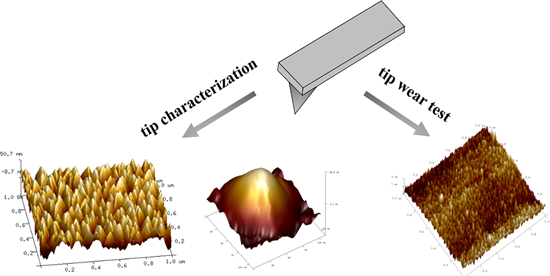
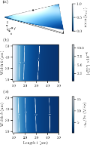
- lead to tip breakage during probe engagement. Therefore, in our experiments, we used a higher set point for engaging the probe, ensuring stable contact with the sample surface. Once the tip was stably in contact, we gradually adjusted the set point to avoid damaging the tip during the engagement




Multiscale modelling of biomolecular corona formation on metallic surfaces
Beilstein J. Nanotechnol. 2024, 15, 215–229, doi:10.3762/bjnano.15.21
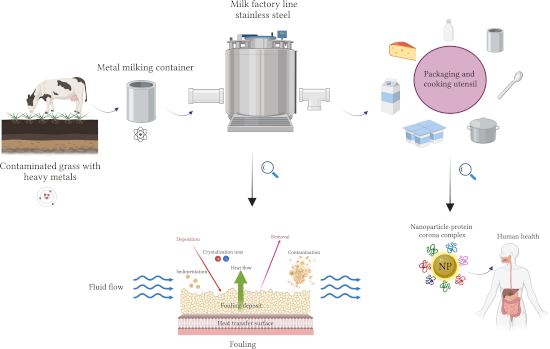
- engage in a complex interplay of dynamic physicochemical interactions, kinetics, and thermodynamic exchanges that can lead to undesirable outcomes [1][8][9][10]. In a more general context, the importance in understanding the mechanism of bionano interactions arises from the increasing awareness and




Graphene removal by water-assisted focused electron-beam-induced etching – unveiling the dose and dwell time impact on the etch profile and topographical changes in SiO2 substrates
Beilstein J. Nanotechnol. 2024, 15, 190–198, doi:10.3762/bjnano.15.18
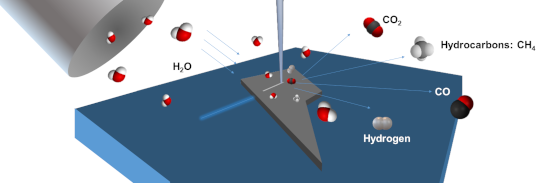
- lead to the formation of the volatile Si(OH)4 compound. A similar mechanism is proposed by Rosamila et al. [33] for O2-promoted water etching of Si surface, established on the observation that the etching rate is proportional to the concentration of OH− groups. Those hydroxyl groups are also electron


Ferromagnetic resonance spectra of linear magnetosome chains
Beilstein J. Nanotechnol. 2024, 15, 157–167, doi:10.3762/bjnano.15.15
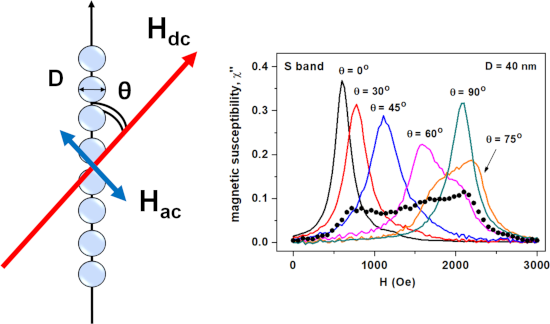
- along the chain axis. In contrast, it was shown [39] that the formation of magnetosomes in a bacterium can occur simultaneously in many germ vesicles along its length. In this case, it is not clear what reason can lead to the occurrence of E-type anisotropy in the chain. Rather, one would expect a


Enhanced feedback performance in off-resonance AFM modes through pulse train sampling
Beilstein J. Nanotechnol. 2024, 15, 134–143, doi:10.3762/bjnano.15.13

- in both measurements were set just below the values that would lead to observable oscillations. Height images in Figure 4A show that the pulse sampling method has better tracking performance for rapid topography changes of the pits. The method provides sharper responses at the pit edges, indicating
- the proposed method, the reference curve is calculated by averaging multiple recorded waveforms to reduce the noise level. However, this reference only represents the tip–sample interaction for one given material, which can lead to over- or undercorrection of the interaction when the tip touches a


Assessing phytotoxicity and tolerance levels of ZnO nanoparticles on Raphanus sativus: implications for widespread adoptions
Beilstein J. Nanotechnol. 2024, 15, 115–125, doi:10.3762/bjnano.15.11

- deficiency or excess of Zn can lead to a cascade of metabolic processes that are detrimental to the health of plants as well as humans and other organisms [9]. Hence, there is a need for a better alternative to provide plants with the proper Zn concentration. Under such circumstances, designing more
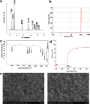


Josephson dynamics and Shapiro steps at high transmissions: current bias regime
Beilstein J. Nanotechnol. 2024, 15, 51–56, doi:10.3762/bjnano.15.5

- voltage peaks can by no means alter any of our results and conclusions and may at most lead to an insignificant modification (decrease) of the numerical prefactor on the right-hand side of Equation 13. The result (Equation 13) demonstrates that the I–V curve of fully transparent superconducting junctions


Measurements of dichroic bow-tie antenna arrays with integrated cold-electron bolometers using YBCO oscillators
Beilstein J. Nanotechnol. 2024, 15, 26–36, doi:10.3762/bjnano.15.3
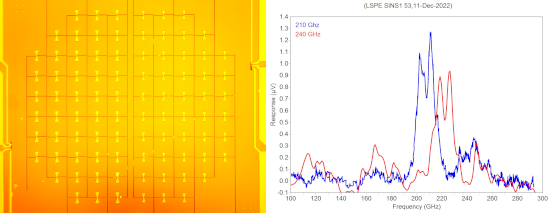
- temperature [20][21][22][23]. This advantage is important for space, balloon, and ground-based applications. While dilution refrigerators are able to cool down below 50 mK, they cannot operate in extreme or even slightly unstable conditions; even the small variation of a tilt angle can lead to the cryostat


Fluorescent bioinspired albumin/polydopamine nanoparticles and their interactions with Escherichia coli cells
Beilstein J. Nanotechnol. 2023, 14, 1208–1224, doi:10.3762/bjnano.14.100

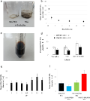
- to heat up under irradiation by non-radiative relaxation. This is favorable to minimize the superposition between absorption and emission peaks, but might lead to a low quantum yield and, thus, poor emission intensity. Indeed, the quantum yield of Ox-BSA/PDA NPs in water (Φ) was calculated to be 0.1



A combined gas-phase dissociative ionization, dissociative electron attachment and deposition study on the potential FEBID precursor [Au(CH3)2Cl]2
Beilstein J. Nanotechnol. 2023, 14, 1178–1199, doi:10.3762/bjnano.14.98
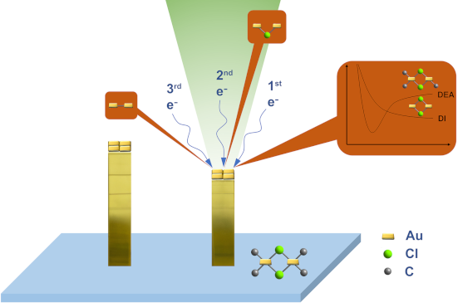
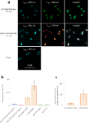
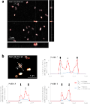
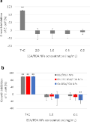
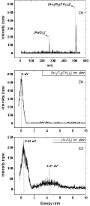
- composition and morphology of FEBID deposits fabricated in an ultrahigh-vacuum (UHV) chamber were explored on different surfaces and at varied beam currents. In the gas phase, dissociative ionization was found to lead to significant carbon loss from this precursor, and about 50% of the chlorine was on average
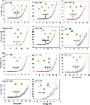
- experiment, this would lead to a deposit composed of approx. 55 atom % Au, 29 atom % Cl, and 16 atom % C. With respect to the high gold content, this is in line with the UHV FEBID deposits. However, the carbon content is significantly lower than that observed in FEBID, and most noticeably, in both the UHV



Spatial variations of conductivity of self-assembled monolayers of dodecanethiol on Au/mica and Au/Si substrates
Beilstein J. Nanotechnol. 2023, 14, 1169–1177, doi:10.3762/bjnano.14.97

- . All these indications lead to the conclusion that ordered DDT SAMs form on the surface with the chosen deposition technique. More importantly, the current maps in Figure 3 show that substrate and measurement technique are suitable for obtaining information on the conductivity of a molecular SAM, as
- in Figure 4 this is slightly distorted by a probe effect duplicating features, the systematic difference in surface structure between Au/Si and Au/mica, already observed in the bare substrates, is reproduced. Just as for the bare Au/Si, the substructures of the substrate lead to strong variations in


Hierarchically patterned polyurethane microgrooves featuring nanopillars or nanoholes for neurite elongation and alignment
Beilstein J. Nanotechnol. 2023, 14, 1157–1168, doi:10.3762/bjnano.14.96
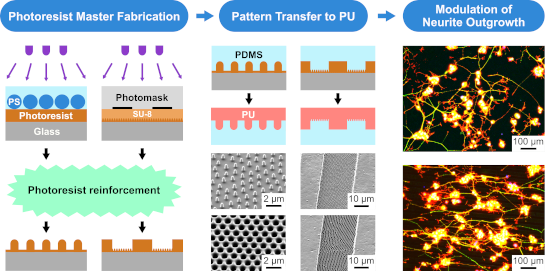
- wider, around 20–24 µm. The microridge height was 1.4–1.5 µm on the microgroove and hole–groove substrates, while it was 1.1 µm or 2 µm on the pillar–groove substrate if measured to the tip or base of the nanopillars, respectively. Water CA measurements on the grooved PU samples lead to two distinct CAs


Elasticity, an often-overseen parameter in the development of nanoscale drug delivery systems
Beilstein J. Nanotechnol. 2023, 14, 1149–1156, doi:10.3762/bjnano.14.95

- radii lead to lower elastic values [33][35]. Figure 2 summarizes factors that impact the elasticity measurement results obtained by AFM. Due to the issues aforementioned discussed, it is tricky to compare different studies. In addition, it is not yet known which absolute elastic values should be chosen


A multi-resistance wide-range calibration sample for conductive probe atomic force microscopy measurements
Beilstein J. Nanotechnol. 2023, 14, 1141–1148, doi:10.3762/bjnano.14.94

- droplets (F42240, lead-free solder paste – class 5, CIF, France). The fused silica substrate was placed on a heating plate set to 270 °C, which required around 3 min to reach the melting temperature of the solder droplets (217 °C), as observed under an optical microscope. Upon cooling, 16 SMD resistors


Curcumin-loaded albumin submicron particles with potential as a cancer therapy: an in vitro study
Beilstein J. Nanotechnol. 2023, 14, 1127–1140, doi:10.3762/bjnano.14.93
- addition, the removal of sericin, which requires a degumming process, is a prerequisite for using silk cocoons in biomedical applications to reduce the risk of an inflammatory response [18]. However, this degumming process can lead to damage to the silk structure, increase the polydispersity of the silk




A bifunctional superconducting cell as flux qubit and neuron
Beilstein J. Nanotechnol. 2023, 14, 1116–1126, doi:10.3762/bjnano.14.92

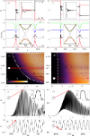
- level convergence for short periods τLZ, the phases of the wave functions change significantly, leading to strong fluctuations of the level populations in the system, and can lead to quasi-random dynamics in the parametron. In addition, Landau–Zener interference has become a tool to access the
- scientific community to be a good flux qubit. We were also surprised by the possibility of controlling the qubit state using unipolar current pulses, which greatly simplifies all control electronics [51][52]. But won’t such a deliberately non-resonant (broadband) impact lead to a parasitic leakage of the



Density functional theory study of Au-fcc/Ge and Au-hcp/Ge interfaces
Beilstein J. Nanotechnol. 2023, 14, 1093–1105, doi:10.3762/bjnano.14.90

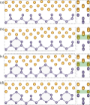
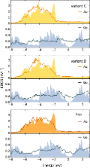
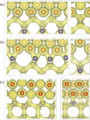
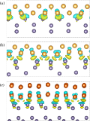
- presented in Figure 4 and Appendix A. The comparison of our results with the available theoretical and experimental data shows that different theoretical approaches lead to discrepancies in absolute values of surface energies; however, the relative changes between the investigated crystal planes are very
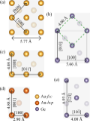
- Ge surface that places the column of Au atoms right over the Ge atoms (Figure 6b) leads to a significant increase in the total energy of the system (supercell) by about 3.5 eV. Additionally, the forces induced to preserve the Ge–Au bond length on the appropriate level lead to an increase of the
- are maximal for a given distance between slabs, that is, extremely short bonds are avoided. It occurs that at each interface there are four short Au–Ge bonds, marked with circles in Figure 9b. As a consequence, DFT calculations with full atomic displacements lead to strong changes in the Au atomic





Dual-heterodyne Kelvin probe force microscopy
Beilstein J. Nanotechnol. 2023, 14, 1068–1084, doi:10.3762/bjnano.14.88

- reference substrate, a bulk organic photovoltaic heterojunction thin film, and an optoelectronic interface obtained by depositing caesium lead bromide perovskite nanosheets on a graphite surface. The conclusion provides perspectives for future improvements and applications. Keywords: heterodyne
- optoelectronic interfaces formed between caesium lead bromide perovskite nanosheets and highly oriented pyrolytic graphite. Kelvin Probe Force Microscopy Background, Amplitude-Modulated Heterodyne KPFM Many KPFM modes rely on the detection of a modulated component of the electrostatic force proportional to the
- depositing caesium lead halide perovskite nanosheets (NSs) on a highly oriented pyrolytic graphite (HOPG) substrate. Lead halide perovskites have emerged recently as materials with unique optical and electronic properties, such as high absorption coefficients, high defect tolerance, and charge mobility. Due


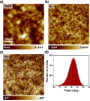


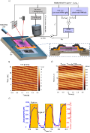
Spatial mapping of photovoltage and light-induced displacement of on-chip coupled piezo/photodiodes by Kelvin probe force microscopy under modulated illumination
Beilstein J. Nanotechnol. 2023, 14, 1059–1067, doi:10.3762/bjnano.14.87

- with atomic vertical resolution. In several studies, AFM has been used to determine photo-induced height/topography variation in organic–inorganic lead halide perovskites [15], nanosheets [16], and photosensitive polymers [17]. Kelvin probe force microscopy (KPFM), an electrostatic variant of AFM, can
- piezoelectric membrane as a reference sample, which can reveal its contribution to the piezo/photodiode device. Methodology Sample fabrication The device type-I employed in this study is a piezo/photodiode device, fabricated following a previously reported procedure [32], where the piezoelectric material, lead
- × 2.8) and (1.4 × 1.2) mm2 labeled as A, B, C, and D, respectively. In the process of fabrication, a 100 nm thick layer of LNO as the bottom electrode was first deposited, using pulsed laser deposition (PLD) technique, on a single crystal silicon wafer. Then, an 850 nm lead barium zirconia titanate


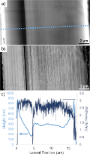
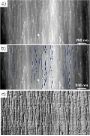
Exploring internal structures and properties of terpolymer fibers via real-space characterizations
Beilstein J. Nanotechnol. 2023, 14, 1004–1017, doi:10.3762/bjnano.14.83

- crystallites, as random sequences of molecules including the DPE monomer (which locally changes chain orientation) would prevent neighboring molecules from forming cohesive extended crystals. This would lead to a mixture of ordered and disordered subdomains with varying alignment, as schematized in Figure 9
- . These unique molecular structures cannot lead to a truly crystalline fiber, but evidently, they are still strong and concentrated enough to form the nanoscale fibrils we repeatedly observe throughout Technora® fibers. At the same time, a random monomer sequence should result in a heterogeneous map of
- differentiation in Technora®, evidenced here via real-space scans, should also lead to more consistent strength values. Additional mechanical properties Significant connections can also be made between the structures of Technora® and Kevlar® fibers and other mechanical properties, such as creep and fatigue





Fragmentation of metal(II) bis(acetylacetonate) complexes induced by slow electrons
Beilstein J. Nanotechnol. 2023, 14, 980–987, doi:10.3762/bjnano.14.81
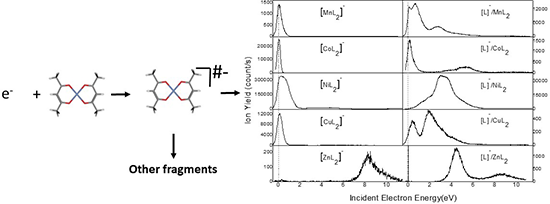
- , where they are decomposed under the focused kiloelectronvolt electron beam. In this technique, both the primary ionizing particles and the secondary species (e.g., ballistic electrons) with energies below 20 eV [6][7] lead to the decomposition of the molecules and the subsequent surface modification
- lenses and plates at oven temperature to prevent powder condensation, which otherwise may lead to undesirable changes in contact potentials during the measurements. The present experiments were carried out at temperatures typically 10–20 K below the temperatures for which the decomposition of the


Metal-organic framework-based nanomaterials for CO2 storage: A review
Beilstein J. Nanotechnol. 2023, 14, 964–970, doi:10.3762/bjnano.14.79
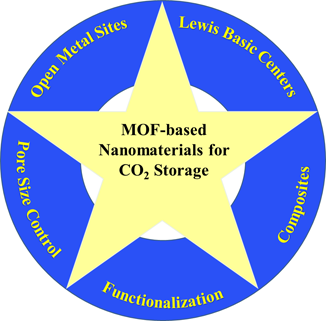
- bonds lead to a reduced pore size in UiO-66(Zr/Ti), thereby facilitating improved interactions between the MOF and CO2 molecules. MOF composites Post-synthetic functionalization was recognized as an effective strategy for enhancing the adsorption ability of nanosized MOF structures. However, it demands




Prediction of cytotoxicity of heavy metals adsorbed on nano-TiO2 with periodic table descriptors using machine learning approaches
Beilstein J. Nanotechnol. 2023, 14, 939–950, doi:10.3762/bjnano.14.77

- metals, upon release and emission, may interact with different environmental components, which may lead to co-exposure to living organisms. Nanoscale titanium dioxide (nano-TiO2) can adsorb heavy metals. The current idea is that nanoparticles (NPs) may act as carriers and facilitate the entry of heavy
- considerably high exposure TiO2 NPs may enter the food chain. Because of current industrialization processes, organisms are also exposed to heavy metal pollutants [7]. Emitted NPs may interact with the pollutants, and this may subsequently lead to bioaccumulation. The contamination of water and soil with heavy
- metals is also time- and dose-dependent. Among many other factors, the valence state plays an important role in toxicokinetics and toxicodynamics. Many studies have shown that an increased concentration of heavy metals is correlated with the severity of hepatotoxicity and nephrotoxicity [37]. Lead causes


Upscaling the urea method synthesis of CoAl layered double hydroxides
Beilstein J. Nanotechnol. 2023, 14, 927–938, doi:10.3762/bjnano.14.76

- measurements. Despite the acute differences in the magnetic behavior of Co-based LDH and simonkolleite-like α-LH [46][54][55], the impurities do not lead to significant changes beyond slight variations in the DC magnetic susceptibility and the out-of-phase contribution of the dynamic susceptibility (Figure S7
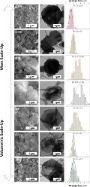
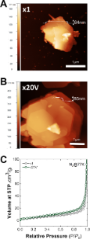
- , regarding the obtained pure CoAl-LDHs, both scale-up processes lead to subtle modifications of the morphological aspects, which can be understood in terms of changes in nucleation, growth and precipitation (mass scale-up), and different alkalization rates (volumetric approach). Conclusion In this work, the