


Search results
Search for "signal-to-noise ratio" in Full Text gives 179 result(s) in Beilstein Journal of Nanotechnology.
Single-pass Kelvin force microscopy and dC/dZ measurements in the intermittent contact: applications to polymer materials
Beilstein J. Nanotechnol. 2011, 2, 15–27, doi:10.3762/bjnano.2.2
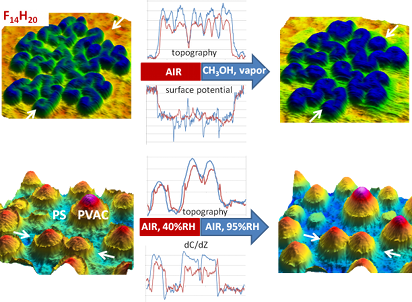
- nanotubes probes (generously provided by Carbon Design Innovations). The probes with small tip apex and tips with high aspect ratio provide higher spatial resolution of surface potential images whereas the probes with thicker tips have a better signal-to-noise ratio of the surface potential. The majority of
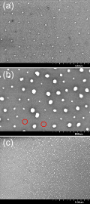
- images obtained in both regimes. The signal-to-noise ratio of the surface potential pattern is higher in the intermittent contact operation due to the larger dC/dZ amplitude in immediate vicinity of the sample. A higher spatial resolution of the surface potential image obtained in the intermittent





Defects in oxide surfaces studied by atomic force and scanning tunneling microscopy
Beilstein J. Nanotechnol. 2011, 2, 1–14, doi:10.3762/bjnano.2.1
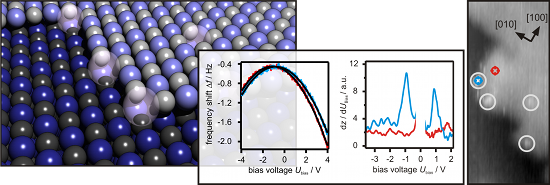
- oscillation amplitude of the tuning fork. The signal is so small that a low-temperature amplifier has to be placed nearby to improve the signal-to-noise ratio. In NC-AFM, the shift of the tuning fork resonance frequency Δf is used as a feedback signal to scan with constant Δf. The tip is electrically


Magnetic nanoparticles for biomedical NMR-based diagnostics
Beilstein J. Nanotechnol. 2010, 1, 142–154, doi:10.3762/bjnano.1.17

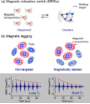
- measurements, and each microcoil held 5–10 μl of sample. In the second-generation μNMR, we changed our design to solenoidal coils [15][16], as such geometry provides higher signal-to-noise ratio (SNR) by producing more homogeneous radio-frequency magnetic fields for sample excitation. The SNR could be further
- factor, better signal-to-noise ratio, and reduced sample volume requirement to ~1 μL. (c) The latest 0.1 kg “palm” DMR system is 20× lighter and 30× smaller than previous generations. To achieve this significant size reduction, a small 0.56 T magnet was used. To compensate for the signal reduction from


Preparation and characterization of supported magnetic nanoparticles prepared by reverse micelles
Beilstein J. Nanotechnol. 2010, 1, 24–47, doi:10.3762/bjnano.1.5

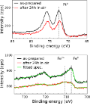
- for the XPS spectra. For example, to arrive at a reasonable signal-to-noise ratio for the Co-2p peaks, a data acquisition time of 12 h is required. Even under UHV conditions such a long exposure of a sample surface to X-rays results in the built-up of a small amount of carbon contamination, which, by






Other Beilstein-Institut Open Science Activities



