
Search results
Search for "surfactants" in Full Text gives 190 result(s) in Beilstein Journal of Nanotechnology.
Influence of the diameter of single-walled carbon nanotube bundles on the optoelectronic performance of dry-deposited thin films
Beilstein J. Nanotechnol. 2012, 3, 692–702, doi:10.3762/bjnano.3.79

- completely avoiding liquid dispersion steps, we were able to avoid any artifacts from residual surfactants or sonication. We found that bundle lengths determined the thin-film performance, as would be expected for highly resistive bundle–bundle junctions. However, we found no evidence that contact
- transistors [7][8] and capacitors [9]. However, most methods of fabricating devices rely on dispersion of the nanotubes in solutions. While the techniques are suitable for research, process-induced damage, such as tube cutting due to sonication [10][11], or residual surfactants severely limit device
- ]. However, due to their sample fabrication method it is likely that residual doping and surfactants were present in the samples, impacting on the results of their measurements. By comparison, aerosol CVD synthesis offers a unique platform to study the impact of bundle characteristics on the performance of


Conducting composite materials from the biopolymer kappa-carrageenan and carbon nanotubes
Beilstein J. Nanotechnol. 2012, 3, 415–427, doi:10.3762/bjnano.3.48

- their high surface energy and van der Waals interactions [3][5][6][7]. To overcome this issue, a diverse range of molecules have been used to aid the dispersion of CNTs in aqueous media, such as surfactants, polymers and biopolymers [8][9][10][11][12][13][14][15][16]. Well known examples of surfactants
- , mechanical and physical characteristics are dependent on various parameters, such as the type of CNTs (SWNT or MWNT), the filtration substrate (pore size; hydrophilic or hydrophobic), the sonication time and the type of dispersant (surfactants or polymers) [9][33]. The electrical properties combined with


Mesoporous MgTa2O6 thin films with enhanced photocatalytic activity: On the interplay between crystallinity and mesostructure
Beilstein J. Nanotechnol. 2012, 3, 123–133, doi:10.3762/bjnano.3.13
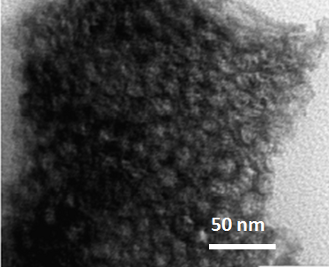
- , with the help of certain surfactants; however, such round concaves containing ordered mesopores have not been noticed before. As a preliminary result, we ascribe the formation of such a nanoarchitecture to the Mg2+ ions in the precursor, which increased the polarity of the ethanol and enhanced the






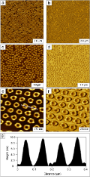
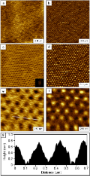
Self-assembly of octadecyltrichlorosilane: Surface structures formed using different protocols of particle lithography
Beilstein J. Nanotechnol. 2012, 3, 114–122, doi:10.3762/bjnano.3.12
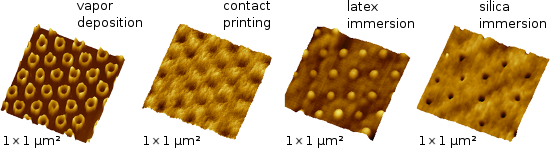
- latex were cleaned by centrifugation to remove surfactants or contaminants. Approximately 300 µL of the latex solution was placed into a microcentrifuge tube and centrifuged at 15,000 rpm for 15 min. A solid pellet was formed, and the supernatant was removed and replaced with deionized water. The latex




Synthesis and catalytic applications of combined zeolitic/mesoporous materials
Beilstein J. Nanotechnol. 2011, 2, 785–801, doi:10.3762/bjnano.2.87

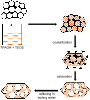
- polymeric organized systems (POS), mostly identical to the surfactants applied for the formation of purely mesoporous materials. Other surfactants are also being developed specifically for their beneficial influence on the formation of mesoporous materials with zeolitic character. Hard templating route
- stems of plants [119], have been put forward as relatively inexpensive and abundantly available templates. Soft templating route: When synthesizing combined zeolitic/mesoporous materials by the soft templating route, mesopores are formed by using, in most cases, the same surfactants (MOS/POS) as for
- guarantee the formation of a true hierarchical mesoporous zeolite [138][139][140][141] is the use of tailor-made organic–inorganic hybrid surfactants. Here, a silylated surfactant is applied in combination with a synthesis gel with the composition of a zeolite. The covalent bonding between the zeolite




Approaches to nanostructure control and functionalizations of polymer@silica hybrid nanograss generated by biomimetic silica mineralization on a self-assembled polyamine layer
Beilstein J. Nanotechnol. 2011, 2, 760–773, doi:10.3762/bjnano.2.84

- additives, mediators or templates [13][14]. This is completely different from the conventional silica deposition, which requires nonideal conditions, such as elevated temperature, extreme pH, and the presence of either a large amount of surfactants and/or organic cosolvents [15][16][17][18]. Moreover, it is


Generation and agglomeration behaviour of size-selected sub-nm iron clusters as catalysts for the growth of carbon nanotubes
Beilstein J. Nanotechnol. 2011, 2, 734–739, doi:10.3762/bjnano.2.80
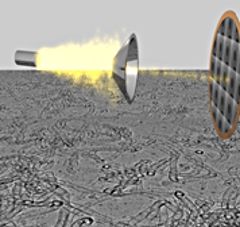
- size due to further agglomeration processes. During CNT growth, adsorbed hydrocarbons, hydrogen gas and water are present in a significant excess on the iron cluster surface, and thus these “surfactants” will certainly modify the surface energy of the catalyst clusters [23], and may have an additional


Ceria/silicon carbide core–shell materials prepared by miniemulsion technique
Beilstein J. Nanotechnol. 2011, 2, 638–644, doi:10.3762/bjnano.2.67
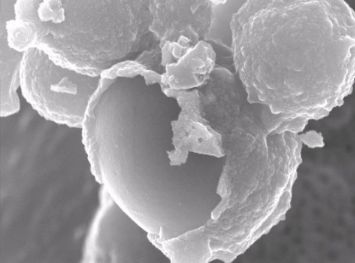
- core–shell particles prepared by the miniemulsion technique. The Si(O)C core was obtained by means of a polycarbosilane precursor (SMP10), which was subsequently functionalized with ceria and pyrolyzed to the ceramic. The size of these particles could easily be adjusted by varying the surfactants and
- usually the inverse miniemulsion technique has to be applied. Here, water soluble precursor compounds (e.g., Ti- or Si-glycolates, Zr or Ce-salts) for sol–gel synthesis and, if desired, templating surfactants, such as CTAB, are dissolved in water, acting as the dispersed phase. After miniemulsification
- approach were reported by Kroke et al. [33]. Here we present a new method to achieve catalytic functionalization and control of the particle size for these spheres either by using different surfactants, surfactant concentrations or by copolymerization with comonomers such as styrene (Sty), methyl


Inorganic–organic hybrid materials through post-synthesis modification: Impact of the treatment with azides on the mesopore structure
Beilstein J. Nanotechnol. 2011, 2, 486–498, doi:10.3762/bjnano.2.52

- (ethylene oxide)-based polymer. In our group, silicon diolates in the presence of surfactants were applied for the preparation of monolithic gels (silica and inorganic–organic hybrid networks) with a cellular network built up of macropores of about 2 μm diameter and periodically arranged mesopores of 7 nm


Platinum nanoparticles from size adjusted functional colloidal particles generated by a seeded emulsion polymerization process
Beilstein J. Nanotechnol. 2011, 2, 459–472, doi:10.3762/bjnano.2.50

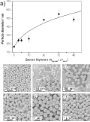
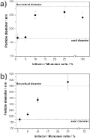
- nanoparticles [17][18][19][20]. Here, the monomer droplets are preformed by ultrasonication and critically stabilized against coagulation by the addition of surfactants. Ostwald ripening, the mechanism that leads to formation of bigger particles at the expense of smaller ones due to the higher Laplace pressure
- marginally grew in size, and most of the monomer added was found as a polymeric film covering the complete surface. This is not surprising as non-ionic surfactants are known to stabilize colloids less efficiently than charged ones. Thus, significantly larger amounts of non-ionic surfactants are usually
- the reaction details, respectively. First, sodium chloride was added to the continuous phase. The presence of salt affects the stability of colloidal particles as the extension of the electrical double layer of ionic surfactants present at the colloid interface is reduced by the counter ions of the



Plasmonic nanostructures fabricated using nanosphere-lithography, soft-lithography and plasma etching
Beilstein J. Nanotechnol. 2011, 2, 448–458, doi:10.3762/bjnano.2.49

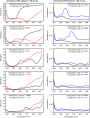
- , 500 nm, 900 nm, 1000 nm, 1100 nm and 3 μm diameter were used. The suspensions conform the NIST Standards and have sharp size distributions of 1.0% to 2.5%. According to the supplier some proprietary surfactants may be added to the suspension. Volumes of 1 mL were centrifuged until full sedimentation
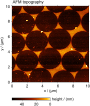
- of the beads was achieved. After removal of the liquid, the same volume of MilliQ water was added and the sediment beads resuspended. The process was repeated three times in order to remove surfactants of the suspension, which prevent the aggregation of the beads, but limit the quality and size of





Dynamics of capillary infiltration of liquids into a highly aligned multi-walled carbon nanotube film
Beilstein J. Nanotechnol. 2011, 2, 311–317, doi:10.3762/bjnano.2.36

- entirely alter their interface performance, from highly lipophilic to even lipophobic [12][13]. In turn, preparation of aqueous dispersions of CNTs requires the use of low or high molecular weight surfactants [14]. Most of the theoretical approaches concerning dispersibility of CNTs in various liquids
- [39]. In order to draw further conclusions for the water-based systems a variety of surfactants with different concentrations would have to be examined. Conclusion Infiltration by a variety of organic liquids, aqueous ionic/non-ionic solutions and metallic mercury into a model HACNT film was studied


Extended X-ray absorption fine structure of bimetallic nanoparticles
Beilstein J. Nanotechnol. 2011, 2, 237–251, doi:10.3762/bjnano.2.28
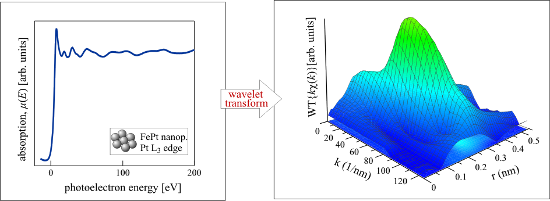
- nanoparticles follows the approach by S. Sun et al. [84] by the reduction of platinum diacetylacetonate, Pt(acac)2 and thermal decomposition of iron pentacarbonyl, Fe(CO)5, in hexadecane-1,2-diol at about 300 °C. The chemical reactions were initiated in the presence of the surfactants oleic acid and oleyl amine
- , thus providing a route to synthesise nanoparticles of a chemically disordered FexPt1−x alloy surrounded by the surfactants. After cooling to room temperature, the particles were precipitated by adding ethanol and separated by centrifugation. After this procedure, the particles were dispersed in n
- -hexane with surfactants, precipitated out and centrifuged once again. This can be repeated several times, until a stable dispersion of nanoparticles in n-hexane is obtained. The nanoparticles can be brought onto a naturally oxidised Si substrate using the spin coating technique, dip coating or just by



Magnetic nanoparticles for biomedical NMR-based diagnostics
Beilstein J. Nanotechnol. 2010, 1, 142–154, doi:10.3762/bjnano.1.17

- prepared via an aqueous co-precipitation method [25][26]. During these hydrolytic processes, control of solution pH and the addition of suitable coating surfactants are critical for regulating the nanoparticle size as well as the magnetic properties. Unfortunately, depending on the synthesis procedure used
- , magnetization can vary significantly among nanoparticles of similar sizes. More recently, high quality MNPs have been prepared through thermal decomposition of organometallic precursors, in nonhydrolytic organic solutions containing surfactants [15][16][27][28][29]. Monomers are generated via high-temperature


Preparation and characterization of supported magnetic nanoparticles prepared by reverse micelles
Beilstein J. Nanotechnol. 2010, 1, 24–47, doi:10.3762/bjnano.1.5

- flexibility to produce monatomic [28] as well as bimetallic NPs [24][29][30]. However, due to the preparation technique the NPs are covered by surfactants which may alter the magnetic properties of NPs [31]. Common to all the mentioned approaches is that oxides are formed when the NPs are exposed to ambient
- colloidal particles are dispersed at low concentration in a salt matrix which allows high-temperature annealing without NP coalescence. After removal of the salt matrix and recovery of NPs applying surfactants as spacers, the particles show size-dependent degrees of chemical order, coercive fields