


Search results
Search for "switching" in Full Text gives 260 result(s) in Beilstein Journal of Nanotechnology. Showing first 200.
Customized MFM probes with high lateral resolution
Beilstein J. Nanotechnol. 2016, 7, 1068–1074, doi:10.3762/bjnano.7.100

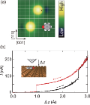
- the external field and extract the intrinsic hysteresis loop of the MFM tip [25]. Typically, a large Barkhausen jump is observed with a well-defined switching field. By doing so, the measured average switching field for the 20 nm Co homemade tip is μ0∙
= (31 ± 4) mT, where a total of 30

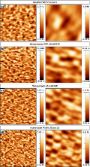

Dielectrophoresis of gold nanoparticles conjugated to DNA origami structures
Beilstein J. Nanotechnol. 2016, 7, 948–956, doi:10.3762/bjnano.7.87

- origami chains may occur around the field intensity maxima. Switching the field off resulted in diffusing of the structures away from the electrodes, and thus, disassembling of the chains (Figure 4d). On the one hand, this is a clear sign that the gold nanoparticle-conjugated DNA origami do not
- irreversibly aggregate during DEP deposition, as it was observed for the formation of conducting wires by DEP deposition of plain, unsupported gold nanoparticles [35][36][37][38][39]. On the other hand, the disassembly of our chain structures upon switching off the electrical field prohibits any further high
- at 1·106 V/m and 16 MHz. Inverted fluorescence microscopy image after 16 min (left) and 26 min (right) ac field application. (d) Inverted fluorescence microscopy images of the trapping behavior during on/off-switching of the ac field. Electrical field intensity (a) in the presence of a gold




Reorientation of single-wall carbon nanotubes in negative anisotropy liquid crystals by an electric field
Beilstein J. Nanotechnol. 2016, 7, 825–833, doi:10.3762/bjnano.7.74

- for the possibility of tuning the LC properties by doping with SWCNTs. In the last years, several studies have described SWCNT orientation in LC matrices, based on for example the conductivity of SWCNT-doped LC cells at different switching degrees [12][13][14][15]. SWCNT–LC blends co-align
- switching of the CNTs caused by the interaction with the field and with the LC molecules in this study. Therefore, this study is focused on determining the origin of the SWCNT switching in a LC matrix, by isolating the LC switching and the SWCNT switching, and by studying both individual SWCNTs in a
- negative LC matrix and the macroscopic impedance of a liquid crystal cell filled with negative LC doped with SWCNTs. In order to separate the field induced switching of the LC and the SWCNTs, a cells with homogenously aligned LC of negative dielectric anisotropy is employed. The SWCNT switching pattern in


Assembling semiconducting molecules by covalent attachment to a lamellar crystalline polymer substrate
Beilstein J. Nanotechnol. 2016, 7, 784–798, doi:10.3762/bjnano.7.70

- changed from constant velocity to constant surface pressure: A threshold-value of Π = 0.5 mN/m was used for switching from fast compression to constant surface pressure. When the pressure dropped below the threshold-value, the control unit compressed the film until the surface pressure had re-increased to


Magnetic switching of nanoscale antidot lattices
Beilstein J. Nanotechnol. 2016, 7, 733–750, doi:10.3762/bjnano.7.65
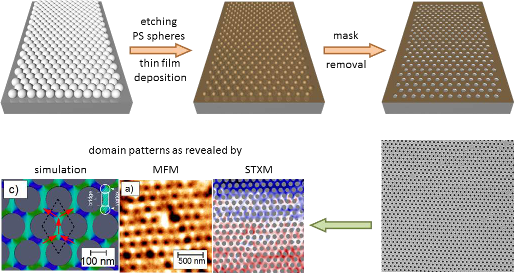
- Republic 10.3762/bjnano.7.65 Abstract We investigate the rich magnetic switching properties of nanoscale antidot lattices in the 200 nm regime. In-plane magnetized Fe, Co, and Permalloy (Py) as well as out-of-plane magnetized GdFe antidot films are prepared by a modified nanosphere lithography allowing
- for non-close packed voids in a magnetic film. We present a magnetometry protocol based on magneto-optical Kerr microscopy elucidating the switching modes using first-order reversal curves. The combination of various magnetometry and magnetic microscopy techniques as well as micromagnetic simulations
- delivers a thorough understanding of the switching modes. While part of the investigations has been published before, we summarize these results and add significant new insights in the magnetism of exchange-coupled antidot lattices. Keywords: antidot lattice; first-order reversal curves; Kerr microscopy



Cantilever bending based on humidity-actuated mesoporous silica/silicon bilayers
Beilstein J. Nanotechnol. 2016, 7, 637–644, doi:10.3762/bjnano.7.56
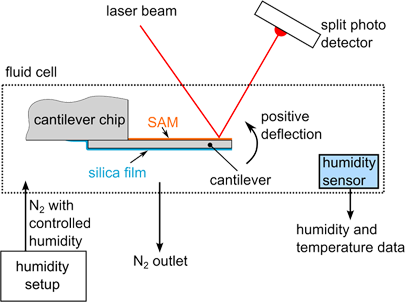
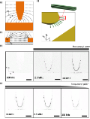
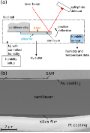
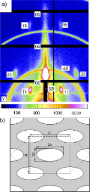
- switching operations. (a) Scheme of an AFM cantilever coated with a porous silica film in the fluid cell with deflection readout. (b) Backscattered electron SEM image of the cross section of a silica-coated cantilever. Cantilever deflection as a function of the relative humidity. (a) GISAXS pattern of


Charge and heat transport in soft nanosystems in the presence of time-dependent perturbations
Beilstein J. Nanotechnol. 2016, 7, 439–464, doi:10.3762/bjnano.7.39

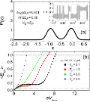
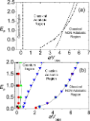
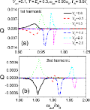
- consequence, intriguing nonlinear phenomena, such as hysteresis, switching, and negative differential conductance have been observed in molecular junctions. In conducting molecules, either the center of mass oscillations [9], or thermally induced acoustic phonons [10] can be the source of coupling between
- of gigahertz. Recently, it has been found that phenomena such as switching, hysteresis, as well as multistability can be observed in NEMS [13]. NEMS have been proposed as high sensitive position and mass sensors [14][15][16][17][18][19][20]. Recently, research at the nanoscale has focused not only on
- and NEMS. In this review, we analyze the adiabatic regime, realized when the internal vibrational modes have frequencies smaller than the hopping rate. Within this regime, one can observe phenomena such as switching, multistability and hysteresis in molecular junctions or NEMS, and study the physics






Invariance of molecular charge transport upon changes of extended molecule size and several related issues
Beilstein J. Nanotechnol. 2016, 7, 418–431, doi:10.3762/bjnano.7.37

- rather than operators. For nonorthonormal basis sets, the nondiagonal overlap matrix SC would replace the identity matrix 1C of Equation 1. Switching between orthonormal and nonorthonormal basis sets leaves the diagonal matrix elements (on-site energies) unchanged while renormalizing the nondiagonal


Rigid multipodal platforms for metal surfaces
Beilstein J. Nanotechnol. 2016, 7, 374–405, doi:10.3762/bjnano.7.34







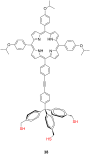
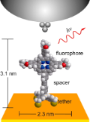


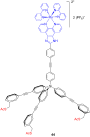
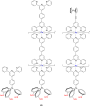
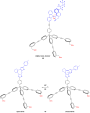

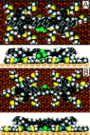
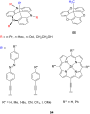

Molecular machines operating on the nanoscale: from classical to quantum
Beilstein J. Nanotechnol. 2016, 7, 328–350, doi:10.3762/bjnano.7.31


![[Graphic 40]](/bjnano/content/inline/2190-4286-7-31-i86.png?max-width=637&scale=1.18182) with depth ε. Bias Δμ < 0 per one rotation tur...
with depth ε. Bias Δμ < 0 per one rotation tur...

![[Graphic 48]](/bjnano/content/inline/2190-4286-7-31-i94.png?max-width=637&scale=1.18182) , for the most asymmetric sawtooth mod...
, for the most asymmetric sawtooth mod...


Large area scanning probe microscope in ultra-high vacuum demonstrated for electrostatic force measurements on high-voltage devices
Beilstein J. Nanotechnol. 2015, 6, 2485–2497, doi:10.3762/bjnano.6.258
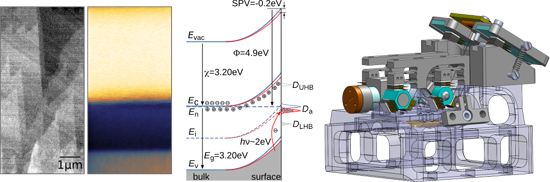
- power switches. Each switching process results in a melting of the contact surface and after several hundred events in a degradation of the device properties. Therefore, the chemical and structural properties of these surfaces are of major interest. Since the melting zone is typically macroscopically


Probing the local environment of a single OPE3 molecule using inelastic tunneling electron spectroscopy
Beilstein J. Nanotechnol. 2015, 6, 2477–2484, doi:10.3762/bjnano.6.257

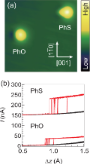
- at the interface between the molecule and the metallic electrodes or in the electronic configuration. Finally, to investigate the switching dynamics of OPE3 between the different configurations (1–5) we recorded the conductance of junction 1 as a function of time (see Figure 6a). The traces have been
- a higher value and then it switches back to the original values shortly thereafter. For increasing voltage, the switching behavior becomes more frequent, resembling telegraph noise. This points to a two-level system characterized by two different conductance values [32]. By comparing the conductance
- notice that for bias voltages higher than 0.20 V, some of the two-level fluctuations involve configurations 4 and 5b, and four levels of current are present. In conclusion we observed fluctuations induced by the bias voltage, two-level switching between 3 and 5a, above 0.16 V, and four-level switching


An adapted Coffey model for studying susceptibility losses in interacting magnetic nanoparticles
Beilstein J. Nanotechnol. 2015, 6, 2173–2182, doi:10.3762/bjnano.6.223

- is a solid-state mechanism that occurs within the nanoparticle. It corresponds to a switching of the magnetic moment between two equilibrium positions. The latter is due to the physical rotation of nanoparticle within the colloidal solution. Changing in orientation of the magnetic moment of a


Conformational switching of ethano-bridged Cu,H2-bis-porphyrin induced by aromatic amines
Beilstein J. Nanotechnol. 2015, 6, 2154–2160, doi:10.3762/bjnano.6.221

- -porphyrin host and the aromatic amine guest is observed. A clear-cut variation of the profile of surface pressure vs area per molecule curve is observed. Reflection spectroscopy highlights that the aromatic amines dissolved in the subphase are able to induce the syn-to-anti conformational switching in the
- in aqueous solution. The high selectivity of the SPR sensing device has been verified by checking the spectral response of the active layer towards other analytes dissolved in the aqueous solutions. Keywords: aromatic amines; bis-porphyrin; conformational switching; Langmuir film; surface plasmon
- subphase, which is further confirmed by reflection spectroscopy at the air/subphase interface. In fact, a red shift of the Soret band by about 10 nm was induced by the aniline, thus suggesting the syn-to-anti conformational switching in the Cu,H2-Por2 molecules (Figure 4b). This effect is similar to that


Virtual reality visual feedback for hand-controlled scanning probe microscopy manipulation of single molecules
Beilstein J. Nanotechnol. 2015, 6, 2148–2153, doi:10.3762/bjnano.6.220

- of or as obtained from the SPM. Switching between the log(I) and Δf color-codes can be performed by pressing a custom-defined action button on the Apex device. Results and Discussion We begin the discussion of our results by characterising the precision of the implemented visual feedback system


Controlled switching of single-molecule junctions by mechanical motion of a phenyl ring
Beilstein J. Nanotechnol. 2015, 6, 2088–2095, doi:10.3762/bjnano.6.213
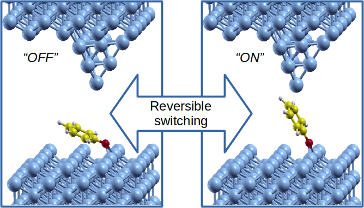
- be particularly appealing if device properties (such as switching power, speed, and stability) could be engineered and controlled by chemical design. By optimizing the on-state conductance, a large on/off ratio can be achieved, which is essential for the reliable operation of a molecular switch. In
- anchored to the surface via an oxygen atom. The reversible switching of the junction allowed us to explore the effect of molecular interaction on the molecular conductance. Here we extend this study and show that switching can be controlled by voltage pulses as well as by mechanical manipulation of the tip
- dehydrogenation as in the case of phenol. An electrochemically etched tungsten tip was used as an STM probe. The tips were repeatedly and gently touched to the Cu surface to coat them with copper, resulting in Cu-terminated tips for reliable switching [14]. We observed that sharp tips give high-contrast images



High Ion/Ioff current ratio graphene field effect transistor: the role of line defect
Beilstein J. Nanotechnol. 2015, 6, 2062–2068, doi:10.3762/bjnano.6.210

- carrier mobility and velocity of graphene is utilized in ballistic and high switching speeds devices [3][4]. However, the very large off-current of graphene at room temperature, which is associated with the small band gap, renders it incapable of being integrated as a building block for pure carbon-based
- -current decrease is much more significant than the on-current reduction in ELD-GNRFET. The results indicate that on/off ratio improved 30% in the defected transistor. The simulating of the average of transconductance and the subthreshold swing describe the switching-on and the immunity of the short
- channel effects in the switching-off performance. In this study, the transconductance decreased from gm = 94 μS in the ideal transistor to gm = 55.7 μS for the defected transistor. The subthreshold swing, which is defined as ∆VG/∆log(∆ID) at the subthreshold region in GNRFET, was S = 166.9 mV/dec, whereas


Conductance through single biphenyl molecules: symmetric and asymmetric coupling to electrodes
Beilstein J. Nanotechnol. 2015, 6, 1690–1697, doi:10.3762/bjnano.6.171

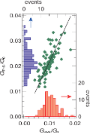
- to changes in bonding sites of the molecule on the electrodes, which have a great impact on conductance. The pronounced switching in conductance at times between 36–46 h has been characterized earlier as blinking of the thiol–gold bond, a characteristic of any molecule bonded to gold surface via


Continuum models of focused electron beam induced processing
Beilstein J. Nanotechnol. 2015, 6, 1518–1540, doi:10.3762/bjnano.6.157

- simultaneous FEBIE and FEBID processes, and are not caused by adsorbate diffusion (which is ignored by Equation 27–Equation 37). This competition and the resulting phenomenon of electron flux controlled switching between etching and deposition have been discussed in detail in [11][14]. The additional effects


![[Graphic 37]](/bjnano/content/inline/2190-4286-6-157-i117.png?max-width=637&scale=1.18182) and chemisorbed
and chemisorbed ![[Graphic 38]](/bjnano/content/inline/2190-4286-6-157-i118.png?max-width=637&scale=1.18182) adsorbates versus pressure, calcul...
adsorbates versus pressure, calcul...


Transformations of PTCDA structures on rutile TiO2 induced by thermal annealing and intermolecular forces
Beilstein J. Nanotechnol. 2015, 6, 1498–1507, doi:10.3762/bjnano.6.155
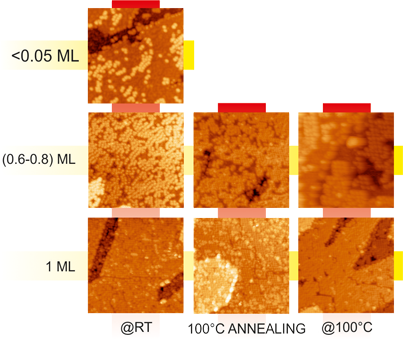
- disordered phase. In the analysed case, the self-assembly process is steered by thermal annealing, which provides additional energy, enabling equilibration. The method allows for switching from the formation of meandering, not well-organized chains to a well-ordered phase. Deposition of the molecules on a


Enhanced fullerene–Au(111) coupling in (2√3 × 2√3)R30° superstructures with intermolecular interactions
Beilstein J. Nanotechnol. 2015, 6, 1421–1431, doi:10.3762/bjnano.6.147
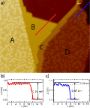
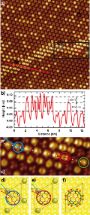
- treatment, that is after a thermally activated vacancy forming process, but also after storage at room temperature for several days. At room temperature the energy for vacancy formation on clean substrates is not supplied. However, at room temperature the switching of C60 from bright–to-dim and vice versa
- of the ac tunnelling current achieved by modulating the sample bias after switching off the feedback loop. The single crystal Au(111) substrate (MaTecK, Germany) was cleaned in UHV by cycles of Ne+ ion sputtering (1 kV, 10 min) and thermal annealing (600 °C, 20 min). The cleanliness was checked by




Influence of the shape and surface oxidation in the magnetization reversal of thin iron nanowires grown by focused electron beam induced deposition
Beilstein J. Nanotechnol. 2015, 6, 1319–1331, doi:10.3762/bjnano.6.136

- . All results shown in Figure 2 correspond to the average of more than 100 hysteresis loops. Given the sharp switching transitions observed, a high level of reproducibility can be inferred. The observed decrease of HC with the width was also observed in polycrystalline cobalt nanowires grown by FEBID
- already multidomain-type, as shown in Figure 10. Indeed, for nominal thicknesses of 30 and 35 nm, the switching is produced through the formation and displacement of several magnetic domains along the nanowire length. The example of the 30 nm nanowire is shown in Figure 10a. For tNom = 40 and 50 nm, the


Magnetic properties of iron cluster/chromium matrix nanocomposites
Beilstein J. Nanotechnol. 2015, 6, 1158–1163, doi:10.3762/bjnano.6.117

- clusters one can assume that FM spins residing on the surface are exchange-coupled to the AFM neighbors with a strength determined by the exchange integral J. The FM/AFM interaction keeps all the spins of the cluster along the unidirectional anisotropy axis. During the magnetization switching process the
- external magnetic field flips the magnetization in the opposite direction. The switching field must overcome the FM/AFM coupling which is proportional to J multiplied by the cluster surface area πR2, where R is the cluster radius. On the other hand the bigger the total magnetic moment of the cluster (which
- is proportional to the number of magnetic moments per cluster and, thus, to the volume, i.e., to R3) the higher is the torque induced by the external magnetic field and the easier is the rotation away from an easy axis. Thus the switching field is proportional to the ratio J·R2/R3, which eventually


Electrical characterization of single molecule and Langmuir–Blodgett monomolecular films of a pyridine-terminated oligo(phenylene-ethynylene) derivative
Beilstein J. Nanotechnol. 2015, 6, 1145–1157, doi:10.3762/bjnano.6.116

- directionally oriented monolayers when the molecule contains two different terminal groups that each have affinity for the substrate [30]. In particular, LB films have been used to analyze different properties and explore potential applications including molecular switching behavior [35][36], rectifying




Statistics of work and orthogonality catastrophe in discrete level systems: an application to fullerene molecules and ultra-cold trapped Fermi gases
Beilstein J. Nanotechnol. 2015, 6, 755–766, doi:10.3762/bjnano.6.78

- to handle the diagonalization of the total Hamiltonian H′(x) = H(x) + V (x), which describes the gas after switching on the potential. In particular, the perturbed eigenfunctions in presence of the excited impurity can be written in terms of the parabolic cylinder functions with normalization
- . Lowest and highest occupied valence states for the neutral fullerene molecule (C60) and corresponding valence states in the ionized fullerene molecule (). The sudden switching mechanism leads most of the content of the unperturbed Fermi state to be found in a state lying about 0.22 eV below the perturbed
- effects induced by core hole creation (see also below in Figure 2). Squared overlap integrals in a spin 1/2 trapped gas of 122 particles with a sudden switching impurity potential characterized by the critical exponent value α = 0.1 (see also Figure 3). The lowest occupied (v = 0, ε0 = 0.5 eV) and highest

![[Graphic 22]](/bjnano/content/inline/2190-4286-6-78-i30.png?max-width=637&scale=1.18182) ) fullerene molecules, as com...
) fullerene molecules, as com...





