


Search results
Search for "5-FU" in Full Text gives 5 result(s) in Beilstein Journal of Nanotechnology.
Development and in vitro evaluation of liposomes and immunoliposomes containing 5-fluorouracil and R-phycoerythrin as a potential phototheranostic system for colorectal cancer
Beilstein J. Nanotechnol. 2026, 17, 97–121, doi:10.3762/bjnano.17.7
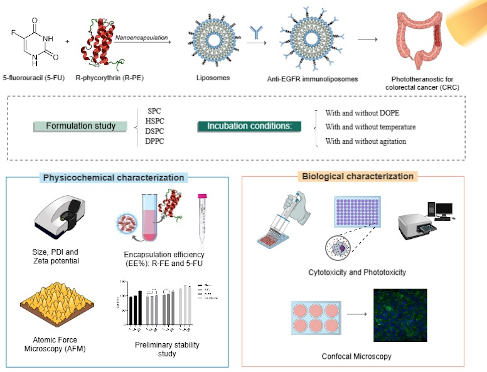
- São Paulo, Ribeirão Preto, São Paulo, Brazil Federal University of Ceará, Center of Technology, Department of Chemical Engineering, Fortaleza, Ceará, Brazil 10.3762/bjnano.17.7 Abstract 5-Fluorouracil (5-FU) is the first-line drug for the treatment of colorectal cancer (CRC), which is considered the
- third most prevalent type of cancer in the world. R-phycoerythrin (R-PE) is a phycobiliprotein isolated from red algae such as Solieria filiformis, with fluorescent properties, photodynamic activity and potential for cancer treatment. However, 5-FU toxicity promotes several side effects and R-PE low
- stability hampers its clinical use. Thus, the present work aimed to develop co-encapsulated liposomes system for co-delivery of 5-FU and R-PE as theranostic nanosystems for CRC, as well as immunoliposomes targeted with the anti-EGFR monoclonal antibody, cetuximab, as a strategy for targeted delivery to EGFR



Hydrogels and nanogels: effectiveness in dermal applications
Beilstein J. Nanotechnol. 2025, 16, 1216–1233, doi:10.3762/bjnano.16.90
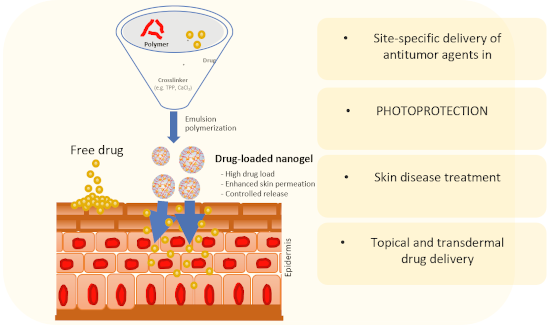
- synthesis. Among the antineoplastic agents, 5-fluorouracil (5-FU) is the classic and most widely tested drug to fight skin cancer. 5-FU is a chemotherapeutic agent analogous to pyrimidine. The metabolism of 5-FU blocks the methylation reaction of deoxyuridine acid to thymidyl acid, interfering with DNA
- synthesis, and subsequently inhibiting the formation of RNA. The effects of reduction on DNA and RNA syntheses occur mostly in cells that proliferate more rapidly and therefore capture more 5-FU [216][217]. Among modern antimetabolite agents, capecitabine is the first-choice antineoplastic drug in contrast
- to 5-FU. Capecitabine is a molecule derived from fluoropyrimidine carbamate, a tumor-activated and tumor-selective cytotoxic agent. Therefore, capecitabine exerts anti-tumor action after the conversion of its molecule into 5-FU in the tumor itself. The formation of 5-FU preferably occurs by an


Recent advances in photothermal nanomaterials for ophthalmic applications
Beilstein J. Nanotechnol. 2025, 16, 195–215, doi:10.3762/bjnano.16.16
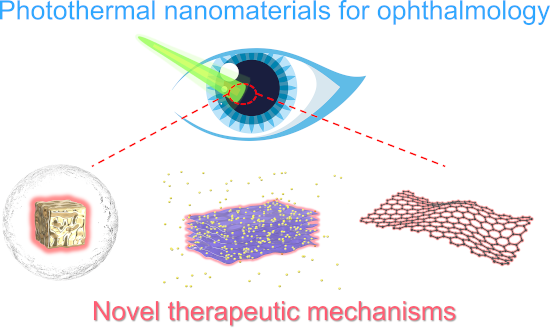
- vesicle leakage, bacterial endophthalmitis, and ocular hypotonia. Wang et al. developed a polyvinyl alcohol (PVA) hydrogel with enhanced photothermal, antimicrobial, and drug-delivery capabilities (PVA@rGO-Ag/5-Fu) [71]. Under NIR irradiation, the rGO-Ag component in the hydrogel effectively targets and
- thermally destroys conjunctival fibroblasts and invasive bacteria around conjunctival vesicles, while the 5-fluorouracil (5-Fu) inhibits fibrous responses in filter vesicles, thus achieving effective IOP reduction [145]. 3.5 Endophthalmitis Endophthalmitis, commonly resulting from pathogenic infections, is


Poly(1-vinylimidazole) polyplexes as novel therapeutic gene carriers for lung cancer therapy
Beilstein J. Nanotechnol. 2020, 11, 354–369, doi:10.3762/bjnano.11.26
- procured from HiMedia, USA. Ribogreen reagent was purchased from Invitrogen, USA. All other reagents of analytical grade were purchased from Merck, India. 5-Fluorouracil (5-FU) was procured from Sigma-Aldrich, USA. VEGF antibody (Santa Cruz Biotechnology Ltd., USA), β- actin and other antibodies (Cell
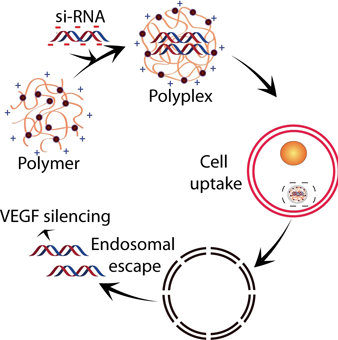
- reader (Epoch i2, Biotek, USA). For assessing the effect of VEGF silencing on the cytotoxicity of 5-FU, the cells were initially treated with the polyplex or with free siRNA at a siRNA concentration of 100 nM for 4 h. The medium was then replaced with fresh medium to which 400 μM of 5-FU was added and
- . Cell viability measurements VEGF inhibition can also be used in combination with chemotherapeutic agents to enhance their therapeutic efficacy. The ability of the polyplex to alter the cell viability of A549 cells treated with 5-FU was investigated and the results are represented in Figure 12. The


Enhanced antineoplastic/therapeutic efficacy using 5-fluorouracil-loaded calcium phosphate nanoparticles
Beilstein J. Nanotechnol. 2018, 9, 2499–2515, doi:10.3762/bjnano.9.233
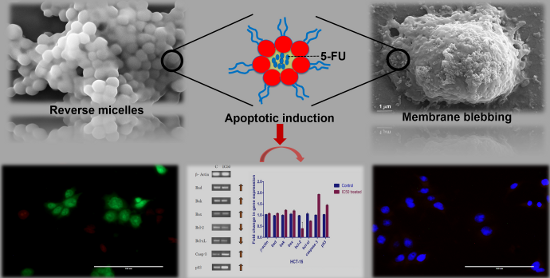
- excellent loading efficiency, biodegradable nature and controlled-release behaviour. Herein, we report a novel system of 5-fluorouracil (5-FU)-loaded calcium phosphate nanoparticles (CaP@5-FU NPs) synthesized via a reverse micelle method. The formation of monodispersed, spherical, crystalline nanoparticles
- with an approximate diameter of 160–180 nm was confirmed by different methods. The physicochemical characterization of the synthesized CaP@5-FU NPs was done with transmission electron microscopy (TEM), dynamic light scattering (DLS), field emission scanning electron microscopy (FE-SEM), Fourier
- -transform infrared spectroscopy (FTIR), and X-ray diffraction (XRD). The antineoplastic potential of the CaP@5-FU NPs against colorectal and lung cancer cells was reported. The CaP@5-FU NPs were found to inhibit half the population (IC50) of lung adenocarcinoma (A549) cells at 32 μg/mL and colorectal (HCT


Other Beilstein-Institut Open Science Activities



