


Search results
Search for "Erbitux" in Full Text gives 2 result(s) in Beilstein Journal of Nanotechnology.
Development and in vitro evaluation of liposomes and immunoliposomes containing 5-fluorouracil and R-phycoerythrin as a potential phototheranostic system for colorectal cancer
Beilstein J. Nanotechnol. 2026, 17, 97–121, doi:10.3762/bjnano.17.7
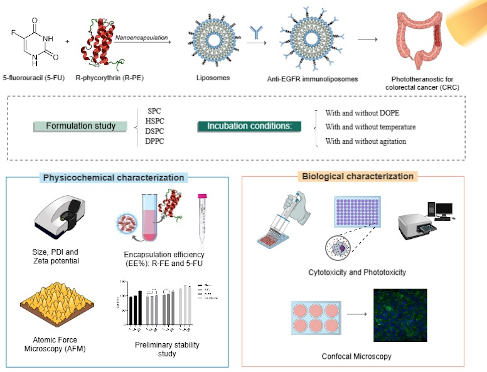
- either anti-EGFR immunoliposomes HSPC IM 07 (25 μg/mL) or cetuximab (Erbitux, 25 μg/mL) for 5 min. Each treatment was followed by a 20 min incubation at 37 °C. After incubation, the cells were washed twice, detached with trypsin-EDTA, centrifuged, and resuspended in a live cell buffer containing DAPI (3



Theranostic potential of self-luminescent branched polyethyleneimine-coated superparamagnetic iron oxide nanoparticles
Beilstein J. Nanotechnol. 2022, 13, 82–95, doi:10.3762/bjnano.13.6

- delivery of an anionic cargo. Besides, a strong intracellular optical signal supports the optically traceable nature of these nanoparticles. SPION@bPEI nanoparticles were further conjugated with Erbitux (Erb), which is an anti-EGFR antibody for targeting EGFR-overexpressing cancer cell lines. SPION@bPEI
- selective uptake and hence the targeting ability of Erb-tagged nanoparticles. Altogether, this study proves luminescent, cationic, and small SPION@bPEI nanoparticles as strong candidates for imaging and gene therapy. Keywords: Erbitux; photoluminescence; polyethyleneimine; polyinosinic–polycytidylic acid
- therapeutic dose. Next, SPION@bPEI were conjugated with Erbitux (Erb), which is an anti-EGFR antibody for targeting EGFR-overexpressing cancer cell lines. Finally, SPION@bPEI-Erb nanoparticles were used for the targeted delivery of a GFP plasmid, whose transfection can be confirmed with the luminescence of




Other Beilstein-Institut Open Science Activities



