


Search results
Search for "Fermi liquid" in Full Text gives 5 result(s) in Beilstein Journal of Nanotechnology.
Fractional shot noise of an SU(N) Kondo system
Beilstein J. Nanotechnol. 2026, 17, 515–540, doi:10.3762/bjnano.17.34
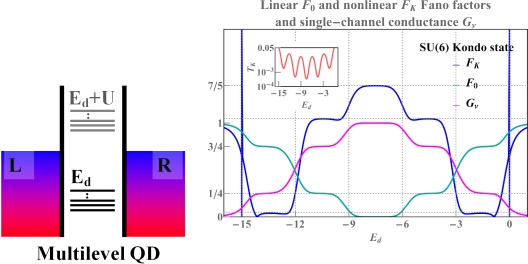
- quasiparticle partitioning. To discuss nonlinear conductance, susceptibilities, and shot noise in the strong coupling regime, we apply Fermi liquid theory with parameters expressed by susceptibilities of pseudofermions determined within SBMFA. Nonlinear shot noise is dominated by two-quasiparticle scattering
- . However, we demonstrate that for occupation regions distant from the electron–hole symmetry point, the role of three-body correlations must be considered. Keywords: Fermi liquid; Kondo effect; quantum dots; shot noise; Introduction Quantum dot (QD) structures are being intensively investigated regarding
- disrupt the superposition of states and entanglement, leading to information loss and decoherence. The considerations made in this work are in the spirit of the effective Fermi liquid (FL) theory [77][78][79][80][81][82][83][84][85][86]. One can analyze the low-energy behavior of a multilevel interacting


![[Graphic 127]](/bjnano/content/inline/2190-4286-17-34-i187.svg?max-width=637&scale=1.18182)

Experimental and theoretical study of field-dependent spin splitting at ferromagnetic insulator–superconductor interfaces
Beilstein J. Nanotechnol. 2022, 13, 682–688, doi:10.3762/bjnano.13.60
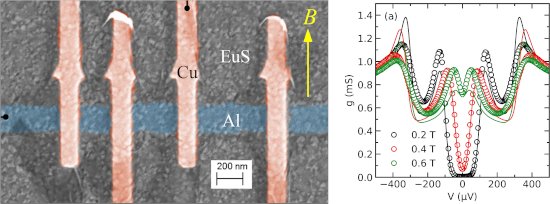
- deviation can be explained by Fermi-liquid renormalization of the effective spin splitting near the critical field [49][46], which is not included in our model. Conclusion Based on the general spin-dependent boundary condition [30][31] augmenting the spin-dependent circuit theory [38][50], we investigated



Kondo effects in small-bandgap carbon nanotube quantum dots
Beilstein J. Nanotechnol. 2020, 11, 1873–1890, doi:10.3762/bjnano.11.169

- is correct in the unitary Kondo regime and it leads to a local Fermi-liquid behavior at zero temperature. It gives reliable results of the linear conductance also for systems with weakly broken symmetry. The results obtained are in good agreement with experiments and with renormalization group
- calculations [27][28]. The SBMFA method best describes systems close to the Kondo fixed point, that is, for the case of deep fully degenerate atomic levels at low temperatures. This approximation correctly describes spin or pseudospin fluctuations and reproduces local Fermi-liquid behavior at zero temperature
- Fermi-liquid relationships and that the Kondo effect is absent at the particle–hole symmetry point. Simple higher-order truncations remove the latter drawback [72]. There are also attempts to recover Fermi-liquid behavior at low energy in the EOM formalism [73] but, to our knowledge, without full



![[Graphic 37]](/bjnano/content/inline/2190-4286-11-169-i52.svg?max-width=637&scale=1.18182) as a functio...
as a functio...


Molecular attachment to a microscope tip: inelastic tunneling, Kondo screening, and thermopower
Beilstein J. Nanotechnol. 2019, 10, 1243–1250, doi:10.3762/bjnano.10.124

- temperature and by showing that it fits the Fermi liquid theory [21]. The sharp zero-bias peak in the dI/dV spectrum of a single MnPc molecule attached to the Au-covered probe tip in Figure 2f, shows that the molecule preserves the spin state of the Mn ion similar to MnPc on Au(111) and Ag(111) surfaces [19


Focused electron beam induced deposition: A perspective
Beilstein J. Nanotechnol. 2012, 3, 597–619, doi:10.3762/bjnano.3.70





Other Beilstein-Institut Open Science Activities



