


Search results
Search for "Lacticaseibacillus rhamnosus" in Full Text gives 1 result(s) in Beilstein Journal of Nanotechnology.
Biosynthesis, characterization, and biofunctional assessment of niobium oxide nanostructures obtained using lactic acid bacteria-derived supernatants
Beilstein J. Nanotechnol. 2026, 17, 1128–1141, doi:10.3762/bjnano.17.77
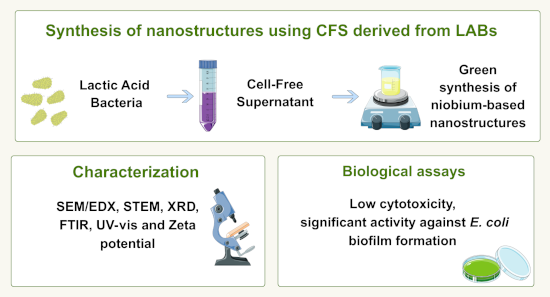
- , cell-free approach using supernatants derived from lactic acid bacteria (LAB) Lacticaseibacillus rhamnosus and Lacticaseibacillus paracasei UFTM 2.9. The use of LAB supernatants provided an eco-friendly and sustainable route for nanoparticle production, avoiding toxic reagents while exploiting
- activity; green synthesis; Lacticaseibacillus paracasei; Lacticaseibacillus rhamnosus; niobium oxide nanoparticles; Introduction Nanotechnology is a field focused on the study, development, and application of materials at the nanoscale [1][2]. Among the various types of nanomaterials, metallic and metal
- Lacticaseibacillus rhamnosus (Lcr) and Lacticaseibacillus paracasei as biological agents in the synthesis of metallic nanostructures. Lavecchia et al. demonstrated that the synthesis of silver nanoparticles using Lcr resulted in a material with strong antimicrobial activity and high photocatalytic efficiency [16


Other Beilstein-Institut Open Science Activities



