


Search results
Search for "R-phycoerythrin" in Full Text gives 2 result(s) in Beilstein Journal of Nanotechnology.
Development and in vitro evaluation of liposomes and immunoliposomes containing 5-fluorouracil and R-phycoerythrin as a potential phototheranostic system for colorectal cancer
Beilstein J. Nanotechnol. 2026, 17, 97–121, doi:10.3762/bjnano.17.7
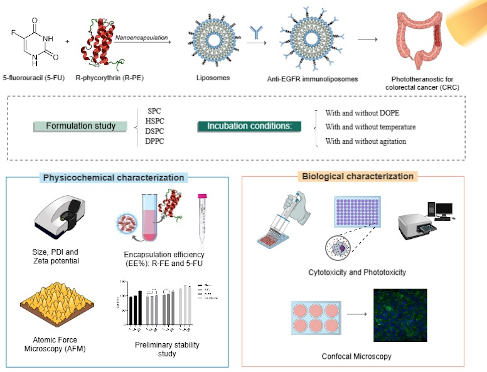
- third most prevalent type of cancer in the world. R-phycoerythrin (R-PE) is a phycobiliprotein isolated from red algae such as Solieria filiformis, with fluorescent properties, photodynamic activity and potential for cancer treatment. However, 5-FU toxicity promotes several side effects and R-PE low
- , the HSPC 50 formulation containing R-PE and 5-FU, functionalized with cetuximab, is a promising alternative for the development of co-encapsulation delivery systems as a phototheranostic nanocarriers. Keywords: colorectal cancer; immunoliposomes; photodynamic therapy; R-phycoerythrin; 5-fluorouracil
- for more effective, safer, and personalized theranostic treatment of colorectal cancer [11]. R-phycoerythrin (R-PE) is a phycobiliprotein isolated from red algae Solieria filiformis, which is cultivated on the Brazilian coast [12]. Several pre-clinical studies have shown that this protein has



Biocompatibility of cerium dioxide and silicon dioxide nanoparticles with endothelial cells
Beilstein J. Nanotechnol. 2014, 5, 1795–1807, doi:10.3762/bjnano.5.190

- markers, respectively. After staining both CD31 (monoclonal anti-human CD31 antibodies conjugated to fluorescein isothiocyanate (FITC), Miltenyi Biotec GmbH, Germany) and CD90 (monoclonal anti-human CD90 antibodies conjugated to R-phycoerythrin (PE) Miltenyi Biotec GmbH, Germany), the cells were washed


Other Beilstein-Institut Open Science Activities



