


Search results
Search for "RBS" in Full Text gives 17 result(s) in Beilstein Journal of Nanotechnology.
Enhanced erosion resistance and radiation stability of WC–WO3 nanocomposite films under 100 keV Kr+ ion irradiation
Beilstein J. Nanotechnol. 2026, 17, 922–934, doi:10.3762/bjnano.17.65
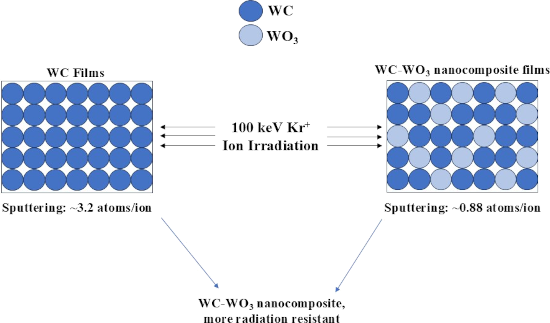
- that only the other half of the film is exposed to ion irradiation keeping the covered half pristine, as shown schematically in Figure 1, to determine the sputter yield using Rutherford backscattering spectrometry (RBS) measurements post-irradiation. S1 samples were also irradiated by scanning the
- complete area (i.e., 1 cm × 1 cm) to study the structural modifications due to ion irradiation. The pristine and irradiated halves were analysed using RBS with a 2 MeV He-ion beam from the 1.7 MV Pelletron accelerator at IUAC to measure the sputtering/erosion rate. The RBS measurements were taken at a
- scattering angle of 165°, with a beam spot size of around 2 mm in diameter. The RBS spectra were analysed using SIMNRA 6.06 software [74]. Further, to find the crystalline state of the nanocomposite films (S1) both before and after irradiation, glancing incidence X-ray diffraction (GIXRD) measurements were



Electrical, photocatalytic, and sensory properties of graphene oxide and polyimide implanted with low- and medium-energy silver ions
Beilstein J. Nanotechnol. 2025, 16, 1794–1811, doi:10.3762/bjnano.16.123
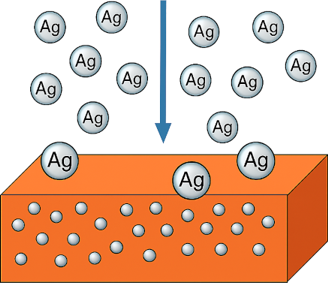
- multifunctional behavior of polymer systems. Keywords: ERDA; graphene oxide; ion implantation; photocatalysis; polyimide; RBS; Introduction Silver ion implantation is an effective strategy for controlling modification of the physicochemical properties of polymers and graphene-based materials. This method allows
- yield. Such properties are promising for applications including photocatalytic water purification, self-cleaning surfaces, and light-activated antimicrobial coatings [20]. The elemental composition of the modified films was characterized by Rutherford backscattering spectrometry (RBS) and elastic recoil
- calculation was performed through a complex Monte Carlo simulation. The initial GO composition for SRIM simulation was determined by RBS analysis of the pristine sample, while the composition and density of the PI polymer were obtained from the SRIM database. The results of the SRIM simulation are shown in


Investigating ripple pattern formation and damage profiles in Si and Ge induced by 100 keV Ar+ ion beam: a comparative study
Beilstein J. Nanotechnol. 2024, 15, 367–375, doi:10.3762/bjnano.15.33
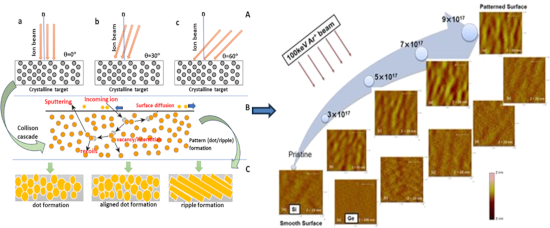
- processes (i.e., thermal diffusion and ion-induced diffusion) [32]. This approach is based on the linear cascade model and Gaussian approximation of energy distribution as developed by Sigmund [26] to describe ion–atom collisions inside the target. Rutherford backscattering spectrometry (RBS) studies in the
- . Channelling is an important process which has been heavily studied by Norlund et al. [24] and Hobler et al. [36]. Thus, in our studies, RBS-c plays a significant role in understanding the damage fractions in Si and Ge due to Ar+ ions. In the present work, 100 keV Ar+ ion bombardment was simultaneously
- performed on Si and Ge substrates. A correlation between ripple morphology and ion beam parameters was derived to understand the damage incurred by Ar+ ions inside both materials using RBS-c measurements. Experimental Details Commercially available Si and Ge wafers, procured from Semiconductor wafers Inc


Bio-imaging with the helium-ion microscope: A review
Beilstein J. Nanotechnol. 2021, 12, 1–23, doi:10.3762/bjnano.12.1

- detectors Rutherford back-scattering (RBS) of high-energy (typically in the range of 1 to 5 MeV) ions is a well-known (micro)analytical technique for the investigation of the elemental composition of a sample. Recently, Klingner, Heller, and Hlawacek demonstrated a time-of-flight RBS spectrometer for the
- HIM [32][34][49]. We are not aware of any currently published biological application of RBS in the HIM. However, from scattering kinetics it follows that RBS is most sensitive to heavy elements in a light matrix. For bio-imaging this implies that RBS could be a promising technique to study systems


Nanosecond resistive switching in Ag/AgI/PtIr nanojunctions
Beilstein J. Nanotechnol. 2020, 11, 92–100, doi:10.3762/bjnano.11.9

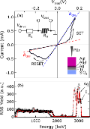
- following the method of Kumar and co-workers [36]. The Ag films were evaporated on standard Si/SiO2 wafers using a 12 nm thick Ti sticking layer. The structural characterization of the thin film samples was carried out by Rutherford backscattering spectrometry (RBS) using an ion beam of 3500 keV 4He
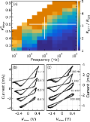
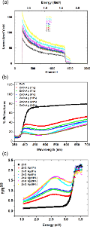
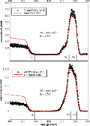
- illustrates the sample structure. The upper inset shows the dc measurement setup. (b) Energy-resolved RBS spectra of a 200 nm thick AgI thin film recorded at 7° (full circles) and 60° (empty circles) tilt angles. The red solid and dashed lines display the corresponding model spectra. (a) The color scale shows


Nanocomposite–parylene C thin films with high dielectric constant and low losses for future organic electronic devices
Beilstein J. Nanotechnol. 2019, 10, 428–441, doi:10.3762/bjnano.10.42
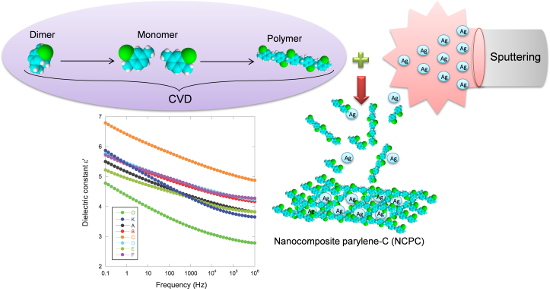
- layer). The thickness of each single layer (either with or without Ag) was measured by RBS in monomeric units·cm−2. As highlighted in the Experimental section (see below), the parylene C amount deposited on the substrate (in monomeric units·cm−2) is directly obtained from the Cl RBS atomic dose, since
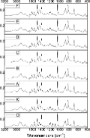
- film thickness measured in monomeric units·cm−2 (by RBS) of the samples O, K and from A to F as a function of the number of rotations. The first important feature to be noted is the effect of plasma on the deposition rate of parylene. When the plasma is switched on (sample K), we observe an increase of
- samples (see samples C to F). The plasma-induced increase of the deposition rate affects the film density, as shown by the data in Figure 2, where the film thickness measured in micrometers (by the profilometer) is plotted as a function of the thickness measured in monomeric units·cm−2 (by RBS). In Figure




Laser irradiation in water for the novel, scalable synthesis of black TiOx photocatalyst for environmental remediation
Beilstein J. Nanotechnol. 2017, 8, 196–202, doi:10.3762/bjnano.8.21
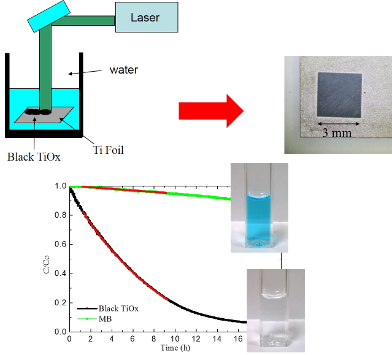
- percentage. The crystalline structure of the Ti and TiOx/Ti samples was determined by grazing angle (0.5°) X-ray diffraction by using a Bruker D-9000 instrument (Cu Kα) and Bruker diffraction suite software for the diffraction analysis. Rutherford backscattering spectrometry (RBS) measurements were run using
- a 2 MeV He+ beam with a scattering angle of 165° in normal incidence. The RUMP software was employed for the analysis of the RBS spectra. In order to evaluate the photocatalytic activity of the TiOx nanostructured film, the methylene blue (MB) discoloration test was performed [24]. The apparent
- appears similar to the case of irradiation under 1064 nm wavelength [22]. However, in the present condition, the holes on the surface of the irradiated sample appear to be concentrated at the grain boundaries generated on the surface by the laser annealing. RBS spectra clearly show the presence of oxygen


Influence of hydrofluoric acid treatment on electroless deposition of Au clusters
Beilstein J. Nanotechnol. 2017, 8, 183–189, doi:10.3762/bjnano.8.19

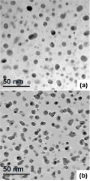
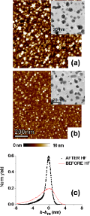
- light gray, thin regions of square shape (labeled 1 in Figure 2b) and the dark, thick round particles (labeled 2 in Figure 2b) is clearly shown. The two samples were also analyzed by Rutherford backscattering (RBS) measurements with 2 MeV He+ ions in order to obtain the areal density of the deposited
- the Au atoms after the HF solution treatment indicates that the heteroepitaxial relationship with the substrate is partially lost. Moreover, the amount of Au on the sample, as measured using RBS, does not change even after an HF treatment of 70 s, indicating that the atomic arrangement is not



Thickness dependence of the triplet spin-valve effect in superconductor–ferromagnet–ferromagnet heterostructures
Beilstein J. Nanotechnol. 2016, 7, 957–969, doi:10.3762/bjnano.7.88
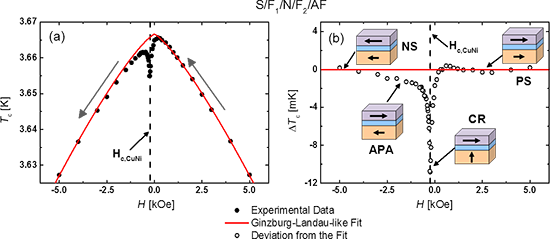
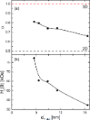
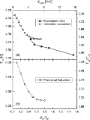
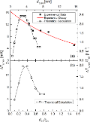
- distinguishable and have sharp and plain interfaces. Furthermore, the layer thicknesses determined by the TEM analysis are used as initial guesses to fit the Rutherford backscattering spectroscopy (RBS) spectra, from which the thicknesses of the layers of further samples are obtained. The thicknesses for the
- samples investigated by cross-sectional TEM are summarized in Table 1. About one half of the samples were investigated by RBS analysis. In Figure 3 the results for all constituent layers are shown. The layer thicknesses from the TEM analysis are shown as open symbols. Since the sensitivity of RBS for
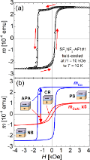
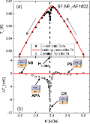
- values for the splitting of the metallic and oxide cobalt signals, cross-checked with the RBS spectra for plausibility and slightly adapted to yield the best fit to the RBS spectra. Furthermore, we conducted superconducting quantum interference device (SQUID) magnetometry investigations on several SF1NF2


Novel ZnO:Ag nanocomposites induce significant oxidative stress in human fibroblast malignant melanoma (Ht144) cells
Beilstein J. Nanotechnol. 2015, 6, 570–582, doi:10.3762/bjnano.6.59
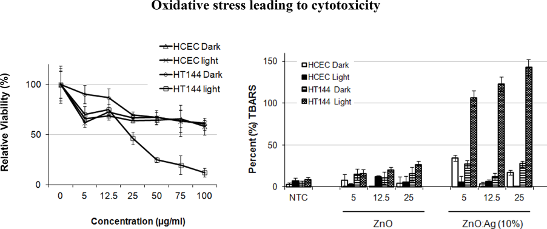
- backscattering spectrometry (RBS) analysis (Figure 3a and Table 1) shows that our samples contain the correct elemental compositions regarding Zn, O and Ag and confirm the presence of Zn:O:Ag in 1:1:0.01, 1:1:0.03, 1:1:0.05, 1:1:0.1, 1:1:0.2 and 1:1:0.3 ratios in ZnO:Ag (1%), ZnO:Ag (3%), ZnO:Ag (5%), ZnO:Ag (10
- size range of 30–40 nm. The RBS analysis of ZnO:Ag nanoparticles indicated the purity of the prepared samples with the atomic percentages of Zn, O and Ag according to the expectations. Zinc and oxygen are present in correct stoichiometric amounts indicating the presence of pure ZnO and excluding any
- 2θ = 20–70°. Rutherford backscattering spectrometry (RBS) was carried out on a 5 MV pelletron tandem accelerator with He++ beam of energy 2.085 MeV employing 26 nA current and a solid state barrier detector. Detector resolution was set at 20 keV. Incident angle during analysis was kept at 0° whereas




Synthesis of Pt nanoparticles and their burrowing into Si due to synergistic effects of ion beam energy losses
Beilstein J. Nanotechnol. 2014, 5, 1864–1872, doi:10.3762/bjnano.5.197

- /Sn) from 1 to 10. The irradiated films were characterized using Rutherford backscattering spectroscopy (RBS), atomic force microscopy (AFM), scanning electron microscopy (SEM), X-ray diffraction (XRD) and high resolution transmission electron microscopy (HRTEM). A TEM image of a cross section of the
- . The irradiated samples were characterized using Rutherford backscattering spectroscopy (RBS), atomic force microscopy (AFM), scanning electron microscopy (SEM) and X-ray diffraction (XRD) techniques. High resolution cross sectional transmission electron microscopy (HRXTEM) of the sample irradiated
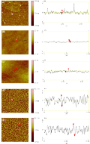
- AFM scans were made at a slower rate using a single crystal silicon tip. The apex of the tip has a radius of curvature of ≈10 nm and a locking frequency ≈350 KHz. For RBS measurements, 2 MeV He+ ions were bombarded onto the samples using the Pelletron Accelerator RBS-AMS System (PARAS) facility at



A study on the consequence of swift heavy ion irradiation of Zn–silica nanocomposite thin films: electronic sputtering
Beilstein J. Nanotechnol. 2014, 5, 1691–1698, doi:10.3762/bjnano.5.179
- . Results RBS spectra of the pristine and the irradiated samples are shown in Figure 2a and Figure 2b, respectively. The integrated area under the Zn peak in RBS spectra is used to determine the Zn content. The Zn content in case of set A is found to be (2.65 ± 0.05) × 1016 atoms/cm2 for pristine and (2.32
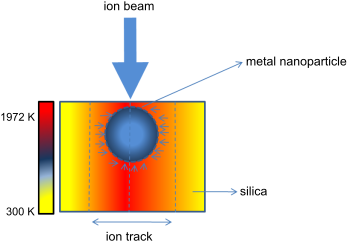
- pressure spike inside the ion track, initiated by a thermal spike. Experimental setup. The ion beam is incident perpendicularly to the nanocomposite thin film and catcher is placed at an angle of 60° from thin film surface. RBS spectra of Zn–silica nanocomposite thin film before and after irradiation, (a


A nanometric cushion for enhancing scratch and wear resistance of hard films
Beilstein J. Nanotechnol. 2014, 5, 1005–1015, doi:10.3762/bjnano.5.114
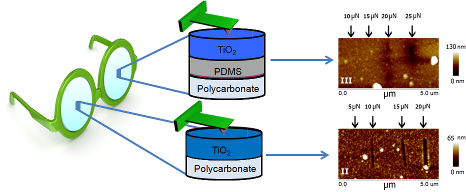
- Discussion The initial development of our experimental approach was done using plasma treated Si wafers, kapton and PDMS which were coated with a uniform TiO2 nanoscale overlayer. Figure 2 shows SEM images of those coatings. RBS measurements gave TiO2 thicknesses of 43, 38, and 40 nm respectively for the
- was assessed by SEM (Inspect, FEI), at an accelerating voltage of 30 kV with surface gold coatings of approximately 10 nm thickness. Rutherford backscattering spectrometry (RBS). The thicknesses of the TiO2 layers were measured by Rutherford backscattering spectrometry (RBS). This work was done using
- a) Si, b) kapton and c) PDMS. rms roughness measured by AFM and thickness by RBS. AFM images of titania on Si (I, II), kapton (III, IV) and PDMS (V, VI) before and after scratching loads for the 3 scratch lines were a) 15 µN, b) 20 µN, c) 25 µN. Wear volumes (in µm3) resulting from different loads



Ellipsometry and XPS comparative studies of thermal and plasma enhanced atomic layer deposited Al2O3-films
Beilstein J. Nanotechnol. 2013, 4, 732–742, doi:10.3762/bjnano.4.83

- ]. Herein the typical parameters like growth rate per cycle (GPC), density and refractive index were determined by ellipsometry whereas the elemental composition was mostly deduced from Rutherford Backscattering Spectrometry (RBS). The influence of the substrate temperature onto these parameters was
- the composition results of the Kessels group based on RBS data where oxygen rich layers were found at lower temperatures [1][20]. However, we have analyzed here only the Al–O specific contributions. In case that also OH and COO contributions would be considered for the analysis O/Al ratios of 1.9 and
- due to the ex-situ handling of the samples in particular in the surface sensitive XPS method. Nevertheless, our elemental composition data confirm findings of other authors based on RBS data [1][20]. In addition, the observed trend of carbon components within the films is similar to the EDX


Structural and thermoelectric properties of TMGa3 (TM = Fe, Co) thin films
Beilstein J. Nanotechnol. 2013, 4, 461–466, doi:10.3762/bjnano.4.54

- detector. Information about the chemical composition of the (TM)Ga3 films was obtained by Rutherford backscattering spectroscopy (RBS) with 700 keV He2+ ions backscattered by 170° from samples deposited on silicon substrates. Simulating the experimental RBS spectra by the freely accessible software RUMP
- powders consisting of grains with chemical compositions statistically fluctuating around an average value leads to thin films with a stoichiometry reflecting this average. For this purpose RBS experiments were performed and two examples of FeGa3 (42 nm) and CoGa3 (47 nm) films on Si substrates
- composition CoGa3 with a film thickness of 43 nm. Given the typical RBS accuracy of 10%, in both cases the compositions are close to the expected ones of the starting material. Similarly, the thicknesses agree with those obtained from the quartz balance within an error of 9%. Thus, the RBS data confirm that


Channeling in helium ion microscopy: Mapping of crystal orientation
Beilstein J. Nanotechnol. 2012, 3, 501–506, doi:10.3762/bjnano.3.57

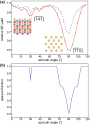
- past in the context of ion scattering methods, such as Rutherford backscattering (RBS) and medium- and low-energy ion scattering. Many ion scattering phenomena are well understood for the very high energies of several hundred keV up to MeV that are used in RBS. Although energies in HIM are different




The morphology of silver nanoparticles prepared by enzyme-induced reduction
Beilstein J. Nanotechnol. 2012, 3, 404–414, doi:10.3762/bjnano.3.47
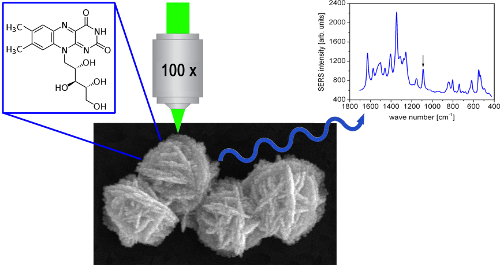
- contaminations. Therefore, the enzymatically grown silver nanoparticles were investigated by employing different microscopic techniques, namely scanning electron microscopy (SEM) and transmission electron microscopy (TEM), together with analytical methods, namely Rutherford backscattering spectrometry (RBS) and
- show silver Lα and Lβ lines only. Hence, the enzymatically grown silver nanoparticles consist of pure silver. Furthermore, TEM diffraction patterns show the silver plates of the EGNP to be single crystalline. RBS analysis for the density of silver in the EGNP In order to study the integral coverage of
- the silver nanoparticles on the substrate surface the Rutherford backscattering spectrometry (RBS) technique was applied. RBS is able to deliver significant data about the averaged three-dimensional distribution of chemical elements, which is a clear advantage compared to the aforementioned grey-scale





