


Search results
Search for "Trypanosoma cruzi" in Full Text gives 4 result(s) in Beilstein Journal of Nanotechnology.
Targeting the vector of arboviruses Aedes aegypti with nanoemulsions based on essential oils: a review with focus on larvicidal and repellent properties
Beilstein J. Nanotechnol. 2025, 16, 1894–1913, doi:10.3762/bjnano.16.132
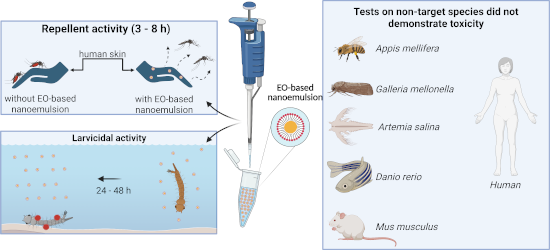
- ], photodynamic therapy [96], antimicrobial applications [97], intracellular parasites such as Trypanosoma cruzi and Leishmania spp. [98][99], and for antioxidant potential [100], larvicidal, and repellent activities against arthropod vectors [101]. Nanotechnology has shown the potential to enhance the


When nanomedicines meet tropical diseases
Beilstein J. Nanotechnol. 2024, 15, 830–832, doi:10.3762/bjnano.15.69
- article collection. Among the articles, an interesting strategy to improve the bioavailability of benzonidazole towards Chagas disease has been presented by Muraca and colleagues, who reported a stable and safe nanostructured lipid formulation with potential effects against Trypanosoma cruzi [2]. In turn
Nanomedicines against Chagas disease: a critical review
Beilstein J. Nanotechnol. 2024, 15, 333–349, doi:10.3762/bjnano.15.30

- still required regarding a realistic use of nanomedicines effective against CD. Keywords: benznidazole; liposomes; nanocrystals; nanomedicines; nanoparticles; Trypanosoma cruzi; Introduction Nanomedicines are used to solve the problems posed by poor solubility and/or permeability and high toxicity of
- nanomedicines against CD will be critically analyzed. Review Chagas disease, a threat no longer limited to developing countries Chagas disease is a parasitic, systemic, chronic, and often fatal infection caused by the protozoan Trypanosoma cruzi [4]. The World Health Organization classifies CD as the most

Nanostructured lipid carriers containing benznidazole: physicochemical, biopharmaceutical and cellular in vitro studies
Beilstein J. Nanotechnol. 2023, 14, 804–818, doi:10.3762/bjnano.14.66
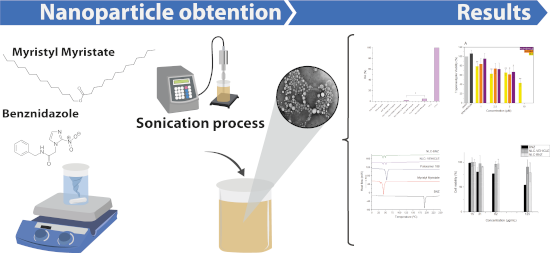
- in the chronic stage, possibly because current treatment regimens do not eradicate transiently dormant Trypanosoma cruzi amastigotes. Nanostructured lipid carriers (NLC) appear to be a promising approach for delivering pharmaceutical active ingredients as they can have a positive impact on
- . These results show potential for the development of new nanomedicines against T. cruzi. Keywords: benznidazole; biopharmaceutical study; Chagas disease; nanoparticles; nanostructured lipid carriers; physicochemical characterization; Trypanosoma cruzi; Introduction Chagas disease is a neglected disease
- ]. It is caused by the hemoflagellate protozoan Trypanosoma cruzi, whose life cycle involves transitioning from non-flagellated multiplicative intracellular forms (amastigotes) to blood-circulating non-multiplicative forms (trypomastigotes). It is mainly transmitted by an insect vector of the


Other Beilstein-Institut Open Science Activities



