


Search results
Search for "ZnSe nanowires" in Full Text gives 2 result(s) in Beilstein Journal of Nanotechnology.
Laser ablation in liquids for shape-tailored synthesis of nanomaterials: status and challenges
Beilstein J. Nanotechnol. 2025, 16, 1963–1997, doi:10.3762/bjnano.16.137
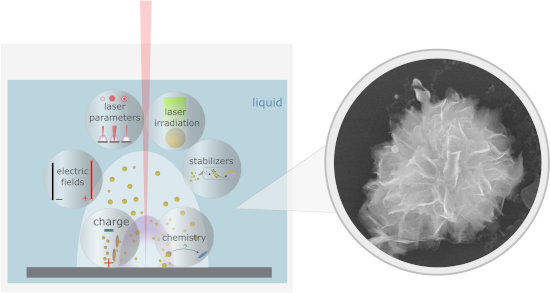
- room temperature. At an intermediate stage, the particles are organized in a network structure. The self-assembly processes can result in one-dimensional nanomaterials as well. Yang et al. [31] fabricated ZnSe nanowires through the self-assembly of ≈ 50 nm seed NPs, which were first generated by





Room temperature, ppb-level NO2 gas sensing of multiple-networked ZnSe nanowire sensors under UV illumination
Beilstein J. Nanotechnol. 2014, 5, 1836–1841, doi:10.3762/bjnano.5.194

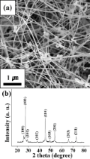
- temperatures. In this study, ZnSe nanowires were synthesized by the thermal evaporation of ZnSe powders and the sensing performance of multiple-networked ZnSe nanowire sensors toward NO2 gas was examined. The results showed that ZnSe might be a promising gas sensor material if it is used at room temperature
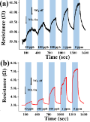
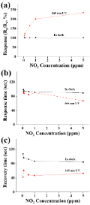
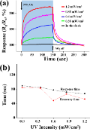
- . The response of the ZnSe nanowires to 50 ppb–5 ppm NO2 at room temperature under dark and UV illumination conditions were 101–102% and 113–234%, respectively. The responses of the ZnSe nanowires to 5 ppm NO2 increased from 102 to 234% with increasing UV illumination intensity from 0 to 1.2 mW/cm2. The
- response of the ZnSe nanowires was stronger than or comparable to that of typical metal oxide semiconductors reported in the literature, which require higher NO2 concentrations and operate at higher temperatures. The origin of the enhanced response of the ZnSe nanowires towards NO2 under UV illumination is

Other Beilstein-Institut Open Science Activities



