


Search results
Search for "adhesive protein" in Full Text gives 3 result(s) in Beilstein Journal of Nanotechnology.
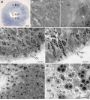
The cement of the tube-dwelling polychaete Sabellaria alveolata: a complex composite adhesive material
Beilstein J. Nanotechnol. 2025, 16, 1998–2014, doi:10.3762/bjnano.16.138
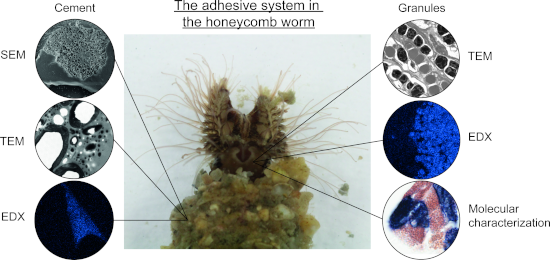
- and that of the cement suggests that the inclusions of the heterogeneous granules would inflate through a still unexplained process to form hollow spheroids dispersed in the cement matrix, leading to the formation of a complex composite material. Keywords: adhesive protein; Annelida; biological
- characterization of the adhesive system of S. alveolata through the ultrastructural and chemical characterization of the two types of adhesive cells and the cement they produce, as well as the identification of new adhesive protein candidates. Another goal is to address the gap in knowledge about adhesive protein
- transmission electron microscope. Identification and characterization of new adhesive protein and kinase candidates Local basic local alignment search tool (BLAST) searches were performed in the transcriptome of the anterior part of S. alveolata [26] using the adhesive protein sequences of P. californica from



Self-assembly and adhesive properties of Pollicipes pollicipes barnacle cement protein cp19k: influence of pH and ionic strength
Beilstein J. Nanotechnol. 2025, 16, 1863–1872, doi:10.3762/bjnano.16.129
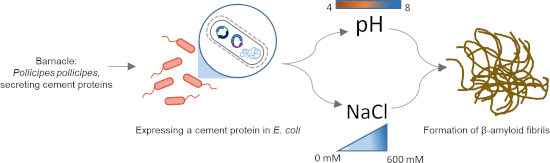
- study, we investigated the influence of environmental parameters on the self-assembly of recombinant cp19k, a key adhesive protein in Pollicipes pollicipes. Using TEM imaging, a low pH (4.0) and high salt concentration (600 mM NaCl) environment, mimicking P. pollicipes gland conditions, was identified


The structural and chemical basis of temporary adhesion in the sea star Asterina gibbosa
Beilstein J. Nanotechnol. 2018, 9, 2071–2086, doi:10.3762/bjnano.9.196

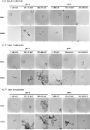
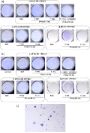
- interference microscopy, and atomic force microscopy (AFM). A. gibbosa tube feet and footprints were labelled with antibodies raised against the adhesive protein Sfp1 from A. rubens, but no cross-reactivity was observed. To detect carbohydrate moieties, we performed lectin labelling with 24 commercially
- and lectins to further investigate the similarities and differences in adhesive material composition between A. gibbosa and A. rubens. Adhesive protein variability. The footprints of A. rubens consist of a complex blend of different proteins [29] but only one of them, Sfp1, has been fully
- . rubens. Furthermore, only one lectin labelled footprints of A. gibbosa, suggesting a lower complexity in sugar moieties. Finally, antibodies raised against the adhesive protein Sfp1 from A. rubens did not cross-react with the adhesive gland cells or footprints in A. gibbosa. All these differences might




Other Beilstein-Institut Open Science Activities



