

Search results
Search for "catalytic graphitization" in Full Text gives 4 result(s) in Beilstein Journal of Nanotechnology.
Upcycling agroindustrial waste into graphene oxide supports for gold nanoparticles: toward sustainable nanomaterials
Beilstein J. Nanotechnol. 2026, 17, 489–504, doi:10.3762/bjnano.17.32
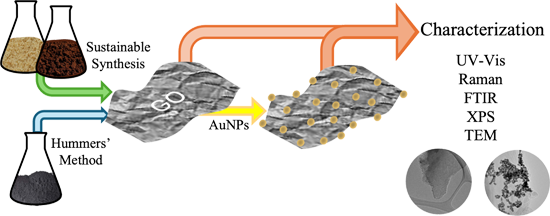
- the biomass with Mn(NO3)2 and pyrolyzing it at 900–950 °C to achieve catalytic graphitization. Although this route avoids a separate chemical oxidation step, it still demands prolonged high-temperature treatment [16]. To overcome the limitations of these high-temperature routes, more energy-efficient
- , while enabling precursor-dependent tuning of oxygen functionality and sp2 domains. Another approach relies on high-temperature catalytic graphitization followed by mild exfoliation, producing few-layer, weakly oxidized GO-like materials; for example, Mn-assisted graphitization at ~950 °C combined with



Heat-induced transformation of nickel-coated polycrystalline diamond film studied in situ by XPS and NEXAFS
Beilstein J. Nanotechnol. 2025, 16, 887–898, doi:10.3762/bjnano.16.67
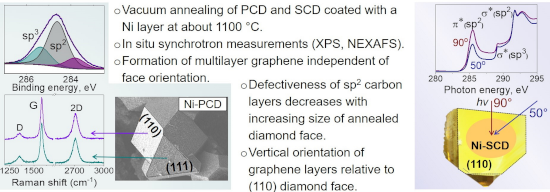
- during the catalytic graphitization of small crystallites contain more defects compared to those formed on the continuous surface of micro-sized crystallites. The number of graphitic layers in the carbon coating forming the graphitized surface of the annealed Ni-PCD film can be analyzed by the ratio of


Synthesis of amorphous and graphitized porous nitrogen-doped carbon spheres as oxygen reduction reaction catalysts
Beilstein J. Nanotechnol. 2020, 11, 1–15, doi:10.3762/bjnano.11.1
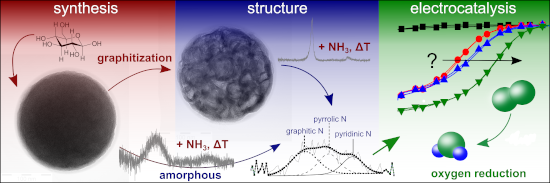
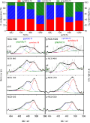
- synthesized by hydrothermal treatment of a glucose solution yielding carbon spheres with sizes of 330 ± 50 nm, followed by nitrogen doping via heat treatment in ammonia atmosphere. The influence of a) varying the nitrogen doping temperature (550–1000 °C) and b) of a catalytic graphitization prior to nitrogen
- beneficial or disadvantageous. The degree of graphitization can be increased, e.g., by higher reaction temperatures or catalytic graphitization [31][32][33]. Previously, we had reported on core–shell titanium (oxy)nitride and tantalum (oxy)nitride@N-doped carbon composite spheres, which were based on a
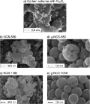
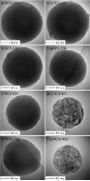
- catalytic graphitization of g-NCS-850 and g-NCS-1000, the smooth surface becomes texturized or perforated as seen in the SEM images (cf. Figure 2d,e), and the spheres partially erode. This can be explained as a result of catalytic graphitization, for which the following mechanism was proposed by Nettelroth




Improving control of carbide-derived carbon microstructure by immobilization of a transition-metal catalyst within the shell of carbide/carbon core–shell structures
Beilstein J. Nanotechnol. 2019, 10, 419–427, doi:10.3762/bjnano.10.41

- pronounced energy consumption for the reactor heating as well as with challenges to handle chlorine at such high temperatures. The second approach is using catalytic graphitization during the material synthesis. It typically requires only moderate temperatures (typically starting from 800 °C, depending on
- types of carbides [19]). Commonly used graphitization catalysts are transitions metals such as Fe, Ni, and Co [18][21][22]. The conventional method for catalytic graphitization is to mix the non-porous carbide and metal catalyst precursor prior to the selective etching at high temperature. Indeed, the
- heterogeneous combination. Immobilizing the transition metal-catalyst at each particle would ensure a homogeneous catalytic graphitization of the whole powder samples. We recently introduced the possibility to obtain core–shell particles in which a nanoporous carbon shell is covering a carbide core [14][15][24


Other Beilstein-Institut Open Science Activities