


Search results
Search for "cell co-culture" in Full Text gives 5 result(s) in Beilstein Journal of Nanotechnology.
Influence of surface characteristics on the in vitro stability and cell uptake of nanoliposomes for brain delivery
Beilstein J. Nanotechnol. 2026, 17, 139–158, doi:10.3762/bjnano.17.9
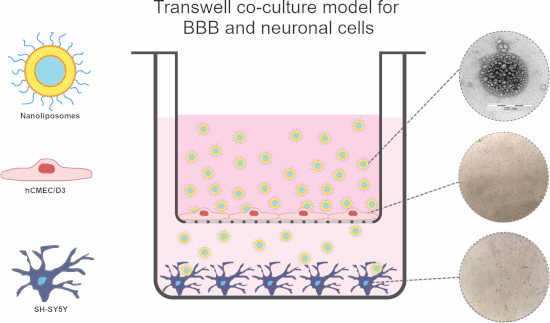
- neurons (ranging from 25.17% to 27.54%). Fluorescence and confocal microscopy micrographs revealed that, once internalized, NLs were concentrated in the perinuclear cell regions. Keywords: blood–brain barrier; cell co-culture; cell uptake; internalization; nanoliposomes; stability; surface




Nanoparticle delivery to metastatic breast cancer cells by nanoengineered mesenchymal stem cells
Beilstein J. Nanotechnol. 2018, 9, 321–332, doi:10.3762/bjnano.9.32
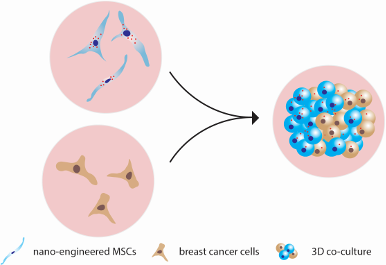
- , Vilnius University, Sauletekio Ave. 7, LT-10257 Vilnius, Lithuania, Laser Research Centre, Vilnius University, Sauletekio al. 9, corp. 3, LT-10222 Vilnius, Lithuania 10.3762/bjnano.9.32 Abstract We created a 3D cell co-culture model by combining nanoengineered mesenchymal stem cells (MSCs) with the
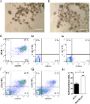
- ]. However, after 48 h, 72 h and 96 h propagation on polyHEMA coatings, CD90 expression was reduced to 92%, 81% and 88%, respectively (Figure 2C). Therefore, we chose 24 h as the optimal incubation time for 3D cell co-culture experiments to ensure the selectivity of the CD90 marker towards MSCs. Quantum dot
- . Endocytosis inhibitor assay; QD endocytic pathway analysis in MSCs, MCF7 and MDA-MB-231 cells; Confocal microscopy z-sections of MSC and breast cancer cell co-culture spheroids; EpCAM expression in MSCs and breast cancer cells MCF7 and MDA-MB-231; QD transfer from nanoengineered MSCs to MCF7 cells using EpCAM



Atomic force microscopy as analytical tool to study physico-mechanical properties of intestinal cells
Beilstein J. Nanotechnol. 2015, 6, 1457–1466, doi:10.3762/bjnano.6.151
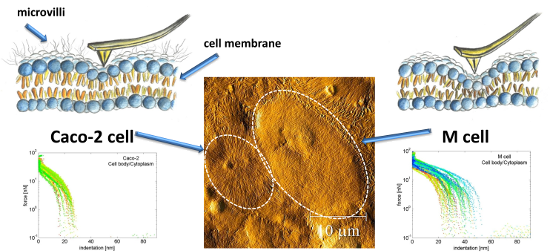
- determined. For all calculations a cantilever spring constant of 0.1 N/m was assumed (specified by the manufactures). A matlab program based on Butt et al. [65] was used for data handling and plotting. SEM analyses of the Caco-2 monolayer (A, B) and the Caco-2/M cell co-culture (C, D). The most prominent


PVP-coated, negatively charged silver nanoparticles: A multi-center study of their physicochemical characteristics, cell culture and in vivo experiments
Beilstein J. Nanotechnol. 2014, 5, 1944–1965, doi:10.3762/bjnano.5.205





Mimicking exposures to acute and lifetime concentrations of inhaled silver nanoparticles by two different in vitro approaches
Beilstein J. Nanotechnol. 2014, 5, 1357–1370, doi:10.3762/bjnano.5.149
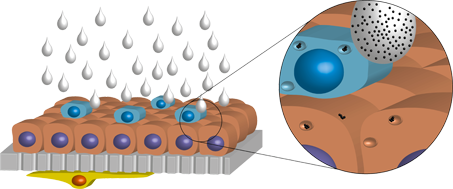
- interaction with Ag NPs can occur through the lung, skin, gastrointestinal tract, and bloodstream. However, the inhalation of Ag NP aerosols is a primary concern. To study the possible effects of inhaled Ag NPs, an in vitro triple cell co-culture model of the human alveolar/airway barrier (A549 epithelial
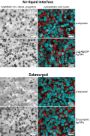
- layer of the triple cell co-culture model, which is a similar pattern as we have observed for Ag NPs exposed to cells at the ALI [44]. To reduce misinterpretation due to staining artefacts [48], samples were treated with uranyl acetate only, without lead citrate. Cytotoxicity As described in [44], we
- ]. Furthermore, the triple cell co-culture system has been evaluated in terms of its functional relevance in vivo and also allows studies at the ALI [40][61]. Only a few studies investigated the effects of Ag NPs at the ALI [44][57][62]. We have used the same cell cultures and similar endpoints as described in



Other Beilstein-Institut Open Science Activities



