


Search results
Search for "chiral surface" in Full Text gives 2 result(s) in Beilstein Journal of Nanotechnology.
Stereodiscrimination of guests in chiral organosilica aerogels studied by ESR spectroscopy
Beilstein J. Nanotechnol. 2025, 16, 2034–2054, doi:10.3762/bjnano.16.140
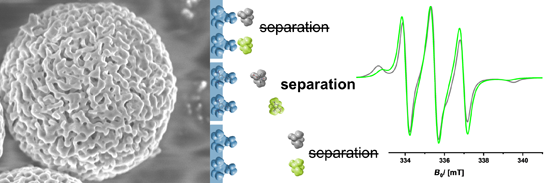
- (Figure 8f). The thermal energy at T = 260 K is approximately 2 kJ·mol−1. The difference in interaction enthalpies of two enantiomers with a chiral surface depends on many factors, but it is exactly in the range of 1–2 kJ·mol−1 [18][67], which we could deduce from ESR spectroscopy. If (+)-3CP is more
- frequently interacting with the chiral surface than (−)-3CP, the fraction of the immobile component is higher and its transport through the material is slower, which leads to separation and a potentially promising material for chiral chromatography. The location of a spin probe is impossible to determine
- detach from the surface, which will change the local environment. This shift contributes to the Azz value. One also sees that there are differences between (+)-3CP and (−)-3CP, which is reasonable, assuming that their interaction with the chiral surface is also different. Therefore, the difference in Azz




Design of surface nanostructures for chirality sensing based on quartz crystal microbalance
Beilstein J. Nanotechnol. 2022, 13, 1201–1219, doi:10.3762/bjnano.13.100
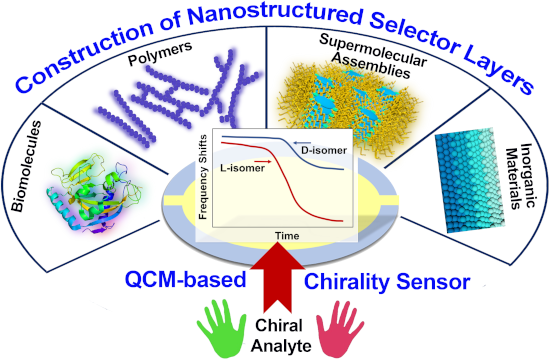
- ; chiral surface; chirality recognition; quartz crystal microbalance (QCM); sensing applications; surface architecture; Introduction Chirality is a prevalent phenomenon in nature. Many common biological macromolecules such as proteins, ribose, and cellulose are inherently chiral. Chiral molecules have two
- sensors is always based on aspects of effective chiral host molecules, proper chiral surface functions, and suitable host nanostructures. To achieve high chiral selectivity and sensitivity, it is also essential to understand the basis of the interactions for the formation of transient diastereomeric


Other Beilstein-Institut Open Science Activities



