


Search results
Search for "dark states" in Full Text gives 3 result(s) in Beilstein Journal of Nanotechnology.
Locally induced Stark shifts of collective excitonic modes in polyradical aggregates
Beilstein J. Nanotechnol. 2026, 17, 1185–1193, doi:10.3762/bjnano.17.81
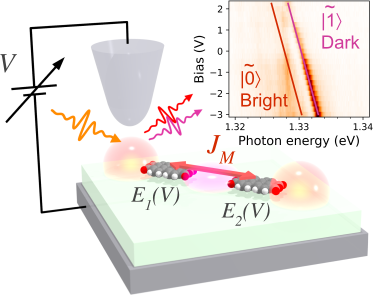
- , nanocavity coupling, and electrostatic charge inhomogeneities in the clusters. This sensitivity to the external parameters demonstrates an effective means of control over radical excitonic aggregates. Keywords: chromophore; dark states; exciton; Stark shift; TEPL; tip-enhanced photoluminescence
- radiative rates; also, the dark states with their characteristically long lifetimes hold the promise to support efficient energy transfer among chromophores, which can be of high importance for the development of future optoelectronic devices and may help to better understand fundamental energy harvesting
- -field spectroscopic techniques employ an extremely localized electromagnetic field confined in the junction of a scanning probe microscope to make the otherwise forbidden transitions optically accessible [25][26][27][28][29]. With this approach, demonstrations of the sensitivity to the dark states were


Horizontal versus vertical charge and energy transfer in hybrid assemblies of semiconductor nanoparticles
Beilstein J. Nanotechnol. 2012, 3, 629–636, doi:10.3762/bjnano.3.72

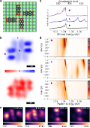
- transferred from the donors, follows the same linker dependency as observed for the acceptor layer alone. It is well documented that the PL-lifetime of semiconductor NPs increases with decreasing temperature owing to less efficient electron–phonon coupling and to the emission from "dark states" [27][32][33


Room temperature excitation spectroscopy of single quantum dots
Beilstein J. Nanotechnol. 2011, 2, 516–524, doi:10.3762/bjnano.2.56

- from long lasting dark states longer than the integration time per excitation wavelength, could be avoided by repeated, possibly faster, scanning of the excitation wavelength, which requires further technical development for implementation in future studies. We argue that the observed transitions
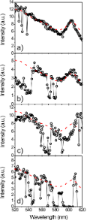
- exhibiting almost no dips and gaps due to emission intermittencies (Figure 2a), to spectra where numerous transitions between emitting and dark states can be observed (Figure 2b–d). The excitation spectrum shown in Figure 2a is very intense and shows only minor signs of blinking, and is based on the
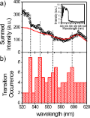
- understood from the details of how each single emitter excitation spectrum was recorded, that is, by considering that the excitation wavelength was always scanned from short to long wavelength. As the transition to dark states is driven by the excitation light, the probability to find a single quantum dot in

Other Beilstein-Institut Open Science Activities



