

Search results
Search for "dual band" in Full Text gives 2 result(s) in Beilstein Journal of Nanotechnology.
Electromagnetic study of a split-ring resonator metamaterial with cold-electron bolometers
Beilstein J. Nanotechnol. 2025, 16, 2199–2206, doi:10.3762/bjnano.16.152
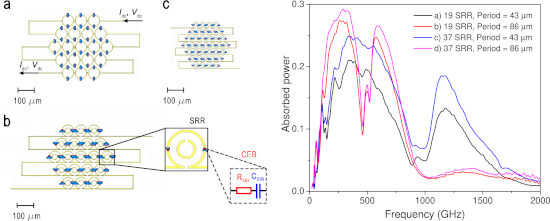
- response of the entire path (oscillator, waveguide-feeder, lens and the CEB metamaterial itself), with “fingers” due to the used log-periodic antenna of the Josephson oscillator, which was not fully matched to the antenna. Despite this convolution, the experimental data clearly confirm the calculated dual
- -band behavior of the metamaterial, showing two broad peaks centered at approximately 350 and 1100 GHz. This agreement validates our simulation model. The AFC of the single-ring and SRR metamaterials with various scaling factors are presented in Figure 3. The optimal number and size of the resonators


Double-layer symmetric gratings with bound states in the continuum for dual-band high-Q optical sensing
Beilstein J. Nanotechnol. 2022, 13, 1408–1417, doi:10.3762/bjnano.13.116
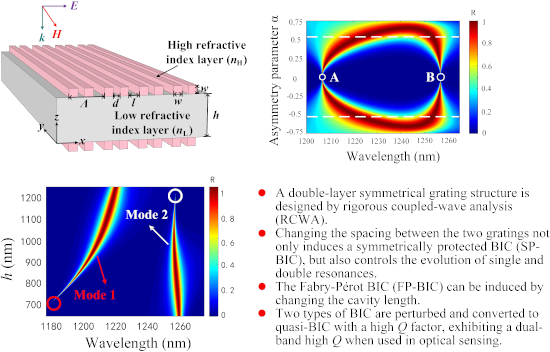
- , Hebei 056038, P. R. China 10.3762/bjnano.13.116 Abstract Herein, we theoretically demonstrate that a double-layer symmetric gratings (DLSG) resonator consisting of a low-refractive-index layer sandwiched between two high-contrast gratings (HCG) layers, can host dual-band high-quality (Q) factor
- controlling the cavity length of the structure. Further, the two types of BIC can be converted into quasi-BIC (QBIC) by either changing the spacing between adjacent gratings or changing the distance between the upper and lower gratings. The simulation results show that the dual-band high-performance sensor is
- achieved with the highest sensitivity of 453 nm/RIU and a maximum figure of merit (FOM) of 9808. Such dual-band high-Q resonator is expected to have promising applications in multi-wavelength sensing and nonlinear optics. Keywords: bound states in the continuum; dual band; high quality factor; localized


Other Beilstein-Institut Open Science Activities