


Search results
Search for "hydrogen abstraction" in Full Text gives 2 result(s) in Beilstein Journal of Nanotechnology.
Gold nanoparticle-decorated reduced graphene oxide as a highly effective catalyst for the selective α,β-dehydrogenation of N-alkyl-4-piperidones
Beilstein J. Nanotechnol. 2026, 17, 218–238, doi:10.3762/bjnano.17.15
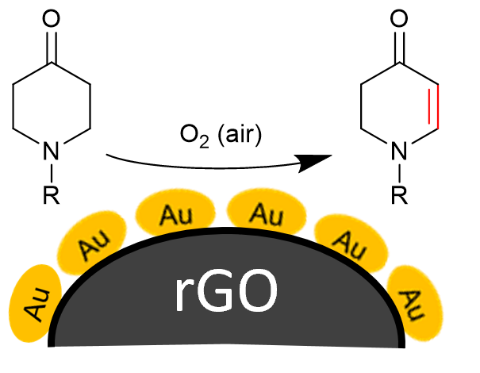
- - compared to N-methyl-4-piperidone. This behavior is consistent with the increased steric bulk, which make the α-hydrogen abstraction step more difficult. The observed catalytic trends further confirm the robustness and adaptability of the Au/rGO catalysts for ODH of structurally related β-N-substituted
- intermediates required for α,β-hydrogen abstraction, thereby decreasing the overall catalytic efficiency. Minor by-products that have been observed for oxidative dehydrogenation/oxidation of N-methyl piperidone-type substrates include N-oxides (oxidation at the tertiary N), oxidative N-demethylation products


Formation of stable Si–O–C submonolayers on hydrogen-terminated silicon(111) under low-temperature conditions
Beilstein J. Nanotechnol. 2015, 6, 19–26, doi:10.3762/bjnano.6.3

- solution, surface coupling is biased towards the formation of Si–O–C linkages instead of Si–C linkages, thus indirectly supporting the kinetic model of hydrogen abstraction from the Si–H surface (Khung, Y. L. et al. Chem. – Eur. J. 2014, 20, 15151–15158). To further examine the probability of this kinetic
- essential towards directing the nature of surface linkage. Keywords: hydrogen abstraction; thermal hydrosilylation; UV-initated hydrosilylation; X-ray photoelectron spectroscopy; Introduction Forming covalently-attached organic submonolayers on silicon remains one of the challenges in surface science. In
- the hydrogenated silicon surface. One question to address would be the actual reaction preference of the Si–H surface when exposed to both an alkyne and an alcohol at lower temperatures, i.e., whether the surface would still undergo hydrogen abstraction in the presence of a competing reactant. One of


Other Beilstein-Institut Open Science Activities



