


Search results
Search for "log-periodic antenna" in Full Text gives 2 result(s) in Beilstein Journal of Nanotechnology.
Electromagnetic study of a split-ring resonator metamaterial with cold-electron bolometers
Beilstein J. Nanotechnol. 2025, 16, 2199–2206, doi:10.3762/bjnano.16.152
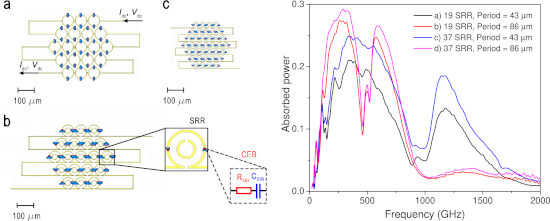
- response of the entire path (oscillator, waveguide-feeder, lens and the CEB metamaterial itself), with “fingers” due to the used log-periodic antenna of the Josephson oscillator, which was not fully matched to the antenna. Despite this convolution, the experimental data clearly confirm the calculated dual
- the dynamic range and complicating the optimization of noise-equivalent power (NEP). There have been proposals to integrate multiple sensing elements directly into the structure of a log-periodic antenna [28][29][30]. While promising, such designs face significant challenges in implementation. The
- challenging to realize within the constrained geometry of a single-feed log-periodic antenna. Conclusion In this work, we have presented a comprehensive electromagnetic study on the design and optimization of a metamaterial receiver based on split-ring resonators integrated with cold-electron bolometers. The


A broadband detector based on series YBCO grain boundary Josephson junctions
Beilstein J. Nanotechnol. 2022, 13, 325–333, doi:10.3762/bjnano.13.27
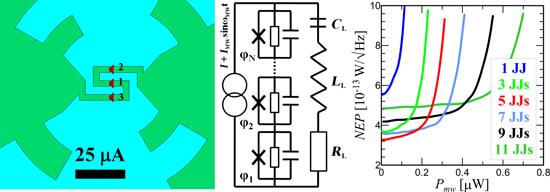
- Technology, SE-41296 Gothenburg, Sweden 10.3762/bjnano.13.27 Abstract Modeling of a broadband receiving system based on a meander series of Josephson YBaCuO grain boundary junctions integrated into a log-periodic antenna was carried out. The electromagnetic properties of the system, namely amplitude
- ; electromagnetic modeling; log-periodic antenna; RCSJ model; series Josephson junctions; YBaCuO Josephson junction; Introduction High-temperature superconducting (HTSC) Josephson junctions (JJs) have great potential as promising materials for creating high-frequency devices, such as microwave generators [1][2
- the electromagnetic analysis and numerical simulation of the broadband detector based on a series of HTSC bicrystal Josephson junctions to maximize response, power dynamic range, and noise-equivalent power. Electromagnetic Simulation Figure 1a–c shows options for the geometry of a log-periodic antenna



Other Beilstein-Institut Open Science Activities



