


Search results
Search for "metal-ion sensing" in Full Text gives 7 result(s) in Beilstein Journal of Nanotechnology.
Cross-scale design of chemosensor arrays: from molecular self-assembly in water to paper-based devices for metal ion detection
Beilstein J. Nanotechnol. 2026, 17, 828–838, doi:10.3762/bjnano.17.59
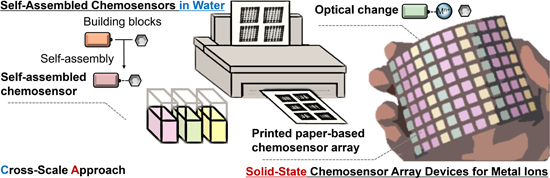
- chemosensors for metal ion sensing The general strategy of metal-ion recognition primarily relies on multivalent coordination between target metal ions and donor atoms (e.g., nitrogen, oxygen, and sulfur) of binding sites [44]. Upon metal ion capture, the chemical information is visualized using optical units
- real-sample analysis with simple operation and minimal sample pretreatment. Indeed, the sensor performance from the viewpoint of usability and applicability is beyond that of solution-based chemosensors in metal ion sensing. Conclusion In this perspective, we described the concept of cross-scale design


Environmental applications of silver nanoparticles: state-of-the-art review and emerging trends
Beilstein J. Nanotechnol. 2026, 17, 697–736, doi:10.3762/bjnano.17.49
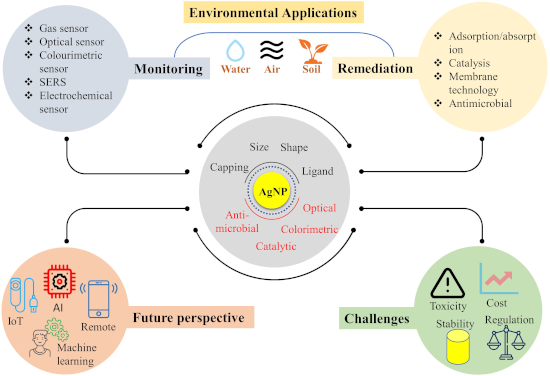
- min−1, respectively. Additionally, NPs demonstrated metal ion sensing and antibacterial activity against various strains [65]. The above studies concluded that the capping agent played a prominent role in nanoparticle-mediated applications by providing an interaction site for targeted molecules and by


Facile synthesis of size-tunable L-carnosine-capped silver nanoparticles and their role in metal ion sensing and catalytic degradation of p-nitrophenol
Beilstein J. Nanotechnol. 2024, 15, 1576–1592, doi:10.3762/bjnano.15.124
- the potential of gelatine-embedded silver nanoparticles in the degradation of P-NP, but it was not used for heavy metal ion sensing [17]. Similarly, citrate-stabilized silver nanospheres were used for the colorimetric detection of Ni2+ with a threshold limit of 0.75 mM without any catalytic activity
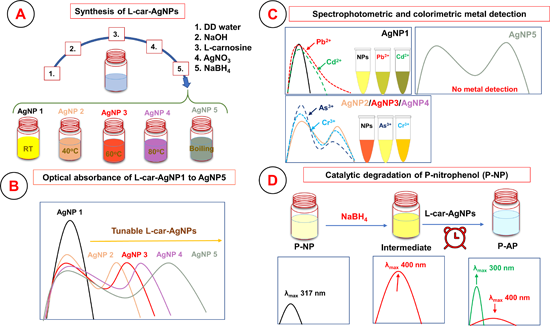
- +, Pb2+, and Cd2+ was achieved via ʟ-carnosine–metal interaction [20][21]. With this study, an attempt has been made to address the issues associated with traditional environmental monitoring and remediation systems. This article aims to develop a metal ion sensing and catalyst platform with in situ
- line and the red dashed boxes show the spectrophotometric and colorimetric change upon adding Cd2+ (no. 4) and Pb2+ (no. 10). Heavy metal ion sensing using ʟ-car-AgNP2 and ʟ-car-AgNP5. (a) UV–vis spectrophotometric determination of As3+ and Cr3+ (marked by arrows). (b) Optical absorbance of ʟ-car-AgNP2




Recent advances in green carbon dots (2015–2022): synthesis, metal ion sensing, and biological applications
Beilstein J. Nanotechnol. 2022, 13, 1068–1107, doi:10.3762/bjnano.13.93
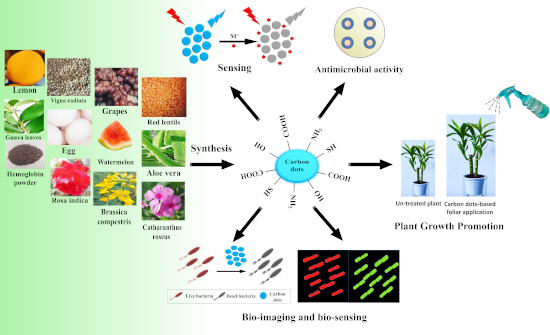
- synthesis of CDs, the effects of surface states on optical properties, the characterization of CDs, metal ion sensing, and biological and agricultural applications of CDs, that is, microbial bioimaging, detection, and viability studies, pathogen control, and plant growth promotion (Figure 1). Review Green




Luminescent gold nanoclusters for bioimaging applications
Beilstein J. Nanotechnol. 2020, 11, 533–546, doi:10.3762/bjnano.11.42
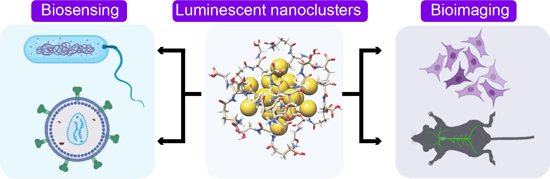
- rapid detection and the development of new immunoassays. Imaging and labeling mammalian cell lines Beyond their antibacterial effect and pathogen sensing, the surface functionalities of NCs allow for selective labeling for the detection of biomolecules, intracellular metal ion sensing, live-cell imaging


Selective detection of Mg2+ ions via enhanced fluorescence emission using Au–DNA nanocomposites
Beilstein J. Nanotechnol. 2017, 8, 762–771, doi:10.3762/bjnano.8.79

- samples. These, however, are time consuming and expensive. However, very little information is available regarding the optical properties and fluorescence intensity of Au–DNA nanocomposites (NCs) utilized for metal-ion sensing. The present study demonstrates (Scheme 1) how the preparation and




Facile synthesis of water-soluble carbon nano-onions under alkaline conditions
Beilstein J. Nanotechnol. 2016, 7, 758–766, doi:10.3762/bjnano.7.67
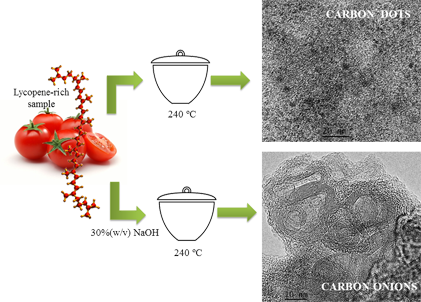
- versatile materials for chemical sensing of metal ions. The high content of lycopene in tomatoes may explain the formation of C-onions in alkaline media and a possible formation mechanism for such structures was outlined. Keywords: carbon dots; carbon onions; metal-ion sensing; photoluminescence; thermal


Other Beilstein-Institut Open Science Activities



