


Search results
Search for "phase-locking" in Full Text gives 4 result(s) in Beilstein Journal of Nanotechnology.
Terahertz-range on-chip local oscillator based on Josephson junction arrays for superconducting quantum-limited receivers
Beilstein J. Nanotechnol. 2025, 16, 2296–2305, doi:10.3762/bjnano.16.158
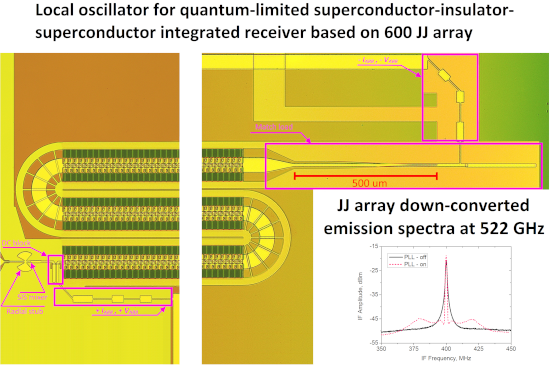
- improvement of the oscillator performance. Keywords: Josephson junction arrays; phase-locking; superconducting local oscillator; superconductor integrated receiver; terahertz-range oscillators; Introduction Superconducting heterodyne receivers based on superconductor–insulator–superconductor (SIS) tunnel
- the harmonic mixer (HM) for frequency and phase locking. For the first time the possibility of phase locking of the JJ array to the local source unit was demonstrated with a spectral ratio higher than 90% at the best points [39]. We have also studied and compared the free-running linewidth of the
- within the black dashed rectangle in Figure 1). The purpose of the samples under study is to develop the wideband matching circuits between the LO and HM and implement the phase locking loop (PLL) for a new type of LO [42]. The image of one of the experimental samples captured by an optical microscope is


Frontiers of nanoelectronics: intrinsic Josephson effect and prospects of superconducting spintronics
Beilstein J. Nanotechnol. 2023, 14, 79–82, doi:10.3762/bjnano.14.9
- sum of the power values from two individually biased arrays. The detected phenomenon is attributed to the phase locking of Josephson junctions in different arrays via a common electromagnetic field [20]. Modeling of a multi-frequency receiving system based on an array of dipole antennas with cold
Observation of collective excitation of surface plasmon resonances in large Josephson junction arrays
Beilstein J. Nanotechnol. 2022, 13, 1578–1588, doi:10.3762/bjnano.13.132

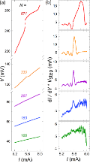
- , the standing wave imprints its order on the array, facilitating mutual phase-locking of junctions. This provides an indirect coupling mechanism, allowing for the synchronization of junctions, which do not directly interact with each other. Our results demonstrate that electrodes can effectively work
- as a common external resonator, facilitating long-range phase-locking of large junction arrays with sizes larger than the emitted wavelength. Keywords: cavity modes; Josephson junctions; synchronization mechanism; THz radiation; Introduction Terahertz sources of electromagnetic waves (EMWs) in the
- between JJs and the long-range phase-locking of the arrays. Our main result is the observation of a gradual development of collective resonances upon sequential switching of JJs into the oscillating resistive state. We show that a threshold number of JJs, Nth ≈ 100, is required for excitation of the




Coherent amplification of radiation from two phase-locked Josephson junction arrays
Beilstein J. Nanotechnol. 2022, 13, 1445–1457, doi:10.3762/bjnano.13.119
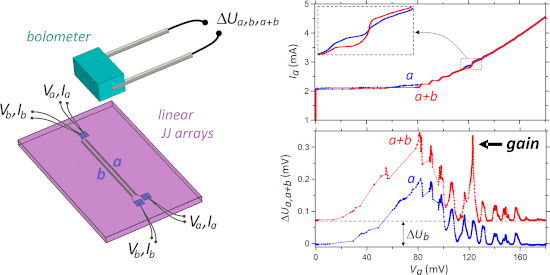
- .13.119 Abstract We analyze experimentally and theoretically mutual phase locking and electromagnetic interaction between two linear arrays with a large number of Josephson junctions. Arrays with different separation, either on the same chip or on two separate substrates are studied. We observe a large
- coherent gain, up to a factor of three, of emitted power from two simultaneously biased arrays, compared to the sum of powers from two individually biased arrays. The phenomenon is attributed to the phase locking of junctions in different arrays via a common electromagnetic field. Remarkably, the gain can
- exceed the factor of two expected for a simple constructive interference of two oscillators. The larger gain is explained by an additional consequence of mutual interaction between two large arrays. Mutual phase locking of large arrays does not only result in constructive interference outside the arrays


Other Beilstein-Institut Open Science Activities



