Abstract
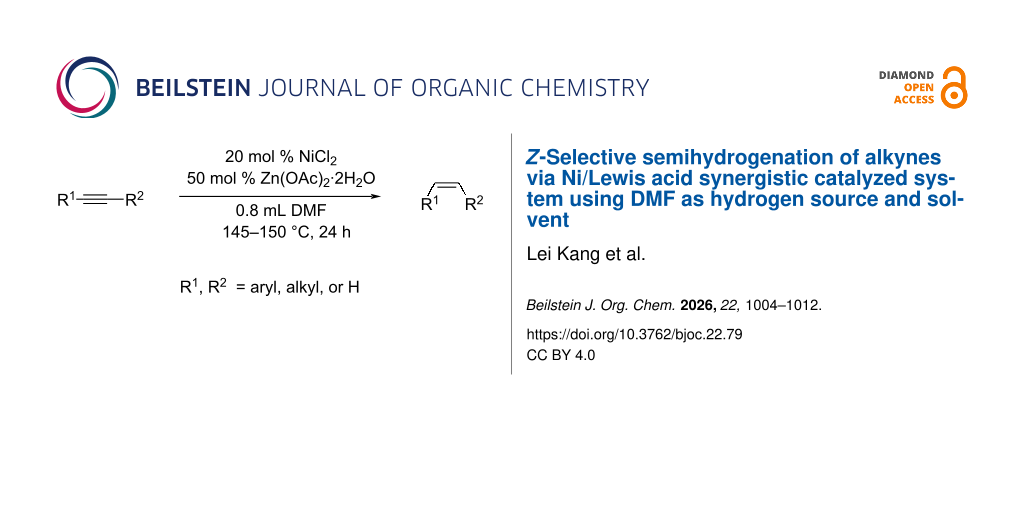
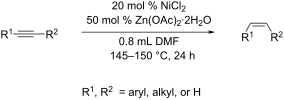
A Ni/Lewis acid dual-catalytic system has been developed for the Z-selective semihydrogenation of alkynes. Utilizing DMF as both the hydrogen donor and reaction medium, this method affords Z-alkenes in high yield with excellent stereoselectivity under mild conditions. The protocol employs cost-effective and readily available catalysts, and demonstrates broad applicability across a wide range of substrates.
Graphical Abstract
Introduction
Z-Olefins represent important structural units in natural products, pharmaceuticals, and functional materials, making the stereoselective semihydrogenation of alkynes a fundamental transformation in synthesis [1-5]. Among available methods, transition-metal catalysis has played a dominant role. The classical Lindlar catalyst remains the most widely applied heterogeneous system [6], yet it suffers from several limitations – including batch variability, alkene isomerization, and over-reduction to alkanes, which are particularly problematic for terminal and polar substrates [7-10]. Recent review articles have comprehensively summarized advances in this research field. For instance, Gregori et al. outlined the state-of-the-art progress on stereoselective semihydrogenation of alkynes catalyzed by first-row (3d) transition metals, which attract substantial attention owing to their natural abundance and low toxicity [5].
In recent years, homogeneous catalysts based on Ni, Cu, Rh, and Co have shown promise in addressing some of these issues [11-16]. Nickel, in particular, has emerged as an attractive candidate for transfer semihydrogenation [17-22]. Common hydrogen donors employed in transfer hydrogenation include isopropanol, formic acid, methanol, and water; these reagents are generally safer and easier to handle than high-pressure gaseous hydrogen [23]. Still, many of these systems depend on expensive ligands, toxic reductants, or relatively forcing conditions, which can limit their practical utility [24-27]. Single-metal catalytic approaches also frequently exhibit modest stereocontrol. While cobalt-based systems have demonstrated some ability to tune Z/E selectivity, they often rely on ammonia borane as the hydrogen donor, which presents certain atom-economic disadvantages [5,28-33]. Clearly, new strategies are needed to advance this field.
Synergistic catalysis, which combines two distinct catalytic components, has become a valuable approach for overcoming the limitations of single-catalyst systems [34-36]. Lewis acids are well known for their ability to activate polar functional groups and stabilize reactive intermediates, yet their combination with nickel catalysts has been little explored in alkyne semihydrogenation. We envisioned that merging nickel’s competence in alkyne activation and hydrogen transfer with a Lewis acid’s capacity to modulate reaction pathways could enhance both selectivity and efficiency.
Dimethylformamide (DMF), a commonly utilized polar aprotic solvent, has recently attracted interest as a hydrogen donor in catalytic reductions [37-40]. While DMF is classified as a substance of high concern (SVHC) due to its reproductive toxicity and potential health hazards upon improper handling [41], it offers practical advantages over traditional hydrogen sources such as H₂, including high stability, operational simplicity, and ease of handling under ambient conditions – features that align with the practical requirements of synthetic chemistry [24,42]. Its compatibility with both Lewis acids and nickel catalysts further suggests its potential as a combined solvent and hydrogen donor in a synergistic catalytic manifold [43,44]. Related amide derivatives, such as formamide, have also been employed as safe cyanide sources or hydrogen-donor precursors, offering useful precedents for their application in reduction chemistry [45,46].
In this work, we describe a new synergistic catalytic system for the cis-selective semihydrogenation of alkynes, utilizing a Lewis acid together with a nickel catalyst and DMF as the hydrogen source. This method achieves excellent Z-selectivity (up to 98:2 Z/E ratio), operates under mild conditions, and avoids noble metals, toxic reductants, and specialized pressure equipment. The synergy between the Lewis acid and the nickel catalyst, coupled with the dual role of DMF, enables efficient conversion of diverse internal and terminal alkynes to the corresponding Z-olefins. Beyond expanding the toolbox for stereocontrolled alkyne semihydrogenation, this study offers fresh perspectives on the design of Lewis acid–metal synergistic catalytic systems.
Results and Discussion
We began by developing a base metal catalytic system for the semihydrogenation of diphenylacetylene (1a), motivated by the practical limitations associated with previous precious-metal Pd catalysts. Capitalizing on DMF's capacity to act as both solvent and hydrogen source, we investigated a Ni/Lewis acid co-catalytic approach. Employing Co(OAc)2·4H2O as the Lewis acid co-catalyst, we first evaluated the influence of the nickel precursor. As summarized in Table 1, the reaction of 1a was performed in DMF (0.8 mL) at 150 °C for 24 h, using various Ni sources (20 mol %) and Co(OAc)2·4H2O (50 mol %).
Table 1: Evaluation of nickel precursors in the semihydrogenation of 1,2-diphenylacetylene (1a) catalyzed by Ni/Co(OAc)2·4H2O.
![[Graphic 1]](/bjoc/content/inline/1860-5397-22-79-i6.svg?max-width=637&scale=1.0)
|
|||
| Entry |
[Ni]
(20 mol %) |
Lewis acid
(50 mol %) |
Yield [%]a |
| 1 | NiCl2 | Co(AcO)2·4H2O | 68 |
| 2 | NiF2 | Co(AcO)2·4H2O | 23 |
| 3 | Ni(acac)2 | Co(AcO)2·4H2O | 6 |
| 4 | Ni(NO3)2·6H2O | Co(AcO)2·4H2O | 34 |
| 5 | Ni(Cp)2 | Co(AcO)2·4H2O | 30 |
| 6 | (dppe)NiCl2 | Co(AcO)2·4H2O | 20 |
| 7 | (Ph3P)2·NiCl2 | Co(AcO)2·4H2O | 43 |
| 8 | (Ph3P)2·NiBr2 | Co(AcO)2·4H2O | 45 |
| 9 | (dppp)NiCl2 | Co(AcO)2·4H2O | 50 |
| 10 | NiCO3·2Ni(OH)2·4H2O | Co(AcO)2·4H2O | 2 |
| 11 | – | Co(AcO)2·4H2O | trace |
aYields were determined by GC analysis using mesitylene as an internal standard.
When NiCl₂ was used, 2a (cis-stilbene) was obtained in 68% GC yield (Table 1, entry 1). In contrast, NiF2 and Ni(acac)2 proved considerably less effective, yielding only 23% and 6% of 2a, respectively (Table 1, entries 2–3). Moderate conversions were observed with Ni(NO3)2·6H2O, NiCp2, (Ph3P)2NiCl2, (Ph3P)2NiBr2, and (dppp)NiCl2 (34%, 30%, 43%, 45% and 50% yields; Table 1, entries 4, 5, 7, 8, 9). Notably, phosphine-ligated Ni complexes such as (dppe)NiCl2 showed poor activity (20% yield, Table 1, entry 6), while NiCO3·2Ni(OH)2·4H2O afforded 2a in 2% yield (entry 10). Unsurprisingly, control experiments confirmed that the reaction does not proceed in the absence of a nickel source (Table 1, entry 11). These findings underscore a strong dependence of catalytic activity on the nature of the Ni precursor, with NiCl2 emerging as the most effective candidate under the conditions screened.
Having identified NiCl2 as a suitable nickel source (Table 1), we next fixed this component (20 mol %) and proceeded to screen various Lewis acids (50 mol %) for the semihydrogenation of diphenylacetylene (1a). The reactions were conducted in DMF at 150 °C for 24 h, and the results are compiled in Table 2.
Table 2: Screening of Lewis acids for the NiCl2-co-catalyzed semihydrogenation of 1,2-diphenylacetylene (1a).
![[Graphic 2]](/bjoc/content/inline/1860-5397-22-79-i7.svg?max-width=637&scale=1.0)
|
||||
| Entry |
[Ni]
(20 mol %) |
Lewis acid
(50 mol %) |
Temp
(°C) |
Yield
[%]a |
| 1 | NiCl2 | – | 150 | 9 |
| 2 | NiCl2 | Co(AcO)2·4H2O | 150 | 68 |
| 3 | NiCl2 | Fe(NO3)3·9H2O | 150 | trace |
| 4 | NiCl2 | ZnCl2 | 150 | 96 |
| 5 | NiCl2 | CoCl2·6H2O | 150 | 17 |
| 6 | NiCl2 | Co(acac)2 | 150 | 7 |
| 7 | NiCl2 | BF3·Et2O | 150 | trace |
| 8 | NiCl2 | Zn(AcO)2·2H2O | 150 | 98 (95; Z/E = 98:2)b |
| 9 | NiCl2 | SnCl2·2H2O | 150 | 11 |
aYields were determined by GC analysis using mesitylene as an internal standard. Value in parentheses is the isolated yield. bThe Z/E ratio of the product was determined via GC of the reaction mixture.
Unsurprisingly, the Lewis acid proved crucial: in its absence, only a 9% GC yield of 2a was obtained (Table 2, entry 1). Using Co(OAc)2·4H2O, our initial co-catalyst from the previous screening, gave a 68% yield (Table 1, entry 2), consistent with earlier data. Screening other Lewis acids, however, revealed considerable variation in performance. Fe(NO3)3·9H2O and BF3·Et2O, for instance, afforded merely trace product (Table 2, entries 3 and 7). Other candidates, including CoCl2·6H2O, Co(acac)2, and SnCl2·2H2O, showed low activity, yielding 2a in 7–17% (Table 2, entries 5, 6, and 9).
Interestingly, zinc-based Lewis acids stood out. ZnCl2 significantly improved the yield to 96% (Table 2, entry 4). Most notably, Zn(OAc)2·2H2O delivered the best performance, achieving a 98% GC yield (95% isolated yield) of 2a with an excellent Z/E selectivity of >98:2 (Table 2, entry 8). These results clearly demonstrate that zinc salts, particularly Zn(OAc)2·2H2O, form a highly effective synergistic pair with NiCl₂, dramatically enhancing both the efficiency and stereoselectivity of the transformation.
With Zn(OAc)2·2H2O established as the optimal Lewis acid (Table 2), we proceeded to optimize the remaining reaction parameters, keeping the Lewis acid loading fixed at 50 mol %. The outcomes of this study are summarized in Table 3. Consistent with our earlier findings, the nickel catalyst proved indispensable; omitting it resulted in only a trace of product 2a (Table 3, entry 1). Screening various nickel precursors confirmed NiCl2 as the most effective, delivering 2a in 98% GC yield (95% isolated) with excellent Z-selectivity (Table 3, entry 2). Other nickel sources, including Ni(acac)2 and phosphine-ligated complexes such as (dppe)NiCl2, gave notably lower yields (Table 3, entries 3–12). We then examined the catalyst loading. The combination of 20 mol % NiCl2 and 50 mol % Zn(OAc)2·2H2O (Table 3, entry 2) remained optimal. Reducing either the nickel loading (Table 3, entry 13) or the Lewis acid amount (Table 3, entries 14–15) led to a clear decrease in yield. While increasing both loadings slightly improved the yield (Table 3, entries 16–17), the marginal gain did not justify the higher catalyst use.
Table 3: Optimization of reaction conditions for the semihydrogenation of 1,2-diphenylacetylene (1a) catalyzed by NiCl2/Zn(OAc)2·2H2O.
![[Graphic 3]](/bjoc/content/inline/1860-5397-22-79-i8.svg?max-width=637&scale=1.0)
|
||||
| Entry |
[Ni]
(20 mol %) |
Lewis acid
(50 mol %) |
Temp
(°C) |
Yield
[%]a |
| 1 | – | Zn(AcO)2·2H2O | 150 | trace |
| 2 | NiCl2 | Zn(AcO)2·2H2O | 150 | 98 (95) |
| 3 | NiF2 | Zn(AcO)2·2H2O | 150 | 73 |
| 4 | Ni(acac)2 | Zn(AcO)2·2H2O | 150 | 45 |
| 5 | Ni(NO3)2·6H2O | Zn(AcO)2·2H2O | 150 | 4 |
| 6 | Ni(AcO)2·4H2O | Zn(AcO)2·2H2O | 150 | 89 |
| 7 | (dppe)NiCl2 | Zn(AcO)2·2H2O | 150 | 73 |
| 8 | (Ph3P)2·NiCl2 | Zn(AcO)2·2H2O | 150 | 69 |
| 9 | (Ph3P)2·NiBr2 | Zn(AcO)2·2H2O | 150 | 50 |
| 10 | NiCO3·2Ni(OH)2·4H2O | Zn(AcO)2·2H2O | 150 | 79 |
| 11 | (dppp)NiCl2 | Zn(AcO)2·2H2O | 150 | 72 |
| 12 | NiSO4·6H2O | Zn(AcO)2·2H2O | 150 | 78 |
| 13 |
NiCl2
(10 mol %) |
Zn(AcO)2·2H2O
(50 mol %) |
150 | 65 |
| 14 |
NiCl2
(20 mol %) |
Zn(AcO)2·2H2O
(30 mol %) |
150 | 54 |
| 15 |
NiCl2
(20 mol %) |
Zn(AcO)2·2H2O
(40 mol %) |
150 | 85 |
| 16 |
NiCl2
(30 mol %) |
Zn(AcO)2·2H2O
(30 mol %) |
150 | 86 |
| 17 |
NiCl2
(30 mol %) |
Zn(AcO)2·2H2O
(40 mol %) |
150 | 92 |
| 18 | NiCl2 | Zn(AcO)2·2H2O | 130 | 9 |
| 19 | NiCl2 | Zn(AcO)2·2H2O | 140 | 88 |
| 20b | NiCl2 | Zn(AcO)2·2H2O | 150 | 46 |
| 21c | NiCl2 | Zn(AcO)2·2H2O | 150 | 85 |
| 22d | NiCl2 | Zn(AcO)2·2H2O | 150 | 13 |
| 23e | NiCl2 | Zn(AcO)2·2H2O | 150 | 60 |
| 24f | NiCl2 | Zn(AcO)2·2H2O | 150 | trace |
| 25g | NiCl2 | Zn(AcO)2·2H2O | 150 | ND |
aYields were determined by GC analysis using mesitylene as an internal standard. Value in parentheses is the isolated yield. bReaction time was 12 h. cReaction time was 18 h. dFormamide was used as the solvent/H-donor. eN-Methylformamide was used as the solvent/H-donor. fAnhydrous DMF was used as the reaction solvent. gN,N-Dimethylacetamide (DMA) was used as a substitute for DMF as the solvent; not detected (ND).
The reaction temperature was also critical. A significant drop in yield was observed at 130 °C (Table 3, entry 18), and although 140 °C provided an 88% yield (entry 19), optimal conversion required 150 °C (entry 2). The reaction time was optimized to 24 hours; shorter (12 h, Table 3, entry 20) or moderately shorter (18 h, entry 21) durations resulted in incomplete conversion.
Finally, the role of DMF was confirmed. Replacing DMF with formamide afforded markedly reduced yields (Table 3, entry 22), primarily because severe competitive alkyne hydrocyanation consumes substrates, which was comprehensively explored in our previous work [47]. Similarly, poor yields were obtained when N-methylformamide was used as the alternative solvent (Table 3, entry 23). Notably, only trace target product was detected when rigorously dried anhydrous DMF (Table 3, entry 24) was applied, and no desired product could be isolated after switching the solvent to DMA (entry 25). These results further confirm the unique advantages of DMF acting as both solvent and hydrogen source.
After the above full-parameter condition optimization, the optimized conditions were established as: 20 mol % NiCl2, 50 mol % Zn(OAc)2·2H2O, in DMF at 150 °C for 24 h (Table 3, entry 2). This protocol afforded product 2a in 98% GC yield (95% isolated) with >98:2 Z/E selectivity. Prolonging the reaction duration to 48 h did not cause obvious accumulation of the E-isomer product.
Under the optimized conditions (20 mol % NiCl2, 50 mol % Zn(OAc)2·2H2O, DMF, 150 °C, 24 h), we evaluated the generality of this Z-selective semihydrogenation with various internal alkynes (Scheme 1). The system proved broadly effective for both symmetrical and unsymmetrical diarylacetylenes 1a–p. Substrates bearing electron-donating groups (methyl 2b, 2c, 2e; methoxy 2d), electron-withdrawing groups (trifluoromethyl 2f; halogens 2g–o), and even an amide moiety (2p) were smoothly converted to the corresponding (Z)-stilbene derivatives in good to excellent yields (70–95%), with uniformly high stereoselectivity (Z/E = 97:3 to >99:1).
![[1860-5397-22-79-i1]](/bjoc/content/inline/1860-5397-22-79-i1.svg?scale=2.0&max-width=1024&background=FFFFFF)
Scheme 1: NiCl2/Zn(AcO)2·2H2O-co-catalyzed Z-selective semihydrogenation of internal alkynes to Z-internal alkenes.
Scheme 1: NiCl2/Zn(AcO)2·2H2O-co-catalyzed Z-selective semihydrogenation of internal alkynes to Z-internal al...
The reaction demonstrated excellent functional group tolerance. Ethers, halides (C–Cl, C–Br, C–F), and amides remained intact under the reaction conditions. Notably, substrates with strong electron-withdrawing substituents (e.g., –CF3 in 2f) or multiple halogen atoms (2i, 2o) were also well tolerated, affording the products in good yields and highlighting the robust applicability of this catalytic system.
Having optimized the conditions for internal alkynes such as diphenylacetylene, we next sought to apply this Ni/Zn dual-catalytic system to the semihydrogenation of terminal alkynes. Using phenylacetylene (3a) as the model substrate, we focused on screening the reaction temperature while maintaining a fixed reaction time of 24 h. The results are summarized in Table 4.
Table 4: Screening of reaction temperatures for the semihydrogenation of terminal alkynes.
![[Graphic 4]](/bjoc/content/inline/1860-5397-22-79-i9.svg?max-width=637&scale=1.0)
|
||
| Entry | Temp (°C) | Yield [%]a |
| 1 | 130 | 30 |
| 2 | 135 | 58 |
| 3 | 140 | 70 (65) |
| 4 | 145 | 67 |
| 5 | 150 | 51 |
aYields were determined by GC using mesitylene as an internal standard. The value in parentheses is the isolated yield.
At 130 °C, the GC yield of styrene (4a) was only 30% (Table 4, entry 1). Raising the temperature to 135 °C improved the yield to 58% (Table 4, entry 2) and the optimal performance was observed at 140 °C, providing 4a in 70% GC yield (64% isolated yield, entry 3). Further increases to 145 °C or 150 °C led to diminished yields of 67% and 51%, respectively (Table 4, entries 4–5). These results suggest that the reduction of terminal alkynes is more temperature-sensitive than that of internal alkynes, with an optimum at 140 °C compared to 150 °C for diphenylacetylene.
With suitable conditions for the terminal alkyne 3a in hand, we then examined the scope of this Ni/Zn system for various substituted terminal aryl alkynes (Scheme 2). Employing the standard protocol (20 mol % NiCl2, 50 mol % Zn(OAc)2·2H2O, DMF, 150 °C, 24 h), substrates bearing methyl (4b), methoxy (4c), and halogen (F for 4d, Cl for 4e, Br for 4f) substituents were smoothly converted to the corresponding styrene derivatives in 64–68% yields. Both electron-donating groups (methyl, methoxy) and halogen functional groups (F, Cl, Br) remained intact under the reaction conditions without side reactions, fully demonstrating the good functional group tolerance and substrate generality of this catalytic system. We speculate that the relatively moderate isolated yields mainly originate from the thermal polymerization of the generated alkene products under the relatively high reaction temperature of 150 °C, which partially consumes the target olefin products and reduces the final isolated yields.
![[1860-5397-22-79-i2]](/bjoc/content/inline/1860-5397-22-79-i2.svg?scale=2.0&max-width=1024&background=FFFFFF)
Scheme 2: NiCl2/Zn(AcO)2·2H2O-co-catalyzed semihydrogenation of terminal alkynes to terminal alkenes.
Scheme 2: NiCl2/Zn(AcO)2·2H2O-co-catalyzed semihydrogenation of terminal alkynes to terminal alkenes.
In a preliminary experiment, we tested 1-phenyl-1-propyne (5a) and 5-decyne (7a) as substrates under the established conditions and both substrates were fully consumed. (Scheme 3) Compound 5a was quantitatively converted to (Z)-1-phenyl-1-propene (6a), as confirmed by GC–MS, while 7a delivered (Z)-5-decene (8a) within 24 h (based on the crude ¹H NMR spectrum; see Supporting Information File 1, Figure S3). No E-isomer was detected after 64 h, thus ruling out a catalyst-mediated Z/E isomerization.
![[1860-5397-22-79-i3]](/bjoc/content/inline/1860-5397-22-79-i3.svg?scale=2.0&max-width=1024&background=FFFFFF)
Scheme 3: NiCl2/Zn(AcO)2·2H2O-co-catalyzed semihydrogenation of alkylarylacetylene and dialkylacetylene to (Z)-internal alkenes. See a) Figure S2 and b) Figure S3 in Supporting Information File 1.
Scheme 3: NiCl2/Zn(AcO)2·2H2O-co-catalyzed semihydrogenation of alkylarylacetylene and dialkylacetylene to (Z...
To further verify that formic acid serves as the hydrogen donor while the polar amide solvent assists the catalytic cycle, diphenylacetylene was subjected to the standard reaction conditions using DMA together with 2.5 equivalents of HCOOH instead of DMF (Scheme 4). Gratifyingly, the desired (Z)-stilbene was obtained in 87% isolated yield, confirming that exogenous formic acid can be used as the hydrogen source for the alkyne semihydrogenation in our Ni/Zn synergistic catalytic system, and DMA can effectively replace DMF as the reaction medium to facilitate this transformation.
![[1860-5397-22-79-i4]](/bjoc/content/inline/1860-5397-22-79-i4.svg?scale=2.0&max-width=1024&background=FFFFFF)
Scheme 4: Control experiment using DMA as solvent together with exogenous formic acid instead of DMF.
Scheme 4: Control experiment using DMA as solvent together with exogenous formic acid instead of DMF.
Based on our experimental observations, well-established nickel chemistry [40,48], and relevant findings from palladium-catalyzed systems [49], we propose a plausible catalytic cycle for the NiCl2-catalyzed semihydrogenation of internal alkynes, as outlined in Scheme 5.
![[1860-5397-22-79-i5]](/bjoc/content/inline/1860-5397-22-79-i5.svg?scale=2.0&max-width=1024&background=FFFFFF)
Scheme 5: Proposed catalytic cycle for the Ni/Lewis acid-catalyzed semihydrogenation of alkynes with DMF.
Scheme 5: Proposed catalytic cycle for the Ni/Lewis acid-catalyzed semihydrogenation of alkynes with DMF.
The cycle likely begins with the reduction of the Ni(II) precursor to an active Ni(0) species A – a common initiation step in nickel-catalyzed transformations, and the in-situ-generated formic acid functions as the reducing agent for this Ni(II)-to-Ni(0) conversion. Simultaneously, the Lewis acid promotes the hydrolysis of DMF with trace water existing in the solvent system to gradually liberate formic acid (HCOOH) and HNMe2. This in situ formation of HCOOH appears critical; analogous systems relying on DMF/water to generate HCOOH for the reduction of metal catalysts have been documented for both nickel and palladium catalysis in prior literature [11,40,49]. Maintaining an appropriate concentration of HCOOH via its gradual release from DMF hydrolysis thus seems essential for efficient semihydrogenation, a requirement that parallels findings in related transfer hydrogenation systems.
HCOOH then reacts with the Ni species to form a formate nickel hydride intermediate B (HCOONi(II)H), a key species documented in nickel-catalyzed hydrogen-transfer reactions. Subsequent selective insertion of the internal alkyne into the Ni–H bond of B affords the vinyl-nickel intermediate C. Following decarboxylation, the resulting dihydrido vinyl-nickel species D undergoes reductive elimination to release the (Z)-alkene product and regenerates the Ni(0) catalyst A, thereby closing the catalytic cycle.
Conclusion
In summary, we have developed a highly Z-selective semihydrogenation of alkynes using a synergistic Ni/Lewis acid dual-catalytic system. The protocol employs DMF as a combined solvent and hydrogen donor, operating under mild conditions without external reductants or pressurized equipment. This method delivers Z-alkenes in high yields (up to 95%) with excellent stereoselectivity (up to >98:2 Z/E ratio) and demonstrates broad functional-group compatibility across a range of internal and terminal arylalkynes. Key practical advantages include the use of inexpensive, readily available nickel and zinc salts, as well as the operational simplicity afforded by DMF’s dual role. Overall, this work provides a practical and cost-effective alternative to existing semihydrogenation methods and highlights the potential of base metal synergistic catalysis in stereocontrolled synthetic transformations.
Experimental
All experiments were performed under air. An oven-dried reaction vessel was charged with diphenylacetylene (0.2 mmol, 35.6 mg), Zn(OAc)2·2H2O (50 mol %, 22 mg), and NiCl2 (20 mol %, 3.3 mg). DMF (0.8 mL) was then added, the vessel was sealed, and the mixture was stirred and heated at 150 °C (oil bath temperature) for 24 h. The reaction was monitored by GC analysis; upon complete consumption of the starting material, heating was discontinued. After cooling to room temperature, the volatiles were removed under reduced pressure. The resulting crude residue was purified by flash column chromatography on silica gel (eluent: petroleum ether) to afford pure (Z)-stilbene (2a) as a colorless solid in 95% isolated yield (34.4 mg). The Z/E ratio (98:2) was determined by GC analysis of the crude mixture.
Supporting Information
| Supporting Information File 1: Experimental procedure, compound characterization data, and copies of spectra. | ||
| Format: PDF | Size: 2.6 MB | Download |
Acknowledgements
The authors sincerely appreciate Professor Weiyu Li at Guangxi University for his kind help on performing revision experiments addressing the referees’ suggestions, with his research team finishing all required supplementary experiments.
Funding
The authors are grateful for the Natural Science Basic Research Program of Shaanxi (2024JC-YBQN-0077), Weinan City Key Research and Development Plan Project (2023ZDYFJH-254), Talent Project of Shaanxi Railway Institute (2023KYYC-03), Young and Middle-aged Science and Technology Innovation Talent Program of Shaanxi Railway Institute (KJRC202204),
Data Availability Statement
All data that supports the findings of this study is available in the published article and/or the supporting information of this article.
References
-
Oger, C.; Balas, L.; Durand, T.; Galano, J.-M. Chem. Rev. 2013, 113, 1313–1350. doi:10.1021/cr3001753
Return to citation in text: [1] -
Fürstner, A.; Guth, O.; Rumbo, A.; Seidel, G. J. Am. Chem. Soc. 1999, 121, 11108–11113. doi:10.1021/ja992074k
Return to citation in text: [1] -
Liang, S.; Hammond, G. B.; Xu, B. Chem. Commun. 2016, 52, 6013–6016. doi:10.1039/c6cc01318j
Return to citation in text: [1] -
Kusy, R.; Grela, K. Chem. Rev. 2025, 125, 4397–4527. doi:10.1021/acs.chemrev.4c00001
Return to citation in text: [1] -
Gregori, B. J.; Schmotz, M.-O. W. S.; Jacobi von Wangelin, A. ChemCatChem 2022, 14, e202200886. doi:10.1002/cctc.202200886
Return to citation in text: [1] [2] [3] -
Lindlar, H. Helv. Chim. Acta 1952, 35, 446–450. doi:10.1002/hlca.19520350205
Return to citation in text: [1] -
Ulan, J. G.; Maier, W. F.; Smith, D. A. J. Org. Chem. 1987, 52, 3132–3142. doi:10.1021/jo00390a032
Return to citation in text: [1] -
Kluwer, A. M.; Koblenz, T. S.; Jonischkeit, T.; Woelk, K.; Elsevier, C. J. J. Am. Chem. Soc. 2005, 127, 15470–15480. doi:10.1021/ja052729j
Return to citation in text: [1] -
van Laren, M. W.; Elsevier, C. J. Angew. Chem., Int. Ed. 1999, 38, 3715–3717. doi:10.1002/(sici)1521-3773(19991216)38:24<3715::aid-anie3715>3.3.co;2-f
Return to citation in text: [1] -
Chen, X.-B.; Zhang, J. R.; Sun, D.-Q.; Chen, K.-Q.; Chen, X.-Y. Synthesis 2025, 57, 1928–1935. doi:10.1055/a-2502-8374
Return to citation in text: [1] -
Richmond, E.; Moran, J. J. Org. Chem. 2015, 80, 6922–6929. doi:10.1021/acs.joc.5b01047
Return to citation in text: [1] [2] -
Han, X.; Hu, J.; Chen, C.; Yuan, Y.; Shi, Z. Chem. Commun. 2019, 55, 6922–6925. doi:10.1039/c9cc03213d
Return to citation in text: [1] -
Fu, S.; Chen, N.-Y.; Liu, X.; Shao, Z.; Luo, S.-P.; Liu, Q. J. Am. Chem. Soc. 2016, 138, 8588–8594. doi:10.1021/jacs.6b04271
Return to citation in text: [1] -
Rai, R. K.; Awasthi, M. K.; Singh, V. K.; Barman, S. R.; Behrens, S.; Singh, S. K. Catal. Sci. Technol. 2020, 10, 4968–4980. doi:10.1039/d0cy01153c
Return to citation in text: [1] -
Sheikh Mohammad, T.; Sakharov, P.; Raje, S.; de Ruiter, G. ACS Catal. 2025, 15, 5370–5377. doi:10.1021/acscatal.5c00792
Return to citation in text: [1] -
Xia, S.; Peng, J.; Xie, S.; Xu, T.; Li, L.; Liu, X.; Cao, D.; He, L.-N.; Li, C.-J. Org. Lett. 2025, 27, 5423–5428. doi:10.1021/acs.orglett.5c01372
Return to citation in text: [1] -
Sansores-Paredes, M. L. G.; Lutz, M.; Moret, M.-E. Nat. Chem. 2024, 16, 417–425. doi:10.1038/s41557-023-01380-1
Return to citation in text: [1] -
Redl, S.; Topf, C. Tetrahedron Chem 2024, 12, 100089. doi:10.1016/j.tchem.2024.100089
Return to citation in text: [1] -
Avello, M. G.; Golling, S.; Truong-Phuoc, L.; Vidal, L.; Romero, T.; Papaefthimiou, V.; Gruber, N.; Chetcuti, M. J.; Leroux, F. R.; Donnard, M.; Ritleng, V.; Pham-Huu, C.; Michon, C. Chem. Commun. 2023, 59, 1537–1540. doi:10.1039/d2cc05302k
Return to citation in text: [1] -
Li, K.; Yang, C.; Chen, J.; Pan, C.; Fan, R.; Zhou, Y.; Luo, Y.; Yang, D.; Fan, B. Asian J. Org. Chem. 2021, 10, 2143–2146. doi:10.1002/ajoc.202000716
Return to citation in text: [1] -
Thiel, N. O.; Kaewmee, B.; Tran Ngoc, T.; Teichert, J. F. Chem. – Eur. J. 2020, 26, 1597–1603. doi:10.1002/chem.201903850
Return to citation in text: [1] -
Wu, Y.; Ao, Y.; Li, Z.; Liu, C.; Zhao, J.; Gao, W.; Li, X.; Wang, H.; Liu, Y.; Liu, Y. Nat. Commun. 2023, 14, 1655. doi:10.1038/s41467-023-37022-w
Return to citation in text: [1] -
Wang, D.; Astruc, D. Chem. Rev. 2015, 115, 6621–6686. doi:10.1021/acs.chemrev.5b00203
Return to citation in text: [1] -
Pape, F.; Thiel, N. O.; Teichert, J. F. Chem. – Eur. J. 2015, 21, 15934–15938. doi:10.1002/chem.201501739
Return to citation in text: [1] [2] -
Wakamatsu, T.; Nagao, K.; Ohmiya, H.; Sawamura, M. Organometallics 2016, 35, 1354–1357. doi:10.1021/acs.organomet.6b00126
Return to citation in text: [1] -
Semba, K.; Kameyama, R.; Nakao, Y. Synlett 2015, 26, 318–322. doi:10.1055/s-0034-1379896
Return to citation in text: [1] -
Chugh, V.; Wu, J.; Leutzsch, M.; Randel, H.; Weyhermüller, T.; Auer, A. A.; Farès, C.; Werlé, C. Chem Catal. 2024, 4, 101078. doi:10.1016/j.checat.2024.101078
Return to citation in text: [1] -
Qi, X.; Liu, X.; Qu, L.-B.; Liu, Q.; Lan, Y. J. Catal. 2018, 362, 25–34. doi:10.1016/j.jcat.2018.03.016
Return to citation in text: [1] -
Tokmic, K.; Fout, A. R. J. Am. Chem. Soc. 2016, 138, 13700–13705. doi:10.1021/jacs.6b08128
Return to citation in text: [1] -
Pandey, D. K.; Khusnutdinova, J. R. ChemCatChem 2025, 17, e202500041. doi:10.1002/cctc.202500041
Return to citation in text: [1] -
Ren, X.; Lu, P.; Zheng, C.; Wang, Y.; Lu, Z. Angew. Chem., Int. Ed. 2025, 64, e202511269. doi:10.1002/anie.202511269
Return to citation in text: [1] -
Li, K.; Khan, R.; Zhang, X.; Gao, Y.; Zhou, Y.; Tan, H.; Chen, J.; Fan, B. Chem. Commun. 2019, 55, 5663–5666. doi:10.1039/c9cc01970g
Return to citation in text: [1] -
Feng, W.-J.; Chang, Z.; Lu, X.; Fu, Y. Nat. Commun. 2025, 16, 2390. doi:10.1038/s41467-025-57782-x
Return to citation in text: [1] -
Dong, X.-Q.; Zhao, Q.; Li, P.; Chen, C.; Zhang, X. Org. Chem. Front. 2015, 2, 1425–1431. doi:10.1039/c5qo00226e
Return to citation in text: [1] -
Deng, Y.; Kumar, S.; Wang, H. Chem. Commun. 2014, 50, 4272–4284. doi:10.1039/c4cc00072b
Return to citation in text: [1] -
Wasilke, J.-C.; Obrey, S. J.; Baker, R. T.; Bazan, G. C. Chem. Rev. 2005, 105, 1001–1020. doi:10.1021/cr020018n
Return to citation in text: [1] -
Zhao, C.; Wang, Y.; Pham, Q.; Dai, C.; Chatterjee, A.; Wasa, M. J. Am. Chem. Soc. 2023, 145, 14233–14250. doi:10.1021/jacs.3c00169
Return to citation in text: [1] -
Lang, Q.; Gu, G.; Cheng, Y.; Yin, Q.; Zhang, X. ACS Catal. 2018, 8, 4824–4828. doi:10.1021/acscatal.8b00827
Return to citation in text: [1] -
Wen, J.; Jiang, J.; Zhang, X. Org. Lett. 2016, 18, 4451–4453. doi:10.1021/acs.orglett.6b01812
Return to citation in text: [1] -
Guo, S.; Zhou, J. (Steve). Org. Lett. 2016, 18, 5344–5347. doi:10.1021/acs.orglett.6b02662
Return to citation in text: [1] [2] [3] -
Prat, D.; Pardigon, O.; Flemming, H.-W.; Letestu, S.; Ducandas, V.; Isnard, P.; Guntrum, E.; Senac, T.; Ruisseau, S.; Cruciani, P.; Hosek, P. Org. Process Res. Dev. 2013, 17, 1517–1525. doi:10.1021/op4002565
Return to citation in text: [1] -
Gao, Y.; Yang, R.; Wamg, C.; Wu, Y.; Li, H.; Zhang, B. Sci. Adv. 2022, 8, 10.1126/sciadv.abm9477. doi:10.1126/sciadv.abm9477
Return to citation in text: [1] -
Sarkar, S.; Jana, M.; Tadigoppula, N. RSC Adv. 2013, 3, 18755. doi:10.1039/c3ra42955e
Return to citation in text: [1] -
Cella, R.; Stefani, H. A. Tetrahedron 2006, 62, 5656–5662. doi:10.1016/j.tet.2006.03.090
Return to citation in text: [1] -
Luo, L.; Dai, H.; Yang, M.-Q.; Yang, L. Adv. Synth. Catal. 2024, 366, 3920–3924. doi:10.1002/adsc.202400482
Return to citation in text: [1] -
Zhang, J.; Luo, C.-P.; Yang, L. Adv. Synth. Catal. 2021, 363, 283–288. doi:10.1002/adsc.202000935
Return to citation in text: [1] -
Yang, L.; Liu, Y.-T.; Park, Y.; Park, S.-W.; Chang, S. ACS Catal. 2019, 9, 3360–3365. doi:10.1021/acscatal.8b05111
Return to citation in text: [1] -
Chen, T.; Xiao, J.; Zhou, Y.; Yin, S.; Han, L.-B. J. Organomet. Chem. 2014, 749, 51–54. doi:10.1016/j.jorganchem.2013.09.023
Return to citation in text: [1] -
Li, J.; Hua, R.; Liu, T. J. Org. Chem. 2010, 75, 2966–2970. doi:10.1021/jo100247a
Return to citation in text: [1] [2]
| 11. | Richmond, E.; Moran, J. J. Org. Chem. 2015, 80, 6922–6929. doi:10.1021/acs.joc.5b01047 |
| 40. | Guo, S.; Zhou, J. (Steve). Org. Lett. 2016, 18, 5344–5347. doi:10.1021/acs.orglett.6b02662 |
| 49. | Li, J.; Hua, R.; Liu, T. J. Org. Chem. 2010, 75, 2966–2970. doi:10.1021/jo100247a |
| 40. | Guo, S.; Zhou, J. (Steve). Org. Lett. 2016, 18, 5344–5347. doi:10.1021/acs.orglett.6b02662 |
| 48. | Chen, T.; Xiao, J.; Zhou, Y.; Yin, S.; Han, L.-B. J. Organomet. Chem. 2014, 749, 51–54. doi:10.1016/j.jorganchem.2013.09.023 |
| 49. | Li, J.; Hua, R.; Liu, T. J. Org. Chem. 2010, 75, 2966–2970. doi:10.1021/jo100247a |
| 1. | Oger, C.; Balas, L.; Durand, T.; Galano, J.-M. Chem. Rev. 2013, 113, 1313–1350. doi:10.1021/cr3001753 |
| 2. | Fürstner, A.; Guth, O.; Rumbo, A.; Seidel, G. J. Am. Chem. Soc. 1999, 121, 11108–11113. doi:10.1021/ja992074k |
| 3. | Liang, S.; Hammond, G. B.; Xu, B. Chem. Commun. 2016, 52, 6013–6016. doi:10.1039/c6cc01318j |
| 4. | Kusy, R.; Grela, K. Chem. Rev. 2025, 125, 4397–4527. doi:10.1021/acs.chemrev.4c00001 |
| 5. | Gregori, B. J.; Schmotz, M.-O. W. S.; Jacobi von Wangelin, A. ChemCatChem 2022, 14, e202200886. doi:10.1002/cctc.202200886 |
| 11. | Richmond, E.; Moran, J. J. Org. Chem. 2015, 80, 6922–6929. doi:10.1021/acs.joc.5b01047 |
| 12. | Han, X.; Hu, J.; Chen, C.; Yuan, Y.; Shi, Z. Chem. Commun. 2019, 55, 6922–6925. doi:10.1039/c9cc03213d |
| 13. | Fu, S.; Chen, N.-Y.; Liu, X.; Shao, Z.; Luo, S.-P.; Liu, Q. J. Am. Chem. Soc. 2016, 138, 8588–8594. doi:10.1021/jacs.6b04271 |
| 14. | Rai, R. K.; Awasthi, M. K.; Singh, V. K.; Barman, S. R.; Behrens, S.; Singh, S. K. Catal. Sci. Technol. 2020, 10, 4968–4980. doi:10.1039/d0cy01153c |
| 15. | Sheikh Mohammad, T.; Sakharov, P.; Raje, S.; de Ruiter, G. ACS Catal. 2025, 15, 5370–5377. doi:10.1021/acscatal.5c00792 |
| 16. | Xia, S.; Peng, J.; Xie, S.; Xu, T.; Li, L.; Liu, X.; Cao, D.; He, L.-N.; Li, C.-J. Org. Lett. 2025, 27, 5423–5428. doi:10.1021/acs.orglett.5c01372 |
| 45. | Luo, L.; Dai, H.; Yang, M.-Q.; Yang, L. Adv. Synth. Catal. 2024, 366, 3920–3924. doi:10.1002/adsc.202400482 |
| 46. | Zhang, J.; Luo, C.-P.; Yang, L. Adv. Synth. Catal. 2021, 363, 283–288. doi:10.1002/adsc.202000935 |
| 5. | Gregori, B. J.; Schmotz, M.-O. W. S.; Jacobi von Wangelin, A. ChemCatChem 2022, 14, e202200886. doi:10.1002/cctc.202200886 |
| 47. | Yang, L.; Liu, Y.-T.; Park, Y.; Park, S.-W.; Chang, S. ACS Catal. 2019, 9, 3360–3365. doi:10.1021/acscatal.8b05111 |
| 7. | Ulan, J. G.; Maier, W. F.; Smith, D. A. J. Org. Chem. 1987, 52, 3132–3142. doi:10.1021/jo00390a032 |
| 8. | Kluwer, A. M.; Koblenz, T. S.; Jonischkeit, T.; Woelk, K.; Elsevier, C. J. J. Am. Chem. Soc. 2005, 127, 15470–15480. doi:10.1021/ja052729j |
| 9. | van Laren, M. W.; Elsevier, C. J. Angew. Chem., Int. Ed. 1999, 38, 3715–3717. doi:10.1002/(sici)1521-3773(19991216)38:24<3715::aid-anie3715>3.3.co;2-f |
| 10. | Chen, X.-B.; Zhang, J. R.; Sun, D.-Q.; Chen, K.-Q.; Chen, X.-Y. Synthesis 2025, 57, 1928–1935. doi:10.1055/a-2502-8374 |
| 24. | Pape, F.; Thiel, N. O.; Teichert, J. F. Chem. – Eur. J. 2015, 21, 15934–15938. doi:10.1002/chem.201501739 |
| 42. | Gao, Y.; Yang, R.; Wamg, C.; Wu, Y.; Li, H.; Zhang, B. Sci. Adv. 2022, 8, 10.1126/sciadv.abm9477. doi:10.1126/sciadv.abm9477 |
| 43. | Sarkar, S.; Jana, M.; Tadigoppula, N. RSC Adv. 2013, 3, 18755. doi:10.1039/c3ra42955e |
| 44. | Cella, R.; Stefani, H. A. Tetrahedron 2006, 62, 5656–5662. doi:10.1016/j.tet.2006.03.090 |
| 5. | Gregori, B. J.; Schmotz, M.-O. W. S.; Jacobi von Wangelin, A. ChemCatChem 2022, 14, e202200886. doi:10.1002/cctc.202200886 |
| 28. | Qi, X.; Liu, X.; Qu, L.-B.; Liu, Q.; Lan, Y. J. Catal. 2018, 362, 25–34. doi:10.1016/j.jcat.2018.03.016 |
| 29. | Tokmic, K.; Fout, A. R. J. Am. Chem. Soc. 2016, 138, 13700–13705. doi:10.1021/jacs.6b08128 |
| 30. | Pandey, D. K.; Khusnutdinova, J. R. ChemCatChem 2025, 17, e202500041. doi:10.1002/cctc.202500041 |
| 31. | Ren, X.; Lu, P.; Zheng, C.; Wang, Y.; Lu, Z. Angew. Chem., Int. Ed. 2025, 64, e202511269. doi:10.1002/anie.202511269 |
| 32. | Li, K.; Khan, R.; Zhang, X.; Gao, Y.; Zhou, Y.; Tan, H.; Chen, J.; Fan, B. Chem. Commun. 2019, 55, 5663–5666. doi:10.1039/c9cc01970g |
| 33. | Feng, W.-J.; Chang, Z.; Lu, X.; Fu, Y. Nat. Commun. 2025, 16, 2390. doi:10.1038/s41467-025-57782-x |
| 37. | Zhao, C.; Wang, Y.; Pham, Q.; Dai, C.; Chatterjee, A.; Wasa, M. J. Am. Chem. Soc. 2023, 145, 14233–14250. doi:10.1021/jacs.3c00169 |
| 38. | Lang, Q.; Gu, G.; Cheng, Y.; Yin, Q.; Zhang, X. ACS Catal. 2018, 8, 4824–4828. doi:10.1021/acscatal.8b00827 |
| 39. | Wen, J.; Jiang, J.; Zhang, X. Org. Lett. 2016, 18, 4451–4453. doi:10.1021/acs.orglett.6b01812 |
| 40. | Guo, S.; Zhou, J. (Steve). Org. Lett. 2016, 18, 5344–5347. doi:10.1021/acs.orglett.6b02662 |
| 24. | Pape, F.; Thiel, N. O.; Teichert, J. F. Chem. – Eur. J. 2015, 21, 15934–15938. doi:10.1002/chem.201501739 |
| 25. | Wakamatsu, T.; Nagao, K.; Ohmiya, H.; Sawamura, M. Organometallics 2016, 35, 1354–1357. doi:10.1021/acs.organomet.6b00126 |
| 26. | Semba, K.; Kameyama, R.; Nakao, Y. Synlett 2015, 26, 318–322. doi:10.1055/s-0034-1379896 |
| 27. | Chugh, V.; Wu, J.; Leutzsch, M.; Randel, H.; Weyhermüller, T.; Auer, A. A.; Farès, C.; Werlé, C. Chem Catal. 2024, 4, 101078. doi:10.1016/j.checat.2024.101078 |
| 41. | Prat, D.; Pardigon, O.; Flemming, H.-W.; Letestu, S.; Ducandas, V.; Isnard, P.; Guntrum, E.; Senac, T.; Ruisseau, S.; Cruciani, P.; Hosek, P. Org. Process Res. Dev. 2013, 17, 1517–1525. doi:10.1021/op4002565 |
| 23. | Wang, D.; Astruc, D. Chem. Rev. 2015, 115, 6621–6686. doi:10.1021/acs.chemrev.5b00203 |
| 17. | Sansores-Paredes, M. L. G.; Lutz, M.; Moret, M.-E. Nat. Chem. 2024, 16, 417–425. doi:10.1038/s41557-023-01380-1 |
| 18. | Redl, S.; Topf, C. Tetrahedron Chem 2024, 12, 100089. doi:10.1016/j.tchem.2024.100089 |
| 19. | Avello, M. G.; Golling, S.; Truong-Phuoc, L.; Vidal, L.; Romero, T.; Papaefthimiou, V.; Gruber, N.; Chetcuti, M. J.; Leroux, F. R.; Donnard, M.; Ritleng, V.; Pham-Huu, C.; Michon, C. Chem. Commun. 2023, 59, 1537–1540. doi:10.1039/d2cc05302k |
| 20. | Li, K.; Yang, C.; Chen, J.; Pan, C.; Fan, R.; Zhou, Y.; Luo, Y.; Yang, D.; Fan, B. Asian J. Org. Chem. 2021, 10, 2143–2146. doi:10.1002/ajoc.202000716 |
| 21. | Thiel, N. O.; Kaewmee, B.; Tran Ngoc, T.; Teichert, J. F. Chem. – Eur. J. 2020, 26, 1597–1603. doi:10.1002/chem.201903850 |
| 22. | Wu, Y.; Ao, Y.; Li, Z.; Liu, C.; Zhao, J.; Gao, W.; Li, X.; Wang, H.; Liu, Y.; Liu, Y. Nat. Commun. 2023, 14, 1655. doi:10.1038/s41467-023-37022-w |
| 34. | Dong, X.-Q.; Zhao, Q.; Li, P.; Chen, C.; Zhang, X. Org. Chem. Front. 2015, 2, 1425–1431. doi:10.1039/c5qo00226e |
| 35. | Deng, Y.; Kumar, S.; Wang, H. Chem. Commun. 2014, 50, 4272–4284. doi:10.1039/c4cc00072b |
| 36. | Wasilke, J.-C.; Obrey, S. J.; Baker, R. T.; Bazan, G. C. Chem. Rev. 2005, 105, 1001–1020. doi:10.1021/cr020018n |
© 2026 Kang et al.; licensee Beilstein-Institut.
This is an open access article licensed under the terms of the Beilstein-Institut Open Access License Agreement (https://www.beilstein-journals.org/bjoc/terms), which is identical to the Creative Commons Attribution 4.0 International License (https://creativecommons.org/licenses/by/4.0). The reuse of material under this license requires that the author(s), source and license are credited. Third-party material in this article could be subject to other licenses (typically indicated in the credit line), and in this case, users are required to obtain permission from the license holder to reuse the material.