


Search results
Search for "T-shaped" in Full Text gives 35 result(s) in Beilstein Journal of Organic Chemistry.
The trans-influence in gold chemistry from a catalytic perspective
- Manfred Bochmann
Beilstein J. Org. Chem. 2026, 22, 838–856, doi:10.3762/bjoc.22.66
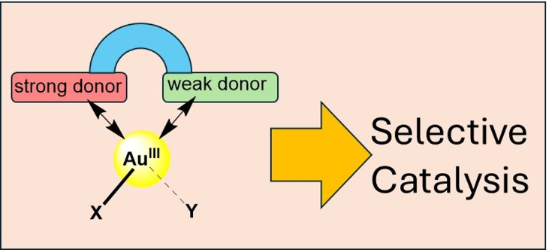
- deprotonation [29] of [(P^N^C)AuH]+ by water, to give a T-shaped Au(I) intermediate, (P^N^C)Au, capable of sequestering the alkyne. This in turn is attacked by another Au(III) hydride to complete the anti-addition process (Scheme 13) [69]. Ligand effects of C^N, C^P and P^N chelates Gold(III) complexes of C^N

Graphical Abstract

Scheme 1: Assessment of ligand influence by kinetic competition experiments.

Scheme 2: Ligand types employed in the stabilisation of gold(III) complexes.

Scheme 3: Au(III) π- and σ-complexes stabilised by C^N^C and C^N chelate ligands [28-32] and an example of a gold(II...

Scheme 4: Gold(III) C^C chelate complexes.

Figure 1: Examples of photoemissive gold(III) pyrazine complexes. Dr. J. Fernandez-Cestau is gratefully ackno...

Scheme 5: Gold hydride complexes supported by tridentate pincer ligands and corresponding1H NMR chemical shif...

Scheme 6: Gold(III) hydride formation by oxygen transfer.

Scheme 7: Heterolytic H–H bond cleavage by cationic Au(III) complexes [32,56].

Scheme 8: Gold(III) models of the water-gas shift reaction [30].

Scheme 9: Gold(III) hydride complexes supported by C^C and C^N chelate ligands [32,50].

Scheme 10: O2 insertions into Au–H bonds.

Scheme 11: Alkyne, alkene and isocyanide hydroauration by a bimolecular gold radical mechanism [49,65,66].

Scheme 12: Reactions of (C^C)Au–H with DMAD [50].

Scheme 13: Alkyne hydroauration by a bimolecular Au(III)–Au(I)-assisted process [69].

Scheme 14: Gold(III) π-allyl complexes.

Scheme 15: Outer-sphere mechanism of ethylene insertion into Au–O bonds [20,84].

Scheme 16: Catalytic acetylene functionalisation [86,87].

Scheme 17: Examples of alkene insertions into Au–C bonds [88,89].

Scheme 18: Examples of β-H elimination and chain walking processes in (C^P)-ligated gold alkyls [90].

Scheme 19: Mechanism of alkyne hydroarylation with (C^P) gold catalysts [92].

Scheme 20: Vinylic triflate esters by gold-catalysed nucleophilic attack on alkynes [94].

Scheme 21: Gold-catalysed and gold-free steps in the formation of Heck-type olefins [97,99].
Photoswitches beyond azobenzene: a beginner’s guide
- Michela Marcon,
- Christoph Haag and
- Burkhard König
Beilstein J. Org. Chem. 2025, 21, 1808–1853, doi:10.3762/bjoc.21.143
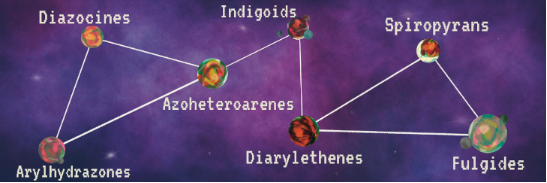
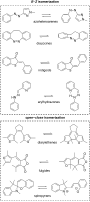
- strong as in the previous examples, a deeper analysis is usually needed to predict the photophysical properties of the azoheteroarenes. While the Z-isomer of 6-membered rings is always in a twisted conformation, it was discovered in the case of 5-membered rings that also a T-shaped conformation could be
- of T-shaped 8a and 9a the Z-isomer was more thermally stable thanks to the weak interaction between the hydrogen and the π-system. However, the high symmetry weakens the intensity of the nπ* absorption band, which is the excitation band for the Z–E isomerisation, resulting in a lower E-PSS. Basic
- heterocyclic imines [36][37][38]. The Z-isomers of the unsubstituted derivatives adapt different conformations: T-shaped for the N-phenyl and twisted for the N-pyrazoles. The half-lives follow the same trends already discussed beforehand. In contrast with the azopyrazoles, mono- and di-ortho-amination of the

Graphical Abstract

Figure 1: Energy diagram of a two-state photoswitch. Figure 1 was redrawn from [2].

Figure 2: Example of the absorption spectra of the isomers of a photoswitch with most efficient irradiation w...
Scheme 1: Photoswitch classes described in this review.

Figure 3: Azoheteroarenes.

Scheme 2: E–Z Isomerisation (top) and mechanisms of thermal Z–E isomerisation (bottom).

Scheme 3: Rotation mechanism favoured by the electron displacement in push–pull systems. Selected examples of...

Figure 4: A) T-shaped and twisted Z-isomers determine the thermal stability and the Z–E-PSS (selected example...

Figure 5: Effect of di-ortho-substitution on thermal half-life and PSS.

Figure 6: Selected thermal lifetimes of azoindoles in different solvents and concentrations. aConcentration o...

Figure 7: Aryliminopyrazoles: N-pyrazoles (top) and N-phenyl (bottom).

Scheme 4: Synthesis of symmetrical heteroarenes through oxidation (A), reduction (B), and the Bayer–Mills rea...

Scheme 5: Synthesis of diazonium salt (A); different strategies of azo-coupling: with a nucleophilic ring (B)...

Scheme 6: Synthesis of arylazothiazoles 25 (A) and heteroaryltriazoles 28 (B).

Scheme 7: Synthesis of heteroarylimines 31a,b [36-38].

Figure 8: Push–pull non-ionic azo dye developed by Velasco and co-workers [45].

Scheme 8: Azopyridine reported by Herges and co-workers [46].

Scheme 9: Photoinduced phase transitioning azobispyrazoles [47].

Figure 9: Diazocines.

Scheme 10: Isomers, conformers and enantiomers of diazocine.

Scheme 11: Partial overlap of the ππ* band with electron-donating substituents and effect on the PSS. Scheme 11 was ada...

Figure 10: Main properties of diazocines with different bridges. aMeasured in n-hexane [56]. bMeasured in THF. cMe...

Scheme 12: Synthesis of symmetric diazocines.

Scheme 13: Synthesis of asymmetric diazocines.

Scheme 14: Synthesis of O- and S-heterodiazocines.

Scheme 15: Synthesis of N-heterodiazocines.

Scheme 16: Puromycin diazocine photoswitch [60].

Figure 11: Indigoids.

Figure 12: The main representatives of the indigoid photoswitch class.

Scheme 17: Deactivation process that prevents Z-isomerisation of indigo.

Figure 13: Stable Z-indigo derivative synthesised by Wyman and Zenhäusern [67].

Figure 14: Selected examples of indigos with aliphatic and aromatic substituents [68]. Dashed box: proposed π–π in...

Scheme 18: Resonance structures of indigo and thioindigo involving the phenyl ring.

Scheme 19: Possible deactivation mechanism for 4,4'-dihydroxythioindigo [76].

Scheme 20: Effect of different heteroaryl rings on the stability and the photophysical properties of hemiindig...

Figure 15: Thermal half-lives of red-shifted hemithioindigos in toluene [79]. aMeasured in toluene-d8.

Scheme 21: Structures of pyrrole [81] and imidazole hemithioindigo [64].

Figure 16: Examples of fully substituted double bond hemithioindigo (left), oxidised hemithioindigos (centre),...

Scheme 22: Structure of iminothioindoxyl 72 (top) and acylated phenyliminoindolinone photoswitch 73 (bottom). ...

Scheme 23: (top) Transition states of iminothioindoxyl 72. The planar transition state is associated with a lo...

Scheme 24: Baeyer–Drewsen synthesis of indigo (top) and N-functionalisation strategies (bottom).

Scheme 25: Synthesis of hemiindigo.

Scheme 26: Synthesis of hemithioindigo and iminothioindoxyl.

Scheme 27: Synthesis of double-bond-substituted hemithioindigos.

Scheme 28: Synthesis of phenyliminoindolinone.

Scheme 29: Hemithioindigo molecular motor [85].

Figure 17: Arylhydrazones.

Scheme 30: Switching of arylhydrazones. Note: The definitions of stator and rotor are arbitrary.

Scheme 31: Photo- and acidochromism of pyridine-based phenylhydrazones.

Scheme 32: A) E–Z thermal inversion of a thermally stable push–pull hydrazone [109]. B) Rotation mechanism favoured...

Scheme 33: Effect of planarisation on the half-life.

Scheme 34: The longest thermally stable hydrazone switches reported so far (left). Modulation of thermal half-...

Figure 18: Dependency of t1/2 on concentration and hypothesised aggregation-induced isomerisation.

Figure 19: Structure–property relationship of acylhydrazones.

Scheme 35: Synthesis of arylhydrazones.

Scheme 36: Synthesis of acylhydrazones.

Scheme 37: Photoswitchable fluorophore by Aprahamian et al. [115].

Scheme 38: The four-state photoswitch synthesised by the Cigáň group [116].

Figure 20: Diarylethenes.

Scheme 39: Isomerisation and oxidation pathway of E-stilbene to phenanthrene.

Scheme 40: Strategies adapted to avoid E–Z isomerisation and oxidation.
Scheme 41: Molecular orbitals and mechanism of electrocyclisation for a 6π system.

Figure 21: Aromatic stabilisation energy correlated with the thermal stability of the diarylethenes [127,129].

Figure 22: Half-lives of diarylethenes with increasing electron-withdrawing groups [128,129].

Scheme 42: Photochemical degradation pathway promoted by electron-donating groups [130].

Figure 23: The diarylethenes studied by Hanazawa et al. [134]. Increased rigidity leads to bathochromic shift.

Scheme 43: The dithienylethene synthesised by Nakatani's group [135].

Scheme 44: Synthesis of perfluoroalkylated diarylethenes.

Scheme 45: Synthesis of 139 and 142 via McMurry coupling.

Scheme 46: Synthesis of symmetrical derivatives 145 via Suzuki–Miyaura coupling.

Scheme 47: Synthesis of acyclic 148, malonic anhydride 149, and maleimide derivatives 154.

Figure 24: Gramicidin S (top left) and two of the modified diarylethene derivatives: first generation (bottom ...

Scheme 48: Pyridoxal 5'-phosphate and its reaction with an amino acid (top). The analogous dithienylethene der...

Figure 25: Fulgides.

Scheme 49: The three isomers of fulgides.

Scheme 50: Thermal and photochemical side products of unsubstituted fulgide [150].

Figure 26: Maximum absorption λc of the closed isomer compared with the nature of the aromatic ring and the su...

Scheme 51: Possible rearrangement of the excited state of 5-dimethylaminoindolylfulgide [153].

Figure 27: Quantum yields of ring closure (ΦE→C) and E–Z isomerisation (ΦE→Z) correlated with the increasing s...

Scheme 52: Active (Eα) and inactive (Eβ) conformers (left) and the bicyclic sterically blocked fulgide 169 (ri...

Scheme 53: Quantum yield of ring-opening (ΦC→E) and E–Z isomerisation (ΦE→Z) for different substitution patter...

Scheme 54: Stobbe condensation pathway for the synthesis of fulgides 179, fulgimides 181 and fulgenates 178.

Scheme 55: Alternative synthesis of fulgides through Pd-catalysed carbonylation.

Scheme 56: Optimised synthesis of fulgimides [166].

Scheme 57: Photoswitchable FRET with a fulgimide photoswitch [167].

Scheme 58: Three-state fulgimide strategy by Slanina's group.

Figure 28: Spiropyrans.

Scheme 59: Photochemical (left) and thermal (right) ring-opening mechanisms for an exemplary spiropyran with a...

Figure 29: Eight possible isomers of the open merocyanine according to the E/Z configurations of the bonds hig...

Scheme 60: pH-Controlled photoisomerisation between the closed spiropyran 191-SP and the open E-merocyanine 19...

Scheme 61: Behaviour of spiropyran in water buffer according to Andréasson and co-workers [180]. 192-SP in an aqueo...

Scheme 62: (left box) Proposed mechanism of basic hydrolysis of MC [184]. (right box) Introduction of electron-dona...

Scheme 63: Photochemical interconversion of naphthopyran 194 (top) and spirooxazine 195 (bottom) photoswitches...

Scheme 64: Synthesis of spiropyrans and spirooxazines 198 and the dicondensation by-product 199.

Scheme 65: Alternative synthesis of spiropyrans and spirooxazines with indolenylium salt 200.

Scheme 66: Synthesis of 4’-substituted spiropyrans 203 by condensation of an acylated methylene indoline 201 w...

Scheme 67: Synthesis of spironaphthopyrans 210 by acid-catalysed condensation of naphthols and diarylpropargyl...

Scheme 68: Photoswitchable surface wettability [194].

Figure 30: Some guiding principles for the choice of the most suitable photoswitch. Note that this guide is ve...
Supramolecular assembly of hypervalent iodine macrocycles and alkali metals
- Krishna Pandey,
- Lucas X. Orton,
- Grayson Venus,
- Waseem A. Hussain,
- Toby Woods,
- Lichang Wang and
- Kyle N. Plunkett
Beilstein J. Org. Chem. 2025, 21, 1095–1103, doi:10.3762/bjoc.21.87
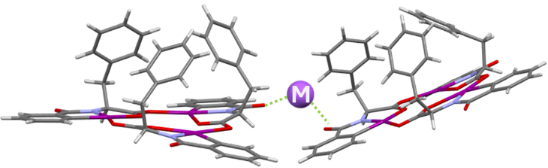
- durability, low harmful, and convenient alternative to heavy-metal reagents [10][11]. Hypervalent iodine compounds exist as trivalent (λ3-iodanes) or pentavalent (λ5-iodanes) species. The λ3-iodanes have an T-shaped structure [12], with the energetically preferred arrangement of the two most electronegative

Graphical Abstract
Figure 1: (A) Our previous work: Assembly and disassembly of phenylalanine hypervalent iodine macrocycles (Ph...

Figure 2: Two conformations of the HIM were found. One conformation projected all three benzyl groups in a ve...

Figure 3: A) Chemical structure of HIM 1: Three iodine atoms and three inward projected ester carbonyls curcu...

Figure 4: 1H NMR titration experiment of 1 with LiBArF20 at an incremental equivalency in CDCl3 and (CD3)2CO ...

Figure 5: Crystal structures of HIM 1 and LiBArF20 (A) and NaBArF24 (B). BARF cation is omitted for clarity. ...

Figure 6: Alternative view of the crystal structure of the HIM 1 and LiBArF20 complex. BArF20 anion is omitte...

Figure 7: Isotherms of 1 titrated with NaBArF24 orLiBArF20. The solid lines are the predicted model fits for ...

Figure 8: Lithium complex 2 (red) overlaid with lithium complex 3 (blue). In lithium complex 2, one benzyl ri...
Reactivity of hypervalent iodine(III) reagents bearing a benzylamine with sulfenate salts
- Beatriz Dedeiras,
- Catarina S. Caldeira,
- José C. Cunha,
- Clara S. B. Gomes and
- M. Manuel B. Marques
Beilstein J. Org. Chem. 2024, 20, 3281–3289, doi:10.3762/bjoc.20.272
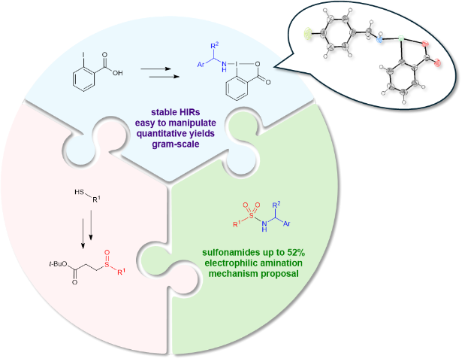
- distorted T-shaped geometry, consistent with previously reported N–bound hypervalent iodine reagents. Additionally, the N–I bond distance is 2.0454(5) Å, which aligns with our previously reported values [4]. The two aromatic rings are nearly coplanar, exhibiting a dihedral angle of 0.7(3)°. All other bond

Graphical Abstract
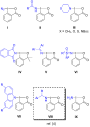
Figure 1: Examples of cyclic HIRs with a nitrogen-based group transfer [4,10,13-20].

Scheme 1: Electrophilic α‑amination of indanone-based β-ketoesters [4].

Scheme 2: Scope of the different (benzylamino)benziodoxolones (BBXs) 2 with ORTEP-3 diagram of compound 2d, u...

Scheme 3: Scope of the different β-sulfinyl esters 4 [32,33]. Isolated yields. rt – room temperature.

Scheme 4: Scope of the primary amine electrophilic reaction of sulfenate salts. Reaction conditions: 4 (2 equ...

Scheme 5: Electrophilic amination reaction in the presence of TEMPO. Reaction conditions: 4a (2 equiv), NaH (...

Scheme 6: Mechanism proposed for sulfonamide 5, β-sulfinyl ester 4, disulfide 7, and sulfide 3 formations. Th...
Structure and thermal stability of phosphorus-iodonium ylids
- Andrew Greener,
- Stephen P. Argent,
- Coby J. Clarke and
- Miriam L. O’Duill
Beilstein J. Org. Chem. 2024, 20, 2931–2939, doi:10.3762/bjoc.20.245
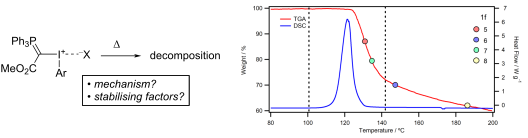
- bipyramidal (T-shaped) with the least electronegative group and the two nonbonding electron pairs occupying the equatorial positions, and the most electronegative substituents forming a hypervalent 3-centre-4-electron (3c-4e) bond in the axial position (Figure 1A) [17][18]. The LUMO of this bond is

Graphical Abstract

Figure 1: Structure and stability of hypervalent iodine compounds.

Figure 2: Phosphorus-iodonium ylids investigated in this study: Yields (for synthetic procedures, see Supporting Information File 1), stru...

Figure 3: (a) Selected TGA thermograms of phosphorus-iodonium ylids at 10 °C min−1 in N2 (full dataset in Supporting Information File 1). ...

Figure 4: (a) Proposed decomposition mechanism based on ex situ analysis (1H, 31P NMR, ESI-MS) following abor...
The Groebke–Blackburn–Bienaymé reaction in its maturity: innovation and improvements since its 21st birthday (2019–2023)
- Cristina Martini,
- Muhammad Idham Darussalam Mardjan and
- Andrea Basso
Beilstein J. Org. Chem. 2024, 20, 1839–1879, doi:10.3762/bjoc.20.162
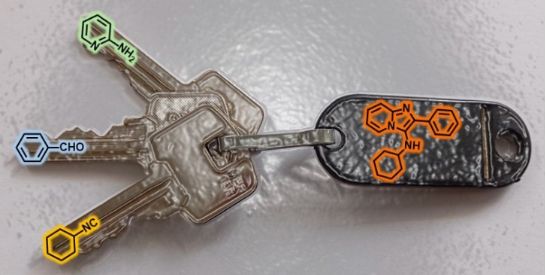

Graphical Abstract

Scheme 1: Mechanism of the GBB reaction.

Scheme 2: Comparison of the performance of Sc(OTf)3 with some RE(OTf)3 in a model GBB reaction. Conditions: a...

Scheme 3: Comparison of the performance of various Brønsted acid catalysts in the synthesis of GBB adduct 6. ...

Scheme 4: Synthesis of Brønsted acidic ionic liquid catalyst 7. Conditions: a) neat, 60 °C, 24 h; b) TfOH, DC...

Scheme 5: Aryliodonium derivatives as organic catalysts in the GBB reaction. In the box the proposed binding ...

Scheme 6: DNA-encoded GBB reaction in micelles made of amphiphilic polymer 13. Conditions: a) 13 (50 equiv), ...

Scheme 7: GBB reaction catalyzed by cyclodextrin derivative 14. Conditions: a) 14 (1 mol %), water, 100 °C, 4...

Scheme 8: Proposed mode of activation of CALB. a) activation of the substrates; b) activation of the imine; c...

Scheme 9: One-pot GBB reaction–Suzuki coupling with a bifunctional hybrid biocatalyst. Conditions: a) Pd(0)-C...

Scheme 10: GBB reaction employing 5-HMF (23) as carbonyl component. Conditions: a) TFA (20 mol %), EtOH, 60 °C...

Scheme 11: GBB reaction with β-C-glucopyranosyl aldehyde 26. Conditions: a) InCl3 (20 mol %), MeOH, 70 °C, 2–3...

Scheme 12: GBB reaction with diacetylated 5-formyldeoxyuridine 29, followed by deacetylation of GBB adduct 30....

Scheme 13: GBB reaction with glycal aldehydes 32. Conditions: a) HFIP, 25 °C, 2–4 h.

Scheme 14: Vilsmeier–Haack formylation of 6-β-acetoxyvouacapane (34) and subsequent GBB reaction. Conditions: ...

Scheme 15: GBB reaction of 4-formlyl-PCP 37. Conditions: a) HOAc or HClO4, MeOH/DCM (2:3), rt, 3 d.

Scheme 16: GBB reaction with HexT-aldehyde 39. Conditions: a) 39 (20 nmol) and amidine (20 μmol), MeOH, rt, 6 ...

Scheme 17: GBB reaction of 2,4-diaminopirimidine 41. Conditions: a) Sc(OTf)3 (20 mol %), MeCN, 120 °C (MW), 1 ...

Scheme 18: Synthesis of N-edited guanine derivatives from 3,6-diamine-1,2,4-triazin-5-one 44. Conditions: a) S...

Scheme 19: Synthesis of 2-aminoimidazoles 49 by a Mannich-3CR followed by a one-pot intramolecular oxidative a...

Scheme 20: On DNA Suzuki–Miyaura reaction followed by GBB reaction. Conditions: a) CsOH, sSPhos-Pd-G2; b) AcOH...

Scheme 21: One-pot cascade synthesis of 5-iminoimidazoles. Conditions: a) Na2SO4, DMF, 220 °C (MW).

Scheme 22: GBB reaction of 5-amino-1H-imidazole-4-carbonile 57. Conditions: a) HClO4 (5 mol %), MeOH, rt, 24 h....

Scheme 23: One-pot cascade synthesis of indole-imidazo[1,2,a]pyridine hybrids. In blue the structural motif in...

Scheme 24: One-pot cascade synthesis of fused polycyclic indoles 67 or 69 from indole-3-carbaldehyde. Conditio...

Scheme 25: One-pot cascade synthesis of linked- and bridged polycyclic indoles from indole-2-carbaldehyde (70)...

Scheme 26: One-pot cascade synthesis of pentacyclic dihydroisoquinolines (X = N or CH). In blue the structural...

Scheme 27: One-pot stepwise synthesis of imidazopyridine-fused benzodiazepines 85. Conditions: a) p-TsOH (20 m...

Scheme 28: One-pot stepwise synthesis of benzoxazepinium-fused imidazothiazoles 89. Conditions: a) Yb(OTf)3 (2...

Scheme 29: One-pot stepwise synthesis of fused imidazo[4,5,b]pyridines 95. Conditions: a) HClO4, MeOH, rt, ove...

Scheme 30: Synthesis of heterocyclic polymers via the GBB reaction. Conditions: a) p-TsOH, EtOH, 70 °C, 24 h.
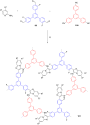
Scheme 31: One-pot multicomponent reaction towards the synthesis of covalent organic frameworks via the GBB re...
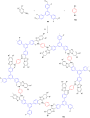
Scheme 32: One-pot multicomponent reaction towards the synthesis of covalent organic frameworks via the GBB re...

Scheme 33: GBB-like multicomponent reaction towards the synthesis of benzothiazolpyrroles (X = S) and benzoxaz...

Scheme 34: GBB-like multicomponent reaction towards the formation of imidazo[1,2,a]pyridines. Conditions: a) I2...

Scheme 35: Post-functionalization of GBB products via Ugi reaction. Conditions a) HClO4, DMF, rt, 24 h; b) MeO...

Scheme 36: Post-functionalization of GBB products via Click reaction. Conditions: a) solvent-free, 150 °C, 24 ...

Scheme 37: Post-functionalization of GBB products via cascade alkyne–allene isomerization–intramolecular nucle...

Scheme 38: Post-functionalization of GBB products via metal-catalyzed intramolecular N-arylation. In red and b...

Scheme 39: Post-functionalization of GBB products via isocyanide insertion (X = N or CH). Conditions: a) HClO4...

Scheme 40: Post-functionalization of GBB products via intramolecular nucleophilic addition to nitriles. Condit...

Scheme 41: Post-functionalization of GBB products via Pictet–Spengler cyclization. Conditions: a) 4 N HCl/diox...

Scheme 42: Post-functionalization of GBB products via O-alkylation. Conditions: a) TFA (20 mol %), EtOH, 120 °...

Scheme 43: Post-functionalization of GBB products via macrocyclization (X = -CH2CH2O-, -CH2-, -(CH2)4-). Condi...
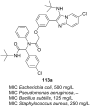
Figure 1: Antibacterial activity of GBB-Ugi adducts 113 on both Gram-negative and Gram-positive strains.

Scheme 44: GBB multicomponent reaction using trimethoprim as the precursor. Conditions: a) Yb(OTf)3 or Y(OTf)3...

Figure 2: Antibacterial activity of GBB adducts 152 against MRSA and VRE; NA = not available.

Figure 3: Antibacterial activity of GBB adduct 153 against Leishmania amazonensis promastigotes and amastigot...

Figure 4: Antiviral and anticancer evaluation of the GBB adducts 154a and 154b. In vitro antiproliferative ac...

Figure 5: Anticancer activity of the GBB-furoxan hybrids 145b, 145c and 145d determined through antiprolifera...

Scheme 45: Synthesis and anticancer activity of the GBB-gossypol conjugates. Conditions: a) Sc(OTf)3 (10 mol %...

Figure 6: Anticancer activity of polyheterocycles 133a and 136a against human neuroblastoma. Clonogenic assay...

Figure 7: Development of GBB-adducts 158a and 158b as PD-L1 antagonists. HTRF assays were carried out against...

Figure 8: Development of imidazo[1,2-a]pyridines and imidazo[1,2-a]pyrazines as TDP1 inhibitors. The SMM meth...

Figure 9: GBB adducts 164a–c as anticancer through in vitro HDACs inhibition assays. Additional cytotoxic ass...

Figure 10: GBB adducts 165, 166a and 166b as anti-inflammatory agents through HDAC6 inhibition; NA = not avail...

Scheme 46: GBB reaction of triphenylamine 167. Conditions: a) NH4Cl (10 mol %), MeOH, 80 °C (MW), 1 h.

Scheme 47: 1) Modified GBB-3CR. Conditions: a) TMSCN (1.0 equiv), Sc(OTf)3 (0.2 equiv), MeOH, 140 °C (MW), 20 ...

Scheme 48: GBB reaction to assemble imidazo-fused heterocycle dimers 172. Conditions: a) Sc(OTf)3 (20 mol %), ...

Figure 11: Model compounds 173 and 174, used to study the acid/base-triggered reversible fluorescence response...
Photoswitchable glycoligands targeting Pseudomonas aeruginosa LecA
- Yu Fan,
- Ahmed El Rhaz,
- Stéphane Maisonneuve,
- Emilie Gillon,
- Maha Fatthalla,
- Franck Le Bideau,
- Guillaume Laurent,
- Samir Messaoudi,
- Anne Imberty and
- Juan Xie
Beilstein J. Org. Chem. 2024, 20, 1486–1496, doi:10.3762/bjoc.20.132
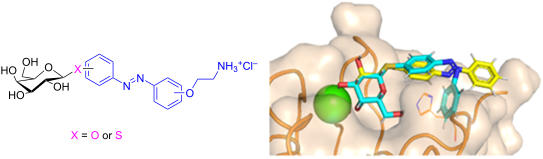
- , with Kd values from micromolar (for monovalent galactosides) to nanomolar range (for di- and multivalent derivatives) [5][6][7][8]. For the monovalent system, it has been shown that aromatic aglycons favored “T-shaped” CH...π interactions with the protons of the His50 imidazole in the carbohydrate

Graphical Abstract

Figure 1: (A) Selected monovalent inhibitors for PA LecA and (B) designed general structure of photoswitchabl...

Scheme 1: Synthesis of photoswitchable LecA inhibitors. Reagents and conditions: (i) DMC, Et3N, H2O, −10 °C t...

Figure 2: (Left) Absorption spectra and (right) fatigue resistance of 1 under alternated 370/485 nm irradiati...

Figure 3: 1H NMR (400 MHz) spectra of E-1 (black line), PSS370 (red line), PSS485 (blue line) in D2O/DMSO-d6 ...

Figure 4: ITC titration of LecA with E- (up) and Z-isomers (bottom) of compounds 1–5 in Tris buffer containin...

Figure 5: (A) Enthalpy–entropy compensation plot of compounds 1–5 from ITC analysis. The dotted green line re...
Introduction of peripheral nitrogen atoms to cyclo-meta-phenylenes
- Koki Ikemoto and
- Hiroyuki Isobe
Beilstein J. Org. Chem. 2024, 20, 1207–1212, doi:10.3762/bjoc.20.103
- configurations preferred over T-shaped stackings [22]. In our study, we observed that pyridine–pyridine stacks were preferred in the crystal stacking (Figure 3), which might be attributed to the biased ESPs on the macrocycles. Finally, we found that nitrogen locations altered chemical characteristics of nitrogen

Graphical Abstract
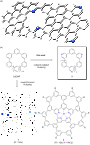
Figure 1: Nitrogen-doped nanocarbons. (a) Schematic illustration of pyridinic nitrogen atoms installed at the...

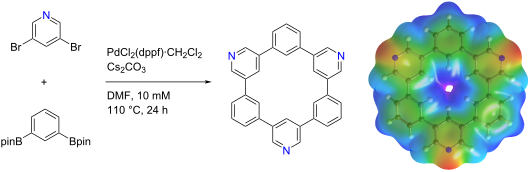
Scheme 1: Syntheses of 3a and 3b.

Figure 2: Photophysical properties of 3a and 3b. (a) UV–vis spectrum of 3a in CHCl3. (b) UV–vis spectrum of 3b...

Figure 3: Crystal structures of 3a and 3b. (a) Molecular structures. Biaryl dihedral angles (ω) are shown. (b...

Figure 4: X-ray charge density analyses of 3a and [6]CMP. (a) Deformation map (Fo – Fc) of a pyridine ring in ...
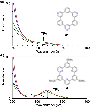
Figure 5: Response towards acid treatment with nitrogen-doped CMPs. (a) Absorption spectra of 3a (CHCl3, 2.3 ...
Rapid gas–liquid reaction in flow. Continuous synthesis and production of cyclohexene oxide
- Kyoko Mandai,
- Tetsuya Yamamoto,
- Hiroki Mandai and
- Aiichiro Nagaki
Beilstein J. Org. Chem. 2022, 18, 660–668, doi:10.3762/bjoc.18.67
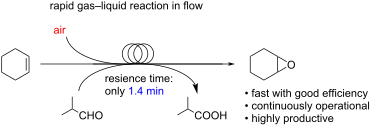
- ratio of aldehyde and oxygen to 1:9. The liquid and gas phases were combined at a T-shaped mixer with a 1 mm inner diameter and flowed through a stainless-steel tube reactor immersed in heated silicon oil for reaction temperature control. The inner pressure was maintained at 0.9 MPa using a back
- with air in the flow microreactor A flow microreactor system consisting of a T-shaped micromixer, and one microtube reactor was used for epoxidation of cyclohexene with air. A solution of cyclohexene (0.065 M), isobutyraldehyde (0.195 M), and tridecane as an internal standard in 1,2-dichloroethane

Graphical Abstract

Scheme 1: Synthesis of cyclochexene oxide via epoxidation with air in the presence of isobutyraldehyde.

Figure 1: Epoxidation of cyclohexene with air bubbling in batch at various temperature.

Figure 2: Schematic diagram (a) and photo (b) of the flow reactor used for cyclohexene epoxidation with air. ...

Figure 3: Investigation of reaction temperature in flow epoxidation of cyclohexene at residence time of 0.35 ...

Figure 4: Investigation of residence time in flow epoxidation of cyclohexene at 100 °C.

Scheme 2: Plausible reaction pathway of the epoxidation of cyclohexene with air in the flow system.

Figure 5: Continuous production of cyclohexene oxide.

Figure 6: Effect of concentration of cyclohexene and eqivalent of aldehyde.
A comprehensive review of flow chemistry techniques tailored to the flavours and fragrances industries
- Guido Gambacorta,
- James S. Sharley and
- Ian R. Baxendale
Beilstein J. Org. Chem. 2021, 17, 1181–1312, doi:10.3762/bjoc.17.90

Graphical Abstract

Figure 1: Representative shares of the global F&F market (2018) segmented on their applications [1].

Figure 2: General structure of an international fragrance company [2].

Figure 3: The Michael Edwards fragrance wheel.

Figure 4: Examples of oriental (1–3), woody (4–7), fresh (8–10), and floral (11 and 12) notes.

Figure 5: A basic depiction of batch vs flow.

Scheme 1: Examples of reactions for which flow processing outperforms batch.

Scheme 2: Some industrially important aldol-based transformations.

Scheme 3: Biphasic continuous aldol reactions of acetone and various aldehydes.

Scheme 4: Aldol synthesis of 43 in flow using LiHMDS as the base.

Scheme 5: A semi-continuous synthesis of doravirine (49) involving a key aldol reaction.

Scheme 6: Enantioselective aldol reaction using 5-(pyrrolidin-2-yl)tetrazole (51) as catalyst in a microreact...

Scheme 7: Gröger's example of asymmetric aldol reaction in aqueous media.

Figure 6: Immobilised reagent column reactor types.

Scheme 8: Photoinduced thiol–ene coupling preparation of silica-supported 5-(pyrrolidin-2-yl)tetrazole 63 and...

Scheme 9: Continuous-flow approach for enantioselective aldol reactions using the supported catalyst 67.

Scheme 10: Ötvös’ employment of a solid-supported peptide aldol catalyst in flow.

Scheme 11: The use of proline tetrazole packed in a column for aldol reaction between cyclohexanone (65) and 2...

Scheme 12: Schematic diagram of an aminosilane-grafted Si-Zr-Ti/PAI-HF reactor for continuous-flow aldol and n...

Scheme 13: Continuous-flow condensation for the synthesis of the intermediate 76 to nabumetone (77) and Microi...

Scheme 14: Synthesis of ψ-Ionone (80) in continuous-flow via aldol condensation between citral (79) and aceton...

Scheme 15: Synthesis of β-methyl-ionones (83) from citral (79) in flow. The steps are separately described, an...

Scheme 16: Continuous-flow synthesis of 85 from 84 described by Gavriilidis et al.

Scheme 17: Continuous-flow scCO2 apparatus for the synthesis of 2-methylpentanal (87) and the self-condensed u...

Scheme 18: Chen’s two-step flow synthesis of coumarin (90).

Scheme 19: Pechmann condensation for the synthesis of 7-hydroxyxcoumarin (93) in flow. The setup extended to c...

Scheme 20: Synthesis of the dihydrojasmonate 35 exploiting nitro derivative proposed by Ballini et al.

Scheme 21: Silica-supported amines as heterogeneous catalyst for nitroaldol condensation in flow.

Scheme 22: Flow apparatus for the nitroaldol condensation of p-hydroxybenzaldehyde (102) to nitrostyrene 103 a...

Scheme 23: Nitroaldol reaction of 64 to 105 employing a quaternary ammonium functionalised PANF.

Scheme 24: Enantioselective nitroaldol condensation for the synthesis of 108 under flow conditions.

Scheme 25: Enatioselective synthesis of 1,2-aminoalcohol 110 via a copper-catalysed nitroaldol condensation.

Scheme 26: Examples of Knoevenagel condensations applied for fragrance components.

Scheme 27: Flow apparatus for Knoevenagel condensation described in 1989 by Venturello et al.

Scheme 28: Knoevenagel reaction using a coated multichannel membrane microreactor.

Scheme 29: Continuous-flow apparatus for Knoevenagel condensation employing sugar cane bagasse as support deve...

Scheme 30: Knoevenagel reaction for the synthesis of 131–135 in flow using an amine-functionalised silica gel. ...

Scheme 31: Continuous-flow synthesis of compound 137, a key intermediate for the synthesis of pregabalin (138)...
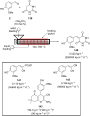
Scheme 32: Continuous solvent-free apparatus applied for the synthesis of compounds 140–143 using a TSE. Throu...

Scheme 33: Lewis et al. developed a spinning disc reactor for Darzens condensation of 144 and a ketone to furn...

Scheme 34: Some key industrial applications of conjugate additions in the F&F industry.

Scheme 35: Continuous-flow synthesis of 4-(2-hydroxyethyl)thiomorpholine 1,1-dioxide (156) via double conjugat...

Scheme 36: Continuous-flow system for Michael addition using CsF on alumina as the catalyst.

Scheme 37: Calcium chloride-catalysed asymmetric Michael addition using an immobilised chiral ligand.

Scheme 38: Continuous multistep synthesis for the preparation of (R)-rolipram (173). Si-NH2: primary amine-fun...

Scheme 39: Continuous-flow Michael addition using ion exchange resin Amberlyst® A26.

Scheme 40: Preparation of the heterogeneous catalyst 181 developed by Paixão et al. exploiting Ugi multicompon...

Scheme 41: Continuous-flow system developed by the Paixão’s group for the preparation of Michael asymmetric ad...

Scheme 42: Continuous-flow synthesis of nitroaldols catalysed by supported catalyst 184 developed by Wennemers...

Scheme 43: Heterogenous polystyrene-supported catalysts developed by Pericàs and co-workers.

Scheme 44: PANF-supported pyrrolidine catalyst for the conjugate addition of cyclohexanone (65) and trans-β-ni...

Scheme 45: Synthesis of (−)-paroxetine precursor 195 developed by Ötvös, Pericàs, and Kappe.

Scheme 46: Continuous-flow approach for the 5-step synthesis of (−)-oseltamivir (201) as devised by Hayashi an...

Scheme 47: Continuous-flow enzyme-catalysed Michael addition.

Scheme 48: Continuous-flow copper-catalysed 1,4 conjugate addition of Grignard reagents to enones. Reprinted w...

Scheme 49: A collection of commonly encountered hydrogenation reactions.

Figure 7: The ThalesNano H-Cube® continuous-flow hydrogenator.

Scheme 50: Chemoselective reduction of an α,β-unsaturated ketone using the H-Cube® reactor.

Scheme 51: Incorporation of Lindlar’s catalyst into the H-Cube® reactor for the reduction of an alkyne.

Scheme 52: Continuous-flow semi-hydrogenation of alkyne 208 to 209 using SACs with H-Cube® system.

Figure 8: The standard setups for tube-in-tube gas–liquid reactor units.

Scheme 53: Homogeneous hydrogenation of olefins using a tube-in-tube reactor setup.
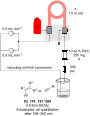
Scheme 54: Recyclable heterogeneous flow hydrogenation system.

Scheme 55: Leadbeater’s reverse tube-in-tube hydrogenation system for olefin reductions.

Scheme 56: a) Hydrogenation using a Pd-immobilised microchannel reactor (MCR) and b) a representation of the i...

Scheme 57: Hydrogenation of alkyne 238 exploiting segmented flow in a Pd-immobilised capillary reactor.

Scheme 58: Continuous hydrogenation system for the preparation of cyrene (241) from (−)-levoglucosenone (240).

Scheme 59: Continuous hydrogenation system based on CSMs developed by Hornung et al.

Scheme 60: Chemoselective reduction of carbonyls (ketones over aldehydes) in flow.

Scheme 61: Continuous system for the semi-hydrogenation of 256 and 258, developed by Galarneau et al.

Scheme 62: Continuous synthesis of biodiesel fuel 261 from lignin-derived furfural acetone (260).

Scheme 63: Continuous synthesis of γ-valerolacetone (263) via CTH developed by Pineda et al.

Scheme 64: Continuous hydrogenation of lignin-derived biomass (products 265, 266, and 267) using a sustainable...

Scheme 65: Ru/C or Rh/C-catalysed hydrogenation of arene in flow as developed by Sajiki et al.

Scheme 66: Polysilane-immobilized Rh–Pt-catalysed hydrogenation of arenes in flow by Kobayashi et al.

Scheme 67: High-pressure in-line mixing of H2 for the asymmetric reduction of 278 at pilot scale with a 73 L p...
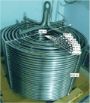
Figure 9: Picture of the PFR employed at Eli Lilly & Co. for the continuous hydrogenation of 278 [287]. Reprinted ...

Scheme 68: Continuous-flow asymmetric hydrogenation using Oppolzer's sultam 280 as chiral auxiliary.
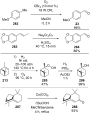
Scheme 69: Some examples of industrially important oxidation reactions in the F&F industry. CFL: compact fluor...

Scheme 70: Gold-catalysed heterogeneous oxidation of alcohols in flow.
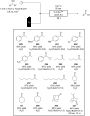
Scheme 71: Uozumi’s ARP-Pt flow oxidation protocol.

Scheme 72: High-throughput screening of aldehyde oxidation in flow using an in-line GC.

Scheme 73: Permanganate-mediated Nef oxidation of nitroalkanes in flow with the use of in-line sonication to p...

Scheme 74: Continuous-flow aerobic anti-Markovnikov Wacker oxidation.

Scheme 75: Continuous-flow oxidation of 2-benzylpyridine (312) using air as the oxidant.

Scheme 76: Continuous-flow photo-oxygenation of monoterpenes.

Scheme 77: A tubular reactor design for flow photo-oxygenation.

Scheme 78: Glucose oxidase (GOx)-mediated continuous oxidation of glucose using compressed air and the FFMR re...

Scheme 79: Schematic continuous-flow sodium hypochlorite/TEMPO oxidation of alcohols.

Scheme 80: Oxidation using immobilised TEMPO (344) was developed by McQuade et al.

Scheme 81: General protocol for the bleach/catalytic TBAB oxidation of aldehydes and alcohols.

Scheme 82: Continuous-flow PTC-assisted oxidation using hydrogen peroxide. The process was easily scaled up by...

Scheme 83: Continuous-flow epoxidation of cyclohexene (348) and in situ preparation of m-CPBA.

Scheme 84: Continuous-flow epoxidation using DMDO as oxidant.

Scheme 85: Mukayama aerobic epoxidation optimised in flow mode by the Favre-Réguillon group.

Scheme 86: Continuous-flow asymmetric epoxidation of derivatives of 359 exploiting a biomimetic iron catalyst.

Scheme 87: Continuous-flow enzymatic epoxidation of alkenes developed by Watts et al.

Scheme 88: Engineered multichannel microreactor for continuous-flow ozonolysis of 366.

Scheme 89: Continuous-flow synthesis of the vitamin D precursor 368 using multichannel microreactors. MFC: mas...

Scheme 90: Continuous ozonolysis setup used by Kappe et al. for the synthesis of various substrates employing ...

Scheme 91: Continuous-flow apparatus for ozonolysis as developed by Ley et al.

Scheme 92: Continuous-flow ozonolysis for synthesis of vanillin (2) using a film-shear flow reactor.

Scheme 93: Examples of preparative methods for ajoene (386) and allicin (388).

Scheme 94: Continuous-flow oxidation of thioanisole (389) using styrene-based polymer-supported peroxytungstat...

Scheme 95: Continuous oxidation of thiosulfinates using Oxone®-packed reactor.

Scheme 96: Continuous-flow electrochemical oxidation of thioethers.

Scheme 97: Continuous-flow oxidation of 400 to cinnamophenone (235).

Scheme 98: Continuous-flow synthesis of dehydrated material 401 via oxidation of methyl dihydrojasmonate (33).

Scheme 99: Some industrially important transformations involving Grignard reagents.

Scheme 100: Grachev et al. apparatus for continuous preparation of Grignard reagents.

Scheme 101: Example of fluidized Mg bed reactor with NMR spectrometer as on-line monitoring system.

Scheme 102: Continuous-flow synthesis of Grignard reagents and subsequent quenching reaction.

Figure 10: Membrane-based, liquid–liquid separator with integrated pressure control [52]. Adapted with permission ...

Scheme 103: Continuous-flow synthesis of 458, an intermediate to fluconazole (459).

Scheme 104: Continuous-flow synthesis of ketones starting from benzoyl chlorides.

Scheme 105: A Grignard alkylation combining CSTR and PFR technologies with in-line infrared reaction monitoring....

Scheme 106: Continuous-flow preparation of 469 from Grignard addition of methylmagnesium bromide.

Scheme 107: Continuous-flow synthesis of Grignard reagents 471.

Scheme 108: Preparation of the Grignard reagent 471 using CSTR and the continuous process for synthesis of the ...

Scheme 109: Continuous process for carboxylation of Grignard reagents in flow using tube-in-tube technology.

Scheme 110: Continuous synthesis of propargylic alcohols via ethynyl-Grignard reagent.

Scheme 111: Silica-supported catalysed enantioselective arylation of aldehydes using Grignard reagents in flow ...

Scheme 112: Acid-catalysed rearrangement of citral and dehydrolinalool derivatives.

Scheme 113: Continuous stilbene isomerisation with continuous recycling of photoredox catalyst.

Scheme 114: Continuous-flow synthesis of compound 494 as developed by Ley et al.

Scheme 115: Selected industrial applications of DA reaction.

Scheme 116: Multistep flow synthesis of the spirocyclic structure 505 via employing DA cycloaddition.

Scheme 117: Continuous-flow DA reaction developed in a plater flow reactor for the preparation of the adduct 508...

Scheme 118: Continuous-flow DA reaction using a silica-supported imidazolidinone organocatalyst.

Scheme 119: Batch vs flow for the DA reaction of (cyclohexa-1,5-dien-1-yloxy)trimethylsilane (513) with acrylon...

Scheme 120: Continuous-flow DA reaction between 510 and 515 using a shell-core droplet system.

Scheme 121: Continuous-flow synthesis of bicyclic systems from benzyne precursors.

Scheme 122: Continuous-flow synthesis of bicyclic scaffolds 527 and 528 for further development of potential ph...

Scheme 123: Continuous-flow inverse-electron hetero-DA reaction to pyridine derivatives such as 531.

Scheme 124: Comparison between batch and flow for the synthesis of pyrimidinones 532–536 via retro-DA reaction ...

Scheme 125: Continuous-flow coupled with ultrasonic system for preparation of ʟ-ascorbic acid derivatives 539 d...

Scheme 126: Two-step continuous-flow synthesis of triazole 543.

Scheme 127: Continuous-flow preparation of triazoles via CuAAC employing 546-based heterogeneous catalyst.

Scheme 128: Continuous-flow synthesis of compounds 558 through A3-coupling and 560 via AgAAC both employing the...

Scheme 129: Continuous-flow photoinduced [2 + 2] cycloaddition for the preparation of bicyclic derivatives of 5...

Scheme 130: Continuous-flow [2 + 2] and [5 + 2] cycloaddition on large scale employing a flow reactor developed...

Scheme 131: Continuous-flow preparation of the tricyclic structures 573 and 574 starting from pyrrole 570 via [...

Scheme 132: Continuous-flow [2 + 2] photocyclization of cinnamates.

Scheme 133: Continuous-flow preparation of cyclobutane 580 on a 5-plates photoreactor.

Scheme 134: Continuous-flow [2 + 2] photocycloaddition under white LED lamp using heterogeneous PCN as photocat...

Figure 11: Picture of the parallel tube flow reactor (PTFR) "The Firefly" developed by Booker-Milburn et al. a...

Scheme 135: Continuous-flow acid-catalysed [2 + 2] cycloaddition between silyl enol ethers and acrylic esters.

Scheme 136: Continuous synthesis of lactam 602 using glass column reactors.

Scheme 137: In situ generation of ketenes for the Staudinger lactam synthesis developed by Ley and Hafner.

Scheme 138: Application of [2 + 2 + 2] cycloadditions in flow employed by Ley et al.

Scheme 139: Examples of FC reactions applied in F&F industry.

Scheme 140: Continuous-flow synthesis of ibuprofen developed by McQuade et al.

Scheme 141: The FC acylation step of Jamison’s three-step ibuprofen synthesis.

Scheme 142: Synthesis of naphthalene derivative 629 via FC acylation in microreactors.

Scheme 143: Flow system for rapid screening of catalysts and reaction conditions developed by Weber et al.

Scheme 144: Continuous-flow system developed by Buorne, Muller et al. for DSD optimisation of the FC acylation ...

Scheme 145: Continuous-flow FC acylation of alkynes to yield β-chlorovinyl ketones such as 638.

Scheme 146: Continuous-flow synthesis of tonalide (619) developed by Wang et al.

Scheme 147: Continuous-flow preparation of acylated arene such as 290 employing Zr4+-β-zeolite developed by Kob...

Scheme 148: Flow system applied on an Aza-FC reaction catalysed by the thiourea catalyst 648.

Scheme 149: Continuous hydroformylation in scCO2.

Scheme 150: Two-step flow synthesis of aldehyde 655 through a sequential Heck reaction and subsequent hydroform...

Scheme 151: Single-droplet (above) and continuous (below) flow reactors developed by Abolhasani et al. for the ...

Scheme 152: Continuous hydroformylation of 1-dodecene (655) using a PFR-CSTR system developed by Sundmacher et ...

Scheme 153: Continuous-flow synthesis of the aldehyde 660 developed by Eli Lilly & Co. [32]. Adapted with permissio...

Scheme 154: Continuous asymmetric hydroformylation employing heterogenous catalst supported on carbon-based sup...

Scheme 155: Examples of acetylation in F&F industry: synthesis of bornyl (S,R,S-664) and isobornyl (S,S,S-664) ...

Scheme 156: Continuous-flow preparation of bornyl acetate (S,R,S-664) employing the oscillating flow reactor.

Scheme 157: Continuous-flow synthesis of geranyl acetate (666) from acetylation of geraniol (343) developed by ...

Scheme 158: 12-Ttungstosilicic acid-supported silica monolith-catalysed acetylation in flow.

Scheme 159: Continuous-flow preparation of cyclopentenone 676.

Scheme 160: Two-stage synthesis of coumarin (90) via acetylation of salicylaldehyde (88).

Scheme 161: Intensification process for acetylation of 5-methoxytryptamine (677) to melatonin (678) developed b...

Scheme 162: Examples of macrocyclic musky odorants both natural (679–681) and synthetic (682 and 683).

Scheme 163: Flow setup combined with microwave for the synthesis of macrocycle 686 via RCM.

Scheme 164: Continuous synthesis of 2,5-dihydro-1H-pyrroles via ring-closing metathesis.

Scheme 165: Continuous-flow metathesis of 485 developed by Leadbeater et al.

Figure 12: Comparison between RCM performed using different routes for the preparation of 696. On the left the...

Scheme 166: Continuous-flow RCM of 697 employed the solid-supported catalyst 698 developed by Grela, Kirschning...

Scheme 167: Continuous-flow RORCM of cyclooctene employing the silica-absorbed catalyst 700.

Scheme 168: Continuous-flow self-metathesis of methyl oleate (703) employing SILP catalyst 704.

Scheme 169: Flow apparatus for the RCM of 697 using a nanofiltration membrane for the recovery and reuse of the...

Scheme 170: Comparison of loadings between RCMs performed with different routes for the synthesis of 709.
Design and synthesis of diazine-based panobinostat analogues for HDAC8 inhibition
- Sivaraman Balasubramaniam,
- Sajith Vijayan,
- Liam V. Goldman,
- Xavier A. May,
- Kyra Dodson,
- Sweta Adhikari,
- Fatima Rivas,
- Davita L. Watkins and
- Shana V. Stoddard
Beilstein J. Org. Chem. 2020, 16, 628–637, doi:10.3762/bjoc.16.59
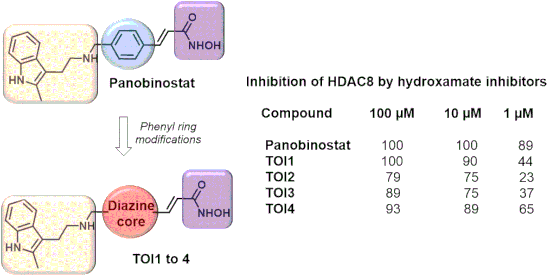
- indole ring of TOI4 was also contorted upward, forming a T-shaped π–π interaction with Phe-207 while both the indole rings of TOI1 and TOI2 were shown to be flipped downward forming a T-shaped π–π interaction with Phe-208. TOI4 is the only diazine compound having two nitrogens directly next to each other
- -rev is tilted downward forming a T-shaped π–π interaction with Phe-208. In review of the computational results, the inclusion of the nitrogen atoms in the core ring structure of panobinostat produced compounds with predicted binding affinities similar to panobinostat. Thus, aiming to develop improved

Graphical Abstract

Figure 1: Chemical structures of the target diazine-based surrogates for the central core of panobinostat.

Figure 2: Docking pose for panobinostat and panobinostat derivatives in the HDAC8 receptor. (a) Overlay of al...

Figure 3: General building blocks for the visualized targets.

Scheme 1: Reaction conditions: a) MeOH, H2SO4 (5 drops), MS 4 Å (2 pieces), 68 °C, 8 h, 81%; b) DIBAL-H (1.2 ...
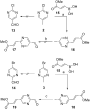
Scheme 2: Reaction conditions: a) boronic acid 15 (1.3 equiv), PdCl2(PPh3)2 (0.1 equiv), dioxane/H2O (3:1), Na...

Scheme 3: Reaction conditions: a) 5-bromo-2-chloropyrimidine (1 equiv), ethyl formate (1.5 equiv), THF (20 mL...

Scheme 4: Reaction conditions: a) boronic acid 15 (1.3 equiv), PdCl2(PPh3)2 (0.1 equiv), dioxane/H2O (8:2, Na2...
Palladium-catalyzed synthesis and nucleotide pyrophosphatase inhibition of benzo[4,5]furo[3,2-b]indoles
- Hoang Huy Do,
- Saif Ullah,
- Alexander Villinger,
- Joanna Lecka,
- Jean Sévigny,
- Peter Ehlers,
- Jamshed Iqbal and
- Peter Langer
Beilstein J. Org. Chem. 2019, 15, 2830–2839, doi:10.3762/bjoc.15.276

- involved in hydrogen bonding were His380, Asn277, Ser378, Ser381, Tyr382, Lys391, Ser387 and Ser386. In addition, the study also showed binding with the zinc ion and π-interactions, in particular, π–π T-shaped and amide–π shaped coupling with Ser377 and Tyr382. The molecular docking study of compound 5c
- exhibited π–π T-shaped interactions connecting the indole and furan rings with Tyr340. However, π–alkyl linkage was observed between the benzofuran moiety of compound 5c and amino acid Lys295. The fluorine atom of the 4-fluorophenyl group was involved in the binding with the zinc ion and Ser377. Hydrogen
- . However, the zinc–metal interaction was exhibited by the substituted phenyl moiety on the indole ring. The oxygen atom of the furan ring of dual inhibitor 6e showed a single hydrogen bond with Phe548. Asp423 was found to be involved in two π–cation bindings with the indole ring, whereas π–π stacked, π–π T

Graphical Abstract

Figure 1: Pharmacologically relevant furoindoles.

Scheme 1: Synthesis of benzo[4,5]furo[3,2-b]indoles 5a–j. Conditions: (i) 1.2 equiv 2-bromophenylboronic acid...

Figure 2: Ortep of 5c (propability of ellipsoids: 45%).

Figure 3: Diindolofurans 6a–e.

Figure 4: Illustration of binding poses of selected inhibitors for the ENPP1 homology model: (a): suramin, (b...

Figure 5: 3D poses of docked selected inhibitors inside homology model of ENPP3. (a): suramin, (b): 5e, (c): ...
A combinatorial approach to improving the performance of azoarene photoswitches
- Joaquin Calbo,
- Aditya R. Thawani,
- Rosina S. L. Gibson,
- Andrew J. P. White and
- Matthew J. Fuchter
Beilstein J. Org. Chem. 2019, 15, 2753–2764, doi:10.3762/bjoc.15.266
- consistent with our previous studies on 4pzH compared to 4pzMe [18], significantly larger half-lives are predicted for 4pzH-X derivatives compared to the dimethylated 4pzMe-X derivatives, which can be rationalized by the stabilizing short CH···π interactions in the T-shaped conformation of Z-4pzH-X (Figure 2
- 4pzH-Pyr compounds, the destabilizing nature of the Cl···pyrazole interaction is evidenced by the absence of heteroring tilting in the T-shaped Z-isomers of the 4pzH-X family (θ = 97° and 94° for 4pzH-Cl1 and 4pzH-Cl2), and the systematic decrease in θ for the 4pzMe-X series in going from 4pzMe (138
- highly depends on the molecular conformation, significantly increasing for T-shaped structures (4pzH-X) compared to twisted arrangements (4pzMe-X), and thus leading to larger n–π* band separation for the 4pzH-X series [18]. On the other hand, the intense π–π* transition of the Z-isomer is generally found

Graphical Abstract

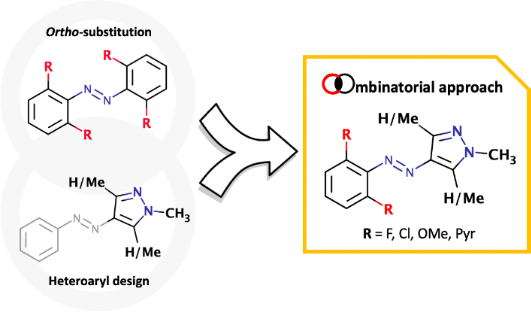
Figure 1: a) Tetra ortho-substituted azobenzenes represent a significant advance in terms of Z-isomer stabili...

Figure 2: Minimum-energy geometry calculated for a) the Z-isomer ground state and b) the transition states wi...

Figure 3: Noncovalent index (NCI) surfaces calculated for representative pyrrolidine-based ortho-substituted ...

Figure 4: Noncovalent index (NCI) surfaces and θ dihedral angles (in red) calculated for the minimum-energy g...
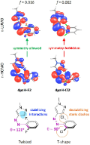
Figure 5: Description of the lowest-lying n–π* excitation for the Z-isomers of halogenated 4pzH-F2 and 4pzH-C...
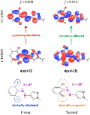
Figure 6: Description of the lowest-lying n–π* excitation for the E-isomers of halogenated 4pzH-F2 and 4pzH-C...

Figure 7: X-ray structures of 4pzMe-F2 (left), 4pzH-F2 (middle) and 4pzMe-OMe2 (right).

Figure 8: Experimental UV–vis spectra of 4pzMe-F2, 4pzMe-Cl2, 4pzMe-OMe2 and 4pzH-F2 in MeCN at 25 µM.
Adhesion, forces and the stability of interfaces
- Robin Guttmann,
- Johannes Hoja,
- Christoph Lechner,
- Reinhard J. Maurer and
- Alexander F. Sax
Beilstein J. Org. Chem. 2019, 15, 106–129, doi:10.3762/bjoc.15.12
- series starts with dipoles, whereas in non-polar molecules it starts with quadrupoles or higher multipoles. Accordingly, there will always be electrostatic interactions of different ranges between molecules with static multipoles. For example, the T-shaped equilibrium structure of the benzene dimer is

Graphical Abstract

Figure 1: Left: The graphs of an interaction potential Vint composed of an attractive component Vatt and a re...

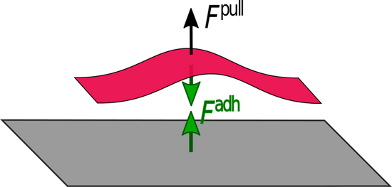
Figure 2: From left to right: An external pulling force acting on the system in its equilibrium structure inc...

Figure 3: Potential functions (thin lines) and the first derivatives (thick lines). Left: For constant ΔV the...

Figure 4: Left: The disk covering the atoms of molecule B seen by an atom in molecule A expands with increasi...

Figure 5: Demonstration of the contact zone and the reduced contact zone of an adsorbate/adsorbent complex wi...

Figure 6: The contact zone of an (8.0)-CNT/tetracene complex. The bold black lines in the traverse section re...

Figure 7: The separation of tetracene from graphene. Top row: Mode S1 (left), mode S2 (right). Bottom row: mo...

Figure 8: The slope functions for the separation of tetracene from graphene for the four separation modes. Re...

Figure 9: Boiling points of straight-chain primary alcohols, straight-chain primary amines and straight-chain...
Metal-free formal synthesis of phenoxazine
- Gabriella Kervefors,
- Antonia Becker,
- Chandan Dey and
- Berit Olofsson
Beilstein J. Org. Chem. 2018, 14, 1491–1497, doi:10.3762/bjoc.14.126
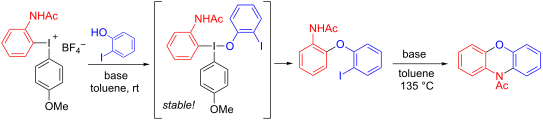
- the neat crude product at rt, along with 52% of 4-iodoanisol (see Supporting Information File 1). This observation is in line with a ligand-coupling (LC) mechanism [30][35][36] where the observed byproduct could be the T-shaped intermediate 9 or the corresponding 4-coordinated species with two

Graphical Abstract

Figure 1: Compounds containing a phenoxazine moiety.

Scheme 1: Reported syntheses of phenoxazine derivatives.

Scheme 2: Retrosynthesis of phenoxazine.

Scheme 3: Synthesis of iodonium salt 5a.

Scheme 4: Synthesis of iodonium salt 7.

Scheme 5: O-Arylation via route B.

Scheme 6: a) Cyclization of diaryl ether 3. b) Attempted one pot-synthesis of 2. aBased on recovered 3.

Scheme 7: Formal synthesis of phenoxazine (1). aBased on recovered 3.
Atom-economical group-transfer reactions with hypervalent iodine compounds
- Andreas Boelke,
- Peter Finkbeiner and
- Boris J. Nachtsheim
Beilstein J. Org. Chem. 2018, 14, 1263–1280, doi:10.3762/bjoc.14.108
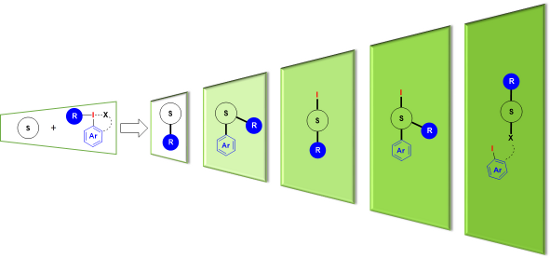
- arylation protocols [18][19][20][21][22]. While in solid state they clearly have a T-shaped pseudotrigonal bipyramid structure, the common structural motif for λ3-iodanes, recent theoretical investigations revealed a potential role of the cationic, normal valent tetrahedral form, in atom transfer processes

Graphical Abstract

Scheme 1: Overview of different types of iodane-based group-transfer reactions and their atom economy based o...

Scheme 2: (a) Structure of diaryliodonium salts 1. (b) Diarylation of a suitable substrate A with one equival...

Scheme 3: Synthesis of biphenyls 3 and 3’ with symmetrical diaryliodonium salts 1.

Scheme 4: Synthesis of diaryl thioethers 5.
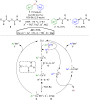
Scheme 5: Synthesis of two distinct S-aryl dithiocarbamates 7 and 7’ from one equivalent of diaryliodonium sa...

Scheme 6: Synthesis of substituted isoindolin-1-ones 9 from 2-formylbenzonitrile 8 and the postulated reactio...

Scheme 7: Domino C-/N-arylation of indoles 10.

Scheme 8: Domino modification of N-heterocycles 12 via in situ-generated directing groups.

Scheme 9: Synthesis of triarylamines 17 through a double arylation of anilines.
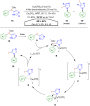
Scheme 10: Selective conversion of novel aryl(imidazolyl)iodonium salts 1b to 1,5-disubstituted imidazoles 18.

Scheme 11: Selected examples for the application of cyclic diaryliodonium salts 19.

Scheme 12: Tandem oxidation–arylation sequence with (dicarboxyiodo)benzenes 20.

Scheme 13: Oxidative α-arylation via the transfer of an intact 2-iodoaryl group.

Scheme 14: Tandem ortho-iodination/O-arylation cascade with PIDA derivatives 20b.

Scheme 15: Synthesis of meta-N,N-diarylaminophenols 28 and the postulated mechanism.

Scheme 16: (Dicarboxyiodo)benzene-mediated metal-catalysed C–H amination and arylation.

Scheme 17: Postulated mechanism for the amination–arylation sequence.

Scheme 18: Auto-amination and cross-coupling of PIDA derivatives 20c.

Scheme 19: Tandem C(sp3)–H olefination/C(sp2)–H arylation.

Scheme 20: Atom efficient functionalisations with benziodoxolones 36.

Scheme 21: Atom-efficient synthesis of furans 39 from benziodoxolones 36a and their further derivatisations.

Scheme 22: Oxyalkynylation of diazo compounds 42.

Scheme 23: Enantioselective oxyalkynylation of diazo compounds 42’.

Scheme 24: Iron-catalysed oxyazidation of enamides 45.
Preparation, structure, and reactivity of bicyclic benziodazole: a new hypervalent iodine heterocycle
- Akira Yoshimura,
- Michael T. Shea,
- Cody L. Makitalo,
- Melissa E. Jarvi,
- Gregory T. Rohde,
- Akio Saito,
- Mekhman S. Yusubov and
- Viktor V. Zhdankin
Beilstein J. Org. Chem. 2018, 14, 1016–1020, doi:10.3762/bjoc.14.87
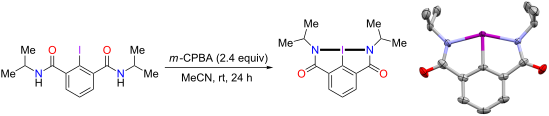
- distorted T-shaped geometry with an N(1)–I(1)–N(2) angle of 153.90 (15)°. Compared to other reported bicyclic hypervalent iodine compounds [23][25][37], this is the most bent structure at the N(1)–I(1)–N(2) angle. An additional relatively weak intermolecular coordination between the iodine atom and the

Graphical Abstract

Scheme 1: Representative examples of benziodoxoles and benziodazoles.

Scheme 2: Preparation of bicyclic benziodazole 7a.

Figure 1: X-ray crystal structure of compound 7a. Ellipsoids are drawn to the 50% probability level. Selected...

Scheme 3: Benziodadiazole 7a mediated oxidatively assisted esterification and amidation reactions.
Synthesis of fluoro-functionalized diaryl-λ3-iodonium salts and their cytotoxicity against human lymphoma U937 cells
- Prajwalita Das,
- Etsuko Tokunaga,
- Hidehiko Akiyama,
- Hiroki Doi,
- Norimichi Saito and
- Norio Shibata
Beilstein J. Org. Chem. 2018, 14, 364–372, doi:10.3762/bjoc.14.24
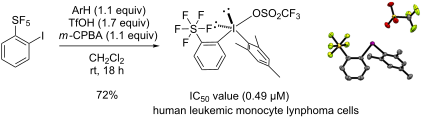
- SF5-diaryliodonium salts 3p, 4b, 5a and 6a were characterized spectroscopically. The single crystal X-ray structure of 3p was also analysed. The SF5-diaryliodonium salt 3p has a T-shaped geometry at the iodine centre, consistent with the general structure of diaryliodonium salts [33] (Figure 3

Graphical Abstract

Figure 1: Compounds used for the biological study.

Figure 2: Compounds 1–4 induced cell death in U937 cells. Briefly, U937 cells (1 × 10⁴ cells/mL) were incubat...

Scheme 1: Synthesis of pentafluoro-(2-iodophenyl)-λ6-sulfane (7).

Scheme 2: Synthesis of unsymmetrical ortho-SF5 diaryliodonium salts 3p, 4b, 5a and 6a.

Figure 3: X-ray crystallographic structure of 3p drawn at 50% probability (CCDC 1573953).

Figure 4: Ortho-SF5 phenyl iodonium salts 3p and 5a and their structural components 7 and 9 induced cell deat...

Figure 5: 3k, 3m and 3p induced cell death in AGLCL, a human normal B cell line. Briefly, AGLCL cells (1 × 10⁴...
Aggregation behaviour of a single-chain, phenylene-modified bolalipid and its miscibility with classical phospholipids
- Simon Drescher,
- Vasil M. Garamus,
- Christopher J. Garvey,
- Annette Meister and
- Alfred Blume
Beilstein J. Org. Chem. 2017, 13, 995–1007, doi:10.3762/bjoc.13.99
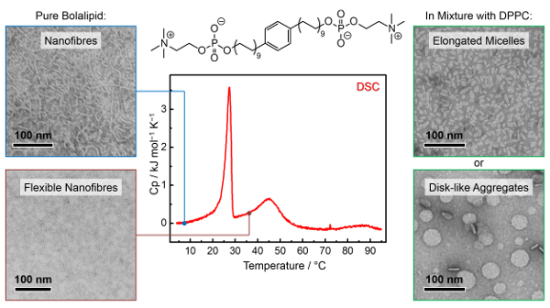
- DPPC/DHPC systems [49], or for mixtures of phospholipids with other amphiphilic substances, e.g., in PEG-stabilized bilayer systems [50][51], for phospholipids with membrane scaffold proteins [52][53] or in combination with copolymers [54][55], or for DPPC in mixture with a T-shaped amphiphile [56

Graphical Abstract

Figure 1: Chemical structure of PC-C18pPhC18-PC.

Scheme 1: Synthesis of PC-C18pPhC18-PC; TBAF: tetra-n-butylammonium fluoride, TEA: triethylamine, rt: room te...

Figure 2: DSC curves for PC-C18pPhC18-PC (c = 1 mg mL−1 in H2O, solid lines, heating: red, cooling: blue). FT...

Figure 3: TEM image of an aqueous suspension (c = 0.05 mg mL−1) of PC-C18pPhC18-PC. The samples were prepared...

Figure 4: SANS data of a suspension of PC-C18pPhC18-PC (c = 1 mg mL−1 in D2O, scattered data) with IFT analys...
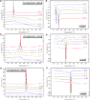
Figure 5: DSC heating (left-hand column) and cooling (right-hand column) scans of different PC-C18pPhC18-PC:p...
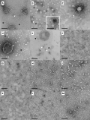
Figure 6: TEM images of aqueous suspensions (c = 60 µM or c = 30 µM for C) of PC-C18pPhC18-PC/phospholipid mi...

Figure 7: FTIR spectroscopic data (symmetric CH2 stretching vibration: red squares, right axis; symmetric CD2...

Figure 8: (A) SAXS diffractograms of an equimolar mixture of PC-C18pPhC18-PC/DPPC (c = 10 mg mL−1, scattered ...
Ring-whizzing in polyene-PtL2 complexes revisited
- Oluwakemi A. Oloba-Whenu,
- Thomas A. Albright and
- Chirine Soubra-Ghaoui
Beilstein J. Org. Chem. 2016, 12, 1410–1420, doi:10.3762/bjoc.12.135
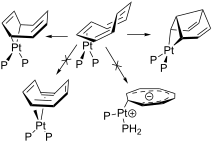
- using the B3LYP hybrid functional and a different basis set. The computed geometric parameters for the molecules are very close to each other. One Pt–C bond is short (2.10 Å) while the other two flanking bonds are 2.52 Å. Thus, 20 strongly resembles an η1 14 electron complex with a “T” shaped geometry

Graphical Abstract

Figure 1: The four coordination geometries for d10 polyene-ML2 complexes along with their hapto numbers and e...

Figure 2: The important valence orbitals of a d10 ML2 group, 5–7, along with the computed structures of Pt(PH3...

Figure 3: The empty degenerate set of π orbitals in the cyclopropenium cation is shown on the left side. On t...

Figure 4: Two unoccupied MOs for Cp+ are shown on the left side. The two stationary points for Cp–Pt(dpe)+ ar...

Figure 5: The half-filled degenerate π orbitals in cyclobutadiene. The computed ground state (15) and transit...
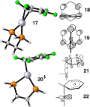
Figure 6: The ground and transition state for ring whizzing in F6C6–Pt(dpe), 17 and 20, respectively. The dom...
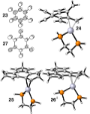
Figure 7: The LUMO, 23, and HOMO, 27, in 6-radialene. The optimized η2 ground states are shown in 24 and 25 w...

Figure 8: Two representations for the half-filled e2u set of π orbitals in cyclooctatetraene.

Figure 9: The stationary points found on the potential energy surface of C8F8–Pt(dpe). For clarity the groups...

Figure 10: The two important bonding interactions for transition state 31 are drawn in 33 and 34.

Figure 11: Three other coordination geometries that did not lead to new stationary points are shown in 35–37.

Figure 12: The LUMO and LUMO+1 shown in 38 and 39, respectively. The four stationary points found for pentalen...
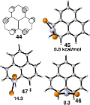
Figure 13: The LUMO of the phenalenium cation is given in 44. The structures of the three stationary points fo...

Figure 14: A top view of two stationary points found for F8C10–Pt(dpe); 48 is the ground state and 50, represe...

Figure 15: At top view of the η4, 52, and η4, 54, transition states along with the η2, 53, intermediate.
Biosynthesis of α-pyrones
- Till F. Schäberle
Beilstein J. Org. Chem. 2016, 12, 571–588, doi:10.3762/bjoc.12.56
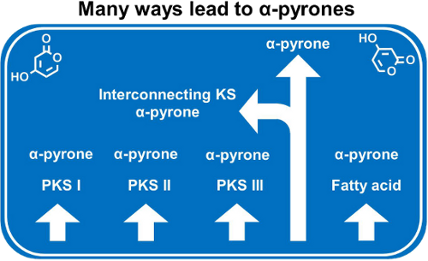
- chain is placed into the proximal cavity, orienting the α-carbon in a position suitable for the nucleophilic attack by the cysteine-tethered, activated chain. Thereby, the second chain is still attached to the ACP, the phosphopantetheine residue reaching into the T-shaped catalytic cavity, enabling the
- -tethered chains are interconnected by the catalytic activity of a free-standing KS. In the second step the lactonization takes place, facilitated by the keto–enol tautomerism. Thereby the α-pyrone 78 is formed. Structures of csypyrones. Schematic drawing of the T-shaped catalytic cavities of the related
- enzymes CorB and MxnB. The two cavities, each harboring one chain are depicted in green and blue, respectively. The phosphopantetheine arm of the ACP reaches into the T-shaped catalytic cavity through a third hydrophobic channel. The oxyanion hole is highlighted by a pink circle. In that way the two

Graphical Abstract

Figure 1: Selected monocyclic and monobenzo α-pyrone structures.

Figure 2: The basic core structure of dibenzo-α-pyrones.

Figure 3: Selected dibenzo-α-pyrones.

Figure 4: Structure of ellagic acid and of the urolithins, the latter metabolized from ellagic acid by intest...
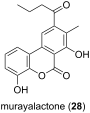
Figure 5: Structure of murayalactone, the only dibenzo-α-pyrone described from bacteria.

Figure 6: Structures of the 6-pentyl-2-pyrone (29) and of trichopyrone (30). Only 29 showed antifungal activi...

Figure 7: Selected monocyclic α-pyrones.

Figure 8: Structures of the gibepyrones A–F.

Figure 9: Structures of the phomenins A and B.

Figure 10: Structures of monocyclic α-pyrones showing pheromone (47) and antitumor activity (48), respectively....

Figure 11: Structures of 6-alkyl (alkoxy or alkylthio)-4-aryl-3-(4-methanesulfonylphenyl)pyrones.

Figure 12: Structures of kavalactones.

Figure 13: Strutures of germicins.

Figure 14: Structures of the pseudopyronines.

Figure 15: The structures of the monobenzo-α-pyrone anticoagulant drugs warfarin and phenprocoumon.

Figure 16: Structures of selected monobenzo-α-pyrones.
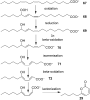
Figure 17: Hypothetical pathway of 29 generation from linoleic acid [34].

Figure 18: Proposed biosynthetic pathway of alternariol (modified from [77]). Malonyl-CoA building blocks are appl...

Figure 19: Structures of phenylnannolones and of enterocin, both biosynthesized via polyketide synthase system...

Figure 20: Pyrone ring formation. Examples for the three types of PKS systems are shown in A–C. In D the mecha...

Figure 21: Structures of csypyrones.

Figure 22: Schematic drawing of the T-shaped catalytic cavities of the related enzymes CorB and MxnB. The two ...

Figure 23: Stereo representation of the CorB binding situation (modified from [89]). The substrate mimic (dark vio...

Figure 24: Proposed mechanism for the CsyB enzymatic reaction. A) Coupling reaction of the β-keto fatty acyl i...
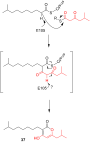
Figure 25: Proposed biosynthesis of photopyrone D (37) by the enzyme PpyS from P. luminescens (modified from [63])...
Synthesis of dinucleoside acylphosphonites by phosphonodiamidite chemistry and investigation of phosphorus epimerization
- William H. Hersh
Beilstein J. Org. Chem. 2015, 11, 184–191, doi:10.3762/bjoc.11.19
- contrast, did not yield a trigonal planar transition state, but rather gave a T-shaped transition state. In fact, such a result has been reported for PF3 [59][60] and is due to the presence of the highly electronegative atoms bound to phosphorus. While the alkoxy groups of the phosphite triester are
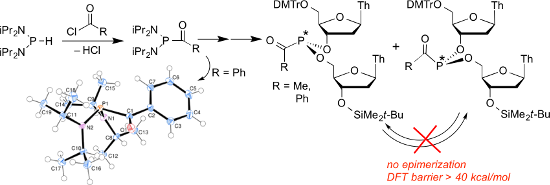
- calculations were then carried out on the chiral acylphosphonite 21 with the expectation that a high phosphite-like barrier might occur. In fact, the barrier of 41.7 kcal/mol was slightly higher than the phosphite triester calculation. Unlike the phosphite T-shaped transition state, this occurs via a trigonal

Graphical Abstract

Figure 1: Acyl phosphorus compounds.

Scheme 1: Synthesis of a dinucleoside acylphosphonate (3b) and a formate diester (1a).

Scheme 2: Reaction of an H-phosphonodiamidite with acid chlorides.

Figure 2: ORTEP [52] drawing of 9. Selected distances (Å) and angles (°): P–N1 1.687(1), P–N2 1.679(1), P–C1 1.87...

Scheme 3: Synthesis of dinucleosides.

Scheme 4: Calculated phosphine, acylphosphine, phosphite, and acylphosphonite inversion barriers.
Synthesis and properties of novel star-shaped oligofluorene conjugated systems with BODIPY cores
- Clara Orofino-Pena,
- Diego Cortizo-Lacalle,
- Joseph Cameron,
- Muhammad T. Sajjad,
- Pavlos P. Manousiadis,
- Neil J. Findlay,
- Alexander L. Kanibolotsky,
- Dimali Amarasinghe,
- Peter J. Skabara,
- Tell Tuttle,
- Graham A. Turnbull and
- Ifor D. W. Samuel
Beilstein J. Org. Chem. 2014, 10, 2704–2714, doi:10.3762/bjoc.10.285

- -shaped molecules. The other series (T-Bn, n = 1–4) represents star-shaped systems with the arms in the meso- and β-positions, providing T-shaped molecules. Results and Discussion Synthesis For the synthesis of the Y-B1–Y-B4 series a convergent strategy was chosen (Scheme 1). The modified Suzuki coupling
- bathochromically shifted optical transitions compared with their T-shaped analogues. The phenyl linker attached to the meso-position is also more twisted in T-B1 (80.8°) than in Y-B1 (58.0°) because the methyl groups in the 1,7-positions exert greater steric hindrance than the hydrogen substituents of Y-B1. The

Graphical Abstract

Figure 1: The structures of the star-shaped oligofluorenes with BODIPY cores, Y-Bn (n = 1–4) and T-Bn (n = 1–...

Scheme 1: Synthesis of the Y-Bn (n = 1–4) series.

Scheme 2: Synthesis of the T-Bn (n = 1–4) series.

Figure 2: The samples of oligofluorene BODIPY solutions in toluene under ambient light (left) and UV illumina...

Figure 3: The normalised absorption (solid lines) and emission (dash lines) spectra of Y-Bn (n = 1–4) (left p...

Figure 4: Optimised structures of T-B1 (left) and Y-B1 (right).
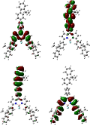
Figure 5: HOMO−1 (bottom, left), HOMO (bottom, right), LUMO (top, left) and LUMO+1 (top, right) of Y-B1.

Figure 6: HOMO−1 (bottom, left), HOMO (bottom, right), LUMO (top, left) and LUMO+1 (top, right) of T-B1.
Carbenoid-mediated nucleophilic “hydrolysis” of 2-(dichloromethylidene)-1,1,3,3-tetramethylindane with DMSO participation, affording access to one-sidedly overcrowded ketone and bromoalkene descendants§
- Rudolf Knorr,
- Thomas Menke,
- Johannes Freudenreich and
- Claudio Pires
Beilstein J. Org. Chem. 2014, 10, 307–315, doi:10.3762/bjoc.10.28

- (2.80 g, 11.0 mmol), dimethyl sulfoxide (45 mL), and a magnetic stirring bar were placed in a round-bottomed flask carrying either a wide-bore connection to a cooled trap or a T-shaped glass-tube with a bubbler and gas inlet. This suspension was stirred at 60 °C until 6 was completely dissolved. Freshly

Graphical Abstract
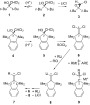
Scheme 1: 1,1,3,3-Tetramethylindane derivatives are preferable.

Scheme 2: “Hydrolysis” of 6, and the KOR/dimsyl-K (11) system.
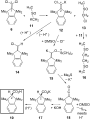
Scheme 3: Proposed carbenoid pathway from 6 to acid 10 and dimethyl sulfide (Me2S) in DMSO as the solvent.
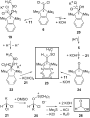
Scheme 4: Proposed pathway to the main side-product 23 formed by nucleophilic addition of 11 to C-2 of 6.
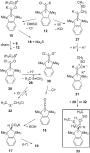
Scheme 5: Possible course of the carbenoid chain reaction of 12 with DMSO and the α,α-dichloroalkene 6.
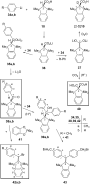
Scheme 6: Synthesis of the one-sidedly overcrowded descendants 38, 39, and 42.
Advancements in the mechanistic understanding of the copper-catalyzed azide–alkyne cycloaddition
- Regina Berg and
- Bernd F. Straub
Beilstein J. Org. Chem. 2013, 9, 2715–2750, doi:10.3762/bjoc.9.308
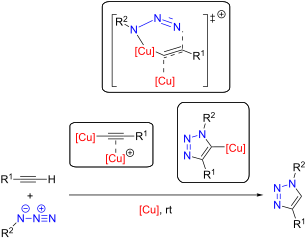

Graphical Abstract

Scheme 1: Exemplary 1,3-dipolar cycloaddition of phenylacetylene with phenyl azide [6].

Scheme 2: CuAAC reaction of benzyl azide with (prop-2-yn-1-yloxy)benzene [12].

Scheme 3: Bioconjugation reaction of capsid-bound azide groups with alkynyl-functionalized dye molecules (cow...

Figure 1: Tris(triazolylmethyl)amine ligands for CuAAC applications in bioorganic chemistry: TBTA = tris[(1-b...

Figure 2: Derivatives of 2,2’-bipyridine and 1,10-phenanthroline, commonly used ligands in CuAAC reactions un...

Scheme 4: CuAAC reaction with copper(II) precursor salt and rate-accelerating monodentate phosphoramidite lig...

Scheme 5: Synthesis of 1-(adamant-1-yl)-1H-1,2,3-triazol-4-ylcarbonyl-Phe-Gly-OH by solid-supported Click cat...

Scheme 6: CuAAC reaction with re-usable copper(I)-tren catalyst [129].

Scheme 7: CuAAC test reaction with chlorido[tris(1-benzyl-1H-1,2,3-triazol-4-yl)methanol-κ3N3]copper(I) and a...

Scheme 8: CuAAC model reaction with [Cu2(μ-TBTA-κ4N2,N3,N3’,N3’’)2][BF4]2 [131].

Scheme 9: Application of a (2-aminoarenethiolato)copper(I) complex as homogeneous catalyst for the CuAAC test...

Scheme 10: Application of [CuBr(PPh3)3] as homogeneous catalyst for the CuAAC test reaction of benzyl azide wi...

Figure 3: Phosphinite and phosphonite copper(I) complexes presented by Díez-González [144].

Scheme 11: Effect of additives on the CuAAC test reaction with [(SIMes)CuCl] [149].

Scheme 12: Initiation of the catalytic cycle by formation of the copper acetylide intermediate from [(ICy)2Cu]...

Scheme 13: Early mechanistic proposal by Sharpless [12,42].

Scheme 14: Chemoselective synthesis of a 5-iodo-1,4-disubstituted 1,2,3-triazole [156].

Scheme 15: Mechanistic proposals for the copper-catalyzed azide–iodoalkyne cycloaddition [156].

Scheme 16: 1,3-Dipolar cycloaddition of 3-hexyne catalyzed by [(SIMes)CuBr] [146].

Scheme 17: Mechanistic picture for the cycloaddition of internal alkynes catalyzed by NHC-copper(I) complexes ...

Scheme 18: Catalytic cycle of the CuAAC reaction on the basis of the proposed mechanistic scheme by Fokin and ...

Figure 4: Schematic representation of the single crystal X-ray structures of copper(I) acetylide complexes [Cu...

Figure 5: Acetylide-bridged dicopper complexes with tris(heteroarylmethyl)amine ligand(s) as key intermediate...

Scheme 19: Off-cycle equilibrium between unreactive polymeric copper(I) acetylide species (right) and reactive...
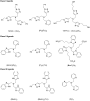
Figure 6: Categories of tris(heteroarylmethyl)amine ligands regarding their binding ability to copper(I) ions ...

Scheme 20: Mechanistic scheme for ligand-accelerated catalysis with tripodal tris(heteroarylmethyl)amine ligan...

Scheme 21: Synthesis of supposed intermediates in the CuAAC’s catalytic cycle [164,187].

Figure 7: Tetranuclear copper acetylide complexes as reported by Weiss (left) [176] and Tasker (middle) [185] and model...

Figure 8: Gibbs free energy diagram for the computed mechanistic pathway of the CuAAC reaction starting from ...

Figure 9: Energy diagram by Ahlquist and Fokin [125].

Scheme 22: Mechanistic proposal for the CuAAC reaction based on DFT calculations by Fokin [125] and our group [186] ([Cu...

Figure 10: ORTEP plot [202,203] of the X-ray powder diffraction crystal structure of (phenylethynyl)copper(I) [(PhC≡CCu)...

Scheme 23: Synthesis of [(PhC≡CCu)2]n as co-product in the Glaser coupling of phenylacetylene in the presence ...

Scheme 24: Mechanistic explanation for the isotopic enrichment in the product triazolide in the presence of th...

Scheme 25: Homogeneous CuAAC catalysis with a bistriazolylidene dicopper complex (0.5 mol %) and comparison wi...



