


Search results
Search for "amines" in Full Text gives 924 result(s) in Beilstein Journal of Organic Chemistry. Showing first 200.
The surprising reaction of (chloro- and methanesulfonyloxy)(phenyl)methylphosphonates and –(phenyl)methylphosphine oxides with potassium diphenylphosphide followed by oxidation
Beilstein J. Org. Chem. 2026, 22, 1160–1167, doi:10.3762/bjoc.22.93
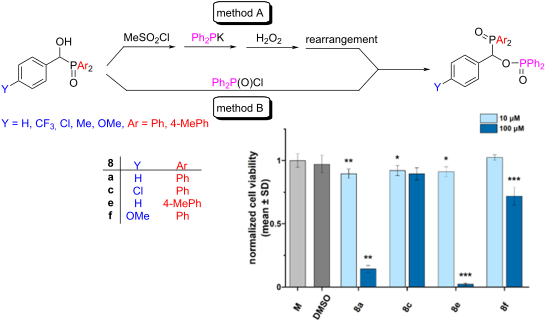
- hydroxy group may be substituted by an amino function in the reaction with primary amines [2][3]. Beyond these unexpected transformations, the hydroxy function was acylated [4], phosphorylated [5][6][7], and sulfonylated [8]. The sulfonyloxyphosphonates were good starting materials in solvolytic reactions


A cascade synthesis of 2-aminothiochromones from 2-fluorophenyl ketone and thiocarbonyldiimidazole
Beilstein J. Org. Chem. 2026, 22, 1151–1159, doi:10.3762/bjoc.22.92
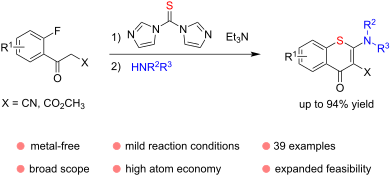
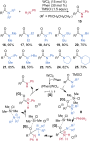
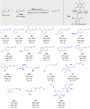
- morpholine as the substrate, we evaluated the generality of the optimized conditions by testing a range of different amines. Moreover, the workup procedure was simplified, yielding the target product in good purity without the need of column chromatography. As shown in Scheme 2, the reaction demonstrated a
- broad amine substrate scope, providing the desired products in moderate to high yields. After having examined morpholine which readily afforded the desired product 3a, next n-butylamine and cyclohexylmethylamine were selected to evaluate the compatibility of the conditions with primary amines. The
- corresponding products 3b and 3c were obtained in good yields (81% and 84%, respectively), indicating that the presence of a free N–H bond does not impede the reaction. Then, we explored aromatic amines and investigated the effect of substituents on the aromatic ring. Anilines bearing either electron-donating



Amino acid-based surfactants: sustainable synthesis and antimicrobial mechanisms
Beilstein J. Org. Chem. 2026, 22, 1067–1085, doi:10.3762/bjoc.22.85
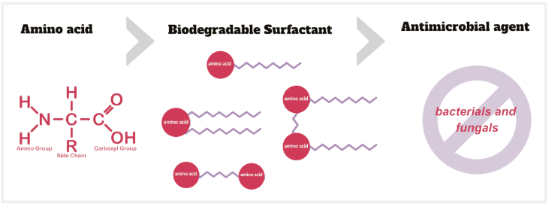
- fatty acids or other lipophilic chains [18][19]. Upon the introduction of a reactive molecule with a hydrophobic chain, such as fatty acids, esters, amines and alcohols, through alkyl ester or amide bonds, amino acids having at least two functional groups (carboxylic and amino groups), can be easily
- moderate to high yields, whereas direct alkylation requires strict stoichiometric and reaction control to minimize overalkylation and side reactions [13]. In addition, double-chain derivatives (e.g., LANHCn) are commonly obtained via aminolysis of methyl esters with long-chain amines under thermal
- series are commonly prepared by aminolysis of Nα-lauroylarginine methyl ester (LAM) with long-chain amines, generating asymmetric double-chain structures with tunable physicochemical and biological properties [44][45]. This dual-chain design imparts significantly higher hydrophobicity compared with


One-pot four-component sequential synthesis of S-alkyl dithiocarbamates using lipase as a biocatalyst
Beilstein J. Org. Chem. 2026, 22, 1048–1056, doi:10.3762/bjoc.22.83
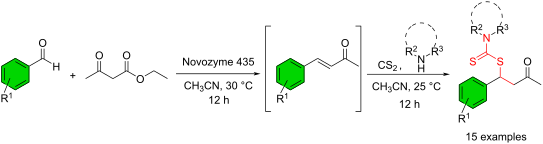
- (CS2), and amines. Initially, α,β-unsaturated carbonyl compounds, serving as Michael acceptors, were generated from aldehydes and ethyl acetoacetate through a decarboxylative Knoevenagel reaction under mild conditions, using lipase as a biocatalyst. These intermediates then sequentially undergo a
- nucleophilic addition reaction with dithiocarbamate anions, which are generated in situ by reacting CS2 with amines. This sequence successfully yields 15 derivatives of S-alkylated dithiocarbamates with high to excellent yields ranging from 69% to 96%. Keywords: biocatalysis; dithiocarbamate; four-component
- the development of efficient and diverse synthetic methodologies for S-alkyl dithiocarbamates remains crucial. The synthesis of S-alkyl dithiocarbamates is primarily achieved through multicomponent reactions [17][18] that involve primary or secondary amines, carbon disulfide (CS2), and electrophilic


Semisynthesis, characterisation, and antibacterial evaluation of a novel lecanoric acid-derived amide library
Beilstein J. Org. Chem. 2026, 22, 1023–1032, doi:10.3762/bjoc.22.81
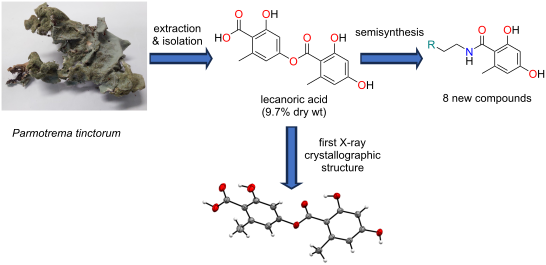
- in decomposition to orsellinic acid (4) [24]. Recognising the reactivity of the scaffold’s ester group, we sought to exploit this by reacting 1 with a series of commercially available primary amines to generate a series of chemically unique amides. Prior to the reaction of scaffold 1 with the eight
- commercially available primary amines, several trial amidation reactions were undertaken. This involved scaffold 1 (20 mg) being reacted with the abundant and moderately volatile isopentylamine (bp 95–97 °C) at three different reaction times (i.e., 1 h, 2 h, and 4 h), with temperature and stirring conditions


The role of spacer length and flexibility in peptide self-assembly
Beilstein J. Org. Chem. 2026, 22, 986–996, doi:10.3762/bjoc.22.77
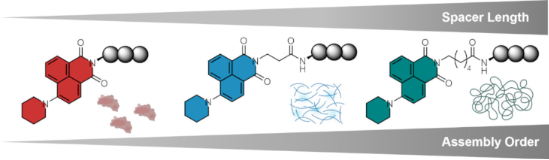
- synthesize the Cx-spacers, the anhydride was transformed into the imides by refluxing the corresponding amines with the anhydride in the presence of a catalytic amount of 4-(dimethylamino)pyridine (4-DMAP). Through reaction of 2 with 6-aminohexanoic acid, 6-(1,3-dioxo-6-(piperidin-1-yl)-1H-benzo[de


Synthesis of sterically shielded piperidine nitroxides via acid-catalyzed heterocyclization of β-aminoketone derivatives with ketones
Beilstein J. Org. Chem. 2026, 22, 948–954, doi:10.3762/bjoc.22.74
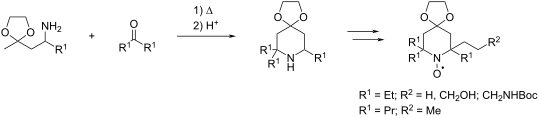
- in materials science and structural biology. The new heterocyclization strategy implies the construction of a 2,2,6-trisubstituted piperidine scaffold from β-aminoketone acetals and dialkyl ketones under acid catalysis. The resulting amines were oxidized to the corresponding ketonitrones and
- fragment ions corresponding to α-cleavage adjacent to the nitrogen atom, resulting in loss of the 2- or 6-alkyl substituent ([M−R]+) in agreement with established fragmentation patterns for cyclic amines [33]. The 2,2,6-trisubstituted piperidines 5a,b were oxidized to the corresponding ketonitrones 6a,b
- lower hydrogenation yields for 7b and 7c presumably stem from labile hydrogens in the substituents that promote N–O bond cleavage under hydrogenation conditions, leading to the corresponding amines [37]. It should be noted, however, that this proposed pathway remains speculative and requires further


Recent advances in copper-catalyzed direct hydroamination of alkenes with (hetero)aromatic amines
Beilstein J. Org. Chem. 2026, 22, 925–947, doi:10.3762/bjoc.22.73
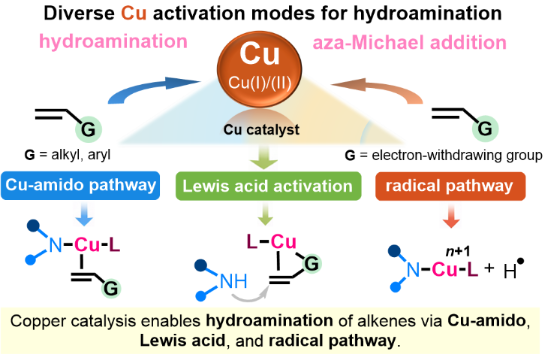
- Hyejeong Lee Yunmi Lee College of Pharmacy, Duksung Women’s University, Seoul 01369, Republic of Korea Department of Chemistry, Kwangwoon University, Seoul 01897, Republic of Korea 10.3762/bjoc.22.73 Abstract Nitrogen-containing aromatic amines and aza-heterocycles are ubiquitous motifs in
- , and functional group tolerance. This review summarizes recent advances in the copper-catalyzed hydroamination of alkenes with (hetero)aromatic N–H nucleophiles, emphasizing the mechanistic paradigms and the factors governing selectivity. Keywords: aromatic amines; aza-Michael addition; Cu catalysis
- ; hydroamination; N-heterocycles; Introduction Nitrogen-containing aromatic compounds, particularly aromatic amines and aza-heterocycles, are indispensable structural motifs in pharmaceuticals, agrochemicals, natural products, and advanced functional materials [1][2][3][4]. Their unique electronic characteristics






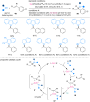

Palladium-catalyzed benzocyclization reactions of quinoline-2-carboxamides via sequential C–H/N–H functionalization
Beilstein J. Org. Chem. 2026, 22, 905–914, doi:10.3762/bjoc.22.71
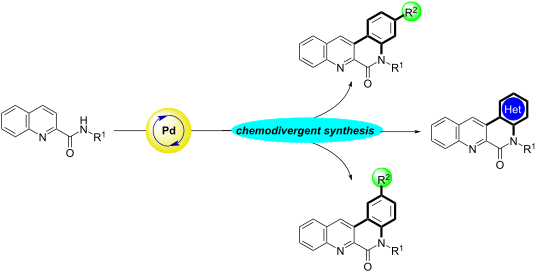
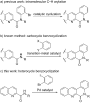
- allow facile preparation of aromatic amines (Scheme 1c) [28][29][30][31]. In general, intramolecular C–H arylation reactions in the presence of a transition-metal catalyst have been reported extensively in recent years. These reactions enable an efficient formation of fused-ring systems [32][33][34][35




Site-specific labelling of native peptides and proteins: chemical and enzymatic strategies
Beilstein J. Org. Chem. 2026, 22, 857–881, doi:10.3762/bjoc.22.67
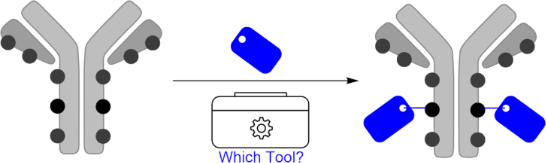
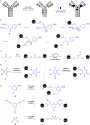
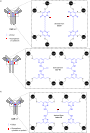
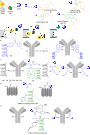
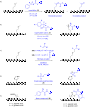
- and glutamine (or other small primary amides) is another frequently used enzyme for bioconjugation. The primary amide in glutamine is converted into an acyl intermediate that is subsequently attacked by amine nucleophiles such as lysine ε-amines and glycine α-amines. Although MTG can modify Gln295 on
- key amines on insulin, including the N-terminal glycine of chain A, the N-terminal phenylalanine of chain B and the ε-amino group of lysine B29. Using a colony picker and UPLC analysis, mutations were introduced within the binding pocket (to enhance localised recognition of insulin) and at distal
- -purification, complicating the engineering workflow. PGA optimisation benefited from the simplicity of insulin, which contains only three primary amines whose labelling can be readily resolved by UPLC, but such strategies become impractical for larger, lysine-rich proteins. For a broader overview, Zhu et al









Halogenated azobenzene acrylates: from efficient solution photoswitching to stable solid-state photochromic materials
Beilstein J. Org. Chem. 2026, 22, 782–794, doi:10.3762/bjoc.22.60
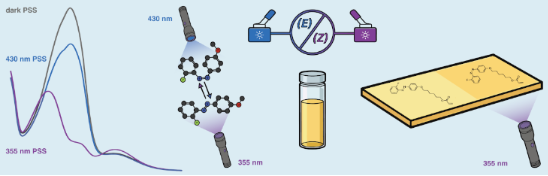
- salts prepared in situ from the commercially available aromatic amines 2a–f [25]. The reaction was buffered by a 10% aq solution of sodium hydroxide and afforded the azobenzenes 3a–f with yields ranging from 41 to 93%. These intermediates were further O-alkylated using 6-chlorohexanol in the presence of


Design, synthesis, and biological evaluation of FXR/ASK1 dual-target modulators
Beilstein J. Org. Chem. 2026, 22, 771–781, doi:10.3762/bjoc.22.59
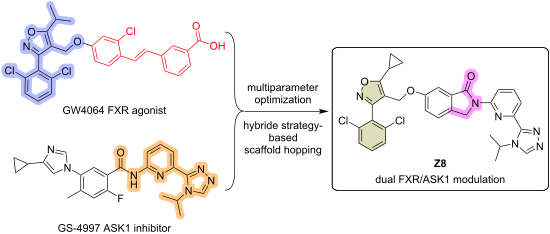
- preparation of triazole intermediates IXa–d is shown in Scheme 5. Firstly, compound VI was reacted with hydrazine hydrate in methanol to obtain hydrazide VII which was mixed with DMF/DMA and heated to provide intermediate VIII. The obtained VIII was not purified and directly reacted with different amines to
- % yield. Synthesis of compounds IXa–d. Conditions: (a) N2H4·H2O, MeOH, rt, 12 h; (b) DMF–DMA, 80 °C, 12 h; (c) amines (for IXa,c,d) or (R)-alanine methyl ester (for IXb), AcOH, MeCN, 90 °C, 16 h, 66–80% yield; (d) absolute stereochemistry is R. Synthesis of compounds Z1–15. Conditions: (a) K2CO3, KI, MeCN


Preparation of 3-(alkylamino)imidazo[1,2-a]pyridine-2-carbaldehydes via Kornblum oxidation and unexpected ring-opening reactions of the corresponding alcohols under oxidative conditions
Beilstein J. Org. Chem. 2026, 22, 763–770, doi:10.3762/bjoc.22.58
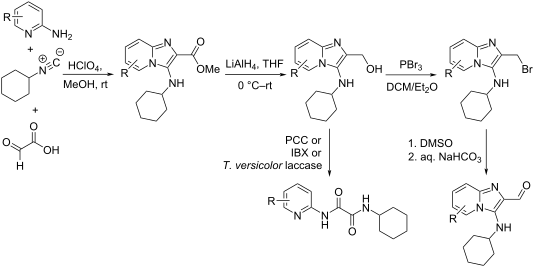
- reductive amination in mind. Imidazo[1,2-a]pyridin-3-amines bearing an aldehyde substituent at the 2-position have not been previously reported and we were uncertain as to their stability. Attempted reduction of the ester (13b) to the corresponding aldehyde using DIBAL-H met with failure, with unreacted


Synthesis of heterocycles based on azomethine ylides from α-amino acids (or amines) and carbonyl compounds
Beilstein J. Org. Chem. 2026, 22, 705–741, doi:10.3762/bjoc.22.55
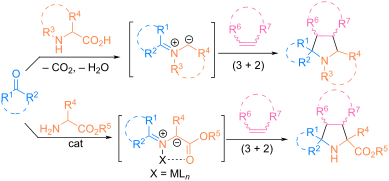
- amines) and to demonstrate their synthetic potential using a number of examples. The main strategies for synthesizing pyrrolidine derivatives via asymmetric and non-asymmetric 1,3-dipolar cycloaddition of azomethine ylides derived from cyclic and acyclic amino acids or amino esters with various carbonyl


Hydrogen production from formic acid catalyzed by NHC–Cu complexes
Beilstein J. Org. Chem. 2026, 22, 620–627, doi:10.3762/bjoc.22.48
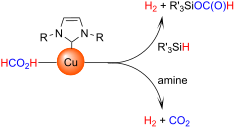
- ][29] and Rh [30][31] have shown to allow the selective transformation of formic acid into H2 and CO2 with high turnover frequencies (TOFs). In most cases, addition of a base (either amines or formate salts) is required to obtain high catalytic activity. Efficient systems based on inexpensive metals
- simplify the catalytic system leading to a decomposition pathway in line with previous reports, the replacement of silanes with other additives was considered. It has been shown that the addition of amines may be crucial for the catalytic FA dehydrogenation. Mixtures of FA/triethylamine have been
- generating an inactive species [44]. Electronic effects were next investigated. Electron-rich anilines like p-toluidine or p-anisidine led to lower conversions than p-chloroaniline (Table 2, entries 5, 8, and 10). As highlighted in Table 2, no correlation between the basicity of the amines and the


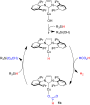

Computational prediction of C–H hydricities and their use in predicting the regioselectivity of electron-rich C–H functionalisation reactions
Beilstein J. Org. Chem. 2026, 22, 603–610, doi:10.3762/bjoc.22.46
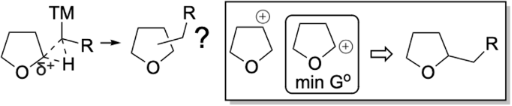
- is less sterically hindered (%Vbur = 62.3%). For comparison, the site with the lowest BDE has an intermediate value for %Vbur of 65.4%. Compounds 5 and 6 Allen and Lambert [42] reported the tropylium ion-mediated α-cyanation of amines, including compounds 5 and 6. In the case of compound 5, the


![[Graphic 6]](/bjoc/content/inline/1860-5397-22-46-i8.svg?max-width=637&scale=1.18182)


Cone p-aminocalix[4]arenes enriched with ‘clickable’ alkyne or azide functionalities
Beilstein J. Org. Chem. 2026, 22, 399–415, doi:10.3762/bjoc.22.28
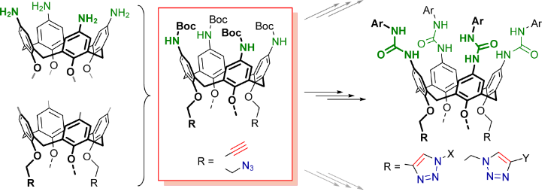
- virtually any functional units attached to them via triazole groups. Keywords: calixarene amines; dimeric capsules; functionalization; tetraureacalixarenes; triazoles; Introduction Considered generally as multifunctional molecular cores, calixarenes in their native forms as cyclic oligophenols actually
- groups, or vice versa. Of these two possibilities, the triazole synthesis conducted prior to the target acylation of amines seems to be more convenient, as the acylation may proceed under milder conditions than the CuAAC reaction. Even more important, the amine-derived functional units may interfere or
- affect the cycloaddition by, for instance, binding copper cations or counter anions, and thus their presence in the structures of calixarenes at the CuAAC step must be avoided. On the other hand, the unmodified amines may also contribute to undesired Cu(I) stabilization and complicate the CuAAC work up




Dialkylaminoalkylation of β-ketosulfones via ring-opening of 3-sulfonylpyrrolidines
Beilstein J. Org. Chem. 2026, 22, 383–389, doi:10.3762/bjoc.22.26
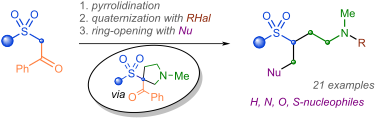
- of the quaternary ammonium salt in the presence of a O-, S- or N-nucleophile with cesium carbonate leads to a retro-Claisen reaction, ring-opening and Michael addition. The resulting novel 4-Nu-3-sulfonylbutan-1-amines are isolated in moderate to excellent overall yields. The reduction of the
- effects [14], сoagulation enzyme factor (FXa) inhibition [15] and antidepressant properties [16]. Considering the approaches to the synthesis of γ-aminosulfones, we focused our attention on the implementation of an aminoalkylation as a powerful and versatile tool for the synthesis of aliphatic amines [17
- -step method for the synthesis of N,N-dialkyl-3-(sulfonyl)butan-1-amines. Results and Discussion We began our survey with the examination of the pyrrolidination reaction [35][36] of β-ketosulfones (Scheme 1). This domino reaction of an active methylene compound, N-methylglycine and paraformaldehyde




Recent advances in the cleavage of non-activated amides
Beilstein J. Org. Chem. 2026, 22, 352–369, doi:10.3762/bjoc.22.23
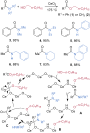
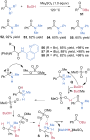
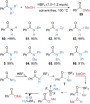
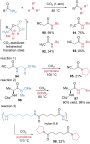
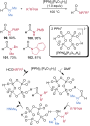
- nucleophilic anilines and bulky secondary amines also reacted smoothly, affording the corresponding amide products 104–107 in high to excellent yields. With respect to the R¹ substituent, phenyl, electron-rich phenyl, electron-poor phenyl, and heteroaryl groups were all well tolerated, affording the
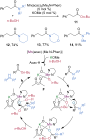
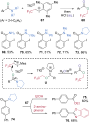
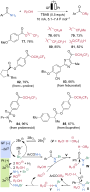
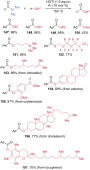
- . Bioactive molecule-derived amides with complex structures smoothly underwent acyl iodide generation, thereby furnishing the products 132, 133, and 134 in 85%, 82%, and 88% yield, respectively, via in-situ amidation with aniline. The scope of amine nucleophiles was broad as well. Anilines, primary amines
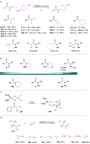
- , and secondary amines all furnished the corresponding amides 135–143 in high yields, though the sterically hindered 1-adamantylamine afforded the corresponding amide 142 in a moderate 56% yield. Notably, the tertiary amide moiety was cleaved with excellent chemoselectivity even in the presence of other










Synthesis of tricyclic fused pyrrolidine nitroxides from 2-alkynylpyrrolidine-1-oxyls
Beilstein J. Org. Chem. 2026, 22, 344–351, doi:10.3762/bjoc.22.22

- nitroxides 2d–f, the samples of the radicals were reduced to the corresponding diamagnetic amines using a Zn/CF3COOH system in CD3OD at 63 °C, according to a literature protocol [23] and the 1H NMR spectra were recorded. The spectra showed similarity to those of previously described for radicals 2a–c [20




Arene activation via π-bond localization: concepts and opportunities
Beilstein J. Org. Chem. 2026, 22, 257–273, doi:10.3762/bjoc.22.19
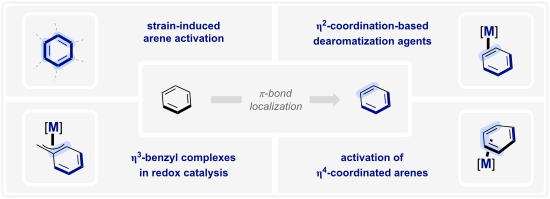
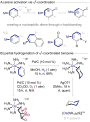
- ], allylgrignards [78], amines [79], and allenylstannanes [80], thereby accessing the corresponding propargyl-functionalized products (Scheme 6B). In parallel, Bao and co-workers demonstrated that the dearomatization manifold extends beyond simple benzenoid systems to include heteroarenes such as furans, thiophenes




A mild and atom-efficient four-component cascade strategy for the construction of biologically relevant 4-hydroxyquinolin-2(1H)-one derivatives
Beilstein J. Org. Chem. 2026, 22, 244–256, doi:10.3762/bjoc.22.18
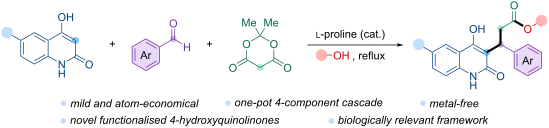
- , replacing alcohols with secondary amines (e.g., pyrrolidine) as the reaction medium did not lead to the desired amides. Experimental trials resulted in the formation of complex mixtures (as confirmed by 1H NMR), suggesting that the high reactivity of amines interferes with the selectivity of the cascade


Reactivity umpolung of the cycloheptatriene core in hexa(methoxycarbonyl)cycloheptatriene
Beilstein J. Org. Chem. 2026, 22, 64–70, doi:10.3762/bjoc.22.2
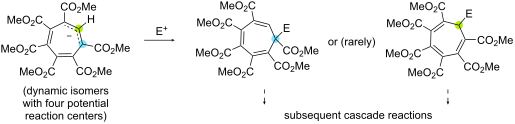
- partial positive charge on the i-positioned carbon atom [36], confirmed by an unusually downfield shifted signal of the CH fragment in the 13C NMR spectrum (δ 160.4 ppm in CD3CN) [21]. Moreover, anion 2 underwent a nucleophilic attack onto the i-position by amines to form fluorescent 5


Synthesis and applications of alkenyl chlorides (vinyl chlorides): a review
Beilstein J. Org. Chem. 2026, 22, 1–63, doi:10.3762/bjoc.22.1
- acetylenic ethers [97][98], ynones [99], ynamides [98][99][100][101][102], acetylenic selenides [103], thioalkynes [98][104], acetylenic nitriles [105], propargyl amines [106], propargylic amides [107], propargylic thioethers [106], propynoic acids [105], and propynoates [105][108] (Figure 8). Over the past

















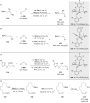


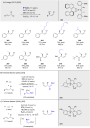


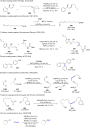


Competitive cyclization of ethyl trifluoroacetoacetate and methyl ketones with 1,3-diamino-2-propanol into hydrogenated oxazolo- and pyrimido-condensed pyridones
Beilstein J. Org. Chem. 2025, 21, 2716–2729, doi:10.3762/bjoc.21.209
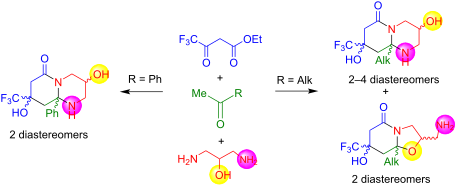
- the mechanistic aspects of these transformations. Our team has discovered a new multicomponent synthesis that is based on autocatalyzed reactions of ethyl trifluoroacetoacetate and other polyfluoroalkyl-3-oxo esters with α-methylenecarbonyl compounds and amines [9]. This approach is appropriate only
- minor when heated in 1,4-dioxane (Scheme 3, Table 3). Previously, we proposed and experimentally confirmed an aldol mechanism underlying the three-component cyclization of polyfluoroalkyl-3-oxo esters with α-methylene ketones and amines in piperidone derivatives. According to this mechanism, the key





