


Search results
Search for "zeolite" in Full Text gives 30 result(s) in Beilstein Journal of Organic Chemistry.
C2 to C6 biobased carbonyl platforms for fine chemistry
- Jingjing Jiang,
- Muhammad Noman Haider Tariq,
- Florence Popowycz,
- Yanlong Gu and
- Yves Queneau
Beilstein J. Org. Chem. 2025, 21, 2103–2172, doi:10.3762/bjoc.21.165
- of Lewis acid–base bifunctional catalyst (Zr-β zeolite and K2CO3) in the Meerwein–Ponndorf–Verley reduction of a concentrated furfural solution (17.3–80.5 wt % in ethanol) combined with in situ cross-aldol condensation with acetaldehyde and crotonization. Ethanol was used as hydrogen donor for the
- -designed Pd@S-1 and H-beta zeolite catalytic system, exhibiting high resistance to coking in presence of NH3. Subsequent carboxylation with CO2 and hydrogenation over Rh/C as catalyst led to racemic proline, an important precursor for pharmaceuticals, in quantitative yield. ᴅ-Proline was then obtained in
- -modified ultra-stable Zeolite Y (SY) [225] or PdNPs-TiO2/Al2O3/SiO2 [226]. Conversion to other carboxylic acids: Valeric acid (VA) and valerate esters (VEs), also named pentanoic acid or esters, are targeted as fuel additives and value-added chemicals. They are obtained by hydrogenation of levulinic acid

Graphical Abstract

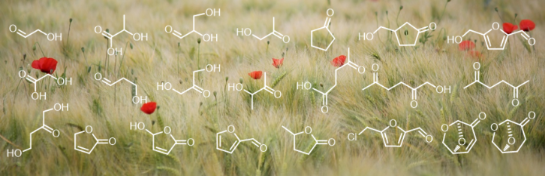
Figure 1: C2–C6 biobased carbonyl building blocks.

Scheme 1: Proposed (2 + 2) route to glycolaldehyde and glycolic acid from erythritol by Cu/AC catalyst (AC = ...

Scheme 2: Reductive amination of GCA.

Scheme 3: N-Formylation of secondary amines by reaction with GCA.

Scheme 4: Synthesis and conversion of hydroxy acetals to cyclic acetals.

Scheme 5: Synthesis of 3-(indol-3-yl)-2,3-dihydrofurans via three-component reaction of glycolaldehyde, indol...

Scheme 6: BiCl3-catalyzed synthesis of benzo[a]carbazoles from 2-arylindoles and α-bromoacetaldehyde ethylene...

Scheme 7: Cu/NCNSs-based conversion of glycerol to glycolic acid and other short biobased acids.

Scheme 8: E. coli-based biotransformation of C1 source molecules (CH4, CO2 and CO) towards C2 glycolic acid.

Scheme 9: N-Formylation of amines with C2 (a) or C3 (b) biomass-based feedstocks.

Scheme 10: Methods for the formation of propanoic acid (PA) from lactic acid (LA).

Scheme 11: Co-polymerization of biobased lactic acid and glycolic acid via a bicatalytic process.

Scheme 12: Oxidation of α-hydroxy acids by tetrachloroaurate(III) in acetic acid–sodium acetate buffer medium.

Figure 2: Selective catalytic pathways for the conversion of lactic acid (LA).

Scheme 13: Synthesis of 1,3-PDO via cross-aldol reaction between formaldehyde and acetaldehyde to 3-hydroxypro...

Scheme 14: Hydrothermal conversion of 1,3-dihydroxy-2-propane and 2,3-dihydroxypropanal to methylglyoxal.

Scheme 15: FLS-catalyzed formose reaction to synthesize GA and DHA.

Scheme 16: GCA and DHA oxidation products of glycerol and isomerization of GCA to DHA under flow conditions us...

Scheme 17: Acid-catalyzed reactions of DHA with alcohols.

Scheme 18: Synthesis of dihydroxyacetone phosphate from dihydroxyacetone.

Scheme 19: Bifunctional acid–base catalyst DHA conversion into lactic acid via pyruvaldehyde or fructose forma...

Scheme 20: Catalytic one-pot synthesis of GA and co-synthesis of formamides and formates from DHA.

Scheme 21: (a) Synthesis of furan derivatives and (b) synthesis of thiophene derivative by cascade [3 + 2] ann...

Scheme 22: Brønsted acidic ionic liquid catalyzed synthesis of benzo[a]carbazole from renewable acetol and 2-p...

Scheme 23: Asymmetric hydrogenation of α-hydroxy ketones to 1,2-diols.

Scheme 24: Synthesis of novel 6-(substituted benzylidene)-2-methylthiazolo [2,3-b]oxazol-5(6H)-one from 1-hydr...

Scheme 25: ʟ-Proline-catalyzed synthesis of anti-diols from hydroxyacetone and aldehydes.

Scheme 26: C–C-bond-formation reactions of a biomass-based feedstock aromatic aldehyde (C5) and hydroxyacetone...

Scheme 27: Ethanol upgrading to C4 bulk chemicals via the thiamine (VB1)-catalyzed acetoin condensation.

Scheme 28: One-pot sequential chemoenzymatic synthesis of 2-aminobutane-1,4-diol and 1,2,4-butanetriol via 1,4...

Scheme 29: Synthesis of 1,4-dihydroxybutan-2-one by microbial transformation.

Scheme 30: Conversion of polyols by [neocuproine)Pd(OAc)]2(OTf)2] to α-hydroxy ketones.

Scheme 31: Chemoselective oxidation of alcohols with chiral palladium-based catalyst 2.

Scheme 32: Electrochemical transformation of furfural to 5-hydroxy-2(5H)-furanone (HFO).

Scheme 33: Selective hydrodeoxygenation of HFO and oxidation to γ-butyrolactone (GBL).

Scheme 34: Photosensitized oxygenation of furan towards HFO via ozonide intermediates.

Scheme 35: Conversion of furfural to HFO and MAN by using mesoporous carbon nitride (SGCN) as photocatalyst.

Scheme 36: Synthesis of HFO from furan derivatives.

Scheme 37: Photooxidation of furfural to 5-hydroxy-2(5H)-furanone (HFO).

Scheme 38: Synthesis of Friedel–Crafts indole adduct from HFO.

Scheme 39: Conversion of HFO to α,γ-substituted chiral γ-lactones.

Scheme 40: Tautomeric transformation of HFO to formylacrylic acid.

Scheme 41: Hydrolysis of HFO to succinic acid in aqueous solution.

Scheme 42: Substitution and condensation reactions of 5-hydroxy-2(5H)-furanone (HFO).

Scheme 43: (a) Conversion of HFO towards valuable C4 chemicals and (b) anodic oxidation of 5-hydroxy-2(5H)-fur...

Figure 3: Conversion of HFO towards other natural and synthetic substances.

Scheme 44: Conversion of furfural to maleic anhydride (reaction a: VOx/Al2O3; reaction b: VPO).

Scheme 45: Conversion of furfural into succinic acid.

Scheme 46: Electro‑, photo‑, and biocatalysis for one-pot selective conversions of furfural into C4 chemicals.

Scheme 47: Production route of furfural from hemicellulose.

Scheme 48: Mechanism for xylose dehydration to furfural through a choline xyloside intermediate.

Scheme 49: Conversion of furfural to furfuryl alcohol and its derivatives.

Scheme 50: Conversion of furfural to furfuryl alcohol and 3-(2-furyl)acrolein.

Scheme 51: The aerobic oxidative condensation of biomass-derived furfural and linear alcohols.

Scheme 52: The single-step synthesis of 2-pentanone from furfural.

Scheme 53: Electrocatalytic coupling reaction of furfural and levulinic acid.

Scheme 54: Conversion of furfural to m-xylylenediamine.

Scheme 55: Conversion of furfural to tetrahydrofuran-derived amines.

Scheme 56: Formation of trans-4,5-diamino-cyclopent-2-enones from furfural.

Scheme 57: Production of pyrrole and proline from furfural.

Scheme 58: Synthesis of 1‑(trifluoromethyl)-8-oxabicyclo[3.2.1]oct-3-en-2-ones from furfural.

Scheme 59: Conversion of furfural to furfural-derived diacids.

Scheme 60: A telescope protocol derived from furfural and glycerol.

Scheme 61: A tandem cyclization of furfural and 5,5-dimethyl-1,3-cyclohexanedione.

Scheme 62: A Ugi four-component reaction to construct furfural-based polyamides.

Scheme 63: One-pot synthesis of γ-acyloxy-Cy7 from furfural.

Scheme 64: Dimerization–Piancatelli sequence toward humins precursors from furfural.

Scheme 65: Conversion of furfural to CPN.

Scheme 66: Synthesis of jet fuels range cycloalkanes from CPN and lignin-derived vanillin.

Scheme 67: Solar-energy-driven synthesis of high-density biofuels from CPN.

Scheme 68: Reductive amination of CPN to cyclopentylamine.

Scheme 69: Asymmetric hydrogenation of C=O bonds of exocyclic α,β-unsaturated cyclopentanones.

Scheme 70: Preparation of levulinic acid via the C5 route (route a) or C6 route (routes b1 and b2).

Scheme 71: Mechanism of the rehydration of HMF to levulinic acid and formic acid.

Scheme 72: Important levulinic acid-derived chemicals.

Scheme 73: Direct conversion of levulinic acid to pentanoic acid.

Scheme 74: Catalytic aerobic oxidation of levulinic acid to citramalic acid.

Scheme 75: Conversion of levulinic acid to 1,4-pentanediol (a) see ref. [236]; b) see ref. [237]; c) see ref. [238]; d) see r...

Scheme 76: Selective production of 2-butanol through hydrogenolysis of levulinic acid.

Scheme 77: General reaction pathways proposed for the formation of 5MPs from levulinic acid.

Scheme 78: Selective reductive amination of levulinic acid to N-substituted pyrroles.

Scheme 79: Reductive amination of levulinic acid to chiral pyrrolidinone.

Scheme 80: Reductive amination of levulinic acid to non-natural chiral γ-amino acid.

Scheme 81: Nitrogen-containing chemicals derived from levulinic acid.

Scheme 82: Preparation of GVL from levulinic acid by dehydration and hydrogenation.

Scheme 83: Ruthenium-catalyzed levulinic acid to chiral γ-valerolactone.

Scheme 84: Catalytic asymmetric hydrogenation of levulinic acid to chiral GVL.

Scheme 85: Three steps synthesis of ε-caprolactam from GVL.

Scheme 86: Multistep synthesis of nylon 6,6 from GVL.

Scheme 87: Preparation of MeGVL by α-alkylation of GVL.

Scheme 88: Ring-opening polymerization of five-membered lactones.

Scheme 89: Synthesis of GVL-based ionic liquids.

Scheme 90: Preparation of butene isomers from GVL under Lewis acid conditions.

Scheme 91: Construction of C5–C12 fuels from GVL over nano-HZSM-5 catalysts.

Scheme 92: Preparation of alkyl valerate from GVL via ring opening/reduction/esterification sequence.

Scheme 93: Construction of 4-acyloxypentanoic acids from GVL.

Scheme 94: Synthesis of 1,4-pentanediol (PDO) from GVL.

Scheme 95: Construction of novel cyclic hemiketal platforms via self-Claisen condensation of GVL.

Scheme 96: Copper-catalyzed lactamization of GVL.

Figure 4: Main scaffolds obtained from HMF.

Scheme 97: Biginelli reactions towards HMF-containing dihydropyrimidinones.

Scheme 98: Hantzsch dihydropyridine synthesis involving HMF.

Scheme 99: The Kabachnik–Fields reaction involving HMF.

Scheme 100: Construction of oxazolidinone from HMF.

Scheme 101: Construction of rhodamine-furan hybrids from HMF.

Scheme 102: A Groebke–Blackburn–Bienaymé reaction involving HMF.

Scheme 103: HMF-containing benzodiazepines by [4 + 2 + 1] cycloadditions.

Scheme 104: Synthesis of fluorinated analogues of α-aryl ketones.

Scheme 105: Synthesis of HMF derived disubstituted γ-butyrolactone.

Scheme 106: Functionalized aromatics from furfural and HMF.

Scheme 107: Diels–Alder adducts from HMF or furfural with N-methylmaleimide.

Scheme 108: Pathway of the one-pot conversion of HMF into phthalic anhydride.

Scheme 109: Photocatalyzed preparation of humins (L-H) from HMF mixed with spoiled HMF residues (LMW-H) and fur...

Scheme 110: Asymmetric dipolar cycloadditions on HMF.

Scheme 111: Dipolar cycloadditions of HMF based nitrones to 3,4- and 3,5-substituted isoxazolidines.

Scheme 112: Production of δ-lactone-fused cyclopenten-2-ones from HMF.

Scheme 113: Aza-Piancatelli access to aza-spirocycles from HMF-derived intermediates.

Scheme 114: Cross-condensation of furfural, acetone and HMF into C13, C14 and C15 products.

Scheme 115: Base-catalyzed aldol condensation/dehydration sequences from HMF.

Scheme 116: Condensation of HMF and active methylene nitrile.

Scheme 117: MBH reactions involving HMF.

Scheme 118: Synthesis of HMF-derived ionic liquids.

Scheme 119: Reductive amination/enzymatic acylation sequence towards HMF-based surfactants.

Scheme 120: The formation of 5-chloromethylfurfural (CMF).

Scheme 121: Conversion of CMF to HMF, levulinic acid, and alkyl levulinates.

Scheme 122: Conversion of CMF to CMFCC and FDCC.

Scheme 123: Conversion of CMF to BHMF.

Scheme 124: Conversion of CMF to DMF.

Scheme 125: CMF chlorine atom substitutions toward HMF ethers and esters.

Scheme 126: Introduction of carbon nucleophiles in CMF.

Scheme 127: NHC-catalyzed remote enantioselective Mannich-type reactions of CMF.

Scheme 128: Conversion of CMF to promising biomass-derived dyes.

Scheme 129: Radical transformation of CMF with styrenes.

Scheme 130: Synthesis of natural herbicide δ-aminolevulinic acid from CMF.

Scheme 131: Four step synthesis of the drug ranitidine from CMF.

Scheme 132: Pd/CO2 cooperative catalysis for the production of HHD and HXD.

Scheme 133: Different ruthenium (Ru) catalysts for the ring-opening of 5-HMF to HHD.

Scheme 134: Proposed pathways for preparing HXD from HMF.

Scheme 135: MCP formation and uses.

Scheme 136: Cu(I)-catalyzed highly selective oxidation of HHD to 2,5-dioxohexanal.

Scheme 137: Synthesis of N‑substituted 3‑hydroxypyridinium salts from 2,5-dioxohexanal.

Scheme 138: Ru catalyzed hydrogenations of HHD to 1,2,5-hexanetriol (a) see ref. [396]; b) see ref. [397]).

Scheme 139: Aviation fuel range quadricyclanes produced by HXD.

Scheme 140: Synthesis of HDGK from HXD and glycerol as a chain extender.

Scheme 141: Synthesis of serinol pyrrole from HXD and serinol.

Scheme 142: Synthesis of pyrroles from HXD and nitroarenes.

Scheme 143: Two-step production of PX from cellulose via HXD.

Scheme 144: Preparation of HCPN from HMF via hydrogenation and ring rearrangement.

Scheme 145: Suggested pathways from HMF to HCPN.

Scheme 146: α-Alkylation of HCPN with ethylene gas.

Scheme 147: Synthesis of 3-(hydroxymethyl)cyclopentylamine from HMF via reductive amination of HCPN.

Scheme 148: Production of LGO and Cyrene® from biomass.

Scheme 149: Synthesis of HBO from LGO and other applications.

Scheme 150: Construction of m-Cyrene® homopolymer.

Scheme 151: Conversion of Cyrene® to THFDM and 1,6-hexanediol.

Scheme 152: RAFT co-polymerization of LGO and butadienes.

Scheme 153: Polycondensation of HO-LGOL and diols with dimethyl adipate.

Scheme 154: Self-condensation of Cyrene® and Claisen–Schmidt reactions.

Scheme 155: Synthesis of 5-amino-2-(hydroxymethyl)tetrahydropyran from Cyrene®.
Synthesis, structure and π-expansion of tris(4,5-dehydro-2,3:6,7-dibenzotropone)
- Yongming Xiong,
- Xue Lin Ma,
- Shilong Su and
- Qian Miao
Beilstein J. Org. Chem. 2025, 21, 1–7, doi:10.3762/bjoc.21.1
- definitively synthesized. The three-dimensional graphene-like carbons formed in a zeolite-template are the carbon forms that are the closest to carbon schwarzites so far [6][7]. Fragments of carbon schwarzites that retain their key structural characteristics are negatively curved polycyclic arenes [8][9

Graphical Abstract

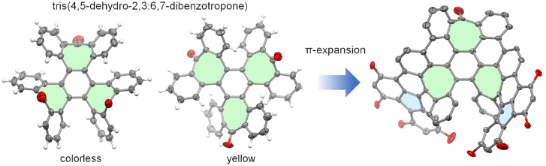
Figure 1: Structures of compounds 1–3 and the polycyclic skeleton of 1 as mapped on a carbon schwarzite unit ...

Scheme 1: a) Synthesis of 1; b) reactions of 1; c) synthesis of 3.

Figure 2: (a) Structures of 1 in the colorless crystal; (b) structures of (P,M,P)-1 in the yellow crystal. (C...

Figure 3: Structure of (M,P,M)-3 in the crystal of 3·CH2Cl2 (carbon and oxygen atoms are shown as grey and re...

Figure 4: UV–vis absorption spectrum (black line) and emission spectrum (blue line, excited at 400 nm) of com...
Decarboxylative 1,3-dipolar cycloaddition of amino acids for the synthesis of heterocyclic compounds
- Xiaofeng Zhang,
- Xiaoming Ma and
- Wei Zhang
Beilstein J. Org. Chem. 2023, 19, 1677–1693, doi:10.3762/bjoc.19.123
- ) [70]. We expected that using olefinic oxindoles 14 as alkenes for the [3 + 2] cycloaddition could afford spirooxindole-pyrrolizidines. The method development revealed that recyclable zeolite HY acid is a good catalyst for the cycloaddition [70]. Thus, the zeolite HY-catalyzed reaction of glycine with
- endo-transition state A to give spirooxindole-pyrrolizidine 17 which spontaneously reacts with another equiv of arylaldehyde to form ylide 18 in the presence of zeolite HY. The second [3 + 2] cycloaddition of 18 with 14a affords product 15a as a major product through an endo-cycloaddition and 15a’ as a

Graphical Abstract

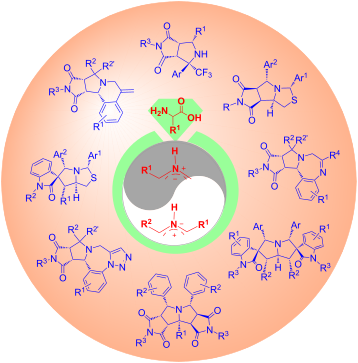
Figure 1: Classification of AMYs.
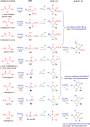
Scheme 1: Aminoester- and amino acid-based AMYs for single and double [3+2] cycloadditions.

Scheme 2: Formation of semi-stabilized AMYs B1 from pyrrolidines.

Scheme 3: Cyclic amine-based AMYs A3 and B1 for [3 + 2] cycloadditions.

Scheme 4: Proposed double cycloaddition reactions involving semi-stabilized AMYs.

Scheme 5: [3 + 2] Cycloaddition for the synthesis of trifluoromethylated pyrrolidines 9.

Figure 2: Biologically interesting pyrrolizidines.

Scheme 6: Double cycloadditions with glycine for the synthesis of products 10 (dr > 9:1).

Scheme 7: Double cycloadditions with α-substituted amino acids leading to products 11 (≈8.5:1 dr).

Scheme 8: Stereochemistry for the formation of products 10 or 11.

Scheme 9: One-pot and stepwise double cycloadditions. Conditions: i) MeCN (0.02 M), 90 °C, 6 h; ii) then AcOH...

Figure 3: Biologically interesting spirooxindole-pyrrolizidines.

Scheme 10: Double cycloadditions for the synthesis of bis[spirooxindole-pyrrolizidine]s.

Scheme 11: Mechanism for the diastereoselective synthesis of bis[spirooxindole-pyrrolizidine]s.

Scheme 12: Stepwise synthesis of triazolobenzodiazepine 21a.

Scheme 13: One-pot synthesis of triazolobenzodiazepines.

Figure 4: Bioactive triazolobenzodiazepine derivatives.

Scheme 14: One-pot synthesis of tetrahydropyrroloquinazolines.

Scheme 15: One-pot synthesis of tetrahydropyrrolobenzodiazepines.

Figure 5: Bioactive pyrroloquinazolines and pyrrolobenzodiazepines.

Scheme 16: Stepwise synthesis of pyrrolo[2,1-a]isoquinolines.

Figure 6: Bioactive pyrrolo[2,1-a]isoquinolines and hexahydropyrrolo[2,1-a]isoquinolines.

Figure 7: Bioactive tetrahydropyrrolothiazoles.

Scheme 17: Pseudo-four-component reaction for the synthesis of tetrahydropyrrolothiazoles 29 and 30 (>4:1 dr).

Scheme 18: One-pot two-step synthesis of spirooxindole-pyrrolothiazoles 31 (>4:1 dr).
One-pot double annulations to confer diastereoselective spirooxindolepyrrolothiazoles
- Juan Lu,
- Bin Yao,
- Desheng Zhan,
- Zhuo Sun,
- Yun Ji and
- Xiaofeng Zhang
Beilstein J. Org. Chem. 2022, 18, 1607–1616, doi:10.3762/bjoc.18.171
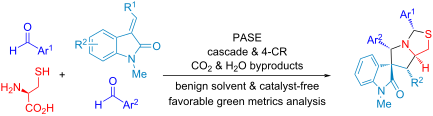
- one-pot reactions with recyclable organocatalysts [69]. Notably, we conferred K10 acid to promote the C–H activation in the synthesis of spirooxindolepyrrolidines, and used Zeolite HY catalyst to synthesize diastereoselective dispiro[oxindolepyrrolidine]s with a butterfly shape (Scheme 1A and 1B) [70

Graphical Abstract

Scheme 1: The diastereoselective synthesis of spirooxindoles through MCRs.

Figure 1: Bioactive Spirooxindole-pyrrolothiazoles.

Scheme 2: The synthesis of spirooxindolepyrrolothiazoles.

Scheme 3: Four-component reaction for the synthesis of compound 5.

Scheme 4: Proposed mechanism for the double [3 + 2] cycloadditions.

Scheme 5: The synthesis of compound 5a with ᴅ- and ʟ-cysteine.

Scheme 6: Two-step (process A) vs cascade (process B) synthesis of 5a. i) 1.0:1.15 of 1a/2, EtOH (0.05 M), 25...

Figure 2: Graphical representation of the green metrics (AE, AEf, CE, RME, OE and MP) analysis for processes ...

Figure 3: Graphical representation of the green metrics (PMI, E-factor, and SI) analysis for processes A and ...
Inductive heating and flow chemistry – a perfect synergy of emerging enabling technologies
- Conrad Kuhwald,
- Sibel Türkhan and
- Andreas Kirschning
Beilstein J. Org. Chem. 2022, 18, 688–706, doi:10.3762/bjoc.18.70
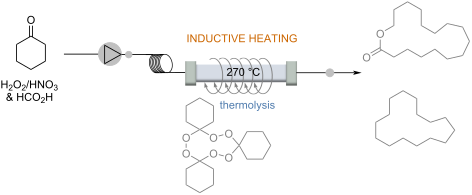
- ) from citronellal (1) as test reaction (Scheme 1). Thus, citronellal (1) was cyclized to isopulegol in the heating zone. This was achieved at 80 °C in 1,4-dioxane using a Zeolite-encapsulated magnetic nickel ferrite nanoparticles (NiFe2O4@TiO2@ZSM-5) catalyst, an aluminosilicate zeolite, which gave best

Graphical Abstract

Figure 1: Inductive heating, a powerful tool in industry and the Life Sciences.

Figure 2: Electric displacement field of a ferromagnetic and superparamagnetic material.

Figure 3: Temperature profiles of reactors heated conventionally and by RF heating (Figure 3 redrawn from [24]).

Scheme 1: Continuous flow synthesis of isopulegol (2) from citronellal (1).

Scheme 2: Dry (reaction 1) and steam (reaction 2) methane reforming.

Scheme 3: Calcination and RF heating.

Scheme 4: The continuously operated “Sabatier” process.

Scheme 5: Biofuel production from biomass using inductive heating for pyrolysis.

Scheme 6: Water electrolysis using an inductively heated electrolysis cell.

Scheme 7: Dimroth rearrangement (reaction 1) and three-component reaction (reaction 2) to propargyl amines 8 ...

Figure 4: A. Flow reactor filled with magnetic nanostructured particles (MagSilicaTM) and packed bed reactor ...

Scheme 8: Claisen rearrangement in flow: A. comparison between conventional heating (external oil bath), micr...
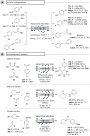
Scheme 9: Continuous flow reactions and comparison with batch reaction (oil bath). A. Pd-catalyzed transfer h...
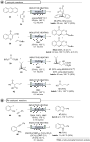
Scheme 10: Continuous flow reactions and comparison with batch reaction (oil bath). A. pericyclic reactions an...
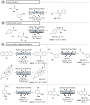
Scheme 11: Reactions under flow conditions using inductively heated fixed-bed materials serving as stoichiomet...
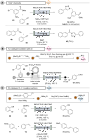
Scheme 12: Reactions under flow conditions using inductively heated fixed-bed materials serving as catalysts: ...

Scheme 13: Two step flow protocol for the preparation of 1,1'-diarylalkanes 77 from ketones and aldehydes 74, ...

Scheme 14: O-Alkylation, the last step in the multistep flow synthesis of Iloperidone (80) accompanied with a ...

Scheme 15: Continuous two-step flow process consisting of Grignard reaction followed by water elimination bein...

Scheme 16: Inductively heated continuous flow protocol for the synthesis of Iso E Super (88) [91,92].

Scheme 17: Three-step continuous flow synthesis of macrocycles 89 and 90 with musk-like olfactoric properties.
Recent advances and perspectives in ruthenium-catalyzed cyanation reactions
- Thaipparambil Aneeja,
- Cheriya Mukkolakkal Abdulla Afsina,
- Padinjare Veetil Saranya and
- Gopinathan Anilkumar
Beilstein J. Org. Chem. 2022, 18, 37–52, doi:10.3762/bjoc.18.4
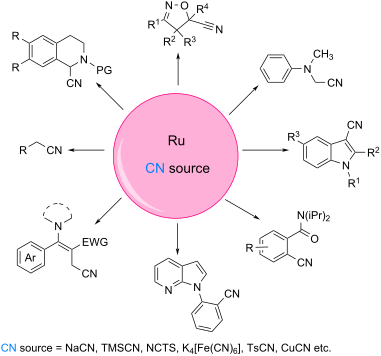
- arenes and heteroarenes using heterogeneous catalysts In 2012, a novel strategy for the 3-cyanation of indole in the presence of Ru(III)-exchanged NaY zeolite (RuY) was reported [36]. In this reaction K4[Fe(CN)6] was utilized as the cyano source in DMF at 110 °C. The Cu(OAc)2 and O2 (1 atm) was found
- mechanism for the ruthenium-catalyzed aerobic oxidative cyanation. RuCl3-catalyzed oxidative cyanation of tertiary amines using acetone cyanohydrin as the cyanating agent. Cyanation of indoles using K4[Fe(CN)6] as cyano source and Ru(III)-exchanged NaY zeolite (RuY) as catalyst. Cyanation of arenes and

Graphical Abstract

Scheme 1: Starch-immobilized ruthenium trichloride-catalyzed cyanation of tertiary amines.

Scheme 2: Proposed mechanism for the cyanation of tertiary amines using starch-immobilized ruthenium trichlor...

Scheme 3: Cyanation of tertiary amines using heterogeneous Ru/C catalyst.

Scheme 4: Proposed mechanism for cyanation of tertiary amines using a heterogeneous Ru/C catalyst.

Scheme 5: Ruthenium-carbamato complex-catalyzed oxidative cyanation of tertiary amines.

Scheme 6: Cyanation of tertiary amines using immobilized MCM-41-2N-RuCl3 as the catalyst.

Scheme 7: Cyanation of tertiary amines using RuCl3·nH2O as the catalyst and molecular oxygen as oxidant.

Scheme 8: RuCl3-catalyzed cyanation of tertiary amines using NaCN/HCN and H2O2 as oxidant.

Scheme 9: Proposed mechanism for the ruthenium-catalyzed oxidative cyanation using H2O2.

Scheme 10: Proposed mechanism for the ruthenium-catalyzed aerobic oxidative cyanation.

Scheme 11: RuCl3-catalyzed oxidative cyanation of tertiary amines using acetone cyanohydrin as the cyanating a...

Scheme 12: Cyanation of indoles using K4[Fe(CN)6] as cyano source and Ru(III)-exchanged NaY zeolite (RuY) as c...

Scheme 13: Cyanation of arenes and heteroarenes using a ruthenium(II) catalyst and N-cyano-N-phenyl-p-toluenes...

Scheme 14: Proposed mechanism for the cyanation of arenes and heteroarenes using ruthenium(II) as catalyst and...

Scheme 15: Synthesis of N-(2-cyanoaryl)-7-azaindoles.

Figure 1: Structure of the TiO2-immobilized ruthenium polyazine complex.

Scheme 16: Visible-light-induced oxidative cyanation of aza-Baylis–Hillman adducts.

Scheme 17: Synthesis of 1° alkyl nitriles using [Ru(bpy)3](PF6)2 as the photocatalyst.

Scheme 18: Synthesis of 2° and 3° alkyl nitriles using [Ru(bpy)3](PF6)2 as the photocatalyst.

Scheme 19: Photoredox cross coupling reaction.

Scheme 20: Synthesis of α-amino nitriles from amines via a one-pot strategy.

Scheme 21: Proposed mechanistic pathway for the cyanation of the aldimine intermediate.

Scheme 22: Strecker-type functionalization of N-aryl-substituted tetrahydroisoquinolines under flow conditions....

Scheme 23: One-pot synthesis of α-aminonitriles using RuCl3 as catalyst.

Scheme 24: Synthesis of alkyl nitriles using (Ru(TMHD)3) as the catalyst.

Scheme 25: Synthesis of cyanated isoxazolines from alkenyl oximes catalyzed by [RuCl2(p-cymene)]2 in the prese...

Scheme 26: Proposed mechanism for the synthesis of cyanated isoxazolines from alkenyl oximes.

Scheme 27: Oxidative cyanation of differently substituted alcohols.
Synthesis of 5-arylacetylenyl-1,2,4-oxadiazoles and their transformations under superelectrophilic activation conditions
- Andrey I. Puzanov,
- Dmitry S. Ryabukhin,
- Anna S. Zalivatskaya,
- Dmitriy N. Zakusilo,
- Darya S. Mikson,
- Irina A. Boyarskaya and
- Aleksander V. Vasilyev
Beilstein J. Org. Chem. 2021, 17, 2417–2424, doi:10.3762/bjoc.17.158

- (TfOH), the strong Lewis acids AlX3 (X = Cl, Br), or the acidic zeolite CBV-720. Results and Discussion The synthesis of 5-arylethynyl-1,2,4-oxadiazoles 3 was based on transformations of the corresponding 5-styryloxadiazoles, i.e., 5-(2-arylethenyl)-3-aryl-1,2,4-oxadiazoles 1a–g (Scheme 1). Bromination
- zeolite CBV-720 (Table 2). However, these Lewis acids showed unsatisfactory results leading to oligomeric materials (Table 2, entries 1 and 2). Probably, due to some secondary reactions of the formed compound 5a with AlCl3, AlBr3. The yield of target compound 5a in the reaction with zeolite was lower than

Graphical Abstract

Scheme 1: Synthesis of 5–arylethynyl-3-aryl-1,2,4-oxadiazoles 3a–e.

Scheme 2: Plausible reaction mechanism for transformations of 5-acetylenyl-1,2,4-oxadiazoles 3 in Brønsted su...

Scheme 3: Quantitative formation of E/Z-vinyl triflates 4a–c from 5-acetylenyl-1,2,4-oxadiazoles 3a–c in TfOH....

Scheme 4: Formation of compound 4d from 5-acetylenyl-1,2,4-oxadiazole 3a in H2SO4.
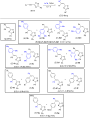
Scheme 5: Hydroarylation of 5-acetylenyl-1,2,4-oxadiazole 3a–d by arenes in TfOH leading to compounds E/Z-5a–g...
A comprehensive review of flow chemistry techniques tailored to the flavours and fragrances industries
- Guido Gambacorta,
- James S. Sharley and
- Ian R. Baxendale
Beilstein J. Org. Chem. 2021, 17, 1181–1312, doi:10.3762/bjoc.17.90
- coated multichannel microreactor with an integrated zeolite ZSM-5 membrane (Scheme 28) [156][157]. The heterogeneous catalyst used was a Cs-exchanged faujasite NaX. The membrane maximised the outcomes in comparison to tested fixed-bed and microreactors. The ZSM-5 membrane allowed fast water exclusion

Graphical Abstract

Figure 1: Representative shares of the global F&F market (2018) segmented on their applications [1].

Figure 2: General structure of an international fragrance company [2].

Figure 3: The Michael Edwards fragrance wheel.

Figure 4: Examples of oriental (1–3), woody (4–7), fresh (8–10), and floral (11 and 12) notes.

Figure 5: A basic depiction of batch vs flow.

Scheme 1: Examples of reactions for which flow processing outperforms batch.

Scheme 2: Some industrially important aldol-based transformations.

Scheme 3: Biphasic continuous aldol reactions of acetone and various aldehydes.

Scheme 4: Aldol synthesis of 43 in flow using LiHMDS as the base.

Scheme 5: A semi-continuous synthesis of doravirine (49) involving a key aldol reaction.

Scheme 6: Enantioselective aldol reaction using 5-(pyrrolidin-2-yl)tetrazole (51) as catalyst in a microreact...

Scheme 7: Gröger's example of asymmetric aldol reaction in aqueous media.

Figure 6: Immobilised reagent column reactor types.

Scheme 8: Photoinduced thiol–ene coupling preparation of silica-supported 5-(pyrrolidin-2-yl)tetrazole 63 and...

Scheme 9: Continuous-flow approach for enantioselective aldol reactions using the supported catalyst 67.

Scheme 10: Ötvös’ employment of a solid-supported peptide aldol catalyst in flow.

Scheme 11: The use of proline tetrazole packed in a column for aldol reaction between cyclohexanone (65) and 2...

Scheme 12: Schematic diagram of an aminosilane-grafted Si-Zr-Ti/PAI-HF reactor for continuous-flow aldol and n...

Scheme 13: Continuous-flow condensation for the synthesis of the intermediate 76 to nabumetone (77) and Microi...

Scheme 14: Synthesis of ψ-Ionone (80) in continuous-flow via aldol condensation between citral (79) and aceton...

Scheme 15: Synthesis of β-methyl-ionones (83) from citral (79) in flow. The steps are separately described, an...

Scheme 16: Continuous-flow synthesis of 85 from 84 described by Gavriilidis et al.

Scheme 17: Continuous-flow scCO2 apparatus for the synthesis of 2-methylpentanal (87) and the self-condensed u...

Scheme 18: Chen’s two-step flow synthesis of coumarin (90).

Scheme 19: Pechmann condensation for the synthesis of 7-hydroxyxcoumarin (93) in flow. The setup extended to c...

Scheme 20: Synthesis of the dihydrojasmonate 35 exploiting nitro derivative proposed by Ballini et al.

Scheme 21: Silica-supported amines as heterogeneous catalyst for nitroaldol condensation in flow.

Scheme 22: Flow apparatus for the nitroaldol condensation of p-hydroxybenzaldehyde (102) to nitrostyrene 103 a...

Scheme 23: Nitroaldol reaction of 64 to 105 employing a quaternary ammonium functionalised PANF.

Scheme 24: Enantioselective nitroaldol condensation for the synthesis of 108 under flow conditions.

Scheme 25: Enatioselective synthesis of 1,2-aminoalcohol 110 via a copper-catalysed nitroaldol condensation.

Scheme 26: Examples of Knoevenagel condensations applied for fragrance components.

Scheme 27: Flow apparatus for Knoevenagel condensation described in 1989 by Venturello et al.

Scheme 28: Knoevenagel reaction using a coated multichannel membrane microreactor.

Scheme 29: Continuous-flow apparatus for Knoevenagel condensation employing sugar cane bagasse as support deve...

Scheme 30: Knoevenagel reaction for the synthesis of 131–135 in flow using an amine-functionalised silica gel. ...

Scheme 31: Continuous-flow synthesis of compound 137, a key intermediate for the synthesis of pregabalin (138)...
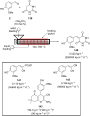
Scheme 32: Continuous solvent-free apparatus applied for the synthesis of compounds 140–143 using a TSE. Throu...

Scheme 33: Lewis et al. developed a spinning disc reactor for Darzens condensation of 144 and a ketone to furn...

Scheme 34: Some key industrial applications of conjugate additions in the F&F industry.

Scheme 35: Continuous-flow synthesis of 4-(2-hydroxyethyl)thiomorpholine 1,1-dioxide (156) via double conjugat...

Scheme 36: Continuous-flow system for Michael addition using CsF on alumina as the catalyst.

Scheme 37: Calcium chloride-catalysed asymmetric Michael addition using an immobilised chiral ligand.

Scheme 38: Continuous multistep synthesis for the preparation of (R)-rolipram (173). Si-NH2: primary amine-fun...

Scheme 39: Continuous-flow Michael addition using ion exchange resin Amberlyst® A26.

Scheme 40: Preparation of the heterogeneous catalyst 181 developed by Paixão et al. exploiting Ugi multicompon...

Scheme 41: Continuous-flow system developed by the Paixão’s group for the preparation of Michael asymmetric ad...

Scheme 42: Continuous-flow synthesis of nitroaldols catalysed by supported catalyst 184 developed by Wennemers...

Scheme 43: Heterogenous polystyrene-supported catalysts developed by Pericàs and co-workers.

Scheme 44: PANF-supported pyrrolidine catalyst for the conjugate addition of cyclohexanone (65) and trans-β-ni...

Scheme 45: Synthesis of (−)-paroxetine precursor 195 developed by Ötvös, Pericàs, and Kappe.

Scheme 46: Continuous-flow approach for the 5-step synthesis of (−)-oseltamivir (201) as devised by Hayashi an...

Scheme 47: Continuous-flow enzyme-catalysed Michael addition.

Scheme 48: Continuous-flow copper-catalysed 1,4 conjugate addition of Grignard reagents to enones. Reprinted w...

Scheme 49: A collection of commonly encountered hydrogenation reactions.

Figure 7: The ThalesNano H-Cube® continuous-flow hydrogenator.

Scheme 50: Chemoselective reduction of an α,β-unsaturated ketone using the H-Cube® reactor.

Scheme 51: Incorporation of Lindlar’s catalyst into the H-Cube® reactor for the reduction of an alkyne.

Scheme 52: Continuous-flow semi-hydrogenation of alkyne 208 to 209 using SACs with H-Cube® system.

Figure 8: The standard setups for tube-in-tube gas–liquid reactor units.

Scheme 53: Homogeneous hydrogenation of olefins using a tube-in-tube reactor setup.
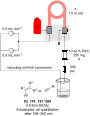
Scheme 54: Recyclable heterogeneous flow hydrogenation system.

Scheme 55: Leadbeater’s reverse tube-in-tube hydrogenation system for olefin reductions.

Scheme 56: a) Hydrogenation using a Pd-immobilised microchannel reactor (MCR) and b) a representation of the i...

Scheme 57: Hydrogenation of alkyne 238 exploiting segmented flow in a Pd-immobilised capillary reactor.

Scheme 58: Continuous hydrogenation system for the preparation of cyrene (241) from (−)-levoglucosenone (240).

Scheme 59: Continuous hydrogenation system based on CSMs developed by Hornung et al.

Scheme 60: Chemoselective reduction of carbonyls (ketones over aldehydes) in flow.

Scheme 61: Continuous system for the semi-hydrogenation of 256 and 258, developed by Galarneau et al.

Scheme 62: Continuous synthesis of biodiesel fuel 261 from lignin-derived furfural acetone (260).

Scheme 63: Continuous synthesis of γ-valerolacetone (263) via CTH developed by Pineda et al.

Scheme 64: Continuous hydrogenation of lignin-derived biomass (products 265, 266, and 267) using a sustainable...

Scheme 65: Ru/C or Rh/C-catalysed hydrogenation of arene in flow as developed by Sajiki et al.

Scheme 66: Polysilane-immobilized Rh–Pt-catalysed hydrogenation of arenes in flow by Kobayashi et al.

Scheme 67: High-pressure in-line mixing of H2 for the asymmetric reduction of 278 at pilot scale with a 73 L p...
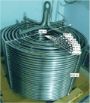
Figure 9: Picture of the PFR employed at Eli Lilly & Co. for the continuous hydrogenation of 278 [287]. Reprinted ...

Scheme 68: Continuous-flow asymmetric hydrogenation using Oppolzer's sultam 280 as chiral auxiliary.
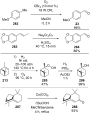
Scheme 69: Some examples of industrially important oxidation reactions in the F&F industry. CFL: compact fluor...

Scheme 70: Gold-catalysed heterogeneous oxidation of alcohols in flow.
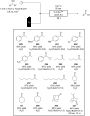
Scheme 71: Uozumi’s ARP-Pt flow oxidation protocol.

Scheme 72: High-throughput screening of aldehyde oxidation in flow using an in-line GC.

Scheme 73: Permanganate-mediated Nef oxidation of nitroalkanes in flow with the use of in-line sonication to p...

Scheme 74: Continuous-flow aerobic anti-Markovnikov Wacker oxidation.

Scheme 75: Continuous-flow oxidation of 2-benzylpyridine (312) using air as the oxidant.

Scheme 76: Continuous-flow photo-oxygenation of monoterpenes.

Scheme 77: A tubular reactor design for flow photo-oxygenation.

Scheme 78: Glucose oxidase (GOx)-mediated continuous oxidation of glucose using compressed air and the FFMR re...

Scheme 79: Schematic continuous-flow sodium hypochlorite/TEMPO oxidation of alcohols.

Scheme 80: Oxidation using immobilised TEMPO (344) was developed by McQuade et al.

Scheme 81: General protocol for the bleach/catalytic TBAB oxidation of aldehydes and alcohols.

Scheme 82: Continuous-flow PTC-assisted oxidation using hydrogen peroxide. The process was easily scaled up by...

Scheme 83: Continuous-flow epoxidation of cyclohexene (348) and in situ preparation of m-CPBA.

Scheme 84: Continuous-flow epoxidation using DMDO as oxidant.

Scheme 85: Mukayama aerobic epoxidation optimised in flow mode by the Favre-Réguillon group.

Scheme 86: Continuous-flow asymmetric epoxidation of derivatives of 359 exploiting a biomimetic iron catalyst.

Scheme 87: Continuous-flow enzymatic epoxidation of alkenes developed by Watts et al.

Scheme 88: Engineered multichannel microreactor for continuous-flow ozonolysis of 366.

Scheme 89: Continuous-flow synthesis of the vitamin D precursor 368 using multichannel microreactors. MFC: mas...

Scheme 90: Continuous ozonolysis setup used by Kappe et al. for the synthesis of various substrates employing ...

Scheme 91: Continuous-flow apparatus for ozonolysis as developed by Ley et al.

Scheme 92: Continuous-flow ozonolysis for synthesis of vanillin (2) using a film-shear flow reactor.

Scheme 93: Examples of preparative methods for ajoene (386) and allicin (388).

Scheme 94: Continuous-flow oxidation of thioanisole (389) using styrene-based polymer-supported peroxytungstat...

Scheme 95: Continuous oxidation of thiosulfinates using Oxone®-packed reactor.

Scheme 96: Continuous-flow electrochemical oxidation of thioethers.

Scheme 97: Continuous-flow oxidation of 400 to cinnamophenone (235).

Scheme 98: Continuous-flow synthesis of dehydrated material 401 via oxidation of methyl dihydrojasmonate (33).

Scheme 99: Some industrially important transformations involving Grignard reagents.

Scheme 100: Grachev et al. apparatus for continuous preparation of Grignard reagents.

Scheme 101: Example of fluidized Mg bed reactor with NMR spectrometer as on-line monitoring system.

Scheme 102: Continuous-flow synthesis of Grignard reagents and subsequent quenching reaction.

Figure 10: Membrane-based, liquid–liquid separator with integrated pressure control [52]. Adapted with permission ...

Scheme 103: Continuous-flow synthesis of 458, an intermediate to fluconazole (459).

Scheme 104: Continuous-flow synthesis of ketones starting from benzoyl chlorides.

Scheme 105: A Grignard alkylation combining CSTR and PFR technologies with in-line infrared reaction monitoring....

Scheme 106: Continuous-flow preparation of 469 from Grignard addition of methylmagnesium bromide.

Scheme 107: Continuous-flow synthesis of Grignard reagents 471.

Scheme 108: Preparation of the Grignard reagent 471 using CSTR and the continuous process for synthesis of the ...

Scheme 109: Continuous process for carboxylation of Grignard reagents in flow using tube-in-tube technology.

Scheme 110: Continuous synthesis of propargylic alcohols via ethynyl-Grignard reagent.

Scheme 111: Silica-supported catalysed enantioselective arylation of aldehydes using Grignard reagents in flow ...

Scheme 112: Acid-catalysed rearrangement of citral and dehydrolinalool derivatives.

Scheme 113: Continuous stilbene isomerisation with continuous recycling of photoredox catalyst.

Scheme 114: Continuous-flow synthesis of compound 494 as developed by Ley et al.

Scheme 115: Selected industrial applications of DA reaction.

Scheme 116: Multistep flow synthesis of the spirocyclic structure 505 via employing DA cycloaddition.

Scheme 117: Continuous-flow DA reaction developed in a plater flow reactor for the preparation of the adduct 508...

Scheme 118: Continuous-flow DA reaction using a silica-supported imidazolidinone organocatalyst.

Scheme 119: Batch vs flow for the DA reaction of (cyclohexa-1,5-dien-1-yloxy)trimethylsilane (513) with acrylon...

Scheme 120: Continuous-flow DA reaction between 510 and 515 using a shell-core droplet system.

Scheme 121: Continuous-flow synthesis of bicyclic systems from benzyne precursors.

Scheme 122: Continuous-flow synthesis of bicyclic scaffolds 527 and 528 for further development of potential ph...

Scheme 123: Continuous-flow inverse-electron hetero-DA reaction to pyridine derivatives such as 531.

Scheme 124: Comparison between batch and flow for the synthesis of pyrimidinones 532–536 via retro-DA reaction ...

Scheme 125: Continuous-flow coupled with ultrasonic system for preparation of ʟ-ascorbic acid derivatives 539 d...

Scheme 126: Two-step continuous-flow synthesis of triazole 543.

Scheme 127: Continuous-flow preparation of triazoles via CuAAC employing 546-based heterogeneous catalyst.

Scheme 128: Continuous-flow synthesis of compounds 558 through A3-coupling and 560 via AgAAC both employing the...

Scheme 129: Continuous-flow photoinduced [2 + 2] cycloaddition for the preparation of bicyclic derivatives of 5...

Scheme 130: Continuous-flow [2 + 2] and [5 + 2] cycloaddition on large scale employing a flow reactor developed...

Scheme 131: Continuous-flow preparation of the tricyclic structures 573 and 574 starting from pyrrole 570 via [...

Scheme 132: Continuous-flow [2 + 2] photocyclization of cinnamates.

Scheme 133: Continuous-flow preparation of cyclobutane 580 on a 5-plates photoreactor.

Scheme 134: Continuous-flow [2 + 2] photocycloaddition under white LED lamp using heterogeneous PCN as photocat...

Figure 11: Picture of the parallel tube flow reactor (PTFR) "The Firefly" developed by Booker-Milburn et al. a...

Scheme 135: Continuous-flow acid-catalysed [2 + 2] cycloaddition between silyl enol ethers and acrylic esters.

Scheme 136: Continuous synthesis of lactam 602 using glass column reactors.

Scheme 137: In situ generation of ketenes for the Staudinger lactam synthesis developed by Ley and Hafner.

Scheme 138: Application of [2 + 2 + 2] cycloadditions in flow employed by Ley et al.

Scheme 139: Examples of FC reactions applied in F&F industry.

Scheme 140: Continuous-flow synthesis of ibuprofen developed by McQuade et al.

Scheme 141: The FC acylation step of Jamison’s three-step ibuprofen synthesis.

Scheme 142: Synthesis of naphthalene derivative 629 via FC acylation in microreactors.

Scheme 143: Flow system for rapid screening of catalysts and reaction conditions developed by Weber et al.

Scheme 144: Continuous-flow system developed by Buorne, Muller et al. for DSD optimisation of the FC acylation ...

Scheme 145: Continuous-flow FC acylation of alkynes to yield β-chlorovinyl ketones such as 638.

Scheme 146: Continuous-flow synthesis of tonalide (619) developed by Wang et al.

Scheme 147: Continuous-flow preparation of acylated arene such as 290 employing Zr4+-β-zeolite developed by Kob...

Scheme 148: Flow system applied on an Aza-FC reaction catalysed by the thiourea catalyst 648.

Scheme 149: Continuous hydroformylation in scCO2.

Scheme 150: Two-step flow synthesis of aldehyde 655 through a sequential Heck reaction and subsequent hydroform...

Scheme 151: Single-droplet (above) and continuous (below) flow reactors developed by Abolhasani et al. for the ...

Scheme 152: Continuous hydroformylation of 1-dodecene (655) using a PFR-CSTR system developed by Sundmacher et ...

Scheme 153: Continuous-flow synthesis of the aldehyde 660 developed by Eli Lilly & Co. [32]. Adapted with permissio...

Scheme 154: Continuous asymmetric hydroformylation employing heterogenous catalst supported on carbon-based sup...

Scheme 155: Examples of acetylation in F&F industry: synthesis of bornyl (S,R,S-664) and isobornyl (S,S,S-664) ...

Scheme 156: Continuous-flow preparation of bornyl acetate (S,R,S-664) employing the oscillating flow reactor.

Scheme 157: Continuous-flow synthesis of geranyl acetate (666) from acetylation of geraniol (343) developed by ...

Scheme 158: 12-Ttungstosilicic acid-supported silica monolith-catalysed acetylation in flow.

Scheme 159: Continuous-flow preparation of cyclopentenone 676.

Scheme 160: Two-stage synthesis of coumarin (90) via acetylation of salicylaldehyde (88).

Scheme 161: Intensification process for acetylation of 5-methoxytryptamine (677) to melatonin (678) developed b...

Scheme 162: Examples of macrocyclic musky odorants both natural (679–681) and synthetic (682 and 683).

Scheme 163: Flow setup combined with microwave for the synthesis of macrocycle 686 via RCM.

Scheme 164: Continuous synthesis of 2,5-dihydro-1H-pyrroles via ring-closing metathesis.

Scheme 165: Continuous-flow metathesis of 485 developed by Leadbeater et al.

Figure 12: Comparison between RCM performed using different routes for the preparation of 696. On the left the...

Scheme 166: Continuous-flow RCM of 697 employed the solid-supported catalyst 698 developed by Grela, Kirschning...

Scheme 167: Continuous-flow RORCM of cyclooctene employing the silica-absorbed catalyst 700.

Scheme 168: Continuous-flow self-metathesis of methyl oleate (703) employing SILP catalyst 704.

Scheme 169: Flow apparatus for the RCM of 697 using a nanofiltration membrane for the recovery and reuse of the...

Scheme 170: Comparison of loadings between RCMs performed with different routes for the synthesis of 709.
An atom-economical addition of methyl azaarenes with aromatic aldehydes via benzylic C(sp3)–H bond functionalization under solvent- and catalyst-free conditions
- Divya Rohini Yennamaneni,
- Vasu Amrutham,
- Krishna Sai Gajula,
- Rammurthy Banothu,
- Murali Boosa and
- Narender Nama
Beilstein J. Org. Chem. 2020, 16, 3093–3103, doi:10.3762/bjoc.16.259
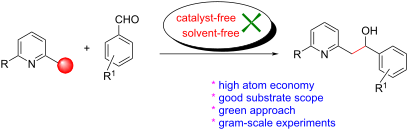
- p-nitrobenzaldehyde (2a) and 2,6-dimethylpyridine (1a) as model substrates. Our investigation started with the reaction of p-nitrobenzaldehyde (2a) and 2,6-dimethylpyridine (1a) in the presence of Hβ zeolite as a catalyst at 120 °C in toluene for 24 h in a sealed vial (Table 1, entry 1). However

Graphical Abstract

Scheme 1: Benzylic addition of aldehydes to azaarenes using different catalysts.

Scheme 2: Synthesis of azaarene derivatives from different precursors.

Scheme 3: Our work: catalyst- and solvent-free benzylic addition of aldehydes to azaarenes.

Scheme 4: Large-scale experiments for the synthesis of 2-(6-methylpyridin-2-yl)-1-(4-nitrophenyl)ethan-1-ol (...

Scheme 5: Plausible mechanism for the formation of 2-(6-methylpyridin-2-yl)-1-(4-nitrophenyl)ethan-1-ol (3a) ...
A new method for the synthesis of diamantane by hydroisomerization of binor-S on treatment with sulfuric acid
- Rishat I. Aminov and
- Ravil I. Khusnutdinov
Beilstein J. Org. Chem. 2020, 16, 2534–2539, doi:10.3762/bjoc.16.205

- , PtO2) in glacial acetic acid under high pressure conditions at 70 °С and 200 psi of H2 [8][9]. In the presence of superacid catalysts, such as B(OSO2CF3)3, CF3SO3H/SbF5 1:1, CF3SO3H/B(OSO2CF3)3 1:1 [10], NaBH4/CF3SO3H [11], or zeolite Y in the NaH form (NaY) [12], hydrocarbons 3a–c isomerize to

Graphical Abstract

Scheme 1: Isomerization of 3а–с to diamantane (1). Reaction conditions: (a) CoBr2·2PPh3–BF3·OEt2, 110 °C, 12 ...

Scheme 2: Isomerization of binor-S (2) to diamantane (1).

Scheme 3: Selective synthesis of tetrahydrobinor-S (3c) from binor-S (2).

Scheme 4: Isomerization of binor-S (2) to hydrocarbons 4а and b.
Natural dolomitic limestone-catalyzed synthesis of benzimidazoles, dihydropyrimidinones, and highly substituted pyridines under ultrasound irradiation
- Kumar Godugu,
- Venkata Divya Sri Yadala,
- Mohammad Khaja Mohinuddin Pinjari,
- Trivikram Reddy Gundala,
- Lakshmi Reddy Sanapareddy and
- Chinna Gangi Reddy Nallagondu
Beilstein J. Org. Chem. 2020, 16, 1881–1900, doi:10.3762/bjoc.16.156
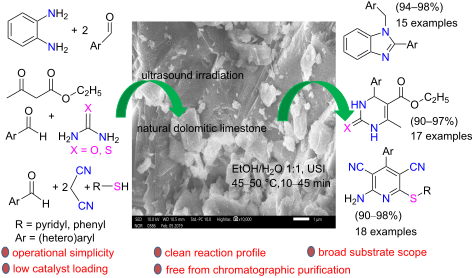
- –proline, trimethylsilyl chloride (TMSCl), Amberlite® IR-120, indion 190, trifluoroethanol, YCl3, HClO4–SiO2, MMZY zeolite, Er(OTf)3, etc. [22][23][24][25][26][27][28][29][30]. Developments in already established multicomponent reactions (MCRs) are interesting topics in organic synthesis. For instance, the

Graphical Abstract

Figure 1: The benzimidazoles I–IV, dihydropyrimidinones/-thiones V–VIII, and 2-amino-4-aryl-3,5-dicarbonitril...

Scheme 1: NDL-catalyzed synthesis of i) 1,2-disubstituted benzimidazoles 3, ii) dihydropyrimidinones/-thiones ...

Figure 2: XRD pattern of the NDL catalyst.

Figure 3: FTIR spectrum of the NDL catalyst.

Figure 4: Raman spectrum of the NDL catalyst.

Figure 5: SEM images of the NDL catalyst.

Figure 6: EDAX analysis of the NDL catalyst.

Scheme 2: Unexpected formation of the bisimine I, 3h, from o-phenylenediamine (1) and salicylaldehyde (2h).

Figure 7: 1H NMR spectrum of 2,2'-((1E,1'E)-(1,2-phenylenebis(azanylylidene))bis (methanylylidene))diphenol (...
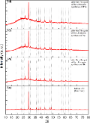
Figure 8: XRD pattern of a) the fresh NDL catalyst; b) the recovered NDL catalyst after the 7th cycle of the ...
Heterogeneous photocatalysis in flow chemical reactors
- Christopher G. Thomson,
- Ai-Lan Lee and
- Filipe Vilela
Beilstein J. Org. Chem. 2020, 16, 1495–1549, doi:10.3762/bjoc.16.125
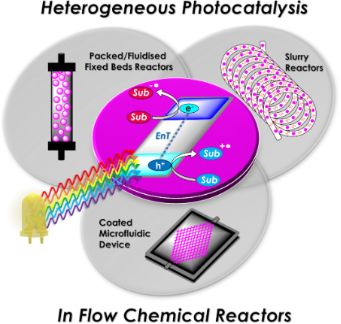
- recombination [154][155]. Suárez and co-workers used the photodeposition of platinum onto tungsten oxide (WO3) powder, before immobilising within a zeolite framework to produce visible light-active HPCats for the degradation of pollutants in air [156]. Scaiano and co-workers have also utilised photodeposition

Graphical Abstract

Figure 1: A) Bar chart of the publications per year for the topics “Photocatalysis” (49,662 instances) and “P...

Figure 2: A) Professor Giacomo Ciamician and Dr. Paolo Silber on their roof laboratory at the University of B...

Scheme 1: PRC trifluoromethylation of N-methylpyrrole (1) using hazardous gaseous CF3I safely in a flow react...

Figure 3: A) Unit cells of the three most common crystal structures of TiO2: rutile, brookite, and anatase. R...

Figure 4: Illustration of the key semiconductor photocatalysis events: 1) A photon with a frequency exceeding...
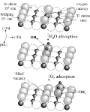
Figure 5: Photocatalytic splitting of water by oxygen vacancies on a TiO2(110) surface. Reprinted with permis...

Figure 6: Proposed adsorption modes of A) benzene, B) chlorobenzene, C) toluene, D) phenol, E) anisole, and F...

Figure 7: Structures of the sulfonate-containing organic dyes RB5 (3) and MX-5B (4) and the adsorption isothe...

Figure 8: Idealised triclinic unit cell of a g-C3N4 type polymer, displaying possible hopping transport scena...

Figure 9: Idealised structure of a perfect g-C3N4 sheet. The central unit highlighted in red represents one t...

Figure 10: Timeline of the key processes of charge transport following the photoexcitation of g-C3N4, leading ...

Scheme 2: Photocatalytic bifunctionalisation of heteroarenes using mpg-C3N4, with the selected examples 5 and ...

Figure 11: A) Structure of four linear conjugated polymer photocatalysts for hydrogen evolution, displaying th...

Figure 12: Graphical representation of the common methods used to immobilise molecular photocatalysts (PC) ont...

Figure 13: Wireless light emitter-supported TiO2 (TiO2@WLE) HPCat spheres powered by resonant inductive coupli...

Figure 14: Graphical representation of zinc–perylene diimide (Zn-PDI) supramolecular assembly photocatalysis v...

Scheme 3: Upconversion of NIR photons to the UV frequency by NaYF4:Yb,Tm nanocrystals sequentially coated wit...

Figure 15: Types of reactors employed in heterogeneous photocatalysis in flow. A) Fixed bed reactors and the s...

Figure 16: Electrochemical potential of common semiconductor, transition metal, and organic dye-based photocat...

Scheme 4: Possible mechanisms of an immobilised molecular photoredox catalyst by oxidative or reductive quenc...
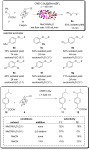
Scheme 5: Scheme of the CMB-C3N4 photocatalytic decarboxylative fluorination of aryloxyacetic acids, with the...

Scheme 6: Scheme of the g-C3N4 photocatalytic desilylative coupling reaction in flow and proposed mechanism [208].

Scheme 7: Proposed mechanism of the radical cyclisation of unsaturated alkyl 2-bromo-1,3-dicarbonyl compounds...

Scheme 8: N-alkylation of benzylamine and schematic of the TiO2-coated microfluidic device [213].

Scheme 9: Proposed mechanism of the Pt@TiO2 photocatalytic deaminitive cyclisation of ʟ-lysine (23) to ʟ-pipe...
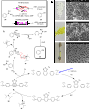
Scheme 10: A) Proposed mechanism for the photocatalytic oxidation of phenylboronic acid (24). B) Photos and SE...

Scheme 11: Proposed mechanism for the DA-CMP3 photocatalytic aza-Henry reaction performed in a continuous flow...

Scheme 12: Proposed mechanism for the formation of the cyclic product 32 by TiO2-NC HPCats in a slurry flow re...

Scheme 13: Reaction scheme for the photocatalytic synthesis of homo and hetero disulfides in flow and scope of...

Scheme 14: Reaction scheme for the MoOx/TiO2 HPCat oxidation of cyclohexane (34) to benzene. The graph shows t...

Scheme 15: Proposed mechanism of the TiO2 HPC heteroarene C–H functionalisation via aryl radicals generated fr...

Scheme 16: Scheme of the oxidative coupling of benzylamines with the HOTT-HATN HPCat and selected examples of ...
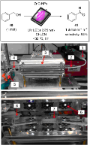
Scheme 17: Photocatalysis oxidation of benzyl alcohol (40) to benzaldehyde (41) in a microflow reactor coated ...

Figure 17: Mechanisms of Dexter and Forster energy transfer.
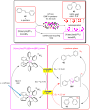
Scheme 18: Continuous flow process for the isomerisation of alkenes with an ionic liquid-immobilised photocata...

Scheme 19: Singlet oxygen synthetic step in the total synthesis of canataxpropellane [265].
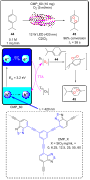
Scheme 20: Scheme and proposed mechanism of the singlet oxygen photosensitisation by CMP_X HPCats, with the st...

Scheme 21: Structures of CMP HPCat materials applied by Vilela and co-workers for the singlet oxygen photosens...
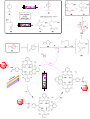
Scheme 22: Polyvinylchloride resin-supported TDCPP photosensitisers applied for singlet oxygen photosensitisat...

Scheme 23: Structure of the ionically immobilised TPP photosensitiser on amberlyst-15 ion exchange resins (TPP...

Scheme 24: Photosensitised singlet oxygen oxidation of citronellol (46) in scCO2, with automatic phase separat...

Scheme 25: Schematic of PS-Est-BDP-Cl2 being applied for singlet oxygen photosensitisation in flow. A) Pseudo-...

Scheme 26: Reaction scheme of the singlet oxygen oxidation of furoic acid (54) using a 3D-printed microfluidic...

Figure 18: A) Photocatalytic bactericidal mechanism by ROS oxidative cleavage of membrane lipids (R = H, amino...

Figure 19: A) Suggested mechanisms for the aqueous pollutant degradation by TiO2 in a slurry flow reactor [284-287]. B)...

Figure 20: Schematic of the flow system used for the degradation of aqueous oxytetracycline (56) solutions [215]. M...
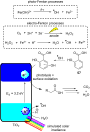
Scheme 27: Degradation of a salicylic acid (57) solution by a coupled solar photoelectro-Fenton (SPEF) process...

Figure 21: A) Schematic flow diagram using the TiO2-coated NETmix microfluidic device for an efficient mass tr...
MoO3 on zeolites MCM-22, MCM-56 and 2D-MFI as catalysts for 1-octene metathesis
- Hynek Balcar,
- Martin Kubů,
- Naděžda Žilková and
- Mariya Shamzhy
Beilstein J. Org. Chem. 2018, 14, 2931–2939, doi:10.3762/bjoc.14.272
- ][15][16][17]. Two dimensional 2D-MFI and MWW delaminated zeolite MCM-56, which have been prepared recently [18][19][20][21], represent two types of these materials, which exhibit relatively high surface areas and high accessibility of catalytic sites on the surface as well [22]. Therefore, we
- been already described [6] and it assumed that most of Mo active species in zeolite-based catalysts are formed by reacting molybdenum oxide with Si-O(H)-Al groups [12][27]. Similarly, Lim et al. showed recently [28], that Brønsted acid sites improve dispersion of molybdenum oxide on the surface
- . Moreover, for related system based on tungsten oxide in zeolite, it was suggested using high resolution STEM that Brønsted acid sites in proximity to metathesis active sites facilitate olefin adsorption and metallocycle formation [29]. Such mechanism may be effective also for Mo catalysts. The decrease in

Graphical Abstract

Scheme 1: 1-Octene metathesis reaction.

Figure 1: A,B,C,D: XRD patterns of parent supports and catalysts used. Asterisk marks MoO3.

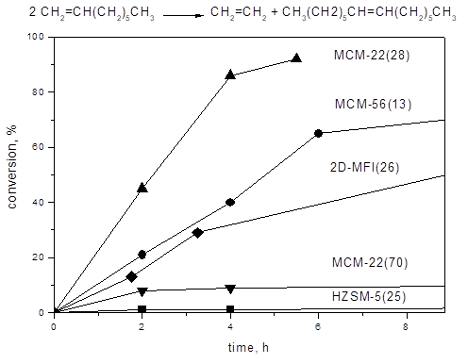
Figure 2: Conversion vs time curves for 1-octene metathesis over 6MoO3/MCM-22(28) and 6MoO3/SBA-15. Neat 1-oc...

Figure 3: Conversion vs time curves for the 1-octene metathesis over 6MoO3/MCM-56(13). Neat 1-octene, 1-octen...

Figure 4: Conversion vs time curves for 1-octene metathesis over 6MoO3/2D-MFI(26) and 6MoO3/HZSM-5(25). Neat ...

Figure 5: Conversion to oligomers for 1-octene over MCM-22(28) and MCM-22(70) (a) and conversion to oligomers...
Novel approach to hydroxy-group-containing porous organic polymers from bisphenol A
- Tao Wang,
- Yan-Chao Zhao,
- Li-Min Zhang,
- Yi Cui,
- Chang-Shan Zhang and
- Bao-Hang Han
Beilstein J. Org. Chem. 2017, 13, 2131–2137, doi:10.3762/bjoc.13.211
- : bisphenol A; carbon dioxide uptake; hydrogen storage; OH-containing; porous organic polymers; Introduction Porous organic polymers standing out from kinds of porous materials such as zeolite, activated carbon, metal-organic frameworks [1][2], and covalent organic frameworks [3][4], with their prominent

Graphical Abstract

Scheme 1: Schematic representation of the possible structures of bisphenol-A-based porous organic polymers.

Figure 1: FTIR spectra of terephthalic aldehyde (M1), BPA, and PPOP-1.

Figure 2: Solid-state 13C CP/MAS NMR spectrum of PPOP-1 recorded at the MAS rate of 5 kHz.
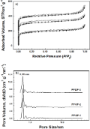
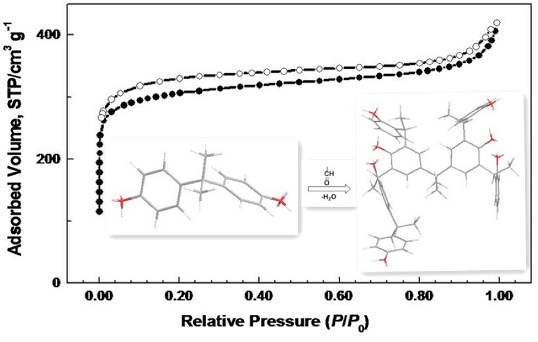
Figure 3: (a) Nitrogen adsorption–desorption isotherms of PPOP-1 (downtriangle), PPOP-2 (circle), and PPOP-3 ...

Figure 4: Gravimetric gas adsorption isotherms for PPOP-1 (downtriangle), PPOP-2 (circle), and PPOP-3 (square...

Figure 5: Variation of isosteric heat of adsorption with amount of adsorbed CO2 in PPOP-1, PPOP-2, and PPOP-3....
Sugar-based micro/mesoporous hypercross-linked polymers with in situ embedded silver nanoparticles for catalytic reduction
- Qing Yin,
- Qi Chen,
- Li-Can Lu and
- Bao-Hang Han
Beilstein J. Org. Chem. 2017, 13, 1212–1221, doi:10.3762/bjoc.13.120
- or embed the AgNPs into a supporting matrix. The loading of AgNPs on different substrates has been reported, for instance, SiO2 [23], TiO2 [24], Al2O3 [25], porous carbon [26], carbonaceous matrix [27], carboxymethyl chitosan [28], zeolite [29], cellulose [30], ZnO paper [31] and polymers such as PVP

Graphical Abstract
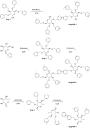
Scheme 1: Preparation of polymers SugPOP-1–3 (FDA: formaldehyde dimethyl acetal).

Figure 1: 13C CP/MAS NMR spectrum of SugPOP-3.
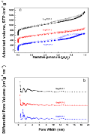
Figure 2: (a) Nitrogen adsorption–desorption isotherms of SugPOP-1–3 measured at 77 K. For clarity, the isoth...

Scheme 2: The preparation of AgNPs/SugPOP-1 composite by the in situ production of AgNPs.
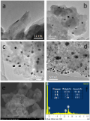
Figure 3: TEM images of the AgNPs/SugPOP-1 composite taken at different reaction times: (a) 0 h, (b) 8 h; (c)...

Figure 4: Nitrogen sorption isotherm at 77 K and the pore size distribution profile calculated by NLDFT analy...
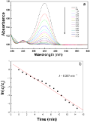
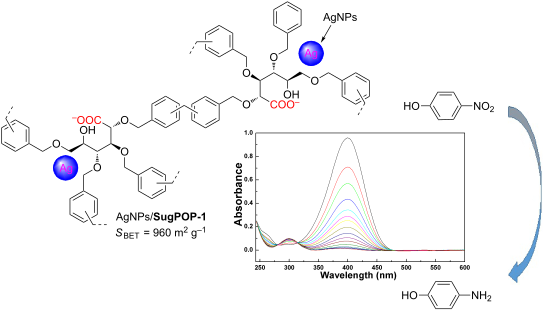
Figure 5: Catalytic performance of the AgNPs/SugPOP-1 composite. Time-dependent UV–vis spectral changes (a) a...
Isosorbide and dimethyl carbonate: a green match
- Fabio Aricò and
- Pietro Tundo
Beilstein J. Org. Chem. 2016, 12, 2256–2266, doi:10.3762/bjoc.12.218
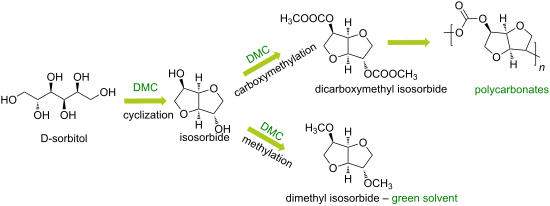
- . However, zeolites are not very efficient catalysts for the dehydration of D-sorbitol as isosorbide yields usually range between 40 to 60% [57][63][64]. Furthermore they also require high temperature, i.e., 430–533 K. Recently Fukuoka and co-workers reported a new efficent Hβ zeolite with a high Si/Al
- ratio (up to 75) that showed an improved activity and allowed dehydration of D-sorbitol into isosorbide in 76% yield at 400 K (127 °C) [65]. The Hβ zeolite can also be reused up to five times before losing its activity as catalyst. Despite this methodology being one of the most promising so far reported

Graphical Abstract

Figure 1: The DOE “Top 10” report [2].

Figure 2: Chemical structure of isosorbide and its epimers isomannide and isoidide.

Scheme 1: Conversion of D-sorbitol to isosorbide via twofold dehydration reaction.

Scheme 2: Possible reaction mechanism for the conversion of D-sorbitol to isosorbide.

Scheme 3: Methoxycarbonylation of isosorbide via DMC chemistry.

Scheme 4: Isosorbide homo- and co-polycarbonate via melt polycondensation.

Scheme 5: Synthesis of DMI via DMC chemistry.

Scheme 6: Comparison of the reactivity of isosorbide with other secondary alcohols in methylation reaction. R...

Figure 3: Chemical structure of isosorbide and its epimers isomannide and isoidide.
Diels–Alder reactions in confined spaces: the influence of catalyst structure and the nature of active sites for the retro-Diels–Alder reaction
- Ángel Cantín,
- M. Victoria Gomez and
- Antonio de la Hoz
Beilstein J. Org. Chem. 2016, 12, 2181–2188, doi:10.3762/bjoc.12.208

- Científica Aplicada (IRICA), Avda. Camilo José Cela s/n, E-13071-Ciudad Real, Spain 10.3762/bjoc.12.208 Abstract Diels–Alder cycloaddition between cyclopentadiene and p-benzoquinone has been studied in the confined space of a pure silica zeolite Beta and the impact on reaction rate due to the concentration
- effect within the pore and diffusion limitations are discussed. Introduction of Lewis or Brønsted acid sites on the walls of the zeolite strongly increases the reaction rate. However, contrary to what occurs with mesoporous molecular sieves (MCM-41), Beta zeolite does not catalyse the retro-Diels–Alder
- ] in where different stereoisomers could be obtained. Lewis-acid centers contained within the framework of zeolite beta (Zr-β, Sn-β) are useful catalysts in the Diels–Alder reaction for the production of bio-based terephthalic acid precursors, one of the monomers for the synthesis of polyethylene

Graphical Abstract

Scheme 1: Distribution of products in the Diels–Alder reaction between cyclopentadiene and p-benzoquinone.

Figure 1: Conversion in the DAR catalysed by silica Beta zeolites and Aerosil.

Figure 2: Effect of Lewis and Brønsted acid sites in the conversion (a) and selectivity (b) of the DAR.

Figure 3: Effect of pore size in the conversion (a) and selectivity (b) of the DAR.

Figure 4: Comparison of conversion (a) and selectivity (b) of the DAR catalysed by Al-Beta zeolite and MCM-41....

Figure 5: Comparison of conversion (a) and selectivity (b) of the DAR catalysed extra-large pore 3D zeolites.

Figure 6: Effect of the Si/Al ratio in the conversion (a) and selectivity (b) of the DAR.

Figure 7: Effect of the reutilization of the catalysts in the conversion (a) and selectivity (b) of the DAR.
Superelectrophilic activation of 5-hydroxymethylfurfural and 2,5-diformylfuran: organic synthesis based on biomass-derived products
- Dmitry S. Ryabukhin,
- Dmitry N. Zakusilo,
- Mikhail O. Kompanets,
- Anton A.Tarakanov,
- Irina A. Boyarskaya,
- Tatiana O. Artamonova,
- Mikhail A. Khohodorkovskiy,
- Iosyp O. Opeida and
- Aleksander V. Vasilyev
Beilstein J. Org. Chem. 2016, 12, 2125–2135, doi:10.3762/bjoc.12.202
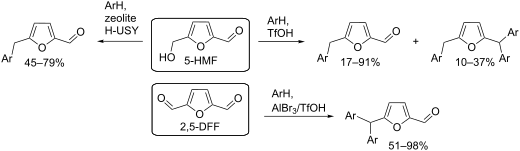
- reactions of 5-HMF (1a) with various arenes in TfOH. Additionally we investigated the reactions under the action of zeolite CBV-720, since zeolites are considered as “green” catalysts in organic synthesis [60][61][62][63][64][65][66] and the data are collected in Table 4. Similarly to the reaction with
- benzene (Table 3), 1a with other arenes yielded 5-arylmethylfurfurals 3b–o in TfOH or with zeolite CBV-720. However, the use of activated arenes, such as toluene, xylenes and pseudocumene, afforded additional Friedel–Crafts products, namely furans 4a–e (Table 4, entries 1, 2, 4–8, 11–13, and 15). These
- blocking zeolite acidic sites by π-donating arenes. Individually isolated compounds 3f and 3g being dissolved in TfOH at room temperature for 24 h gave rise to mixtures containing furans 4c and 4d along with starting 3f and 3g, respectively. This may prove that compounds 4 are the secondary reaction

Graphical Abstract

Figure 1: Formation of 5-HMF from D-glucose or D-fructose followed by oxidation to 2,5-DFF.

Scheme 1: Protonation of 5-HMF (1a) and 2,5-DFF (2) leading to cationic species A, B, C, D.

Figure 2: X-ray crystal structure of compounds 5a (a), and 5c (b) (ORTEP diagrams, ellipsoid contour of proba...
Biocatalysis for the application of CO2 as a chemical feedstock
- Apostolos Alissandratos and
- Christopher J. Easton
Beilstein J. Org. Chem. 2015, 11, 2370–2387, doi:10.3762/bjoc.11.259
- . Zeolite systems utilising Ge or Si, recently described, were able to efficiently dehydrogenate formic acid. This was guided through computational calculations, allowing the design of a zeolite catalyst displaying over 94% selectivity over the counter-productive formate dehydration reaction [145]. The
- combination of biological systems for centralised hydrogen storage through CO2 reduction as formate, with cheap zeolite catalysts for decentralised on demand hydrogen regeneration appears a very promising sustainable approach toward a hydrogen economy (Figure 6). In vitro production of CO with CODH Reduction

Graphical Abstract

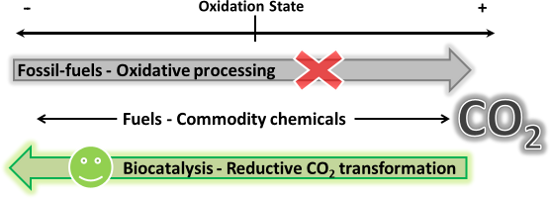
Figure 1: Biocatalytic routes for conversion of CO2 into compounds with carbon in the reduced oxidation state...

Figure 2: Carbonic anhydrase-catalysed rapid interconversion of CO2 and HCO3− in living systems.

Scheme 1: The Calvin cycle for fixation of CO2 with RuBisCO.

Scheme 2: The reductive TCA cycle with CO2 fixation enzymes designated.
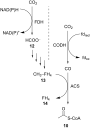
Scheme 3: The Wood–Ljungdahl pathway for generation of acetyl-CoA through reduction of CO2 to formate and CO....

Scheme 4: The acyl-CoA carboxylase pathways for autotrophic CO2 fixation. ACC: acetyl-CoA/propionyl-CoA carbo...

Figure 3: RuBisCO CO2-fixing bypass installed in E. coli and S. cerevisiae to increase carbon flux toward pro...

Scheme 5: Integrated biocatalytic system for carboxylation of phosphoenolpyruvate (19), using PEPC and carbon...
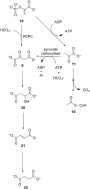
Scheme 6: PEPC and pyruvate carboxylase catalysed carboxylation of pyruvate backbone for the generation of ox...

Scheme 7: Decarboxylase catalysed carboxylation of (a) phenol derivatives, (b) indole and (c) pyrrole.

Figure 4: Formate dehydrogenase (FDH) catalysed reversible reduction of CO2 to formate with electron donor re...

Figure 5: Sequential generation of formate, formaldehyde and methanol from CO2 using reducing equivalents sou...

Figure 6: Hydrogen storage as formic acid through biocatalytic hydrogenation of CO2 and subsequent on-demand ...

Figure 7: Schematic showing required flow of reducing equivalents for CO2 fixation through biotechnological a...
Ru complexes of Hoveyda–Grubbs type immobilized on lamellar zeolites: activity in olefin metathesis reactions
- Hynek Balcar,
- Naděžda Žilková,
- Martin Kubů,
- Michal Mazur,
- Zdeněk Bastl and
- Jiří Čejka
Beilstein J. Org. Chem. 2015, 11, 2087–2096, doi:10.3762/bjoc.11.225
- ) not allowing to anchor appropriate alkylidene complexes in the channel system and to ensure accessibility of catalytic centers by reactants. However, new methods for the preparation of lamellar (also called two-dimensional) zeolite with high surface area and layered structure have been developed [23
- the prepared zeolite, the individual zeolitic layers exhibit or do not exhibit micropore character. Two dimensional zeolites are usually prepared by a bottom-up hydrothermal synthesis [26]; recently also a top-down approach from germanosilicate zeolite UTL was reported [27]. The latter approach
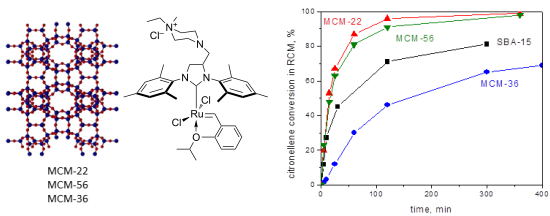
- zeolites MCM-22, MCM-56, and MCM-36. Linker-free immobilizations, consisting in mixing zeolite supports with catalyst solutions and stirring the corresponding suspensions at room temperature, were successfully used. Hybrid catalysts formed (Ru content from 0.7 to 1.1 wt %) exhibited a firm attachment of Ru

Graphical Abstract

Figure 1: Hoveyda–Grubbs type catalysts used for immobilization.

Scheme 1: RCM of (−)-β-citronellene (1) and N,N-diallyl-2,2,2-trifluoroacetamide (2).

Figure 2: Conversion vs time dependence for RCM of (−)-β-citronellene over HGIIN+Cl−/MCM-36 (●), HGIIN+Cl−/SB...

Figure 3: Conversion vs. time dependences for RCM of DAF over catalysts HGIIN+Cl−/MCM-22 (▲), HGIIN+Cl−/MCM-5...

Figure 4: Splitting test for HGIIN+Cl−/MCM-56 in RCM of (−)-β-citronellene. Toluene, 60 °C, molar ratio (−)-β...

Figure 5: Self-metathesis of methyl oleate over HGIIN+Cl−/SBA-15 (■), HGIIN+Cl−/MCM-22 (▲), HGIIN+Cl−/MCM-56 ...

Scheme 2: Cross-metathesis of methyl oleate with cis-3-hexenyl acetate.

Figure 6: Conversion curves for CM of methyl oleate (full symbols) with cis-3-hexenyl acetate (open symbols) ...
Continuous flow nitration in miniaturized devices
- Amol A. Kulkarni
Beilstein J. Org. Chem. 2014, 10, 405–424, doi:10.3762/bjoc.10.38
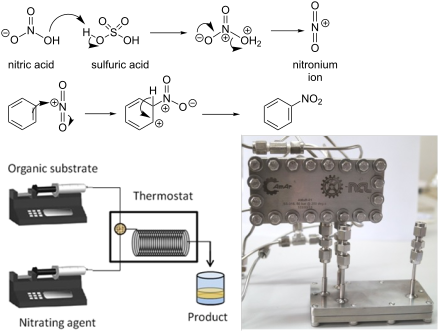
- be overlooked without focusing entirely on using the “micro reactor” concept. 3.1.4 Nitration with solid acid catalysts. The continuous flow vapour phase nitration using a solid acid catalyst has also been explored [26]. It is known that the solid acid catalysts, i.e., ZSM and other zeolite catalysts

Graphical Abstract

Figure 1: Analysis of the literature on aromatic nitration over the last 50 years. Numbers next to each nitra...

Figure 2: Schematic of a typical experimental setup for aromatic nitration. The circular segment shown inside...

Scheme 1: Nitration of substituted pyrazole-5-carboxylic acid 1. T = 90 °C, residence time = 35 min, yield: 7...

Scheme 2: Nitration of 2-methylindole (4). T = 3 °C, residence time = 48 s, yield: 70%. [27].

Scheme 3: Nitration of pyridine-N-oxide (6), T = 120 °C, residence time = 80 min, yield: 78% (72% in the flas...

Scheme 4: Nitration of toluene (8). Method 1: H2SO4/HNO3, T = 65 °C, residence time = 15 min. Method 2: Ac2O/H...

Figure 3: Graphical presentation of a microreactor used for double nitration and the schematic of the experim...

Scheme 5: Nitration of 2-amino-6-chloro-4-pyrimidinol (14) [25].

Scheme 6: Nitration of benzaldehyde (16) [35].

Scheme 7: Nitration of salicylic acid (19) [30].

Scheme 8: Nitration of phenol (22) yielding mono-nitro isomers 23 and 24 as main products, hydroquinone (25),...

Scheme 9: Synthesis of 3-methyl-4-nitropyrazole (29) and 3,5-dimethyl-4-nitropyrazole (31) [31].

Figure 4: Photograph of the experimental setup for the synthesis of alkyl-nitropyrazoles. IMM’s SIMM-V2 micro...

Scheme 10: Nitration of chlorobenzene (33) [23].

Figure 5: Continuous flow nitration of chlorobenzene (33) with nitric acid in a sequence of continuously stir...

Scheme 11: Nitration of 2-isopropoxybenzaldehyde (36) by using red fuming nitric acid [37].

Figure 6: Silicon-glass microreactor by Knapkiewicz et al. [37]. (A) Layout of the microreactor with a built-in m...

Scheme 12: Synthesis of nitropyridine (40) [39].

Figure 7: Schematic of the experimental setup involving a pressure based charging system [39]. Reproduced with pe...

Scheme 13: Nitration of p-difluorobenzene (42) [40].

Figure 8: Schematic of the flow reactor arrangement. Reproduced with permission from [40]. Copyright 2013 The Ame...

Scheme 14: Nitration of naphthalene (47) [34].

Figure 9: Structure of the microreactor. (A) Top view (1, 2 – inlets, 3 – mixing points, 4 – outlet). (B) Lat...

Scheme 15: Nitration of 2-nitropropane (52) [38].

Figure 10: Schematic of the continuous nitration system reported in CN103044261A [56].
Practical synthesis of indoles and benzofurans in water using a heterogeneous bimetallic catalyst
- Cybille Rossy,
- Eric Fouquet and
- François-Xavier Felpin
Beilstein J. Org. Chem. 2013, 9, 1426–1431, doi:10.3762/bjoc.9.160

- CuI [19][20][21]. Alternatively, copper-free heterogeneous catalysis has been proposed thanks to the Lewis acid properties of zeolite [(NH4)Y] used as support [22][23][24]. A challenging approach consisting of a heterobimetallic catalysis has been occasionally envisaged. This area was pioneered by the

Graphical Abstract

Scheme 1: Sonogashira alkynylation–cyclization sequence for indole and benzofuran syntheses.

Scheme 2: Optimization of the nitrogen protecting group. aReaction conditions: 2-iodoaniline (0.5 mmol), phen...

Scheme 3: Preparation of N-protected 2-iodoanilines.

Scheme 4: Preparation of N-protected 3-iodo-2-aminopyridines.
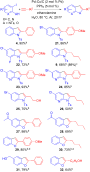
Scheme 5: Preparation of indoles, azaindoles and benzofurans. aReaction conditions: 2-iodoaniline (0.5 mmol),...
Metal-free aerobic oxidations mediated by N-hydroxyphthalimide. A concise review
- Lucio Melone and
- Carlo Punta
Beilstein J. Org. Chem. 2013, 9, 1296–1310, doi:10.3762/bjoc.9.146
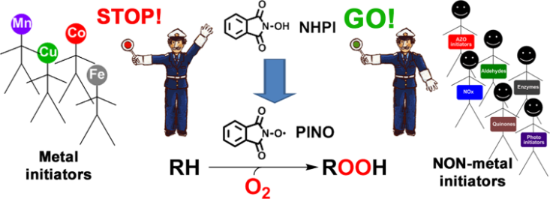
- -electron-transfer interaction of antraquinone (AQ) with NHPI in zeolite HY, followed by hydrogen-atom transfer, successfully led to the formation of the PINO radical, which in turn was responsible for the propagation of the radical chain in the selective oxidation of ethylbenzene to the corresponding
- zeolite, for the oxygenation of a wider range of hydrocarbons [34]. Moreover, the electronic effect of substituents on quinones and on the aromatic ring of NHPI was also investigated. Quinones bearing halogen groups were used in the selective oxidation of alkylarenes, alkenes and alkanes [35], revealing

Graphical Abstract

Scheme 1: Catalytic role of NHPI in the selective oxidation of organic substrates.

Scheme 2: Radical addition of aldehydes and analogues to alkenes.

Scheme 3: NHPI/AIBN-promoted aerobic oxidation of 2,6-diisopropylnaphthalene.

Scheme 4: NHPI/AIBN-promoted aerobic oxidation of CHB.

Scheme 5: NMBHA/MeOAMVN promoted aerobic oxidation of PUFA.

Scheme 6: Alkene dioxygenation by means of N-aryl hydroxamic acid and O2.

Scheme 7: NHPI-catalyzed reaction of adamantane under NO atmosphere.

Scheme 8: Nitration of alkanes and alkyl side-chains of aromatics.

Scheme 9: Radical mechanism for the nitration of alkanes catalyzed by NHPI.

Scheme 10: Benzyl alcohols from alkylbenzenes.

Scheme 11: Catalytic cycle of laccase-NHDs mediator oxidizing system.

Figure 1: Mediators of laccase.

Scheme 12: DADCAQ/NHPI-mediated aerobic oxidation mechanism.

Scheme 13: DADCAQ/TCNHPI mediated aerobic oxidation of ethylbenzene.

Scheme 14: NHPI/xanthone/TMAC mediated aerobic oxidation of ethylbenzene.

Scheme 15: NHPI/AQ-mediated aerobic oxidation of α-isophorone.

Scheme 16: NHPI/AQ-mediated oxidation of cellulose fibers by NaClO/NaBr system.

Scheme 17: NHPI/AQ mediated aerobic oxidation of cellulose fibers.

Scheme 18: Molecule-induced homolysis by peracids.

Scheme 19: Molecule-induced homolysis of NHPI/m- chloroperbenzoic acid system.

Scheme 20: Proposed mechanism for the NHPI/CH3CHO/O2-mediated epoxidation.

Scheme 21: NHPI/CH3CHO-mediated aerobic oxidation of alkyl aromatics.

Scheme 22: Light-induced generation of PINO from N-alkoxyphthalimides.

Scheme 23: Visible-light/g-C3N4 induced metal-free oxidation of allylic substrates.

Scheme 24: NHPI/o-phenanthroline-mediated organocatalytic system.

Scheme 25: NHPI/DMG-mediated organocatalytic system.

Scheme 26: NHPI catalyzed oxidative cleavage of C=C bonds.

Scheme 27: Synthesis of hydrazine derivatives.
Mild and efficient cyanuric chloride catalyzed Pictet–Spengler reaction
- Ashish Sharma,
- Mrityunjay Singh,
- Nitya Nand Rai and
- Devesh Sawant
Beilstein J. Org. Chem. 2013, 9, 1235–1242, doi:10.3762/bjoc.9.140
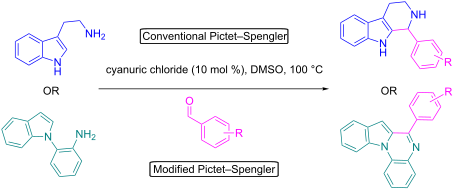
- Brønsted acids. However, recently several other aprotic or Lewis acids, such as Yb(OTf)3 [23][24][25], AuCl3/AgOTf [26], Me3SiCl [27][28], BF3·Et2O [29], iodine [30], zeolite [31] and enzymes [32][33][34], have been used for carrying out the Pictet–Spengler reaction. Though the Pictet–Spengler reaction has

Graphical Abstract

Scheme 1: The Pictet–Spengler reaction of tryptamine with 4-tolualdehyde.

Figure 1: The two Pictet–Spengler substrates employed in the TCT catalyzed cyclization.

Scheme 2: Synthesis of the Pictet–Spengler substrate 4. Reaction conditions: (a) K2CO3, DMF, 80 °C, 3 h; (b) ...
Iron-containing mesoporous aluminosilicate catalyzed direct alkenylation of phenols: Facile synthesis of 1,1-diarylalkenes
- Satyajit Haldar and
- Subratanath Koner
Beilstein J. Org. Chem. 2013, 9, 49–55, doi:10.3762/bjoc.9.6
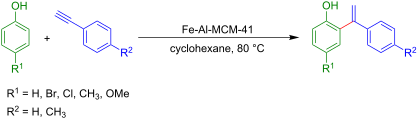
- the iron center in the catalyst Fe-Al-MCM-41. NaY, a microporous aluminosilicate, did not yield any product under the specified reaction conditions (Table 2, entry 1). Sartori et al. reported an electrophilic alkenylation of aromatics with phenylacetylene over zeolite HSZ-360-Y; however, this zeolite
- pretreatment is necessary to activate the catalyst and a moisture-free medium is essential. Furthermore, a higher temperature (110 °C) and a longer reaction time (14 h) were also required for the catalytic reaction. Sartori et. al. suggested that the external surface of HSZ-360-Y zeolite was responsible for
- such catalytic activity rather than the pore of the zeolite. As evidence, they reported the acidic-alumina-catalyzed reaction in which only 25% product yield was observed [43]. However, when we used acidic alumina (under our reaction conditions) at a relatively low temperature (80 °C) without any





