


Search results
Search for "α,β-unsaturated carbonyl compounds" in Full Text gives 48 result(s) in Beilstein Journal of Organic Chemistry.
Rh(II)-mediated domino [4 + 1]-annulation of α-cyanothioacetamides using diazoesters: A new entry for the synthesis of multisubstituted thiophenes
Beilstein J. Org. Chem. 2017, 13, 2569–2576, doi:10.3762/bjoc.13.253

- domino reactions of diazo compounds with intermediate formation of ylides [7][8][9][10][11][12][13][14][15][16][17][18][19][20][21]. Thus, it was for example shown that ammonium or oxonium ylides generated in the course of intermolecular processes can be easily trapped by ketones, imines, α,β-unsaturated
- carbonyl compounds, activated multiple bonds, or other nucleophiles to furnish heterocyclic cores [22][23][24][25][26][27][28][29][30][31][32]. Similar intramolecular transformations of intermediate ylides with several nucleophilic reaction centers in the initial substrate, are also possible. The known


A novel synthetic approach to hydroimidazo[1,5-b]pyridazines by the recyclization of itaconimides and HPLC–HRMS monitoring of the reaction pathway
Beilstein J. Org. Chem. 2017, 13, 2561–2568, doi:10.3762/bjoc.13.252
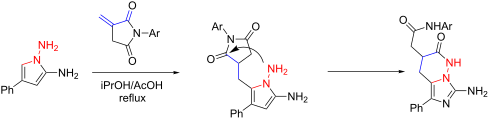
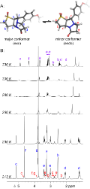
- itaconimides, four primary adducts 5–8 could result (Scheme 5) based on the well-known fact that the heterocyclization reactions of α,β-unsaturated carbonyl compounds with dinucleophilic reagents typically begin with addition like Michael’s reaction, including heterocyclic dinucleophiles [39][40][41][42
- equivalent of C1-electrophile: R2COOH/T3P® [15], BrCN (R2 = NH2) [16], ArNCS/DCC (R2 = NHAr) [20]. Heterocyclization of 1-aminoimidazoles with 1,3-dicarbonyl or α,β-unsaturated carbonyl compounds (route B). Conditions: i) R1 = NH2, NHAlk, R2 = Ph, R3,4 = Alk, Ar, solvent-free [24], AcOH [25][26], R3 = Ph, R4


Mechanochemical synthesis of small organic molecules
Beilstein J. Org. Chem. 2017, 13, 1907–1931, doi:10.3762/bjoc.13.186
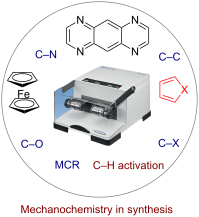
- (Scheme 23). α,β-Unsaturated carbonyl compounds could also undergo a trans-bromination reaction efficiently within 40 min. Following to Wang’s report, Stolle and co-workers also reported a similar method of aryl bromination and chlorination using NaBr and NaCl, respectively, in the presence of oxidizing




Development of a method for the synthesis of 2,4,5-trisubstituted oxazoles composed of carboxylic acid, amino acid, and boronic acid
Beilstein J. Org. Chem. 2017, 13, 1478–1485, doi:10.3762/bjoc.13.146

- materials, such as α-haloketones and primary amides [8], alkynes and nitriles [9], amines and α,β-unsaturated carbonyl compounds [10], etc. [11] have been reported. However, these reactions are often conducted under harsh reaction conditions and multistep syntheses of the starting materials are needed. ii


Synthesis of tetrasubstituted pyrazoles containing pyridinyl substituents
Beilstein J. Org. Chem. 2017, 13, 895–902, doi:10.3762/bjoc.13.90

- most common strategies employ reactions of 1,3-dicarbonyl compounds or α,β-unsaturated carbonyl compounds with substituted hydrazines [4][6][19]. To overcome the drawbacks of this method, namely insufficient regioselectivity [20], other accesses such as, for instance, regioselective metalations of N


Isoxazole derivatives as new nitric oxide elicitors in plants
Beilstein J. Org. Chem. 2017, 13, 659–664, doi:10.3762/bjoc.13.65
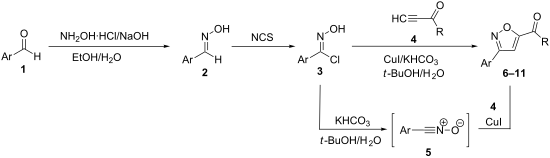
- synthetic approaches towards the isoxazole core include the reactions of hydroxylamine with aryl-β-diketones [20], α,β-unsaturated carbonyl compounds [21], or α,β-unsaturated nitriles [22], and 1,3-dipolar cycloaddition reactions between alkenes or alkynes and nitrile oxides [23][24][25]. Nitrile oxides are


New approaches to organocatalysis based on C–H and C–X bonding for electrophilic substrate activation
Beilstein J. Org. Chem. 2016, 12, 2834–2848, doi:10.3762/bjoc.12.283
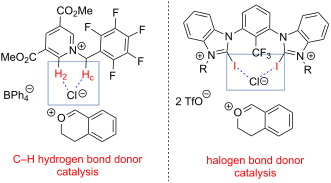
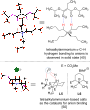
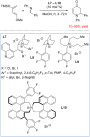
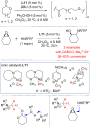
- bond-donor activation of α,β-unsaturated carbonyl compounds in the [2 + 4] cycloaddition reaction of MVK and cyclopentadiene [88]. Halogen bond donor activation of imines in the [2 + 4] cycloaddition reaction of imine and Danishefsky’s diene [90]. Transfer hydrogenation catalyzed by a chiral halogen










Rh-Catalyzed reductive Mannich-type reaction and its application towards the synthesis of (±)-ezetimibe
Beilstein J. Org. Chem. 2016, 12, 1608–1615, doi:10.3762/bjoc.12.157
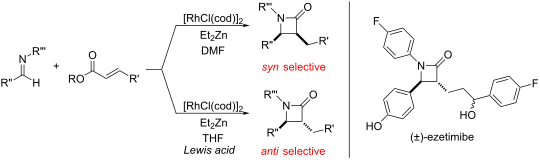
- Mannich-type reactions have been reported to give β-amino esters and/or β-lactams by using metal enolates [10][11][12][13][14][15][16][17]. In contrast, most of reductive Mannich-type reactions using imines and α,β-unsaturated carbonyl compounds gave β-amino esters, but there are only a few reports for a
- results using similar conditions did not give the corresponding products such as β-propiolactones. It is well known that the substituents on the α- or β-position of α,β-unsaturated carbonyl compounds affect the yields and stereoselectivities [37]. A rhodium–hydride complex derived from [RhCl(cod)]2 seems


Synergistic chiral iminium and palladium catalysis: Highly regio- and enantioselective [3 + 2] annulation reaction of 2-vinylcyclopropanes with enals
Beilstein J. Org. Chem. 2016, 12, 1340–1347, doi:10.3762/bjoc.12.127
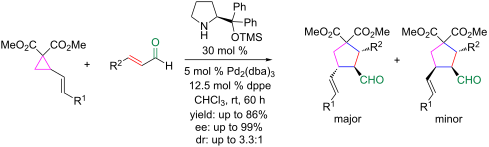
- ]. However, it is difficult to apply the catalytic system for the regio-controlled reaction with C=C bonds in α,β-unsaturated carbonyl compounds, particularly enals. The highly active aldehyde functionality reacts more favorably with the D–A cyclopropane resulting 1,3-dipoles, as elegantly demonstrated by


Facile synthesis of 4H-chromene derivatives via base-mediated annulation of ortho-hydroxychalcones and 2-bromoallyl sulfones
Beilstein J. Org. Chem. 2016, 12, 16–21, doi:10.3762/bjoc.12.3
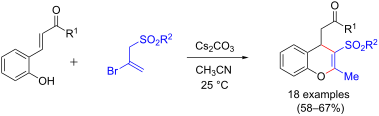
- ], multicomponent reactions [8], ring-closing metathesis approaches [9][10], tandem reactions of 1,3-dicarbonyl compounds [11][12] and cyclocondenzation reactions of salicylic aldehydes with α,β-unsaturated carbonyl compounds [13][14][15]. The utility of some of these methods are limited by drawbacks such as



New metathesis catalyst bearing chromanyl moieties at the N-heterocyclic carbene ligand
Beilstein J. Org. Chem. 2015, 11, 2795–2804, doi:10.3762/bjoc.11.300
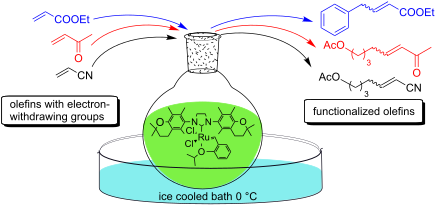
- coordination to the ruthenium atom, and finally, facilitates the initiating process. In the new catalyst 9, which is modified in the NHC ligand, different effects are responsible for its activity. According to Grubbs [31], catalyst 1 is able to react with α,β-unsaturated carbonyl compounds to form an enoic




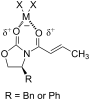
Diastereoselective and enantioselective conjugate addition reactions utilizing α,β-unsaturated amides and lactams
Beilstein J. Org. Chem. 2015, 11, 530–562, doi:10.3762/bjoc.11.60

- of boron to α,β-unsaturated carbonyl compounds. Enantioenriched organoboron reagents are useful because they can be used in cross-coupling reactions [98][100] or they can be converted into the corresponding alcohol [101] while retaining the stereochemical information. Transition metals such as Cu
- [102][103][104][105][106][107][108][109][110][111][112], Rh [113][114][115], Ni [116][117], Pd [116][118] and Pt [119][120] have all been successfully used to catalyze the 1,4-additon of boron to α,β-unsaturated carbonyl compounds. Of the transition metals mentioned, copper is the most cost-effective
- )diboron to various α,β-unsaturated carbonyl compounds [121]. Use of bisboronic acid and tetrakis(dimethylamino)diboron provides boron sources that are more atom economical than B2pin2. Scheme 11 shows an example of the asymmetric 1,4-borylation where the authors used an α,β-unsaturated amide as the




Chiral phosphines in nucleophilic organocatalysis
Beilstein J. Org. Chem. 2014, 10, 2089–2121, doi:10.3762/bjoc.10.218
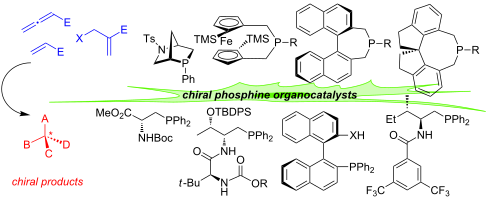
- ] annulation by combining MBH carbonates and electron-deficient alkenes into a single molecule (Scheme 37) [73]. In the presence of 10 mol % of D3, a variety of α,β-unsaturated carbonyl compounds were transformed efficiently in toluene at −5 °C to give optically active benzobicyclo[4.3.0] compounds 5 in
- development of chiral phosphine–assisted asymmetric Michael reactions has lagged behind other phosphine-catalyzed reactions. Recently, using bifunctional chiral amino acid–derived phosphines, Lu and co-workers developed asymmetric Michael additions of oxindoles to α,β-unsaturated carbonyl compounds (Scheme 55


Visible-light-induced, Ir-catalyzed reactions of N-methyl-N-((trimethylsilyl)methyl)aniline with cyclic α,β-unsaturated carbonyl compounds
Beilstein J. Org. Chem. 2014, 10, 890–896, doi:10.3762/bjoc.10.86
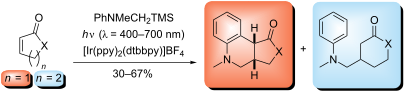
- -induced, iridium-catalyzed addition reactions to cyclic α,β-unsaturated carbonyl compounds. Typical reaction conditions included the use of one equivalent of the reaction substrate, 1.5 equivalents of the aniline and 2.5 mol % (in MeOH) or 1.0 mol % (in CH2Cl2) [Ir(ppy)2(dtbbpy)]BF4 as the catalyst. Two
- reactions to other cyclic α,β-unsaturated carbonyl compounds. In particular, we were interested to see whether cyclization reactions as for product 4 would be observed when using α,β-unsaturated lactones and lactams in combination with a silylated amine and an iridium catalyst. In this article, we provide
- readily not only to the previously reported cyclohexenone but to several cyclic α,β-unsaturated carbonyl compounds. Further reaction of the intermediate α-carbonyl radical was observed with five-membered substrates leading to synthetically interesting tricyclic products. The latter reaction suffers from



An overview of the synthetic routes to the best selling drugs containing 6-membered heterocycles
Beilstein J. Org. Chem. 2013, 9, 2265–2319, doi:10.3762/bjoc.9.265
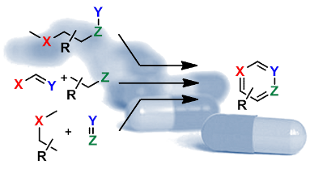
- derivatives are treated with α,β-unsaturated carbonyl compounds in the presence of ammonia to initially form dihydropyridines 1.38, which can ultimately be converted into the corresponding aromatic pyridine upon oxidation with a variety of oxidants such as MnO2, HNO2, HNO3 or cerium ammonium nitrate (CAN


Elucidation of the regio- and chemoselectivity of enzymatic allylic oxidations with Pleurotus sapidus – conversion of selected spirocyclic terpenoids and computational analysis
Beilstein J. Org. Chem. 2013, 9, 2233–2241, doi:10.3762/bjoc.9.262
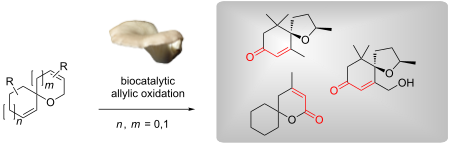
- ] or α,β-unsaturated carbonyl compounds are attractive synthetic targets of high economic and scientific interest [11][12][13][14][15][16][17]. Allylic oxidations of olefins to enones have classically been performed with strong oxidants such as chromium or other metal-based reagents [18][19]. In


AgOTf-catalyzed one-pot reactions of 2-alkynylbenzaldoximes with α,β-unsaturated carbonyl compounds
Beilstein J. Org. Chem. 2013, 9, 1949–1956, doi:10.3762/bjoc.9.231

- various α,β-unsaturated carbonyl compounds under mild conditions are described, which provides a facile and efficient pathway for the synthesis of 1-alkylated isoquinoline derivatives. The method tolerates a wide range of substrates and allows for the preparation of the products of interest in moderate to
- fragmentation from 2-alkynylbenzaldoximes and α,β-unsaturated carbonyl compounds. Based on previous results [36][37][38][39][41][42][43], we expect 2-alkynylbenzaldoxime 1 to easily convert at room temperature to isoquinoline N-oxide A by a AgOTf-catalyzed cyclization. Compound A produced in situ might undergo
- compounds 2a–g (Table 1). In most cases, substrate 1b reacted with α,β-unsaturated carbonyl compounds 2 leading to the corresponding 1-alkylated isoquinolines in moderate to excellent yields. For instance, the reaction with 2b under standard conditions gave rise to the desired product 3c in 81% yield (Table


Dipolar addition to cyclic vinyl sulfones leading to dual conformation tricycles
Beilstein J. Org. Chem. 2013, 9, 1419–1425, doi:10.3762/bjoc.9.159

- expedient regio- and stereospecific synthesis of five-membered ring N-, O- or S-containing heterocycles [4][5]. Various 1,3-dipoles can be used, including nitrones [6], azomethine ylides [7], diazoalkanes [8][9] and many others [10][11][12]. α,β-Unsaturated carbonyl compounds are often found to be good


Reactions of salicylaldehyde and enolates or their equivalents: versatile synthetic routes to chromane derivatives
Beilstein J. Org. Chem. 2012, 8, 2166–2175, doi:10.3762/bjoc.8.244

- (5), followed by an intramolecular aldol reaction and final dehydration to give the desired chromene derivative. Related work involving asymmetric reaction of salicylaldehyde derivatives and α,β-unsaturated carbonyl compounds in the synthesis of 2-phenylchromenes was reported by Li and co-workers


Synthesis and ring openings of cinnamate-derived N-unfunctionalised aziridines
Beilstein J. Org. Chem. 2012, 8, 1747–1752, doi:10.3762/bjoc.8.199
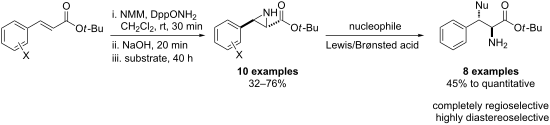
- carbonyl compounds. Our method produces trans-NH-aziridines from α,β-unsaturated carbonyl compounds in good to excellent yield with high diastereoselectivity (Figure 1) [21]. An N–N ylide (aminimine) is the presumed active intermediate, formed from the reaction of a tertiary amine promoter and an aminating
- dihydroxylation, conversion to a cyclic sulfate, ring opening with azide, and finally ring closure to afford the NH-aziridine [18]. We recently reported [21][22] a nucleophilic aziridination methodology [23][24][25][26][27][28][29][30] that allows access to NH-aziridines in a single step from α,β-unsaturated


Michael-type addition of azoles of broad-scale acidity to methyl acrylate
Beilstein J. Org. Chem. 2011, 7, 173–178, doi:10.3762/bjoc.7.24
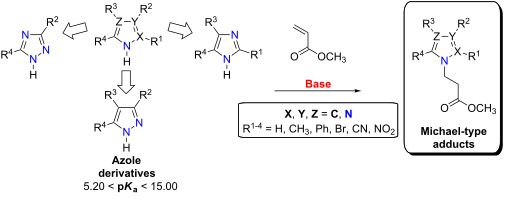
- of various azoles to α,β-unsaturated carbonyl and nitro derivatives has been frequently exploited in the synthesis of precursors of biologically active compounds [3][7][8][9][10][11][12][13][14][15]. This reaction, although structurally restricted to α,β-unsaturated carbonyl compounds and their


Aroylketene dithioacetal chemistry: facile synthesis of 4-aroyl- 3-methylsulfanyl- 2-tosylpyrroles from aroylketene dithioacetals and TosMIC
Beilstein J. Org. Chem. 2007, 3, No. 31, doi:10.1186/1860-5397-3-31

- to general α,β-unsaturated carbonyl compounds. Background The α-aroylketene dithioacetals (AKDTAs) 1 are useful three-carbon synthones extensively employed for the synthesis of a wide variety of heterocyclic compounds and also in several aromatic ring annulation reactions. [1][2] The AKDTAs are α,β
- -unsaturated carbonyl compounds with two electron-donating alkylsulafanyl groups on one end and an electron-withdrawing aroyl group at the other end of the double bond, i.e., they are "push-pull" alkenes. Depending on the nucleophile and the reaction conditions either 1,2- or 1,4-necleophilc additions on 1 are


One-pot synthesis of novel 1H-pyrimido[4,5-c][1,2]diazepines and pyrazolo[3,4-d]pyrimidines
Beilstein J. Org. Chem. 2006, 2, No. 5, doi:10.1186/1860-5397-2-5

- through involvement of an azine (obtained from oxidation of hydrazine group). Similarly other α,β-unsaturated carbonyl compounds 2b-e were reacted and the corresponding pyrimido[1,2]diazepines 3b-e were obtained in 78–90% yields and were characterized fully by spectroscopic and elemental analyses. The IR





