


Search results
Search for "6-endo-dig cyclization" in Full Text gives 27 result(s) in Beilstein Journal of Organic Chemistry.
Synthetic applications of gold-catalyzed ring expansions
Beilstein J. Org. Chem. 2011, 7, 767–780, doi:10.3762/bjoc.7.87
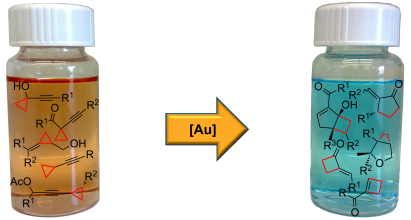
- vinyl alkynyl cyclopropanes 85 to give arenes 86, 87 and cycloheptatriene 88 derivatives through 5-endo-dig and 6-endo-dig cyclization reactions, respectively, under careful control of the reaction conditions (Scheme 25) [58]. A mechanistic rationale for these transformations is shown in Scheme 26
- cations 90 and 91 by delocalization of the positive charge onto gold. The aromatic intermediate 92 is probably converted, via 93, into 86 and 87 by E1 and SN1 mechanisms, respectively. When secondary esters are employed, 6-endo-dig cyclization occurs to give 94, which forms the cycloheptatriene derivate


Sequential Au(I)-catalyzed reaction of water with o-acetylenyl-substituted phenyldiazoacetates
Beilstein J. Org. Chem. 2011, 7, 631–637, doi:10.3762/bjoc.7.74
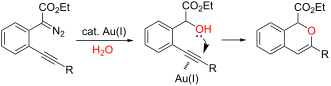
- complexes (PMe3)AuCl and (IPr)AuCl were examined (Table 1, entries 7 and 8). It was found that (IPr)AuCl was an efficient catalyst for both carbene transfer and cyclization. Product 2a from 6-endo-dig cyclization and product 3a from 5-exo-dig cyclization were both obtained in nearly equal amounts in
- the reaction of diazo compounds 1e and 1f with water, only 6-endo-dig cyclization products 2e and 2f were isolated as the sole product in yields of 69% and 75%, respectively. Functional groups such as bromo and hydroxy groups were tolerated under the present catalytic systems. When diazo compound 1g


Other Beilstein-Institut Open Science Activities



