


Search results
Search for "cyanine" in Full Text gives 30 result(s) in Beilstein Journal of Organic Chemistry.
Terminal lipophilization of a unique DNA dodecamer by various nucleolipid headgroups: Their incorporation into artificial lipid bilayers and hydrodynamic properties
Beilstein J. Org. Chem. 2015, 11, 913–929, doi:10.3762/bjoc.11.103
- Emma Werz Helmut Rosemeyer Organic Chemistry I - Bioorganic Chemistry, Institute of Chemistry of New Materials, University of Osnabrück, Barbarastr. 7, 49069 Osnabrück, Germany Ionovation GmbH, Westerbreite 7, 49078 Osnabrück, Germany 10.3762/bjoc.11.103 Abstract A series of six cyanine-5-labeled
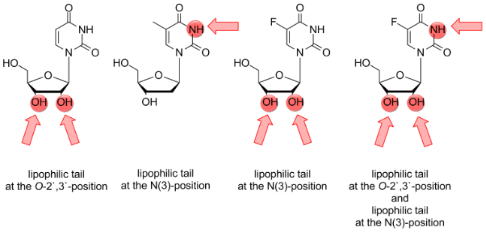
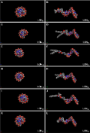
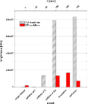
- determination of the bilayer brightness using fluorescence microscopy [8]. In the following, we describe the insertion of six unique single-stranded DNA dodecamers carrying different nucleolipid head groups as well as cyanine-5 (Cy5) at the 5’-(n−1) position in artificial lipid bilayers. In this case we varied
- shows the energy-minimized 3D structures of the lipophilic nucleoside headgroups 4a–9a. The reactive building blocks 4b–9b were subsequently used to synthesize the following lipo-oligonucleotides (LONs), which have an identical nucleotide sequence in common as well as a cyanine-5 (Cy5) fluorophore at






A comparative study of the interactions of cationic hetarenes with quadruplex-DNA forming oligonucleotide sequences of the insulin-linked polymorphic region (ILPR)
Beilstein J. Org. Chem. 2014, 10, 2963–2974, doi:10.3762/bjoc.10.314
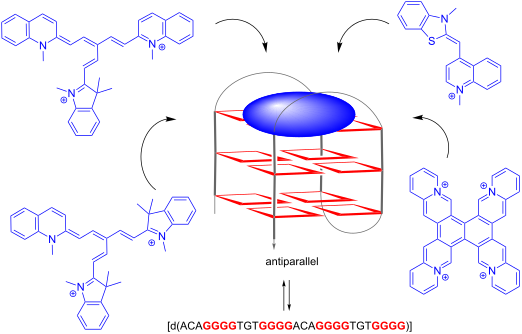
- 1). Most of the tested ligands, i.e. 1a, 1c, 1d, 2, 4, 5, and 6, induced only a moderate increase of the melting temperature of the ILPR-quadruplex (ΔTm = ca. 2–6 °C). Nevertheless, the addition of the cyanine derivative 1b or the bis-quinolinium derivative 3 induced a significantly larger shift of
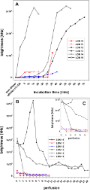
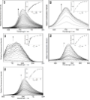
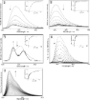
- -quinolinium derivative 3 an isosbestic point developed at 364 nm. The addition of ILPR-DNA a2 to the cyanine derivatives 1a–e and 6 resulted in a strong increase of the emission intensity (light-up effect) with increasing concentration of a2 (Figure 5 and Figure 6E). This effect was most pronounced in the
- case of thiazole orange (6) whose emission intensity increases by a factor of I/I0 = 1766. Within the series of heptamethine cyanine dyes 1a–e, the derivative 1d exhibits the largest light-up factor with I/I0 = 128. In contrast, the emission of coralyne (2), bis-quinolinium derivative 3 and the




Come-back of phenanthridine and phenanthridinium derivatives in the 21st century
Beilstein J. Org. Chem. 2014, 10, 2930–2954, doi:10.3762/bjoc.10.312

- of the phenanthridine/phenanthridinium system for chemical and biochemical research. Widely used fluorimetric dyes, such as cyanine derivatives, are non-fluorescent in the free state but give tremendous fluorescence emission upon binding to biomacromolecular targets. However, many of these dyes show
- non-emissive form in the free state/very strong emission in the bound state, it has several advantages over cyanine dyes: phenanthridine/phenanthridinium fluorescence is characterised by a large Stokes shift (up to 100 nm) allowing the full use of absorption maxima as well as easy incorporation in




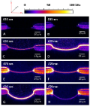
Specific DNA duplex formation at an artificial lipid bilayer: fluorescence microscopy after Sybr Green I staining
Beilstein J. Org. Chem. 2014, 10, 2307–2321, doi:10.3762/bjoc.10.240
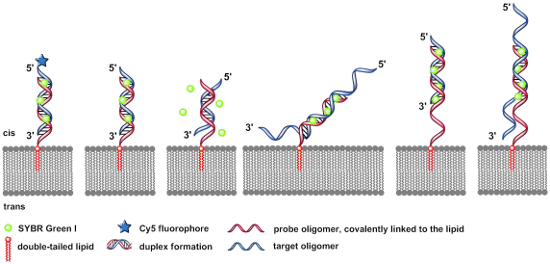
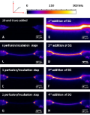
- immobilization of lipo-oligonucleotides carrying a racemic bis(hexadecyloxy)propan-1-yl tag (1a) at the 5’-termini at an artificial lipid bilayer–water phase boundary. These were prepared using the cyanoethyl phosphoramidite 1b. A specific duplex formation with complementary cyanine-5 (Cy5)-labelled DNA strands
- ][22]. This bears the advantage that the target DNA – the presence or absence of which is going to be analysed – should not be labelled separately with a fluorochrome tag such as cyanine-5 (Cy5) or TAMRA, neither by chemical synthesis nor by a polymerase chain reaction (PCR). The chemical formulae (1–3
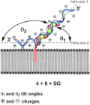
- + 5 + SG. In a preceeding manuscript we have studied the bilayer incorporation of the lipo-oligonucleotide 4 (5’-d(1a-TAG GTC AAT ACT)-3’) and its successful and specific duplex formation with the cyanine-5-labeled complementary strand 5 (5’-d[(Cy5)-p-AGT ATT GAC CTA]-3’) [19]. As a negative control








Molecular recognition of AT-DNA sequences by the induced CD pattern of dibenzotetraaza[14]annulene (DBTAA)–adenine derivatives
Beilstein J. Org. Chem. 2014, 10, 2175–2185, doi:10.3762/bjoc.10.225
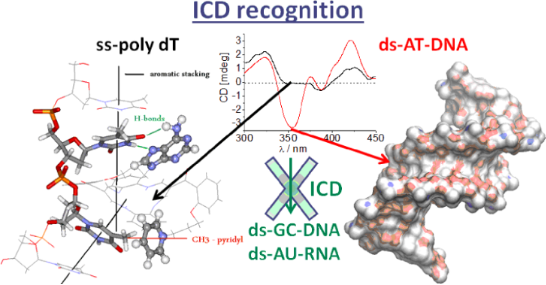
- tracts by length and composition. This has been demonstrated, for instance, by the inability to distinguish between longer tracts (more than 20–30 base pairs) of homo and alternating distribution of AT base pairs. Our recent studies revealed a novel class of cyanine dyes characterized by bulky
- importance of AT tracts and the selectivity of cyanine dyes. On this basis, we were inspired to prepare the novel binders AP5 with a DBTAA–adenine linker length between AP3 (oligo dT specific) and AP6 (oligo-dT inert) and AP3am, in which pyridinium is exchanged by a permethylated amine, with the aim of


Other Beilstein-Institut Open Science Activities



