


Search results
Search for "cyclobutane" in Full Text gives 66 result(s) in Beilstein Journal of Organic Chemistry.
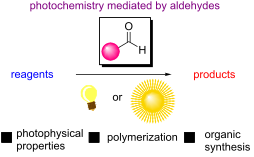
Aldehydes as powerful initiators for photochemical transformations
Beilstein J. Org. Chem. 2020, 16, 833–857, doi:10.3762/bjoc.16.76
- chiral cyclobutene 180, providing highly functionalized cyclobutanes 182 and an access to the enantioenriched cyanosulfones 183, resulting from cyclobutane ring opening, or the new tetrasubstituted cyclobutanes 184 (Scheme 42). The cyclobutenes 180 were subjected to a photocatalyzed radical addition, and






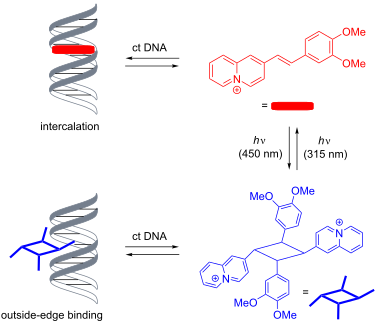
Reversible photoswitching of the DNA-binding properties of styrylquinolizinium derivatives through photochromic [2 + 2] cycloaddition and cycloreversion
Beilstein J. Org. Chem. 2020, 16, 111–124, doi:10.3762/bjoc.16.13
- Information File 1). However, it was observed that further irradiation of the nitro-substituted derivative 3d furnished the dimer in acetonitrile, as shown by the development of the characteristic cyclobutane protons at 4.85–4.95 ppm. In contrast, the NMR-spectroscopic analysis in D2O showed that the
- )bisquinolizinium 4b and 4c as photoproducts in quantitative yield. The products 4b and 4c were fully characterized by NMR spectroscopy (1H, 13C, COSY, HSQC, HMBC, and ROESY) and mass spectrometry, which revealed a cyclobutane structure, specifically by the appearance of the characteristic NMR signals of the
- cyclobutane at 4.89–5.00 ppm [42][43][44][45][46]. Unfortunately, detailed 2D NMR and spectroscopic analyses did not allow a conclusive assignment of the configuration of the products. Even in the ROESY NMR spectra, only unspecific correlations were detected. However, as both products could be obtained as




Synthesis of acremines A, B and F and studies on the bisacremines
Beilstein J. Org. Chem. 2019, 15, 2271–2276, doi:10.3762/bjoc.15.219

- starting material. Next, we tried to trigger the cyclization through a [2 + 2] cycloaddition followed by vinyl cyclobutane rearrangement [19][20]. We reasoned that the initially formed divinyl cyclobutane [21] should undergo an allylic rearrangement to furnish the decalin system [22][23]. Condensation


Azologization and repurposing of a hetero-stilbene-based kinase inhibitor: towards the design of photoswitchable sirtuin inhibitors
Beilstein J. Org. Chem. 2019, 15, 2170–2183, doi:10.3762/bjoc.15.214
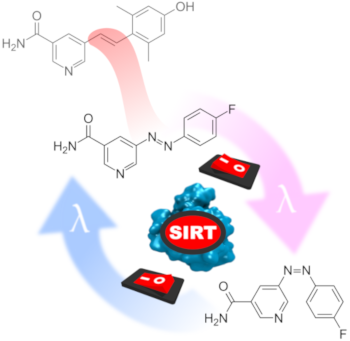
- oxidized to phenantrene in the presence of oxygen [48]. In high concentrations, (E)-stilbene furthermore undergoes photocyclodimerization to cyclobutane derivatives [49]. Photoisomerization and photocyclization are also reported for 3-styrylpyridines, forming two regioisomeric dihydroazaphenanthrenes that


Cyclobutane dication, (CH2)42+: a model for a two-electron four-center (2e-4c) Woodward–Hoffmann frozen transition state
Beilstein J. Org. Chem. 2019, 15, 1475–1479, doi:10.3762/bjoc.15.148
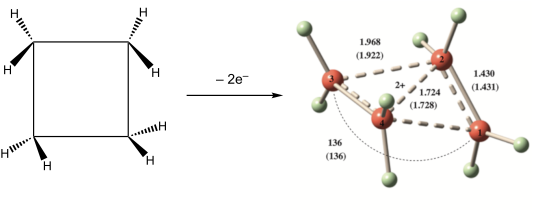
- G. K. Surya Prakash Golam Rasul Loker Hydrocarbon Research Institute and Department of Chemistry, University of Southern California, University Park, Los Angeles, CA 90089-1661, USA 10.3762/bjoc.15.148 Abstract The structures of the elusive cyclobutane dication, (CH2)42+, were investigated at the
- considered as a prototype for a 2e-4c Woodward–Hoffmann frozen transition state. The planar rectangular shaped structure 2 with a 2e-4c bond was found not to be a minimum. Keywords: cyclobutane dication; 2e-4c bond; frozen transition state; Woodward–Hoffmann rule; Introduction The protonated hydrogen
- +, v) and the cyclobutane dication (CH2)42+ (vi)? The structures of H42+ (including v) were previously analyzed at various theoretical levels including CISD/6-311++G(d,2pd) by von Ragué Schleyer, Koch and co-workers [9]. No structure with four connected hydrogens, however, was found to be a minimum on


Synthesis of aryl cyclopropyl sulfides through copper-promoted S-cyclopropylation of thiophenols using cyclopropylboronic acid
Beilstein J. Org. Chem. 2019, 15, 1162–1171, doi:10.3762/bjoc.15.113
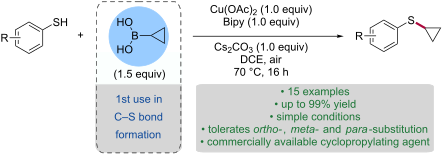
- with hydrobromic acid and zinc bromide leads to 1-arylthiocyclobutenes 7 [13] and 2-alkyl-substituted cyclobutanones 8 [11][12], respectively. Treatment of 6 with hydrobromic acid and zinc bromide in the presence of a thiophenol provides the 1,1-di(arylthio)cyclobutane 9 which, upon reaction with


Mechanochemistry of supramolecules
Beilstein J. Org. Chem. 2019, 15, 881–900, doi:10.3762/bjoc.15.86
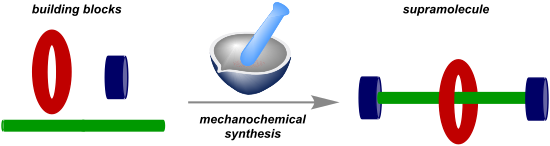
- 1,2-di(pyridin-4-yl)ethylene and 4,6-dichlororesorcinol in the transition state (Figure 24). Finally the cyclobutane derivative 43 was observed after the release of catalyst for the next cycle. In 2012, again the MacGillivray group reported an improved version of the above mentioned [2 + 2


Domino ring-opening–ring-closing enyne metathesis vs enyne metathesis of norbornene derivatives with alkynyl side chains. Construction of condensed polycarbocycles
Beilstein J. Org. Chem. 2018, 14, 2708–2714, doi:10.3762/bjoc.14.248
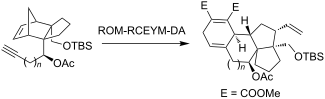
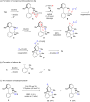
- ) which prohibits intramolecular addition of the ruthenium alkylidine to form ruthena cyclobutane 22. The alkylidine 21 then undergoes cross metathesis with ethylene to form the product 11. The ruthenium alkylidine 8b possibly fails to form chelate 21 (R = Ac) due to the electron deficient nature of the
- OAc group. It forms intramolecularly the ruthena cyclobutane 22 which undergoes ring opening to give rise to the triene 9b. That the metathesis does not proceed through path 2 (Scheme 3) involving ROM–RCM is indicated by failure of the norbornene derivative 17 to undergo ROM. Steric shielding of the




Novel photochemical reactions of carbocyclic diazodiketones without elimination of nitrogen – a suitable way to N-hydrazonation of C–H-bonds
Beilstein J. Org. Chem. 2018, 14, 2250–2258, doi:10.3762/bjoc.14.200

- vacuum from the proper fractions (0.5–0.1 mm Hg). Cyclobutane-2-one carboxylic acid (4а) [46][47]. Yield 1.03 g (90%); mp 43–44.5 °C (distilled); bp 93.5–94 °C (0.2–0.1 mm Hg). It is noteworthy that acid 4а is a very hygroscopic compound which is easily hydrolyzed to produce glutaric acid. Photolysis of
- removal of THF and methanol in vacuum was distilled to give methyl ester 5а. Methyl cyclobutane-2-one carboxylate (5а) [48]. Yield 2.20 g (86%); bp 43.5–45 °С (1 mm Hg); nD20 1.5111. During column chromatography with SiO2 of I or II activity, methyl ester 5а considerably hydrolyzes to give Me ester of


Glycosylation reactions mediated by hypervalent iodine: application to the synthesis of nucleosides and carbohydrates
Beilstein J. Org. Chem. 2018, 14, 1595–1618, doi:10.3762/bjoc.14.137
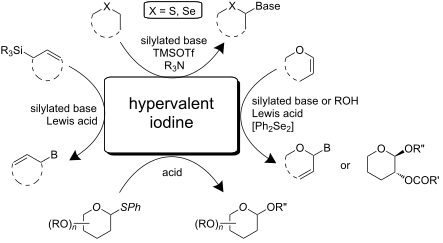
- reaction of trans-cyclobutane sulfoxide 59. The authors concluded that the stereochemistry of the sulfoxide and the nature of the protecting groups had no significant effect on the yield of the Pummerer-type glycosylation [47] (Scheme 8). Pummerer-type glycosylation, which was developed by our group


Stepwise radical cation Diels–Alder reaction via multiple pathways
Beilstein J. Org. Chem. 2018, 14, 704–708, doi:10.3762/bjoc.14.59
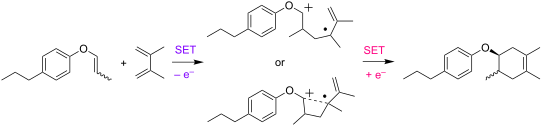
- from the cyclobutane 5 (Scheme 6). We also found that the Diels–Alder adduct 3 with an approximately cis/trans = 1:1 mixture was obtained in the early stage of the reaction (Supporting Information File 1, Figure S3). Taken together, we can now propose a mechanism for the radical cation Diels–Alder
- ). Conditions: 1.0 M LiClO4/CH3NO2, carbon felt electrodes, 1.2 V vs Ag/AgCl, 0.7 F/mol. Oxidative SET-triggered reaction of aryl vinyl ether 1c. Conditions: 1.0 M LiClO4/CH3NO2, carbon felt electrodes, 1.2 V vs Ag/AgCl, 0.1 F/mol. Oxidative SET-triggered rearrangement of vinyl cyclobutane 4. Conditions: 1.0 M


Dialkyl dicyanofumarates and dicyanomaleates as versatile building blocks for synthetic organic chemistry and mechanistic studies
Beilstein J. Org. Chem. 2017, 13, 2235–2251, doi:10.3762/bjoc.13.221
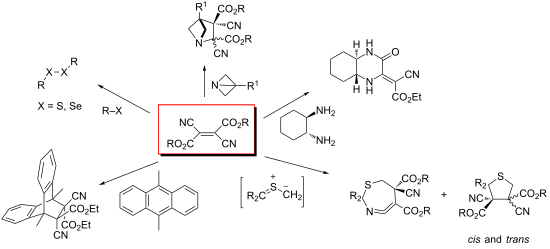
- reactions with diazomethane albeit in very low yields [29]. [2 + 2]-Cycloadditions The electron-deficient dicyanofumarates E-1 react with electron-rich ethenes, yielding cyclobutane derivatives as product of [2 + 2]-cycloadditions. Depending on the reaction conditions and on the type of the electron-rich
- ethene, the reaction occurs stereoselectively or with loss of the stereochemical arrangement of substituents. For example, 4-methoxystyrene (20) reacts with E-1b in 2,5-dimethyltetrahydrofuran in the presence of ZnCl2 with complete stereoselectivity and the cyclobutane derivative 21 is formed as the sole
- product [30] (Scheme 6). The analogous reaction with phenyl vinyl sulfide (22) gave the expected cyclobutane 23 exclusively. However, in the absence of ZnCl2, a mixture of 23 and 3,4-dihydro-2H-pyran 24 was obtained, with the latter compound formed through a competitive hetero-Diels–Alder reaction [30


Bridgehead vicinal diallylation of norbornene derivatives and extension to propellane derivatives via ring-closing metathesis
Beilstein J. Org. Chem. 2016, 12, 1877–1883, doi:10.3762/bjoc.12.177

- as strained as cyclopropane or cyclobutane (norbornene, 100 kJ/mol; cyclopropane, 115 kJ/mol; cyclobutane, 110 kJ/mol) [4][5]. Some of the annulated norbornene derivatives undergo retro Diels–Alder (rDA) reactions at ambient temperature in the presence of methylaluminium dichloride and a reactive


The synthesis of functionalized bridged polycycles via C–H bond insertion
Beilstein J. Org. Chem. 2016, 12, 985–999, doi:10.3762/bjoc.12.97
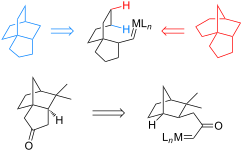
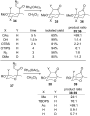
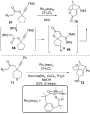
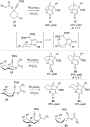
- its reactive equivalent, and then C–H insertion into a cyclopentyl methylene. Insertion into a methylene adjacent to the spirocyclic center in 69 would create a highly strained spirocyclic cyclobutane ring having an sp2 carbon center. Thus, the bicyclo[2.2.1]heptane 70 is the major product, but a







Natural products from microbes associated with insects
Beilstein J. Org. Chem. 2016, 12, 314–327, doi:10.3762/bjoc.12.34
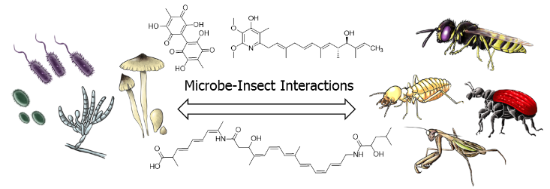
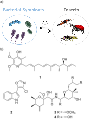
- extract led to the isolation of a new tricyclic macrolactam named tripartilactam (24) [103]. Tripartilactam (24) contains an unprecedented cyclobutane moiety, which links the 8- and 18-membered rings, and it is most likely derived from a photochemically [2 + 2] cycloaddition reaction of the corresponding





Synthesis of Xenia diterpenoids and related metabolites isolated from marine organisms
Beilstein J. Org. Chem. 2015, 11, 2521–2539, doi:10.3762/bjoc.11.273
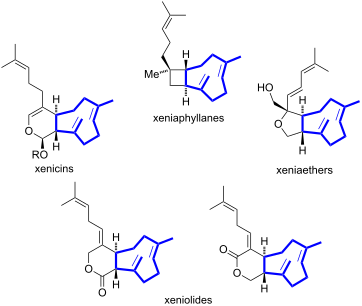
- [7.2.0]undecane ring system 31 as found in xeniaphyllanes [3]. Finally, double C–H oxidation furnishes the β-hydroxy aldehyde 32 which can undergo a retro-aldol reaction with concomitant opening of the cyclobutane ring to form dialdehyde 33 as the common biogenetic precursor of xenicins, xeniolides and
- . The ester group was selectively reduced and desilylation afforded alcohol 84. The generated primary alcohol was tosylated and regioselective deprotonation followed by intramolecular α-alkylation stereoselectively formed the cyclobutane ring. A final Wittig methylenation introduced the exocyclic double







Copper-catalyzed aerobic radical C–C bond cleavage of N–H ketimines
Beilstein J. Org. Chem. 2015, 11, 1933–1943, doi:10.3762/bjoc.11.209

- having a strained cyclobutane ring did not form the desired oxaspirocyclohexadienone (Scheme 6). Instead, γ-bromoketone 8e was isolated in 44% yield along with nitrile 5a in 80% yield. The formation of γ-bromoketone 8e is most likely caused by radical ring opening from the transient cyclobutoxy radical I




A comprehensive study of olefin metathesis catalyzed by Ru-based catalysts
Beilstein J. Org. Chem. 2015, 11, 1767–1780, doi:10.3762/bjoc.11.192
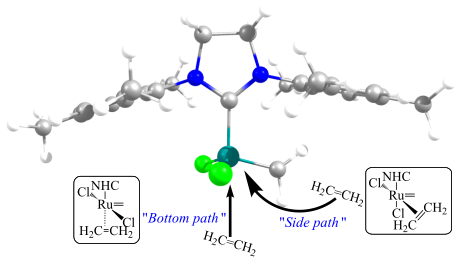
- , Piers and co-workers demonstrated the bottom-bound geometry for a Ru-cyclobutane model compound by NMR data [46]. However, Grubbs and co-workers supported the side-bound pathway [47]. And this sort of discrepancy is displayed in Scheme 3, where the same catalyst shows two conformations, a and b, bottom
- coworkers [33]. Structurally, the Ru–C(metallacycle) bonds in 1, 2, 3 and 7 are rather similar, around 1.97–1.98 Å, see Figure 5a, while in 5 they are remarkably longer with 2.01 Å, probably due to the steric pressure of the t-Bu N-substituents. In all the cases the C–C bonds of the Ru–cyclobutane are




Star-shaped tetrathiafulvalene oligomers towards the construction of conducting supramolecular assembly
Beilstein J. Org. Chem. 2015, 11, 1596–1613, doi:10.3762/bjoc.11.175
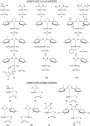
- were synthesized by Ortí, Martín, and co-workers (Figure 3) [44]. The pioneering studies on the synthesis of tetrakis(1,3-dithiol-2-ylidene)cyclobutane (8) and related [5] and [6]radialenes 9 and 10a,b were reported by Yoshida and co-workers in the 1980’s (Figure 4). These π-expanded TTFs 8–10a,b


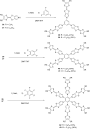


Selected synthetic strategies to cyclophanes
Beilstein J. Org. Chem. 2015, 11, 1274–1331, doi:10.3762/bjoc.11.142
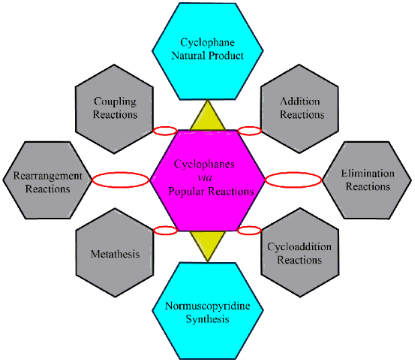
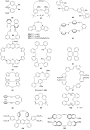
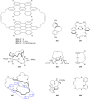
- to generate cyclobutane derivative 262. Finally, the ring opening occurs with catalytic amounts of potassium hexacyanoferrate(III) in the presence of KF to deliver the fluorinated ferrocenophane 263 (Scheme 42). Okada and Nishimura [6] have reported the synthesis of syn-[2.n]metacyclophane 270 as a






Design and synthesis of novel bis-annulated caged polycycles via ring-closing metathesis: pushpakenediol
Beilstein J. Org. Chem. 2014, 10, 2664–2670, doi:10.3762/bjoc.10.280

- ] cycloaddition strategies, which involve the DA reaction of 2,5-dialkyl-1,4-benzoquinone 10 and 1,3-cyclopentadiene (9) followed by the formation of the cyclobutane ring through a [2 + 2] photocycloaddition reaction (Figure 2). Later on, one can introduce two allyl groups by using traditional carbonyl chemistry


Recent applications of the divinylcyclopropane–cycloheptadiene rearrangement in organic synthesis
Beilstein J. Org. Chem. 2014, 10, 163–193, doi:10.3762/bjoc.10.14
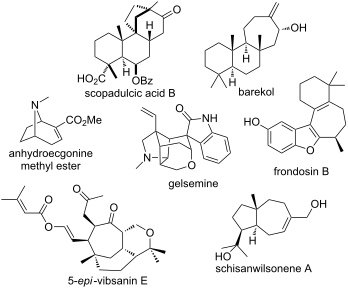
- heteroatom variants of the DVCPR, namely the vinylcyclopropane carbaldehyde–dihydrooxepine rearrangement [217], the vinylcyclopropane carbimine–dihydroazepine [217] rearrangement and the corresponding cyclobutane analogues [229][230][231]. A very stunning application [231] has been achieved using the Claisen




Less reactive dipoles of diazodicarbonyl compounds in reaction with cycloaliphatic thioketones – First evidence for the 1,3-oxathiole–thiocarbonyl ylide interconversion
Beilstein J. Org. Chem. 2013, 9, 2751–2761, doi:10.3762/bjoc.9.309

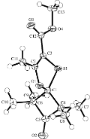
- postulated structures. Owing to their diastereotopic nature, the four Me groups attached to the cyclobutane ring in 1,3-oxathioles 3a–g, derived from thioketone 1a, appeared in the 1H and 13C NMR spectra as two signals (each for 2 Me). This observation can be considered as an additional argument confirming




Gold(I)-catalyzed enantioselective cycloaddition reactions
Beilstein J. Org. Chem. 2013, 9, 2250–2264, doi:10.3762/bjoc.9.264
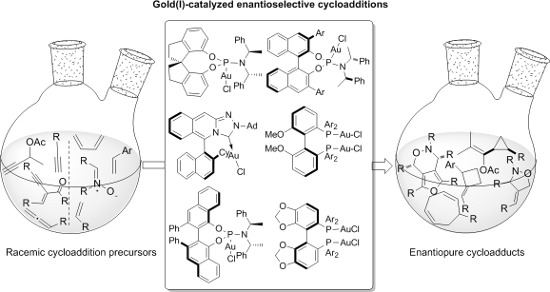
- catalyst provides a gold–allyl cationic species of type IX, which is the species undergoing the cycloaddition process with the diene [73]. Simple alkenes do also react with gold-activated allenamides to provide cyclobutane products, formally resulting from a [2 + 2] cycloaddition. Thus, independent
- of this intermediate and therefore facilitates the overall process. Finally, a ring-closing process through attack of the vinylgold species to the stabilized carbocation yields the cyclobutane system and regenerates the catalyst. In view of this mechanistic proposal, Mascareñas and López recently


Microflow photochemistry: UVC-induced [2 + 2]-photoadditions to furanone in a microcapillary reactor
Beilstein J. Org. Chem. 2013, 9, 2015–2021, doi:10.3762/bjoc.9.237
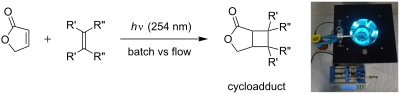
- photoreactor equipped with low wattage UVC-lamps. Conversion rates and isolated yields were compared to analogue batch reactions in a quartz test tube. In all cases examined, the microcapillary reactor furnished faster conversions and improved product qualities. Keywords: cycloaddition; cyclobutane; flow
- . The cyclobutane methine protons emerged as clearly separated signals between 2.35 and 2.90 ppm. Their 3J coupling constants were determined to be 2.9/3.6 and 6.7/7.5 Hz, thus confirming the cis-anti-cis geometry of 3. Under continuous flow conditions, conversion rates increased more rapidly despite
- 90 min and 99% after 8 h of irradiation (Table 2, entries 1 and 2), respectively. From the latter experiment, cyclobutane 5 was isolated in a low yield of just 30%. In CDCl3, the CH3-groups in 5 gave four singlets between 1.02–1.21 ppm. Likewise, the CH2O-bridge appeared at 4.25 and 4.40 ppm with a





