


Search results
Search for "oxocarbenium ion" in Full Text gives 43 result(s) in Beilstein Journal of Organic Chemistry.
Recent advances in synthetic approaches for medicinal chemistry of C-nucleosides
Beilstein J. Org. Chem. 2018, 14, 772–785, doi:10.3762/bjoc.14.65
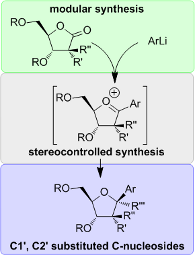
- cleavage proceeds either by activation of a nucleophile that attacks C1' or by stabilization of the leaving group, which could either be the nucleobase or an oxocarbenium ion [31][36]. As such, the oxocarbenium ion is a species formed during the glycosidic bond cleavage, which may be present as an
- intermediate or a transition state depending upon the accumulation of the positive charge on the sugar ring (Figure 2). As a result, any change in the nucleobase–sugar connectivity (C–N) affects the formation of the oxocarbenium ion and thus influences the stability (or instability) of the nucleoside analogues
- ) results in an oxocarbenium ion [62][70][80][81][82][83]. Reduction of this intermediate by various silanes gives C-nucleosides resembling the canonical nucleosides [82][83]. The stereochemical fate of oxocarbenium ion reduction is dictated by the conformation and stability of the oxocarbenium ion, which


Electron-deficient pyridinium salts/thiourea cooperative catalyzed O-glycosylation via activation of O-glycosyl trichloroacetimidate donors
Beilstein J. Org. Chem. 2017, 13, 2385–2395, doi:10.3762/bjoc.13.236

- recovered through column chromatography. Therefore, we conclude that the reaction would have followed an intermolecular glycosylation reaction through an oxocarbenium ion. Combining all of these observations and results from earlier literature reports, a plausible reaction mechanism for the electron
- the glycosyl donor by increasing the acidity of ammonium salt X to form an oxocarbenium intermediate B. Further, the nucleophilic attack of the acceptor to the oxocarbenium ion B would produce the desired glycoside 5. Higher α-selectivity may be attributed to the anomeric effect. Conclusion In


Preactivation-based chemoselective glycosylations: A powerful strategy for oligosaccharide assembly
Beilstein J. Org. Chem. 2017, 13, 2094–2114, doi:10.3762/bjoc.13.207
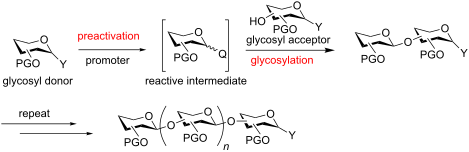
- evolve into several reactive species, such as oxocarbenium ion 79, α-triflate 80, disulfonium ion 81, and dioxalenium ion 82. The nucleophilic attack of the intermediate by a thioglycosyl acceptor would generate the desired glycoside 78. Pioneered by Crich and co-workers, low temperature NMR studies have







Enzymatic synthesis of glycosides: from natural O- and N-glycosides to rare C- and S-glycosides
Beilstein J. Org. Chem. 2017, 13, 1857–1865, doi:10.3762/bjoc.13.180
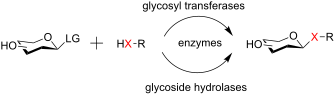
- retention of configuration (Figure 5) as first described by Koshland [53]. However, in the case of GHs, the mechanism generally implies the intervention of two amino acid side chains, typically glutamate or aspartate, and goes through oxocarbenium ion-like transition states. Inverting GHs operate via a




Strategies toward protecting group-free glycosylation through selective activation of the anomeric center
Beilstein J. Org. Chem. 2017, 13, 1239–1279, doi:10.3762/bjoc.13.123

- THF hence forming an oxocarbenium ion. The latter is subsequent attacked by the nucleophilic alcohol to provide the 1,2-trans glycoside with good diastereoselectivity and moderate yield. This methodology holds tremendous potential if the alcohol acceptor is a saccharide moiety as the
- very common and well-studied. Typical Lewis acids employed for anomeric activation are TMSOTf and BF3·Et2O (Scheme 14). The reactions proceed through an oxocarbenium ion that was very recently observed by NMR under cryogenic (−40 °C) conditions stabilized by the HF/SbF5 superacid [52]. The highly
- electrophilic carbon adjacent to the oxocarbenium ion then reacts with the nucleophilic acceptor in either and SN1 or SN2-like mechanism depending on the chemical stability of the glycosyl cation [53]. The stereochemical outcome of the reaction is generally dictated either by neighboring-group participation of




N-Propargylamines: versatile building blocks in the construction of thiazole cores
Beilstein J. Org. Chem. 2017, 13, 625–638, doi:10.3762/bjoc.13.61
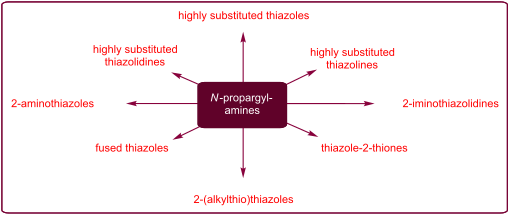
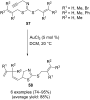
- -2-ylamides 54 in good yields (Scheme 16a). The mechanism for this cyclization as proposed by the authors is depicted in Scheme 16b [98]. Following this work, the Čikotienė group studied the metal-free halogen, chalcogen, or oxocarbenium ion-mediated cyclization of a series of N-propargylthioureas 55




Silyl-protective groups influencing the reactivity and selectivity in glycosylations
Beilstein J. Org. Chem. 2017, 13, 93–105, doi:10.3762/bjoc.13.12

- 2-phthalimido, N-Troc or N-Ac group. It was suggested that the bulky DTBS group is shielding the β-face and thereby preventing attack from that face of the oxocarbenium ion. This methodology has been applied to the synthesis of glycolipids and was shown to also work with 2-O-benzyl [56] or 2-O-TBS
- was proposed that the selectivity was caused by a favored β-attack on the oxocarbenium ion in an E3 conformation as the corresponding α-attack would lead to an unfavorable eclipsed conformation. The exchange of the 2-O-benzyl with a 2-O-TIPS leads to some erosion of stereoselectivity though the donor
- conformational change is not needed to expel the sulfonium ion. This is not the case with the β-anomer. Selectivity is mainly controlled by sterics and hence the α-glycoside is kinetic product as the alcohol approach the oxocarbenium ion intermediate from the exo-side. Glycosylation with sulfoxide 1


New approaches to organocatalysis based on C–H and C–X bonding for electrophilic substrate activation
Beilstein J. Org. Chem. 2016, 12, 2834–2848, doi:10.3762/bjoc.12.283
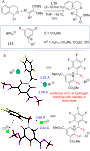
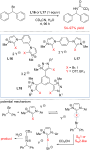
- (NIS) in nitromethane. The resultant carbocation-like species presumably underwent a 1,2-alkyl shift to provide a silylated oxocarbenium ion. The following silyl cation trapping with a bromide anion resulted in 2-phenylcycloheptanone. When a chiral substrate (59% ee) was treated with NIS, a product










Synthesis of the C8’-epimeric thymine pyranosyl amino acid core of amipurimycin
Beilstein J. Org. Chem. 2016, 12, 1765–1771, doi:10.3762/bjoc.12.165
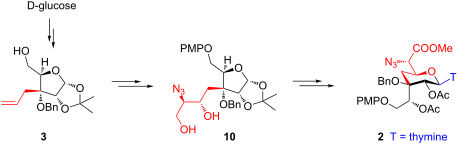
- oxocarbenium ion at C1 to which concomitant addition of a hydroxy group (present in the side chain at C3) will give the requisite pyranose ring skeleton. Intermediate B could be derived from the allyl alcohol C by using the Sharpless asymmetric epoxidation followed by regioselective epoxide ring opening with
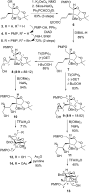
- /13 could be explained as follows (Scheme 3). Thus, treatment of 10/11 with TFA–H2O resulted in the opening of the 1,2-acetonide functionality and generation of an oxocarbenium ion Y. Intermolecular and reversible addition of water would lead to hemiacetal Z, however, intramolecular and irreversible
- attack of the secondary hydroxy group to the oxocarbenium ion Y led to a stable six-membered pyranose ring compound thus shifting the equilibrium in favour of bridged bicyclic system 12/13. In order to validate the configurational assignments at the newly generated stereocenters, the coupling constants






TMSBr-mediated solvent- and work-up-free synthesis of α-2-deoxyglycosides from glycals
Beilstein J. Org. Chem. 2016, 12, 1758–1764, doi:10.3762/bjoc.12.164

- that the acid-catalysed nucleophilic addition of an alcohol to a glycal is likely to proceed through the formation of an oxocarbenium ion via the protonation at C2 [6][63]. In the presence of TPPO, the oxocarbenium cation is stabilized by the ion–dipole interaction with TPPO oriented preferably at the


Enantioselective additions of copper acetylides to cyclic iminium and oxocarbenium ions
Beilstein J. Org. Chem. 2015, 11, 2696–2706, doi:10.3762/bjoc.11.290
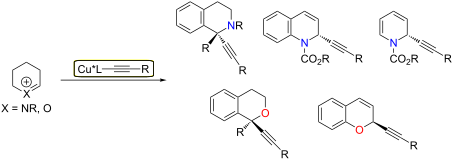
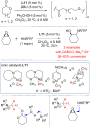
- ; enantioselectivity; iminium ion; oxocarbenium ion; Introduction Nitrogen and oxygen heterocycles with α-stereogenic centers represent important classes of biologicially active compounds [1][2][3][4][5][6][7]. Enantioselective addition of chiral nucleophiles to imines, iminium ions, carbonyls, or oxocarbenium ions
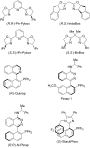
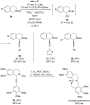
- -based catalysts [9][10][11][12][13][14][15]. Among these, chiral copper catalysts have been used with remarkable success in the alkynylation of cyclic iminium ion and oxocarbenium ion intermediates. This review will focus on the development of these enantioselective, copper-catalyzed alkynylations
- the alkynylations of iminium ions discussed above, we have pursued the development of enantioselective, metal-catalyzed alkynylation of cyclic oxocarbenium ion intermediates. In the course of these studies, we have found that copper-based catalysts are uniquely effective in promoting these





Multicomponent reactions in nucleoside chemistry
Beilstein J. Org. Chem. 2014, 10, 1706–1732, doi:10.3762/bjoc.10.179
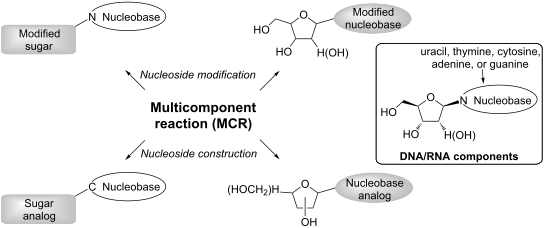
- ), followed by the coupling of the resulting oxocarbenium ion with the silylated nucleobase 118. Compounds 119 were obtained as single diastereoisomers. The similar (not shown) reaction employing the silylated thymine and ethyl glyoxalate gave the corresponding product as 1:1 mixture of isomers at the C-2'a


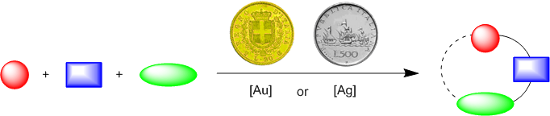
Silver and gold-catalyzed multicomponent reactions
Beilstein J. Org. Chem. 2014, 10, 481–513, doi:10.3762/bjoc.10.46


Stereoselectively fluorinated N-heterocycles: a brief survey
Beilstein J. Org. Chem. 2013, 9, 2696–2708, doi:10.3762/bjoc.9.306
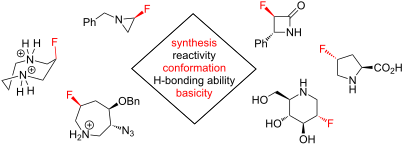
- sugar moiety of natural substrates, or to the activated intermediate of hydrolysis (i.e. the oxocarbenium ion). As a consequence, iminosugars show great promise for the treatment of a variety of diseases including diabetes, viral infection, bacterial infection, and lysosomal storage disorders [37
- oxocarbenium ion, the iminosugars 31 and 41–44 (Figure 11) must bear a positive charge, and since the pKaH values vary considerably amongst the different derivatives, it follows that each derivative has a different “optimal” pH for maximal inhibitory potency. This explains why the Ki values in Figure 11 do not


Gold-catalyzed glycosidation for the synthesis of trisaccharides by applying the armed–disarmed strategy
Beilstein J. Org. Chem. 2013, 9, 2147–2155, doi:10.3762/bjoc.9.252
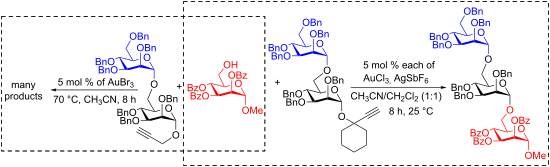
- presence of the aglycon can protonate the exocyclic oxygen present in the disaccharide 4. The protonation of the exocyclic oxygen and subsequent cleavage could give rise to oxocarbenium ion intermediates A and B as shown in Scheme 2. The formation of 1,6-anhydro sugar 5 can be easily envisioned by the


Addition of lithiated enol ethers to nitrones and subsequent Lewis acid induced cyclizations to enantiopure 3,6-dihydro-2H-pyrans – an approach to carbohydrate mimetics
Beilstein J. Org. Chem. 2010, 6, No. 75, doi:10.3762/bjoc.6.75

- stabilized carbenium ion 6 (Scheme 3). Subsequent attack of the oxocarbenium ion on the enol ether moiety leads to ring closure affording the cationic pyran intermediate 7. Subsequent proton transfer to the (moderately basic) hydroxylamine nitrogen re-establishes the enol ether moiety. During aqueous work-up


Diels- Alder reactions using 4,7-dioxygenated indanones as dienophiles for regioselective construction of oxygenated 2,3-dihydrobenz[f]indenone skeleton
Beilstein J. Org. Chem. 2008, 4, No. 15, doi:10.3762/bjoc.4.15
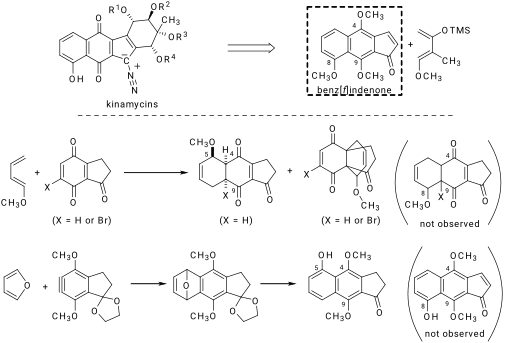
- with conjugation to oxocarbenium ion 36 (path D). In this case, generation of the desired 4,8,9-trioxygenated 2,3-dihydrobenz[f]indenone 28 seemed unlikely due to unfavorable adjacent dicationic intermediate 38 after C5-O bond cleavage of 37. Thus, formation of an alternative dication 39 through C8-O


Vinylogous Mukaiyama aldol reactions with 4-oxy-2-trimethylsilyloxypyrroles: relevance to castanospermine synthesis
Beilstein J. Org. Chem. 2007, 3, No. 38, doi:10.1186/1860-5397-3-38

- destabilization of the intermediate oxocarbenium ion by the adjacent α-ammonium cation. Conclusion In summary, the present work has laid the foundation for a full enantioselective synthesis of castanospermine using a C-8/C-8a disconnection strategy. Future work will focus on C-1 transformation earlier in the





