


Search results
Search for "GlcNAc" in Full Text gives 56 result(s) in Beilstein Journal of Organic Chemistry.
Chemo-enzymatic modification of poly-N-acetyllactosamine (LacNAc) oligomers and N,N-diacetyllactosamine (LacDiNAc) based on galactose oxidase treatment
Beilstein J. Org. Chem. 2012, 8, 712–725, doi:10.3762/bjoc.8.80
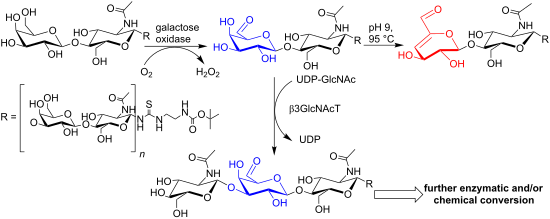
- the semipreparative production of oxidised products. The methyl β-galactoside was chosen as a reference substance because of the comparable linkage at the anomeric C-atom and its known high activity [38]. No activity could be seen with odd-numbered (GlcNAc-terminated) poly-LacNAc–linker–t-Boc
- experiment (bold printed in tables) and confirmed by the downfield glycosylation shift of the involved carbons (C-4 for Glc, C-3 for Gal). Chemical shifts of GlcNAc carbons C-2 agree with N-acetylation. Because of isomerism on the NH-C=S bond, signals of H-1A and CS were not detected. Chemical shifts of
- spin system –(CH2)4CHCH(N–)CH(N–)CH2– of biotin. The anomeric configuration (β) of all saccharide units was determined from the JH-1,H-2 coupling constants. Chemical shifts of GlcNAc carbons C-2 agree with N-acetylation. Because of isomerism on the NH–C=S bond, protons H-1A resonate as two broad




Coupled chemo(enzymatic) reactions in continuous flow
Beilstein J. Org. Chem. 2011, 7, 1449–1467, doi:10.3762/bjoc.7.169
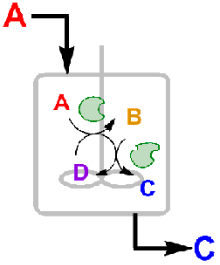
- conversions in the range of 95–98%. The continuous enzymatic synthesis of N-acetylneuraminic acid (17) from N-acetylglucosamine (GlcNAc, 14) in an enzyme membrane reactor employing two enzymes was developed by Kragl and coworkers [27]. In their coupled-reaction system the first enzyme GlcNAc 2-epimerase


The allylic chalcogen effect in olefin metathesis
Beilstein J. Org. Chem. 2010, 6, 1219–1228, doi:10.3762/bjoc.6.140
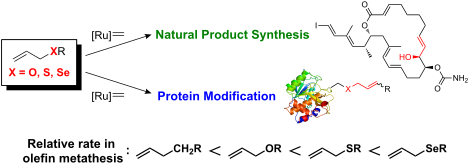
- selenide protein tag is a requirement for most effective CM. Allyl and hexenyl ethers were found to be the most compatible CM partners for allyl sulfide or selenide containing proteins. The more challenging alkene substrates, such as the ones containing electron-deficient N-acetylamine, GlcNAc and
- GlcNAc, mannose and N-acetylamine, which could serve as effective mimics of post-translational protein modifications (glycosylation, lysine acetylation). Conclusion Since the early work by Hoye on secondary allylic alcohols [19] and later the studies on allyl sulfides by our group [17], the allyl


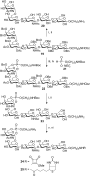
Synthesis of 6-PEtN-α-D-GalpNAc-(1–>6)-β-D-Galp-(1–>4)-β-D-GlcpNAc-(1–>3)-β-D-Galp-(1–>4)-β-D-Glcp, a Haemophilus influenzae lipopolysacharide structure, and biotin and protein conjugates thereof
Beilstein J. Org. Chem. 2010, 6, 704–708, doi:10.3762/bjoc.6.80
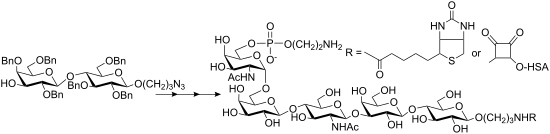
- acetamido function in place. Once more reductive opening of a benzylidene acetal (NaBH3CN/HCl) gave a new mono-hydroxy compound, the acceptor 13 (81%). The 4-hydroxy group in GlcNAc derivatives is known to be quite unreactive towards glycosylations, which, i.a., has led to development of new protecting


Bioorthogonal metabolic glycoengineering of human larynx carcinoma (HEp-2) cells targeting sialic acid
Beilstein J. Org. Chem. 2010, 6, No. 24, doi:10.3762/bjoc.6.24
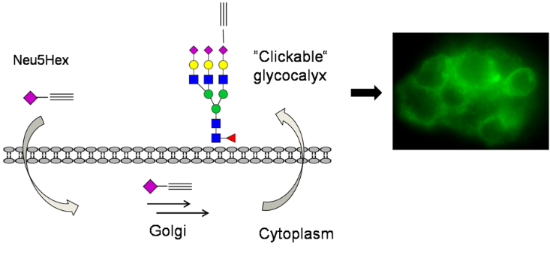
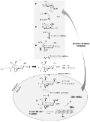
- effects is known [11]. Recently, the regulation of UDP-GlcNAc 2-epimerase/ManNAc kinase expression on the transcriptional level by DNA methylation was demonstrated [12] and a genetic feedback regulation for this process was proposed (Scheme 3) [13]. Ac4GlcNAz 16 or Neu5Hex 3, respectively, were incubated




Chemical synthesis using enzymatically generated building units for construction of the human milk pentasaccharides sialyllacto-N-tetraose and sialyllacto-N-neotetraose epimer
Beilstein J. Org. Chem. 2010, 6, No. 18, doi:10.3762/bjoc.6.18
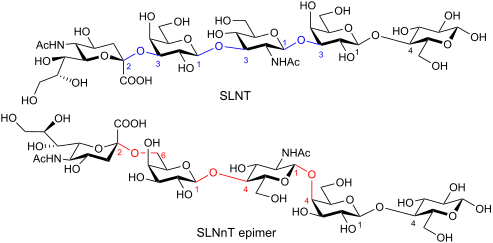
- comparison of the 1H NMR data of 14 with the precursor tri- and disaccharide units 10 and 12, the novel characteristic doublet for the anomeric H-1″ of the β-GlcNAc unit at δ 5.12 (J1″2″ = 8.2 Hz) as well as the downfield shift Δδ 0.15 of H-4′ to δ 4.14 compared to 12 were in accord with structure of the


Other Beilstein-Institut Open Science Activities



