Search results
Search for "acylation" in Full Text gives 355 result(s) in Beilstein Journal of Organic Chemistry. Showing first 200.
One-pot Ugi-azide and Heck reactions for the synthesis of heterocyclic systems containing tetrazole and 1,2,3,4-tetrahydroisoquinoline
Beilstein J. Org. Chem. 2024, 20, 912–920, doi:10.3762/bjoc.20.81
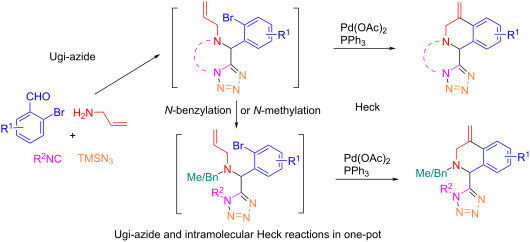
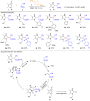
- fused imidazotetrazolodiazepinones (Scheme 2A) [37]. The Gámez-Montaño group introduced a one-pot synthesis of Ugi-azide/N-acylation/Diels–Alder/dehydration reactions for isoindolin-1-one and 1,5-DS-T in a linked manner (Scheme 2B) [41]. The Ding group developed sequential Ugi-azide/Ag-catalyzed


Synthesis of new representatives of A3B-type carboranylporphyrins based on meso-tetra(pentafluorophenyl)porphyrin transformations
Beilstein J. Org. Chem. 2024, 20, 767–776, doi:10.3762/bjoc.20.70
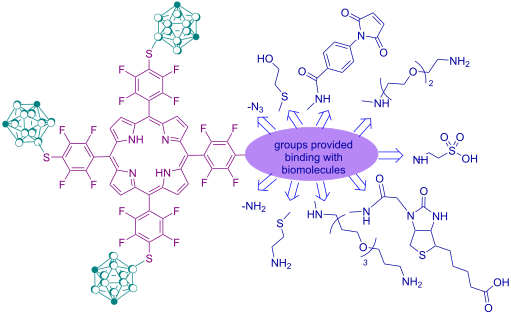
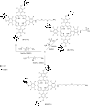
- the ability of the amino group in porphyrin 5 to enter acylation reactions with 4-(N-maleimido)benzoyl chloride (8, prepared in situ from 4-(N-maleimido)benzoic acid (9) and oxalyl chloride) and chloroacetyl chloride (10) with the aim of using these compounds for further functionalization. The



Synthesis of photo- and ionochromic N-acylated 2-(aminomethylene)benzo[b]thiophene-3(2Н)-ones with a terminal phenanthroline group
Beilstein J. Org. Chem. 2024, 20, 552–560, doi:10.3762/bjoc.20.47
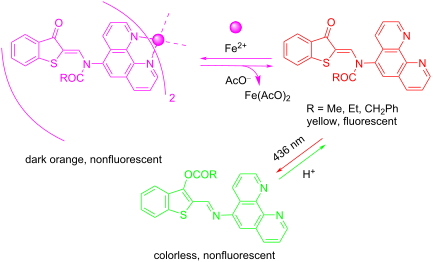
- -wavelength absorption at 458 nm, while acylation led to a hypsochromic shift of the maximum in compounds 2a–c to 423–426 nm (Table 1). The intensity of this absorption band decreased with increasing steric hindrance in the order R = acetyl (i.e., 2a) > propionyl (i.e., 2b) > phenylacetyl (i.e., 2c). N


Synthesis and biological profile of 2,3-dihydro[1,3]thiazolo[4,5-b]pyridines, a novel class of acyl-ACP thioesterase inhibitors
Beilstein J. Org. Chem. 2024, 20, 540–551, doi:10.3762/bjoc.20.46
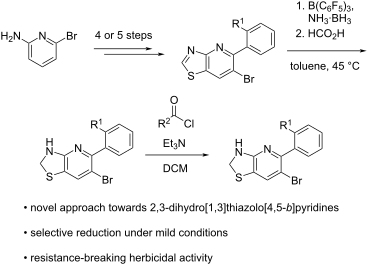
- ]pyridine (13c, 54% combined isolated yield). As shown for N-acylated target compounds 16a–f, the acylation of 6-bromo-2,3-dihydro[1,3]thiazolo[4,5-b]pyridines 13a–c, affording target compounds 14a–c, proceeded under mild conditions with a suitable acyl chloride reagent and triethylamine as base in DCM. It


Metal-catalyzed coupling/carbonylative cyclizations for accessing dibenzodiazepinones: an expedient route to clozapine and other drugs
Beilstein J. Org. Chem. 2024, 20, 193–204, doi:10.3762/bjoc.20.19
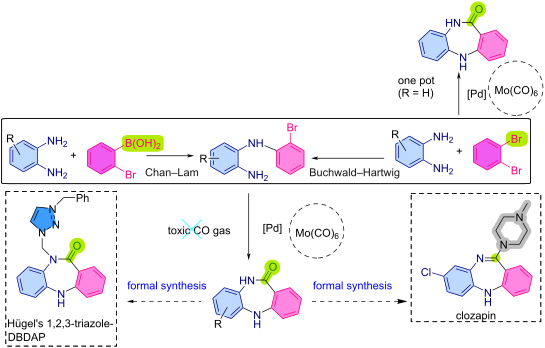
- diverse dibenzodiazepinones via a copper-catalyzed C–N bond coupling between 2-halobenzoates and o-phenylenediamines leading to a key intermediate that undergoes an intramolecular N-acylation to afford the corresponding dibenzodiazepinone structure in high yields (Scheme 1b) [14]. Another innovative


Copper-promoted C5-selective bromination of 8-aminoquinoline amides with alkyl bromides
Beilstein J. Org. Chem. 2024, 20, 155–161, doi:10.3762/bjoc.20.14
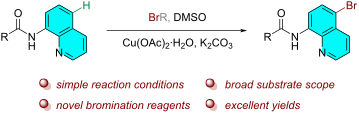
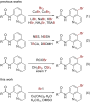
- , and aryl bromides as bromination reagents are limited. Wan and Li, respectively, demonstrated a few examples of a one-pot N-acylation and C5–H bromination of 8‑aminoquinolines using acyl bromines acting as both acyl and halide donors [25][26]. The groups of Lei and Fang independently realized the



Visible-light-induced radical cascade cyclization: a catalyst-free synthetic approach to trifluoromethylated heterocycles
Beilstein J. Org. Chem. 2024, 20, 118–124, doi:10.3762/bjoc.20.12
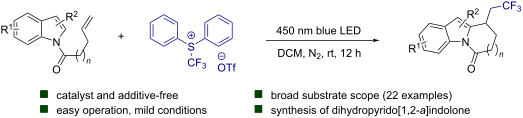
- ], Friedel–Crafts acylation [12], radical cascade reactions [2][13], and photoinduced radical cyclizations [14][15][16][17]. However, these methods often suffer from drawbacks such as harsh reaction conditions and the requirement of transition-metal catalysts. Although photocatalyzed cyclization reactions




Photoinduced in situ generation of DNA-targeting ligands: DNA-binding and DNA-photodamaging properties of benzo[c]quinolizinium ions
Beilstein J. Org. Chem. 2024, 20, 101–117, doi:10.3762/bjoc.20.11
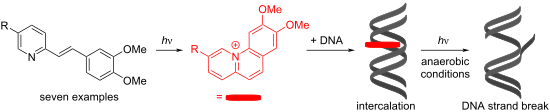
- of 3,4-dimethoxybenzaldehyde with 5-substituted 2-picoline derivatives in low to moderate yields ranging from 13% (2f) to 65% (2a) (Scheme 2). The amino-substituted derivative 2b was synthesized by reduction of the nitrostyrylpyridine 2a with Pd/C and hydrazine in 83% yield. Subsequent acylation of




Using the phospha-Michael reaction for making phosphonium phenolate zwitterions
Beilstein J. Org. Chem. 2024, 20, 41–51, doi:10.3762/bjoc.20.6
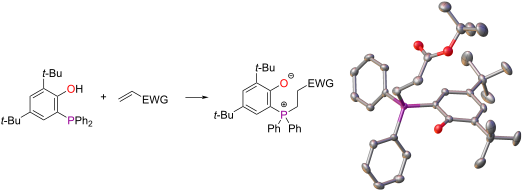
- synthesis of carbonates from CO2 [24][25][26] and the synthesis of oxazolidines from isocyanates and epoxides [27]. Furthermore, their application in primary hydroxy group selective acylation of diols [28] and their use as organophotoredox catalysts [29][30] is known. The latter mentioned catalysts are


Synthetic approach to 2-alkyl-4-quinolones and 2-alkyl-4-quinolone-3-carboxamides based on common β-keto amide precursors
Beilstein J. Org. Chem. 2023, 19, 1804–1810, doi:10.3762/bjoc.19.132
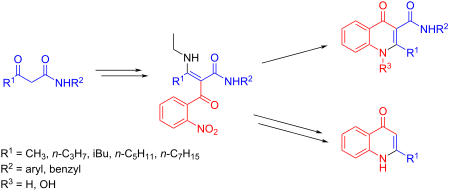
- substituents at the C-2 position. As a way of expanding the scope of this methodology, we resorted to the α-C-acylation of β-enamino amides, a reliable reaction, the utility of which we have already demonstrated in other contexts [62][63]. Results and Discussion As the starting point of our synthetic
- key o-nitrobenzoyl intermediates 3 in a reaction with o-nitrobenzoyl chloride (Scheme 1, conditions ii). The acylation of 2 to 3 proceeded with variable yields, depending on the substituents R1 and R2. Derivatives 2 with a primary carboxamide group (R2 = H) gave generally lower and poorly reproducible


Unprecedented synthesis of a 14-membered hexaazamacrocycle
Beilstein J. Org. Chem. 2023, 19, 1728–1740, doi:10.3762/bjoc.19.126
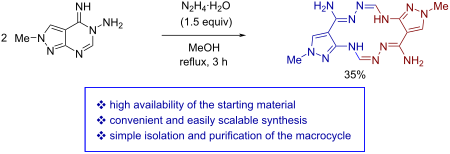
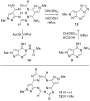
- using acylation reactions (Scheme 7). After a suspension of 5 was refluxed in excess CH(OEt)3 for 28 h, a 58:42 mixture of the starting material and a new compound was isolated. This reaction completed in 8 h in the presence of HCOOH (2.5 equiv) and the new compound was isolated in 59% yield. According


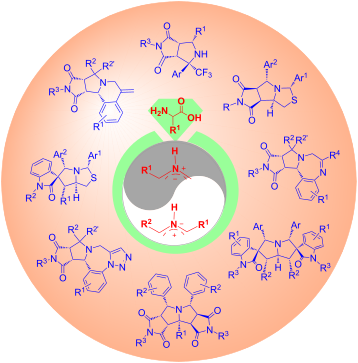
Decarboxylative 1,3-dipolar cycloaddition of amino acids for the synthesis of heterocyclic compounds
Beilstein J. Org. Chem. 2023, 19, 1677–1693, doi:10.3762/bjoc.19.123
- developed a 2-azidobenzladehyde-based reaction sequence including a one-pot [3 + 2] cycloaddition, N-acylation and Staudinger/aza-Wittig reactions for the construction of pyrroloquinazolines and pyrrolobenzodiazepines [73]. The AcOH-catalyzed reaction of 2-azidobenzaldehydes, α-substituted amino acids and
- maleimides in MeCN at 110 °C for 6 h afforded the corresponding monocycloaddition compounds followed by acylation to yield intermediates 22. The subsequent sequential Staudinger/aza-Wittig reaction of intermediates 22 gave products 23a–g in 48–75% yields with 5:1 to 6:1 dr (Scheme 14). This one-pot reaction




N-Sulfenylsuccinimide/phthalimide: an alternative sulfenylating reagent in organic transformations
Beilstein J. Org. Chem. 2023, 19, 1471–1502, doi:10.3762/bjoc.19.106
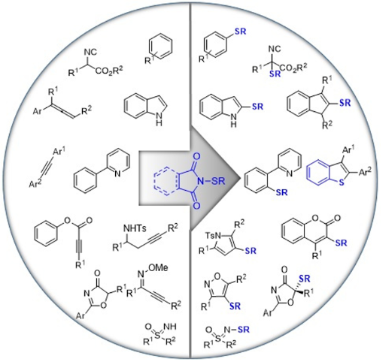
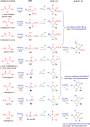
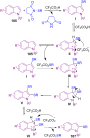
- and S–S bonds. A plausible mechanism for the metal-catalyzed acylation and acylthiolation is illustrated in Scheme 33. Firstly, oxidative addition of palladium to the C–S bond of NTSE 1’’’ afforded intermediate I. The transmetalation from boron to palladium led to intermediate III, followed by
- acylation and acylthiolation. AlCl3-catalyzed synthesis of 3,4-bisthiolated pyrroles. α-Sulfenylation of aldehydes and ketones. Acid-catalyzed sulfetherification of unsaturated alcohols. Enantioselective sulfenylation of β-keto phosphonates. Organocatalyzed sulfenylation of 3‑substituted oxindoles




Cyclization of 1-aryl-4,4,4-trichlorobut-2-en-1-ones into 3-trichloromethylindan-1-ones in triflic acid
Beilstein J. Org. Chem. 2023, 19, 1460–1470, doi:10.3762/bjoc.19.105
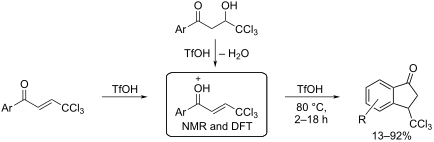
- carried out by condensation of acetophenones with chloral under reflux in acetic acid using the known literature procedure [19] (Scheme 2). Based on another literature approach [20], compounds 1p–v were obtained by acylation of electron-donating arenes with Wynberg lactone [21] (Scheme 3). Additionally
- condensation of acetophenones with chloral in refluxing acetic acid. Synthesis of 1-aryl-4,4,4-trichloro-3-hydroxybutan-1-ones 1p–v by acylation of electron-donating arenes with Wynberg lactone. Synthesis of 1-aryl-4,4,4-trichlorobut-2-en-1-ones 2 by dehydration of hydroxy ketones 1. Cyclization of 1-aryl


Synthesis of ether lipids: natural compounds and analogues
Beilstein J. Org. Chem. 2023, 19, 1299–1369, doi:10.3762/bjoc.19.96
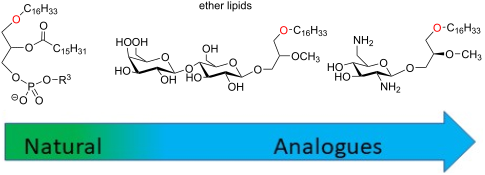
- benzylation produced 4.13. Then, the deprotection of the primary alcohol in acidic conditions allows introducing the phosphocholine polar head group by using POCl3 and the choline tosylate salt as reagents to yield 4.14. Finally, the debenzylation of the secondary alcohol and its acylation produce PAF 4.15. b
- ) The second scheme is shorter (Figure 4D) and starts with the acylation of 4.16 to produce 4.17. Then, the debenzylation of the primary alcohol produced 4.18. Interestingly, the migration of the acetyl group from sn-2 to sn-3 position was not observed. Finally, the installation of the phosphocholine
- group was introduced following the same method to produce PAF 4.15. By using the same methodology, the epimer of PAF 4.15 was synthesized. The group of Bittman reported in 1995 the synthesis of PAF with a four-step sequence starting from S-glycidol 5.1 in which the acylation of the sn-2 position was






Synthesis of aliphatic nitriles from cyclobutanone oxime mediated by sulfuryl fluoride (SO2F2)
Beilstein J. Org. Chem. 2023, 19, 901–908, doi:10.3762/bjoc.19.68
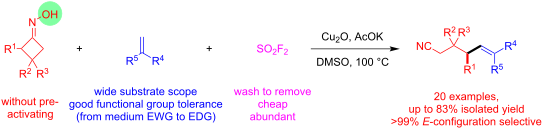
- esters and adopted the pre-acylation activation strategies [39][40][41]. Up to now, only one report employed an oxime for the generation of iminyl radicals to obtain the similar products, in which, substrates were limited to the electron-rich alkenes (Scheme 2b) [42]. On the other hand, sulfuryl fluoride


Strategies in the synthesis of dibenzo[b,f]heteropines
Beilstein J. Org. Chem. 2023, 19, 700–718, doi:10.3762/bjoc.19.51
- precursor 102 and the complementary aldehyde 103. 3.4 Catellani-type reaction The Catellani reaction involves palladium-norbornene cooperative catalysis to functionalise the ortho- and ipso-positions of aryl halides by alkylation, arylation, amination, acylation, thiolation, etc. [63]. Della Ca' et al. [64


Nucleophile-induced ring contraction in pyrrolo[2,1-c][1,4]benzothiazines: access to pyrrolo[2,1-b][1,3]benzothiazoles
Beilstein J. Org. Chem. 2023, 19, 646–657, doi:10.3762/bjoc.19.46
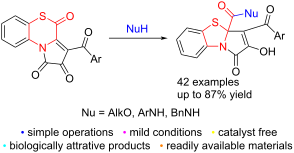
- isolated by a simple crystallization from the reaction mixture. Moreover, we observed the formation of compounds 17 during acylation of enamines 15 with oxalyl chloride to prepare the starting APBTTs 1 (Scheme 21). We noticed that in this case, compounds 17 were formed when HCl was not effectively removed




Enolates ambushed – asymmetric tandem conjugate addition and subsequent enolate trapping with conventional and less traditional electrophiles
Beilstein J. Org. Chem. 2023, 19, 593–634, doi:10.3762/bjoc.19.44
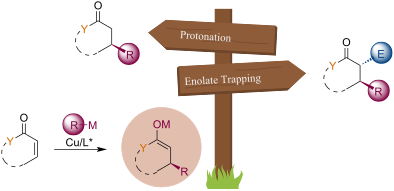
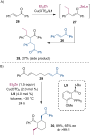
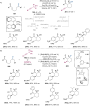
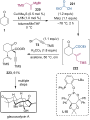
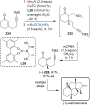
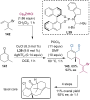
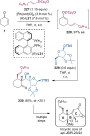
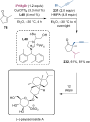
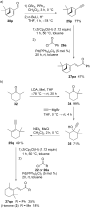
- cyclization. The chiral starting material was prepared by an asymmetric Cu-catalyzed tandem conjugate addition/acylation sequence using ethyl cyanoacetate (Mander’s reagent) as a trapping agent (Scheme 56A). Activation of the zinc enolate by MeLi was necessary, but with optimum reaction conditions the authors
- -catalyzed conjugate addition and subsequent trapping of the zinc enolate by acylation or aldol reaction with an overall yield of 71–78% and good stereoselectivity (Scheme 57) [105][106][107]. Recently, Poock and Kalesse demonstrated the first total synthesis of halioxepine, a meridoterpene isolated from the
- Indonesian sponge Haliclona sp. [108]. Their synthesis takes advantage of the same tandem procedure that gives β-ketoester 219. The asymmetric conjugate 1,4-addition and subsequent acylation provided good stereocontrol and the authors could revise the thus far incorrectly assigned configuration of the target









C3-Alkylation of furfural derivatives by continuous flow homogeneous catalysis
Beilstein J. Org. Chem. 2023, 19, 582–592, doi:10.3762/bjoc.19.43
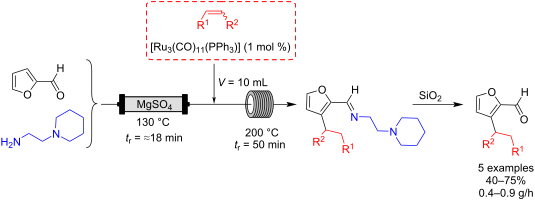
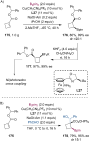
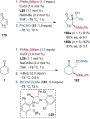
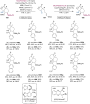
- changing the redox state of the aldehyde function, we have developed a number of directed Ru(0)-catalyzed C3-functionalizations of furfurylimines, such as alkylation [21], arylation [22], alkenylation [23] and acylation [24], as well as an Ir-catalyzed directed C3-silylation (Scheme 1a) [25]. These batch


A new oxidatively stable ligand for the chiral functionalization of amino acids in Ni(II)–Schiff base complexes
Beilstein J. Org. Chem. 2023, 19, 566–574, doi:10.3762/bjoc.19.41
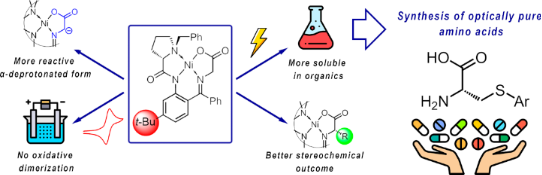
- -substituted o-aminobenzophenone, the synthetic procedure reported in [40] was applied. For acylation of the tert-butylacetanilide, PhCCl3 in the presence of AlCl3 was used. In the reported [40] reaction conditions, a complicated mixture of products was obtained. Lowering the temperature to −15 °C (in contrast
- to rt in [40]) allowed obtaining the targeted compound; however, acylation was accompanied with the migration of the t-Bu group yielding 2-benzoyl-4-tert-butylaniline and the corresponding 5-butylated isomer in a 10:1 ratio. Our attempts to separate the isomers were unsuccessful. However, as it will



Friedel–Crafts acylation of benzene derivatives in tunable aryl alkyl ionic liquids (TAAILs)
Beilstein J. Org. Chem. 2023, 19, 212–216, doi:10.3762/bjoc.19.20
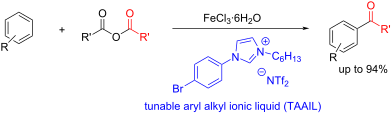
- Swantje Lerch Stefan Fritsch Thomas Strassner Professur für Physikalische Organische Chemie, Technische Universität Dresden, 01062 Dresden, Germany 10.3762/bjoc.19.20 Abstract An iron(III) chloride hexahydrate-catalyzed Friedel–Crafts acylation of benzene derivatives in tunable aryl alkyl ionic
- acylation; homogeneous catalysis; ionic liquids; iron catalysis; TAAILs; Introduction The Friedel–Crafts acylation is one of the oldest metal-catalyzed reactions in organic chemistry [1] and allows for the synthesis of a broad range of diverse compounds [2][3][4][5]. Starting from electron-rich aromatic
- compounds, acylation is possible by an organic acid chloride/acid anhydride and a Lewis acid [6][7]. In the course of the development of ionic liquids (ILs) as a reaction medium for chemical reactions [8][9], the Friedel–Crafts reaction was also examined [10][11][12][13][14][15][16]. First protocols were


Sequential hydrozirconation/Pd-catalyzed cross coupling of acyl chlorides towards conjugated (2E,4E)-dienones
Beilstein J. Org. Chem. 2023, 19, 176–185, doi:10.3762/bjoc.19.17
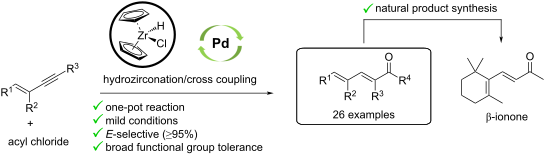
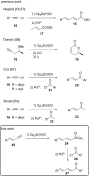
- reactivity and complex synthesis. Based on previous work and own initial results, a new stereospecific sequential hydrozirconation/Pd-catalyzed acylation of enynes with acyl chlorides towards conjugated (2E,4E)-dienones is reported. We investigated a number of substrates with different alkyl and aryl
- example, the sequential hydrozirconation/carbonylation of propargylic ethers 18 reported by Donato [58] yielded α,β-unsaturated lactones 19. Beside the hydrozirconation/acylation sequence of nitriles utilizing acid chlorides published by Majoral/Floreancig [59][60], Cox revealed that terminal alkynes 16
- could be converted to enones 20 by hydrozirconation followed by Pd-catalyzed acylation with acyl chlorides 21 [61]. The substrate scope required aryl units at either alkyne or acid chloride unit. Recently, we could extend this method to alkyl-substituted alkynes 16 and acetyl chloride (22), providing



Functionalization of imidazole N-oxide: a recent discovery in organic transformations
Beilstein J. Org. Chem. 2022, 18, 1575–1588, doi:10.3762/bjoc.18.168
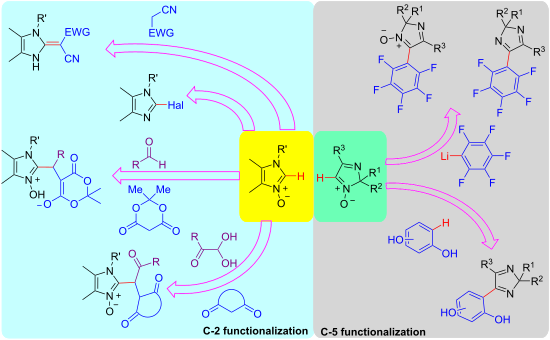
- leaving groups. The eliminating agent (AcCl) led to O-acylation of the intermediate 14 and resulted in deoxygenation through the release of AcOH giving 2H-imidazole derivatives. On the other hand, in case of “addition–oxidation” (SNH AO, path B), the oxidant DDQ picked up a proton from intermediate 14 to
- nucleophilic acylation catalyst in THF as solvent for 1 h. In this reaction, the yield for the transformation of 2-chloro-1-(4-methoxyphenyl)-4,5-dimethyl-1H-imidazole (19a) was 80% when 1.0 equiv TsCl was used. 2-Chloro-1H-imidazoles 20b,c and the corresponding brominated products 21a–c using TsBr were also





Ionic multiresonant thermally activated delayed fluorescence emitters for light emitting electrochemical cells
Beilstein J. Org. Chem. 2022, 18, 1311–1321, doi:10.3762/bjoc.18.136
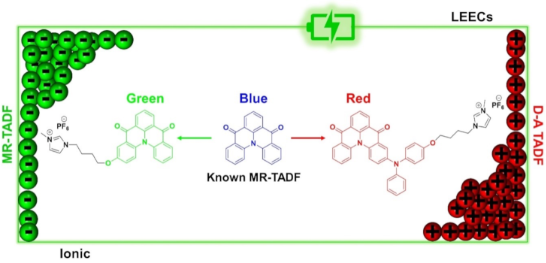
- 23% overall yield. First, hydrolysis of 1, in situ conversion to the acyl chloride and subsequent Lewis acid-promoted Friedel–Crafts acylation reaction produced compound 2 (Scheme 1), where the AlCl3 was also responsible for the demethylation. Compound 2 was then subjected to monoalkylation with 1,4