


Search results
Search for "alkanes" in Full Text gives 111 result(s) in Beilstein Journal of Organic Chemistry.
Mechanochemistry of supramolecules
Beilstein J. Org. Chem. 2019, 15, 881–900, doi:10.3762/bjoc.15.86
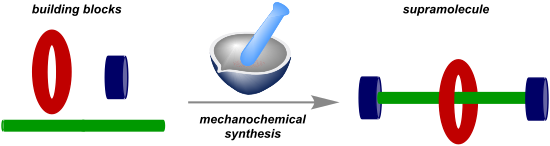
- capsule 40 formed through hydrogen-bonding and the cavity was found to be able to encapsulate different organic molecules such as alkanes, acids, amines, etc. The encapsulation of a [2.2]paracyclophane in the cage was achieved by ball milling at 30 Hz (Figure 22) and the host–guest product 40 was verified


Selective benzylic C–H monooxygenation mediated by iodine oxides
Beilstein J. Org. Chem. 2019, 15, 602–609, doi:10.3762/bjoc.15.55

- widely used in industrial processes as promoters of autoxidation in the functionalization of benzylic C–H bonds of aryl alkanes, such as in the synthesis of terephthalic acid from p-xylene [21]. Metal-free oxidants have been used in benzylic C–H to C–O functionalization. Specifically, the use of
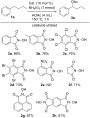
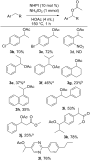
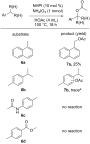
- NO and HNO3 [46][47][48]. In the work that follows, we report the selective monooxygenation of secondary benzylic C–H bonds of simple aryl alkanes using a combination of iodate and catalytic N-hydroxyphthalimide (NHPI), which complements the selectivity and capabilities of existing published work




Metal-free C–H mercaptalization of benzothiazoles and benzoxazoles using 1,3-propanedithiol as thiol source
Beilstein J. Org. Chem. 2019, 15, 279–284, doi:10.3762/bjoc.15.24

- [22] and 1,2-ethanedithiol [23]. In the past decades, C–H functionalization has become an effective strategy for constructing different molecules directly from simple arenes and alkanes. C–H functionalization is an important method for C–S coupling reactions [24][25]. For example, transition metal


Adhesion, forces and the stability of interfaces
Beilstein J. Org. Chem. 2019, 15, 106–129, doi:10.3762/bjoc.15.12
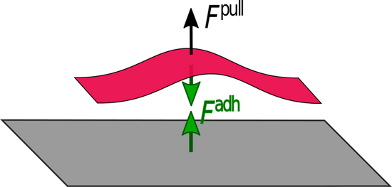
- among alkane molecules in liquid alkanes gives a strong favorable transfer energy for passage of an alkane from vapor into liquid alkane”, explaining the poor solubility of hydrocarbons in water and the good solubility of alkane molecules in liquid alkane [11]. Nonetheless, this interaction is nothing


Reactions of 3-(p-substituted-phenyl)-5-chloromethyl-1,2,4-oxadiazoles with KCN leading to acetonitriles and alkanes via a non-reductive decyanation pathway
Beilstein J. Org. Chem. 2018, 14, 3011–3017, doi:10.3762/bjoc.14.280
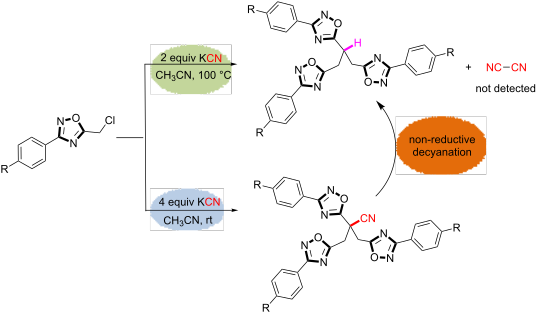
- trisubstituted 1,2,4-oxadiazol-5-ylacetonitriles and their parent alkanes, namely, 1,2,3-trisubstituted-1,2,4-oxadiazol-5-ylpropanes. To the best of our knowledge, the current synthetic route leading to decyanated products will be the first in terms of a decyanation process which allows the transformation of
- trisubstituted acetonitriles into alkanes by the incorporation of KCN with the association of in situ-formed HCN and most likely through the extrusion of cyanogen which could not be detected or isolated. In addition, the plausible mechanisms were proposed for both transformations. The structures of the title
- methods have been reported for the conversion of organic nitriles into the parent alkanes; such as oxidative decyanation [20], dehydrocyanation [21] and more commonly, reductive decyanation [22]. Among them, the reductive decyanation is a widely used method employing metal hydrides [23], electrolysis [24




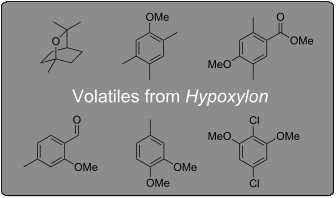
Volatiles from the hypoxylaceous fungi Hypoxylon griseobrunneum and Hypoxylon macrocarpum
Beilstein J. Org. Chem. 2018, 14, 2974–2990, doi:10.3762/bjoc.14.277
- identification requires a good match of the recorded electron impact (EI) mass spectrum to a database spectrum and of the retention index, a standardised GC retention factor that is calculated from the retention times of the analytes and of n-alkanes [15], in comparison to an authentic standard or published data
- min at 50 °C, then increasing with 5 °C min−1 to 320 °C; transfer line 300 °C; electron energy 70 eV. Retention indices (I) were determined from a homologous series of n-alkanes (C8–C38). Synthesis of 2,4,5-trimethylphenol (29a) and 2,3,4-trimethylphenol (29b) Diiodomethane (2.14 g, 8.0 mmol, 2 equiv




Steric “attraction”: not by dispersion alone
Beilstein J. Org. Chem. 2018, 14, 1482–1490, doi:10.3762/bjoc.14.125
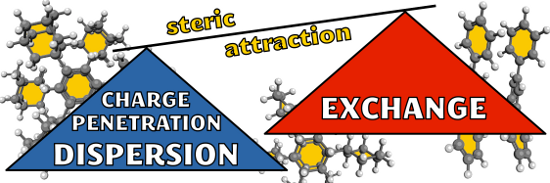
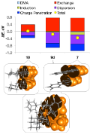
- would lead to elongated intermolecular distances. This might potentially be one of the reasons why the molecular mechanics force fields, commonly applied to aliphatics (see Introduction), significantly underestimate the liquid density and vapor pressure for long chain linear alkanes [70] and branched
- alkanes [71], fail to accurately reproduce the chain length dependence of the tilt and twist angles in alkanethiol self-assembled monolayers [72] and increasingly deviate (by as much as 15%) from experimental data for the hydrophobic solvation free energies of alkanes in alkanes with the increasing chain



Selective carboxylation of reactive benzylic C–H bonds by a hypervalent iodine(III)/inorganic bromide oxidation system
Beilstein J. Org. Chem. 2018, 14, 1087–1094, doi:10.3762/bjoc.14.94
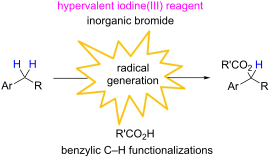
- -workers for the C–H oxidations of unreactive alkanes by iodanyl radicals [80]. Based on these observations, the reaction mechanism via path A that involves the formation of benzyl bromides (X = Br) seems to be more reasonable for our benzylic C–H carboxylation system based on the hypervalent iodine(III


Volatiles from the xylarialean fungus Hypoxylon invadens
Beilstein J. Org. Chem. 2018, 14, 734–746, doi:10.3762/bjoc.14.62
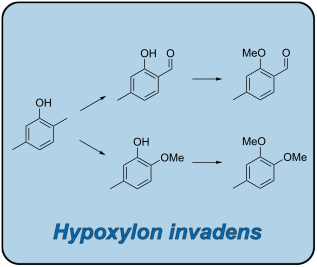
- ; transfer line 300 °C; electron energy 70 eV. Retention indices (I) were determined from a homologous series of n-alkanes (C8–C38). Preparation of methoxy-methylbenzaldehydes To a solution of the hydroxy-methylbenzaldehyde (34 mg, 0.25 mmol) in anhydrous DMF (6.0 mL), K2CO3 (35 mg, 0.25 mmol) was added and




Latest development in the synthesis of ursodeoxycholic acid (UDCA): a critical review
Beilstein J. Org. Chem. 2018, 14, 470–483, doi:10.3762/bjoc.14.33
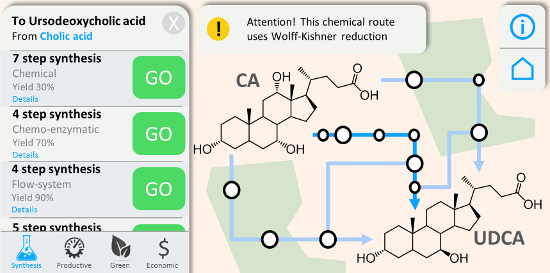
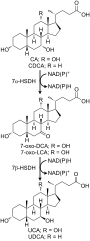
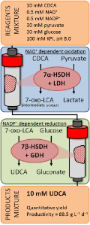
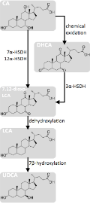
- reagents and products. This methodology is widely used in biocatalysis to solve solubility issues. Unfortunately, the solubility of hydroxysteroids in non-alcoholic organic solvents (e.g., ethers, alkanes, dichloromethane, chloroform) is not very high (e.g., the reported solubility values for CDCA and CA



Syntheses, structures, and stabilities of aliphatic and aromatic fluorous iodine(I) and iodine(III) compounds: the role of iodine Lewis basicity
Beilstein J. Org. Chem. 2017, 13, 2486–2501, doi:10.3762/bjoc.13.246
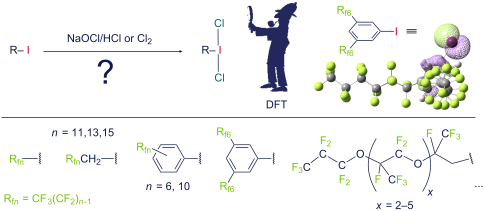
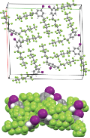
- polar nature of the crystal. Also, the C–C–C–C and F–C–C–F segments in the perfluorohexyl groups do not exhibit the idealized antiperiplanar and gauche conformations associated with saturated alkanes. Rather, the torsion angles for the roughly anti linkages average 164.4(1.6)° and 166.0(3.6



NHC-catalyzed cleavage of vicinal diketones and triketones followed by insertion of enones and ynones
Beilstein J. Org. Chem. 2017, 13, 1816–1822, doi:10.3762/bjoc.13.176
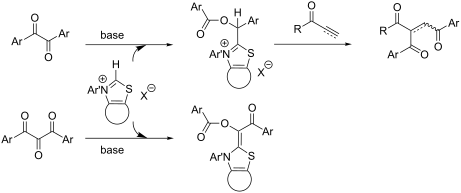
- recently obtained by the dimsyl anion-promoted double acylation of enones with benzils, followed by dehydrogenation of the resulting alkanes in one pot [16]. Moreover, if the reaction of cyclic 1,2-diketone I (G = C(O)R1) with activated alkenes may take place similarly, this reaction could be utilized as a


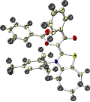


Opportunities and challenges for the sustainable production of structurally complex diterpenoids in recombinant microbial systems
Beilstein J. Org. Chem. 2017, 13, 845–854, doi:10.3762/bjoc.13.85
- in-process-accumulation of the inhibitory metabolite indole [28]. A suitable method for most fermentations is an overlay with apolar alkanes such as dodecane [28][79][95] although subsequent product extraction from this phase may be challenging and oxygenation capacity is reduced. Engineering efflux


Continuous-flow processes for the catalytic partial hydrogenation reaction of alkynes
Beilstein J. Org. Chem. 2017, 13, 734–754, doi:10.3762/bjoc.13.73
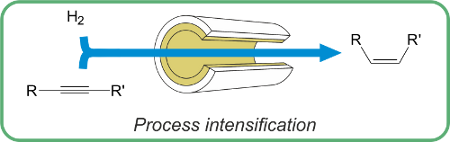
- issues owing to many potential side reactions, particularly in relation to chemoselectivity, i.e., over-hydrogenation of alkenes to alkanes [44][45], resistance of other functional groups (ketones [46][47], amines [48][49], azides [50]), regioselectivity [51][52] , isomerization [53][54] and








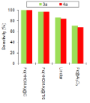
A detailed view on 1,8-cineol biosynthesis by Streptomyces clavuligerus
Beilstein J. Org. Chem. 2016, 12, 2317–2324, doi:10.3762/bjoc.12.225
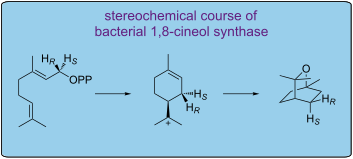
- split mode (10:1, 60 s valve time). Helium was used as the carrier gas at 1 mL/min. Retention indices were determined against a homologous series of n-alkanes (C8–C40). Synthesis of (2-13C)geranyl diphosphate (2-13C)Geraniol was synthesised as reported previously [41]. The synthetic (2-13C)geraniol (16


Mechanistic investigations on six bacterial terpene cyclases
Beilstein J. Org. Chem. 2016, 12, 1839–1850, doi:10.3762/bjoc.12.173
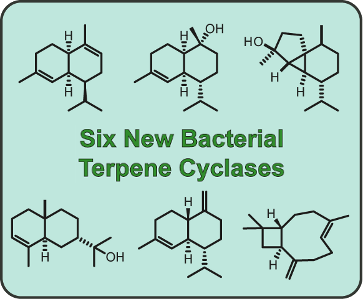
- programmed as follows: 5 min at 50 °C increasing at 5 °C min−1 to 320 °C, and operated in split mode (10:1, 60 s valve time). The carrier gas was He at 1 mL min−1. Retention indices (I) were determined from a homologous series of n-alkanes (C7−C40). Compound identification of the side products of terpene


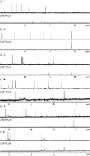
Methylpalladium complexes with pyrimidine-functionalized N-heterocyclic carbene ligands
Beilstein J. Org. Chem. 2016, 12, 1557–1565, doi:10.3762/bjoc.12.150
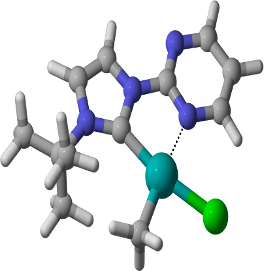
- ]. One of the most prominent examples are the palladium catalyzed cross-coupling reactions [2], but in addition palladium complexes recently received much attention also in the field of selective CH oxidations [3][4][5][6]. The catalytic conversion of alkanes and especially of methane into a value-added


From N-vinylpyrrolidone anions to modified paraffin-like oligomers via double alkylation with 1,8-dibromooctane: access to covalent networks and oligomeric amines for dye attachment
Beilstein J. Org. Chem. 2016, 12, 1395–1400, doi:10.3762/bjoc.12.133

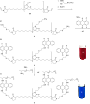
- term paraffin means parum affinis or poor reactivity and comprises acyclic alkanes. They are obtained as byproducts in petroleum industry [28][29]. Technical derivatives are chloro- and chlorosulfonated paraffins which are used, e.g., as surfactants [30][31][32][33]. In the current paper we wish to



Efficient syntheses of climate relevant isoprene nitrates and (1R,5S)-(−)-myrtenol nitrate
Beilstein J. Org. Chem. 2016, 12, 1081–1095, doi:10.3762/bjoc.12.103

- , α-farnesene, β-gurjunene, β-muurolene and allo-aromadendrene, as well as simple alkanes, alkenes, alcohols, esters, aldehydes, ketones and carboxylic acids [3]. The quantities of BVOCs released far exceed non-methane hydrocarbon emissions derived from anthropogenic activity (~90 Tg C yr−1 where 1 Tg


Enantioselective carbenoid insertion into C(sp3)–H bonds
Beilstein J. Org. Chem. 2016, 12, 882–902, doi:10.3762/bjoc.12.87
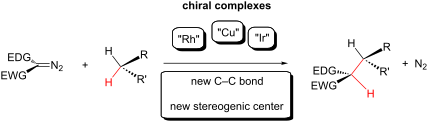
- for enantioselective carbenoid insertion into C(sp3)–H bonds [70]. The reaction with acyclic alkanes showed regioselectivity in favor of the formation of the insertion product into primary carbons in modest stereoselectivity (Scheme 23). The preference for the reaction in less hindered carbon was
- attributed to high steric demand required by the chiral ligand in the transition state of the carbenoid insertion step in the C(sp3)–H bond. Cyclic alkanes were also tested with yields ranging from 64–80% and enantioselectivities between 88 and 92% ee. The reaction with cyclohexane was conducted on a gram


Recent advances in C(sp3)–H bond functionalization via metal–carbene insertions
Beilstein J. Org. Chem. 2016, 12, 796–804, doi:10.3762/bjoc.12.78

- development of intermolecular C–H insertion in the application of C(sp3)–H bond functionalizations, especially for light alkanes, is reviewed. The challenging problem of regioselectivity in C–H bond insertions has been tackled by the use of sterically bulky metal catalysts, such as metal porphyrins and silver
- (I) complexes. In some cases, high regioselectivity and enantioselectivity have been achieved in the C–H bond insertion of small alkanes. This review highlights the most recent accomplishments in this field. Keywords: alkane; diazo compounds; C–H bond functionalization; C–H bond insertion; metal
- development of various directing groups for controlling the site-selectivity of the reaction. Regardless of the great efforts devoted to the field, the intermolecular C(sp3)–H bond activation of simple alkanes still remains a formidable challenge, obviously attributed to the inertness and ubiquitous nature of


From steroids to aqueous supramolecular chemistry: an autobiographical career review
Beilstein J. Org. Chem. 2016, 12, 684–701, doi:10.3762/bjoc.12.69
- two caveats to this statement. First, very small guests such as methane form 1:1 complexes; the cut-off for simple alkanes is between ethane and propane; the former forms a 1:1 complex whilst the latter forms a kinetically stable 2:2 capsular complex. Second, if guest binding generates a rather
- its overall affinity for the capsule and hence will affect any application that these types of complex are applied to. One straightforward approach to examining how flexible guests pack within these capsules is to consider the n-alkanes, the homologous series of which is available in pure form all the
- undergo compression [48]. For alkanes such as C14H30 the guest adopts a helical form; one that is of high energy in solution because of the gauche interactions down the length of the chain, but within the capsule maximizes non-covalent contacts between host and guest. With larger species such as C18H38




Cascade alkylarylation of substituted N-allylbenzamides for the construction of dihydroisoquinolin-1(2H)-ones and isoquinoline-1,3(2H,4H)-diones
Beilstein J. Org. Chem. 2016, 12, 301–308, doi:10.3762/bjoc.12.32

- cross-dehydrogenative coupling (CDC) reactions of alkanes, which were reported by Li and other groups [11][12][13][14][15]. Recently, several types of reactions with alkanes as substrates have been developed, such as the Minisci reaction with heteroarenes [16][17], radical addition to unsaturated bonds
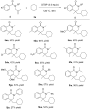
- -initiated cyclization [30][31] and other radical reactions [32][33][34]. Due to their low polarity and high bond-dissociation energy, the functionalization of unactivated sp3 C–H bonds in simple alkanes remains as a challenging task. The direct cascade, 1,2-alkyarylation of alkenes to construct multi
- alkanes resulting in alkyl-substituted oxindoles (Scheme 1a) [43]. However, cyclization of N-allylbenzamides initiated by the functionalization of sp3 C–H bonds of simple alkanes remains unexplored. Very recently, our group developed a metal-free hydroxyalkylation-initiated radical six-membered





Thermal and oxidative stability of Atlantic salmon oil (Salmo salar L.) and complexation with β-cyclodextrin
Beilstein J. Org. Chem. 2016, 12, 179–191, doi:10.3762/bjoc.12.20
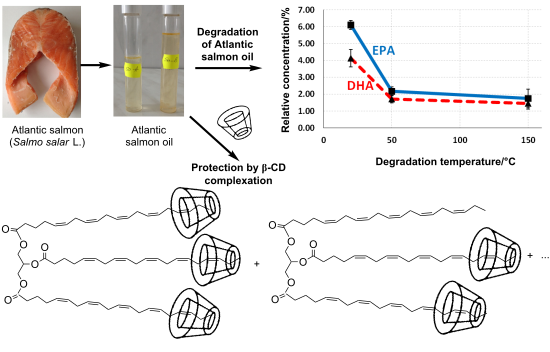
- , aldehydic acids, alkanes and alkenes [17]. In the case of fish oil, the main odoriferous compounds resulting from oxidation are propanal, pent-1-en-3-one, hex-3-enal, and pent-1-en-3-ol [18][19][20]. The stabilization of fish oils can be simply performed by using antioxidants. Natural or synthetic



A journey in bioinspired supramolecular chemistry: from molecular tweezers to small molecules that target myotonic dystrophy
Beilstein J. Org. Chem. 2016, 12, 125–138, doi:10.3762/bjoc.12.14
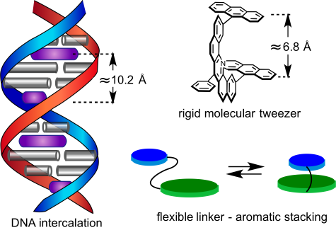
- homologous series of alkanes, not an analysis of a host–guest system. All these values suggest that freezing out a single bond rotation is not terribly costly but association constants can drop significantly if too much flexibility exists; freezing five single bonds within a complex would lower its stability





