


Search results
Search for "antifungal activity" in Full Text gives 62 result(s) in Beilstein Journal of Organic Chemistry.
Modulating the activity of short arginine-tryptophan containing antibacterial peptides with N-terminal metallocenoyl groups
Beilstein J. Org. Chem. 2012, 8, 1753–1764, doi:10.3762/bjoc.8.200
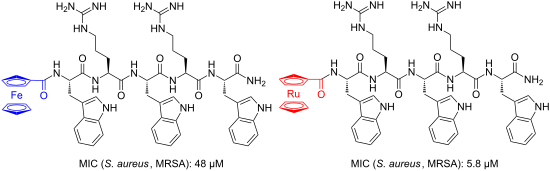
- [14], trivalent lipidated short peptides with antifungal activity [15], peptoids [16], peptides containing D-amino acids [17], and foldamers based on β-amino acid residues with antibacterial activity [18] have been described. Whereas nature has to stick to products compatible with biosynthetic


Reactions of nitroxides XIII: Synthesis of the Morita–Baylis–Hillman adducts bearing a nitroxyl moiety using 4-acryloyloxy-2,2,6,6-tetramethylpiperidine-1-oxyl as a starting compound, and DABCO and quinuclidine as catalysts
Beilstein J. Org. Chem. 2012, 8, 1515–1522, doi:10.3762/bjoc.8.171

- consistent with the spectra of the typical series of the MBH adducts of common aldehydes and methyl acrylate, presented in [32]. Synthesized compounds 5a–o showed a weak antifungal activity. No insecticidal, acaricidal and herbicidal activity were shown. Conclusion In conclusion, it has been demonstrated


A macrolactonization approach to the total synthesis of the antimicrobial cyclic depsipeptide LI-F04a and diastereoisomeric analogues
Beilstein J. Org. Chem. 2012, 8, 1344–1351, doi:10.3762/bjoc.8.154
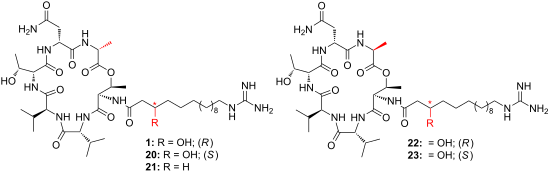
- naturally occurring cyclic peptide may be required for the antifungal activity of this natural product. Keywords: antifungal; cyclic depsipeptide; epimerization; lipopeptide; macrolactonization; peptides; Introduction The LI-F or fusaricidin class of cyclic depsipeptides are produced by a number of
- core through the nitrogen atom of the L-Thr residue. There has been recent interest in the synthesis of the LI-F family of cyclic depsipeptides due to their antifungal activity. Biosynthetic processes have been employed to this end, although these provide mixtures of depsipeptides, which makes it
- precursors. We report here our optimization of these macrolactonization conditions, together with the synthesis of several analogues of LI-F04a using this approach, and an investigation of the antifungal activity of these synthetic lipodepsipeptides. Results and Discussion The required linear precursor for





Triterpenoid saponins from the roots of Acanthophyllum gypsophiloides Regel
Beilstein J. Org. Chem. 2012, 8, 763–775, doi:10.3762/bjoc.8.87
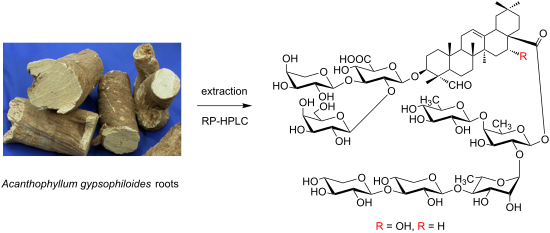
- obtained saponins were elucidated by a combination of mass spectrometry and 2D NMR spectroscopy. A study of acute toxicity, hemolytic, anti-inflammatory, immunoadjuvant and antifungal activity was carried out. Both saponins 1 and 2 were shown to exhibit immunoadjuvant properties within the vaccine
- : Basidiomycetous yeasts Cryptococcus terreus, Filobasidiella neoformans, and ascomycetous yeasts Saccharomyces cerevisiae and Саndida albicans. The data in Table 7 demonstrate that compounds 1 and 2 exhibit antifungal activity against both ascomycetous and basidiomycetous yeasts, including the medically important
- C. albicans and F. neoformans. Saponins are known to be more effective against basidiomycetous yeast and at acidic pH act similarly to natural detergents, such as cellobiose lipids [27]. Growth inhibition experiments showed (Figure 6, Table 7), that the lower pH 4.0 favored antifungal activity of


Phytoalexins of the Pyrinae: Biphenyls and dibenzofurans
Beilstein J. Org. Chem. 2012, 8, 613–620, doi:10.3762/bjoc.8.68
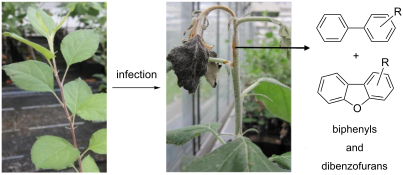
- by microorganisms or herbivores and provide a constitutive barrier. Antimicrobial properties Antifungal activity of biphenyls and dibenzofurans was demonstrated in a number of studies [4][7][8][9][10][12][13][14][15][18][19][21]. Spore germination, germ-tube development, and mycelial growth were
- ) were tested for their inhibitory effect on the scab-causing fungus, Venturia inaequalis, the aglycone exhibited significantly stronger antifungal activity than the glucoside [10]. This finding agrees with the observation that the accumulated phytoalexins are commonly aglycones of biphenyls and
- did [12], whereas the opposite tendency was observed for antifungal activity [26]. However, more biphenyls and dibenzofurans need to be tested for their antibacterial and antifungal potentials in order to allow for reliable conclusions concerning structure–activity relationships. The array of



Synthesis of szentiamide, a depsipeptide from entomopathogenic Xenorhabdus szentirmaii with activity against Plasmodium falciparum
Beilstein J. Org. Chem. 2012, 8, 528–533, doi:10.3762/bjoc.8.60
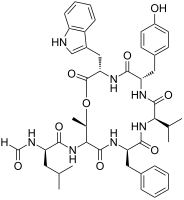
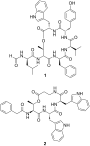
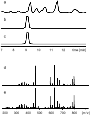
- different Gram-positive (Micrococcus luteus, Bacillus subtilis, Staphylococcus aureus) and Gram-negative (Escherichia coli, Pseudomonas aeroginosa) bacteria, as well as yeast (Candida albicans, Saccharomyces cerivisiae). However, consistent with the published data [12], no antibacterial or antifungal
- activity was detected. Additionally, the peptide 1 was tested against several parasites (Trypanosoma brucei rhodesiense, Trypanosoma cruzi, Leishmania donovani, Plasmodium falciparum) being the causative agents of the neglected tropical diseases [18] sleeping sickness, leishmaniasis and malaria



Synthesis and characterization of new diiodocoumarin derivatives with promising antimicrobial activities
Beilstein J. Org. Chem. 2011, 7, 1688–1696, doi:10.3762/bjoc.7.199
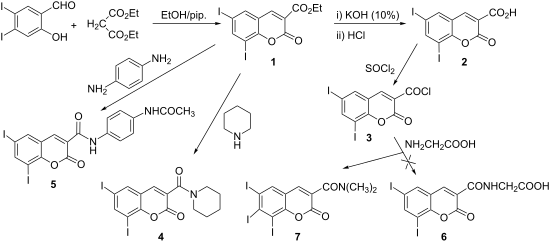
- activity against the tested organisms. Compounds 9–11 exhibited comparable activity to ampicillin against the tested bacteria and moderate to weak antifungal activity against the tested organisms. Furthermore, compounds 1–8 showed moderate to weak activities against all the tested bacteria and fungi
- ampicillin (30 µg mL−1) as the standard antibiotic reference for antibacterial activity, and calforan (30 µg mL−1) was used as a reference antifungal activity. The tested compounds were dissolved in N,N-dimethylformamide (DMF) to give a solution of 1 mg mL−1. The inhibition zones (diameter of the hole) were
- presence of diiodocoumarin-3-carboxamides decreased the antimicrobial activity. Graphical representation of the antibacterial activity of tested compounds compared to ampicillin. Graphical representation of antifungal activity of tested compounds, compared to calforan. Synthesis of 6,8-diiodocoumarin


Natural product biosyntheses in cyanobacteria: A treasure trove of unique enzymes
Beilstein J. Org. Chem. 2011, 7, 1622–1635, doi:10.3762/bjoc.7.191
- ]. Hectochlorin Hectochlorin (10) was isolated from a Jamaican isolate of Lyngbya majuscula and exhibits antifungal activity. It also shows potent activity towards a number of cancer cell lines. HctA, an acyl-CoA synthetase homologue, is expected to activate free hexanoic acid and to provide the starter for


Advances in synthetic approach to and antifungal activity of triazoles
Beilstein J. Org. Chem. 2011, 7, 668–677, doi:10.3762/bjoc.7.79

- that bioisosteric replacement of a triazole ring leads to antifungal activity with a higher selectivity of the fungal targets. Triazole antifungal drugs are used in the treatment of both superficial and deep-seated candidiasis [30]. On the basis of various literature surveys, the triazole nucleus
- occupies the most important place in the treatment of fungal diseases. The triazole derivatives noted below were synthesized by various groups and show antifungal activity. Novel 1,2,3-triazole-linked with β-lactam–bile acid conjugates were prepared via 1,3-dipolar cycloaddition reactions of azido β
- -lactams and terminal alkynes of bile acids in the presence of a Cu(I) catalyst (click chemistry) by Vatmurge et al. The synthesized compounds were evaluated for their antifungal activity against different fungal strains such as Candida albicans, Cryptococcus neoformans, Benjaminiella poitrasii, Yarrowia




First synthesis of 2-(benzofuran-2-yl)-6,7-methylene dioxyquinoline-3-carboxylic acid derivatives
Beilstein J. Org. Chem. 2011, 7, 210–217, doi:10.3762/bjoc.7.28
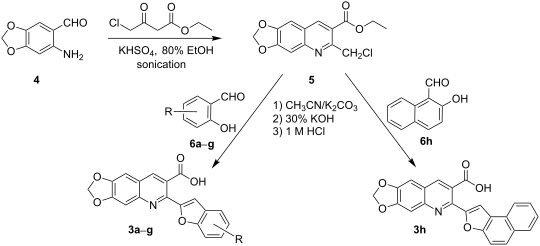
- reported to inhibit C. albicans prolyl-tRNA synthetase and displayed potent in vitro antifungal activity against dermatophytes [6]. Consequently, studies concerning novel 2-heteroarylquinoline derivatives appear frequently in the literature [7][8]. In a nature’s collection of biologically active


Approaches towards the synthesis of 5-aminopyrazoles
Beilstein J. Org. Chem. 2011, 7, 179–197, doi:10.3762/bjoc.7.25
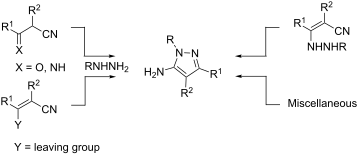
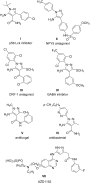
- mammalian receptors [10]. The simple N-phenyl amide of 5-amino -1,3-dimethylpyrazole-4-carboxylic acid V has been shown to exhibit antifungal activity [11] (Figure 1). The 5-amino-1-pyrazinyl-3-carboxamidopyrazole derivative VI has been recently reported as a potent antibacterial agent with a very broad







Synthesis of some novel hydrazono acyclic nucleoside analogues
Beilstein J. Org. Chem. 2010, 6, No. 49, doi:10.3762/bjoc.6.49
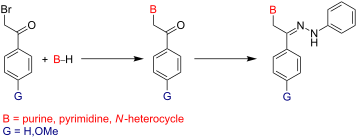
- been an increase in the number of antifungal drugs available with various structures and scaffolds. However, their clinical value has been limited by the emergence of drug resistance, high risk of toxicity, insufficiencies in their antifungal activity as well as undesirable side effects. This situation





