


Search results
Search for "chiral ligands" in Full Text gives 103 result(s) in Beilstein Journal of Organic Chemistry.
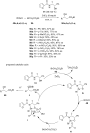
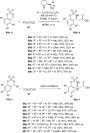
Some mechanistic aspects regarding the Suzuki–Miyaura reaction between selected ortho-substituted phenylboronic acids and 3,4,5-tribromo-2,6-dimethylpyridine
Beilstein J. Org. Chem. 2018, 14, 2384–2393, doi:10.3762/bjoc.14.214
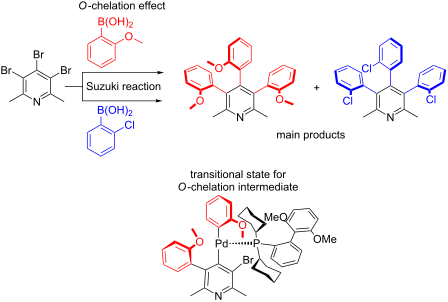
- essential stereochemical element of many popular, commercially available chiral catalysts [3]. Several ortho-substituted arylpyridine derivatives belong to a very important class of axially chiral compounds which have gained interest due to their role as chiral ligands in cross-coupling reactions, or being


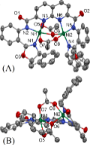
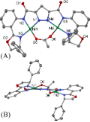
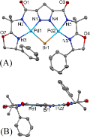
Chiral bisoxazoline ligands designed to stabilize bimetallic complexes
Beilstein J. Org. Chem. 2018, 14, 2002–2011, doi:10.3762/bjoc.14.175

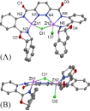
- pyridazine-bridged, and bis-nickel as well as bis-palladium pyrazole-bridged complexes were obtained. Keywords: bimetallic complexes; bisoxazolines; chiral ligands; heterocycles; Introduction Metal-centered asymmetric catalysis most commonly relies on monometallic complexes of various chiral ligands, among







Synthesis of chiral 3-substituted 3-amino-2-oxindoles through enantioselective catalytic nucleophilic additions to isatin imines
Beilstein J. Org. Chem. 2018, 14, 1349–1369, doi:10.3762/bjoc.14.114

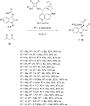
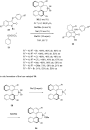
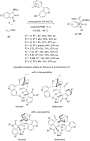
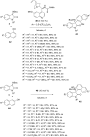
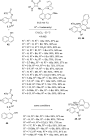
- 20. In 2016, Zhang and Yang reported an asymmetric palladium-catalyzed addition of arylboronic acids 60 to sterically hindered N-tert-butylsulfonylisatin imines 61 [80]. Among a variety of chiral ligands investigated, including different pyridine-oxazolines, oxazolines and (R)-BINAP, the chiral










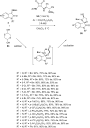

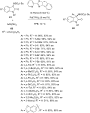
Fluorocyclisation via I(I)/I(III) catalysis: a concise route to fluorinated oxazolines
Beilstein J. Org. Chem. 2018, 14, 1021–1027, doi:10.3762/bjoc.14.88
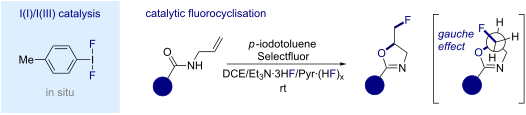
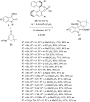
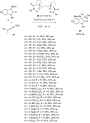
- ranging from drug delivery through to tissue engineering [3][4]. Collectively, the importance of the 2-oxazoline scaffold for translational research, together with its strategic value in the design of chiral ligands and auxiliaries [5][6][7], has culminated in a rich and innovative arsenal of synthetic


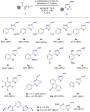


Enantioselective dioxytosylation of styrenes using lactate-based chiral hypervalent iodine(III)
Beilstein J. Org. Chem. 2018, 14, 659–663, doi:10.3762/bjoc.14.53
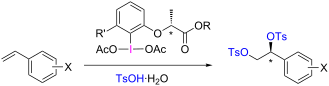
- the electronic and steric properties of the aryl group and the heteroatomic ligand coordinated to the iodine atom. Optically active hypervalent iodine compounds contain chiral ligands or chiral aryl groups. Several types of optically active hypervalent iodine reagents and catalysts have been developed


Recent developments in the asymmetric Reformatsky-type reaction
Beilstein J. Org. Chem. 2018, 14, 325–344, doi:10.3762/bjoc.14.21
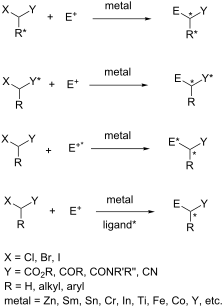
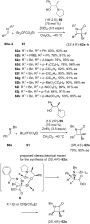
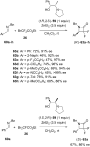
- enantioselective (aza)-variants by using chiral substrates or chiral ligands. As illustrated in this review, the diastereoselective Reformatsky reactions of chiral substrates or auxiliaries have been applied to the total synthesis of a number of important products, such as naturally occurring bioactive products
- Reformatsky reactions [16]. The present review is divided into two parts, dealing successively with diastereoselective (aza)-Reformatsky reactions of chiral substrates or auxiliaries and catalytic enantioselective (aza)-Reformatsky reactions using chiral ligands. Review Diastereoselective Reformatsky
- reassignment of the relative stereochemistries and absolute configurations of their natural counterparts (−)-Q-1047H-A-A and (−)-Q-1047H-R-A. Catalytic enantioselective (aza)-Reformatsky reactions Reformatsky reactions In recent years, novel chiral ligands have been designed to promote catalytic











Polarization spectroscopy methods in the determination of interactions of small molecules with nucleic acids – tutorial
Beilstein J. Org. Chem. 2018, 14, 84–105, doi:10.3762/bjoc.14.5
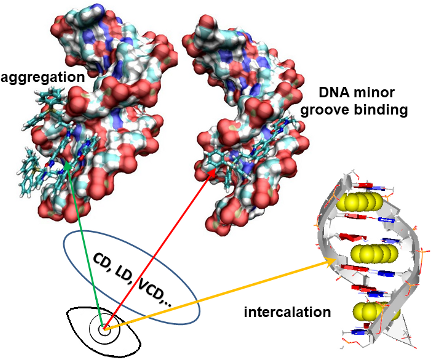
- absorption spectra for chiral ligands, ECD spectra at different concentrations can be collected, taking into account that the total absorbance of the sample is compatible with the sensitivity of the instrument. Again, aggregating ligands could form chiral aggregates with a characteristic exciton-coupled CD

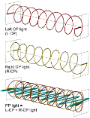


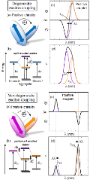


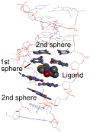

Effect of uridine protecting groups on the diastereoselectivity of uridine-derived aldehyde 5’-alkynylation
Beilstein J. Org. Chem. 2017, 13, 1533–1541, doi:10.3762/bjoc.13.153

- ][17][35][42][43][44][45][46][47]. Aside from the use of chiral ligands promoting an excellent facial discrimination of the aldehyde [34], the addition of Grignard reagents usually proceed with moderate diastereoselectivity and yield (Table 1) [12][35][43][44][45][46][48]. In the course of our program


Chromium(II)-catalyzed enantioselective arylation of ketones
Beilstein J. Org. Chem. 2016, 12, 2771–2775, doi:10.3762/bjoc.12.275
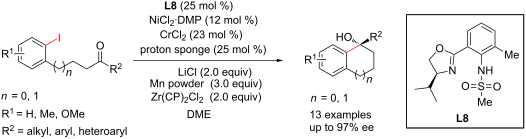
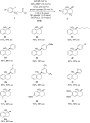
- ) was selected as the model reaction for optimization employing Kishi’s oxazoline/sulfonamides as the chiral ligands. A series of oxazoline/sulfonamide ligands (L1–L8) were tested and the results were summarized in Table 1. Four subgroups of R1 were studied (entries 1–4, Table 1) and isopropyl

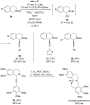
Copper-catalyzed asymmetric sp3 C–H arylation of tetrahydroisoquinoline mediated by a visible light photoredox catalyst
Beilstein J. Org. Chem. 2016, 12, 2636–2643, doi:10.3762/bjoc.12.260
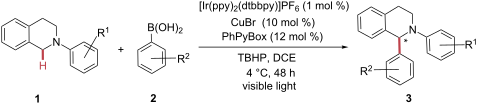
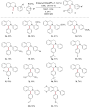
- asymmetric version of this arylation reaction with various chiral ligands (see Scheme 2 and Supporting Information File 1, Table S3, for a detailed screening table). Among them, Box-type ligands have demonstrated a good performance in this reaction, affording low to good enantioselectivities. We began our
- ), [Ir(ppy)2(dtbbpy)]PF6 (0.001 mmol), CuBr2 (0.02 mmol), DCE (0.5 mL), under argon atmosphere. Design light-mediated arylation of THIQs. Evaluation of chiral ligands. Proposed reaction mechanism. Optimization of reaction conditionsa. Effect of chiral ligand on the enantioselectivity of coupling of N




Stereo- and regioselectivity of the hetero-Diels–Alder reaction of nitroso derivatives with conjugated dienes
Beilstein J. Org. Chem. 2016, 12, 1949–1980, doi:10.3762/bjoc.12.184
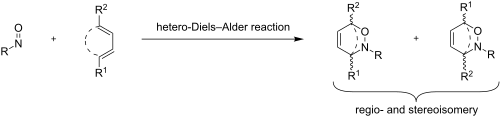
- are able to complex a nitroso derivative with chiral ligands (Scheme 37). Approach based on the in situ generation and trapping of an intermediate acylnitroso dienophile: This approach is exemplified by the results of the Iwasa group from 2008. They performed asymmetric hetero-Diels–Alder reactions of






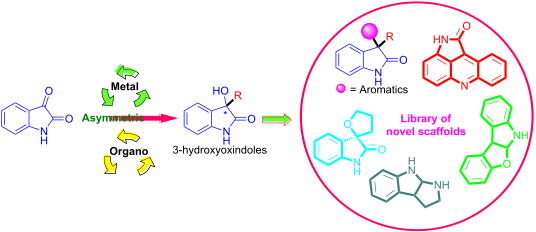
Catalytic asymmetric synthesis of biologically important 3-hydroxyoxindoles: an update
Beilstein J. Org. Chem. 2016, 12, 1000–1039, doi:10.3762/bjoc.12.98




Enantioselective carbenoid insertion into C(sp3)–H bonds
Beilstein J. Org. Chem. 2016, 12, 882–902, doi:10.3762/bjoc.12.87
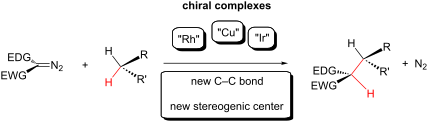
- carboxamide group, in the new chiral catalyst (S)-23 the rhodium atoms are complexed to the chiral ligands by the carboxylate group, similar to those chiral complexes presented by Ikegami and coworkers (Table 1). Another important feature of this work is, unlike to the work that preceded it, that the new
- efforts to better comprehend the scope of this catalytic system, especially on features concerning the BARF salt effect [43][44] and electronic effects on the aromatic rings of the chiral ligands [45]. In 2014, Maguire at al reported the syntheses of N-heterocycles by the enantioselective insertion of
- copper carbenoids to α-nitrogen C(sp3)–H bonds of amides (Scheme 11) [46]. A wide range of bis(oxazolines) were evaluated as chiral ligands in dry dichloromethane with NaBARF as additive. Three catalytic systems, based on ligands (−)-45a, (+)-45a and (4S)-1e, showed a better performance (>82% ee). The


Spiro-fused carbohydrate oxazoline ligands: Synthesis and application as enantio-discrimination agents in asymmetric allylic alkylation
Beilstein J. Org. Chem. 2016, 12, 166–171, doi:10.3762/bjoc.12.18
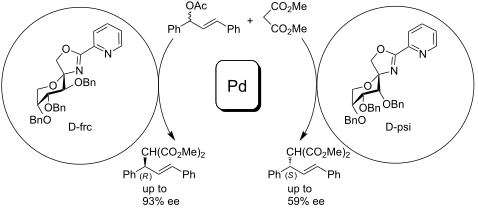
- chiral ligands in palladium-catalyzed allylic alkylation of 1,3-diphenylallyl acetate with dimethyl malonate. The D-fructo-PyOx ligand provided mainly the (R)-enantiomer while the D-psico-configurated ligand gave the (S)-enantiomer with a lower enantiomeric excess. Keywords: asymmetric catalysis
- ; carbohydrates; oxazolines; palladium; spiro compounds; Introduction The design of new chiral ligands for stereo-differentiating metal catalysts that enable asymmetric syntheses is still a highly active field of research in organic chemistry, for there is a continuously growing demand for enantiomeric pure
- as a benchmark for new chiral ligands and examined in great detail [9][10][11][12][13][14][27][28]. In all cases investigated here, the alkylated product 14 was isolated after purification by chromatography and its enantiomeric excess was determined via chiral HPLC using a Reprosil chiral-NR column




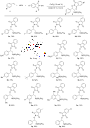
Copper-catalyzed aminooxygenation of styrenes with N-fluorobenzenesulfonimide and N-hydroxyphthalimide derivatives
Beilstein J. Org. Chem. 2015, 11, 2721–2726, doi:10.3762/bjoc.11.293
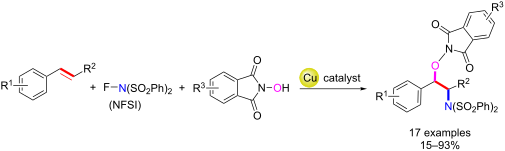
- also been widely used as chiral ligands and auxiliaries in asymmetric synthesis [3]. Therefore, the development of a new aminooxygenation reaction is still highly attractive [4]. Most of the existing aminooxygenation reactions involve an intramolecular cyclization step [5][6][7][8][9][10][11][12][13




Enantioselective additions of copper acetylides to cyclic iminium and oxocarbenium ions
Beilstein J. Org. Chem. 2015, 11, 2696–2706, doi:10.3762/bjoc.11.290
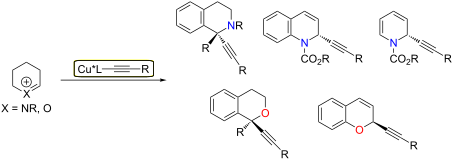
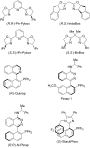
- stereochemical rationale for the enantioselectivities of these reactions is needed to enable further development of catalysts in this important area. Chiral ligands utilized in copper-catalyzed alkynylations of cyclic iminium and oxocarbenium ions. Li’s alkynylation of acyclic N-arylimines. Knochel’s





Recent advances in copper-catalyzed asymmetric coupling reactions
Beilstein J. Org. Chem. 2015, 11, 2600–2615, doi:10.3762/bjoc.11.280
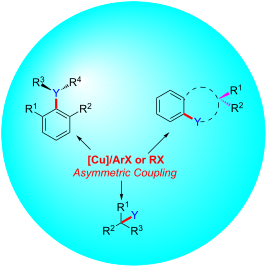
- coupling The biaryl motif is a key subunit in many natural products and axially chiral ligands. The classical Ullmann coupling is one of the most important methods for the practical synthesis of biaryls [14]. However, only few reports of an asymmetric version of the Ullmann coupling have been documented
- atroposelective synthesis of many very useful axially chiral ligands and biologically important natural products. Some representative examples of these compounds are collected in Scheme 14. In 1997, Andrus et al. [33] used this method for the synthesis of enantiomerically pure bisoxazoline. Lin and Zhong [34


Copper-catalyzed asymmetric conjugate addition of organometallic reagents to extended Michael acceptors
Beilstein J. Org. Chem. 2015, 11, 2418–2434, doi:10.3762/bjoc.11.263
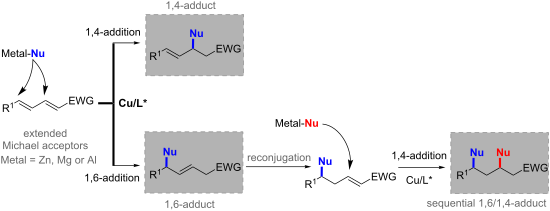
- research groups extensively investigated the effect of various copper precursors, nucleophiles and Michael acceptors in catalysis, in combination with new families of chiral ligands. The results will be presented according to the selectivity of the conjugate addition; the first section will be dealing with
- studied on a substrate scope. As shown in Scheme 2, tertiary and quaternary stereogenic centers could be generated using this methodology leading to products 19 in moderate to good yields and ees. In 2008, Alexakis and Mauduit evaluated a series of different chiral ligands in ACA reactions involving
- or trialkylaluminium reagents) are available. These protocols have shown to be highly dependent on both substrates and reaction conditions. Therefore, a variety of efficient chiral ligands is now available for the chemist willing to design synthetic routes leading to complex chiral molecules


Chiral Cu(II)-catalyzed enantioselective β-borylation of α,β-unsaturated nitriles in water
Beilstein J. Org. Chem. 2015, 11, 2007–2011, doi:10.3762/bjoc.11.217
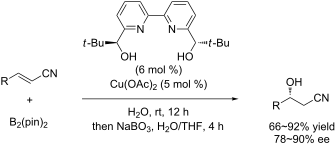
- reactions, which exhibit extremely high TOF values, can be performed easily without requiring the preparation of an array of chiral ligands [1][16][17][18][19]. Rapid protonation in water subsequent to β-borylation would liberate the desired adducts almost instantaneously. In addition to the synthetic


New palladium–oxazoline complexes: Synthesis and evaluation of the optical properties and the catalytic power during the oxidation of textile dyes
Beilstein J. Org. Chem. 2015, 11, 1175–1186, doi:10.3762/bjoc.11.132
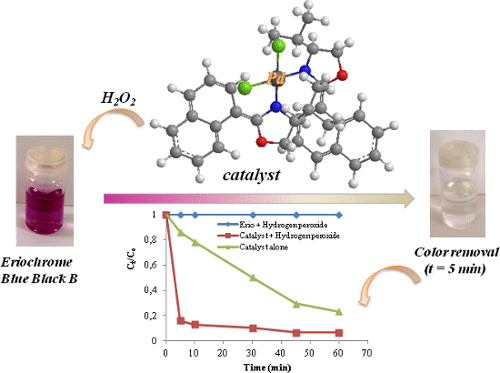
- used for the total synthesis of natural products and nanocompounds [5]. It is only since 1986 that oxazoline-based ligands have been utilized in asymmetric catalysis. This initiated considerable research activity in this field and triggered the synthesis of numerous chiral ligands containing at least


Diastereoselective and enantioselective conjugate addition reactions utilizing α,β-unsaturated amides and lactams
Beilstein J. Org. Chem. 2015, 11, 530–562, doi:10.3762/bjoc.11.60

- addition reactions where they employed organocopper reagents and chiral phosphorus-based ligands [18]. This breakthrough in the field led to the development of different chiral ligands for asymmetric CA reactions. Another major advancement occurred in 1997 when Feringa’s group developed the first catalytic
- require the addition and/or removal of groups on the Michael acceptor in order to achieve good stereoselectivity, which makes these reactions atom economical. Also, the low catalyst loading allows for the use of a variety of chiral ligands. Herein, various types of ECA reactions are discussed. 2.1 Copper
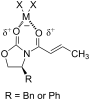
- -unsaturated N- alkenoyloxazolidinones [88]. The authors employed a chiral triamide phosphane in order to induce stereoselectivity, which is quite different from other chiral ligands that have been used in ECA reactions. The Hoveyda group has utilized amino acid-based ligands, which were rapidly identified




Stereoselective cathodic synthesis of 8-substituted (1R,3R,4S)-menthylamines
Beilstein J. Org. Chem. 2015, 11, 294–301, doi:10.3762/bjoc.11.34
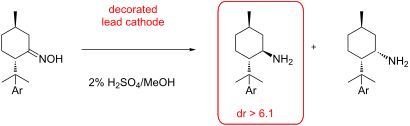
- tools in organic synthesis. Among numerous applications they are applied as chiral ligands [1], as catalysts for various asymmetric transformations [2], and as building blocks for alkaloid and pharmaceutical drug synthesis [3][4]. The increasing number of applications leads to a growing interest in the


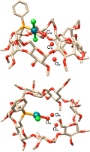
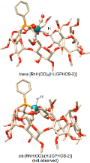
Phosphinocyclodextrins as confining units for catalytic metal centres. Applications to carbon–carbon bond forming reactions
Beilstein J. Org. Chem. 2014, 10, 2388–2405, doi:10.3762/bjoc.10.249
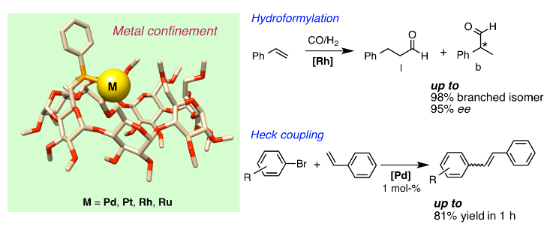
- -catalysed Mizoroki–Heck coupling reactions between aryl bromides and styrene on one hand, and the rhodium-catalysed asymmetric hydroformylation of styrene on the other hand. The inability of both chiral ligands to form standard bis(phosphine) complexes under catalytic conditions was established by high






Chiral phosphines in nucleophilic organocatalysis
Beilstein J. Org. Chem. 2014, 10, 2089–2121, doi:10.3762/bjoc.10.218
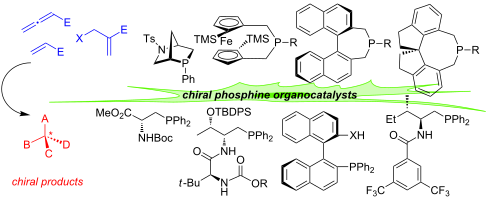
- of inherent air-sensitivity, the storage of trialkylphosphines can be problematic. On the other hand, thousands of arylphosphines have been used as chiral ligands for metal-catalyzed asymmetric reactions [27][28][29][30]. Most of these phosphines are acyclic, usually possess low nucleophilic activity


One-pot stereoselective synthesis of α,β-differentiated diamino esters via the sequence of aminochlorination, aziridination and intermolecular SN2 reaction
Beilstein J. Org. Chem. 2014, 10, 1802–1807, doi:10.3762/bjoc.10.189

- corresponding β,γ-amino alcohols and vicinal diamines. α,β-Diamino acid derivatives have been served as organocatalysts, chiral ligands, chiral auxiliaries for asymmertric synthesis [10][11][12], as well as synthetic fragments for peptides and natural products [13]. Mannich-type addition reactions of α-amino





