


Search results
Search for "donor–acceptor" in Full Text gives 206 result(s) in Beilstein Journal of Organic Chemistry. Showing first 200.
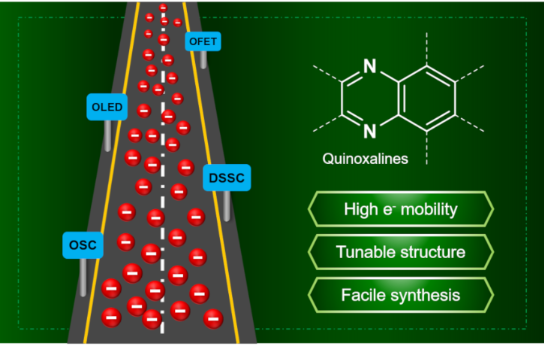
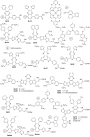
Quinoxaline derivatives as attractive electron-transporting materials
Beilstein J. Org. Chem. 2023, 19, 1694–1712, doi:10.3762/bjoc.19.124
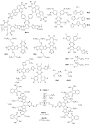
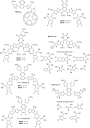
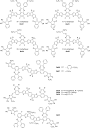
- compounds exhibited good coplanarity through intramolecular interactions, narrow bandgaps, broad absorption in the NIR region and PCEs above 10% [32]. Ayub et al. decorated the central donor–acceptor–donor unit of Qx17 and Qx18 with five new terminal end groups, resulting in the Qx19 series, and predicted
- morphology on Qx26 and Qx27, employing indacenodithiophene, Qx and rhodanine as donor, acceptor and end group, respectively. The incorporation of specific side chains facilitated improved thermal stability, solubility, and broad absorption spectra (300–750 nm), narrow bandgaps (1.68–1.74 eV) and PCEs in the
- quinone unit on quinoxaline to achieve donor–acceptor interactions and desirable electronic properties. The compounds exhibited absorption, emission, electrochemical, and thermal properties suitable for n-type materials. Theoretical properties were also investigated using time-dependent DFT. The HOMO and




A deep-red fluorophore based on naphthothiadiazole as emitter with hybridized local and charge transfer and ambipolar transporting properties for electroluminescent devices
Beilstein J. Org. Chem. 2023, 19, 1664–1676, doi:10.3762/bjoc.19.122
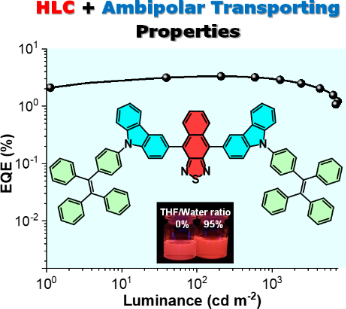
- Frontier Research Center, Vidyasirimedhi Institute of Science and Technology, Wangchan, Rayong 21210, Thailand 10.3762/bjoc.19.122 Abstract Herein, we report the synthesis and characterization of an efficient ambipolar charge-carrier-transporting deep-red fluorophore (TPECNz) based on a donor–acceptor
- extended π-conjugation lengths which eventually favor the undesired formation of poorly emissive molecular aggregates must be overcome. Alternatively, donor–acceptor (D–A)-type organic fluorophores have been introduced and successfully exploited for the development of fluorophores with DR/NIR emissions


A series of perylene diimide cathode interlayer materials for green solvent processing in conventional organic photovoltaics
Beilstein J. Org. Chem. 2023, 19, 1620–1629, doi:10.3762/bjoc.19.119
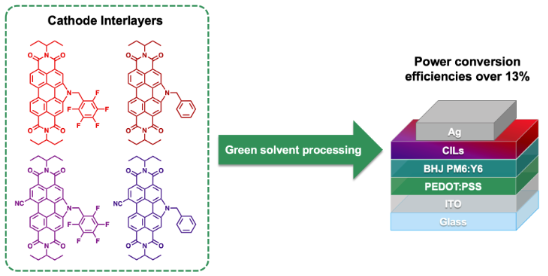
- investigation of the processes involved in the formation of the interfacial layer between the donor–acceptor and the charge transport layer. Nevertheless, based on all the optoelectrical characterization, proposed N-annulated perylene diimides-based CILs are suitable candidates for CILs that can be replaced


Visible-light-induced nickel-catalyzed α-hydroxytrifluoroethylation of alkyl carboxylic acids: Access to trifluoromethyl alkyl acyloins
Beilstein J. Org. Chem. 2023, 19, 1372–1378, doi:10.3762/bjoc.19.98
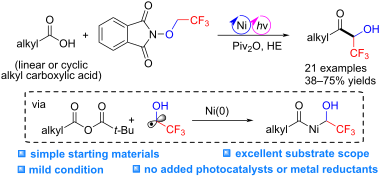
- ., Zibo 256401, China 10.3762/bjoc.19.98 Abstract A visible-light-induced nickel-catalyzed cross coupling of alkyl carboxylic acids with N-trifluoroethoxyphthalimide is described. Under purple light irradiation, an α-hydroxytrifluoroethyl radical generated from a photoactive electron donor–acceptor
- -difluoroethoxyphthalimide as the fluoroalkylating reagent failed to afford the desired product. According to our previous work [39] and literature precedent [27][35][38], a possible mechanism is proposed in Figure 2. The interaction between 2 and HE generates an electron donor–acceptor (EDA) complex A, which undergoes a


Organic thermally activated delayed fluorescence material with strained benzoguanidine donor
Beilstein J. Org. Chem. 2023, 19, 1289–1298, doi:10.3762/bjoc.19.95
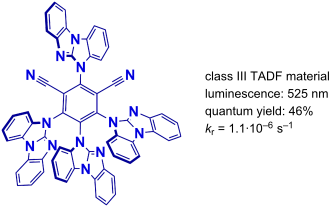
- performance in OLED devices [1]. 4CzIPN is a donor–acceptor-type system where carbazole donor ligands are bound to the benzonitrile acceptor core moiety. In this work we have substituted the carbazole donors with 5H-benzo[d]benzo[4,5]imidazo[1,2-a]imidazole (benzoguanidine) ligands to give 4BGIPN, see Figure
- of 55.1(2)–60.2(2)º for 4CzIPN thus indicating that various carbazole donor ligands possess a very similar twist orientation [12]. The donor–acceptor twist angle has been demonstrated to be one of the key structural parameters enabling fast radiative rates for purely organic TADF materials since it’s
- matrices regardless of numerous efforts and cooling the films down to 16 K and applying long time delays. Conclusion We have synthesized and characterized a donor–acceptor-type thermally activated delayed fluorescent emitter 4BGIPN with four terminal benzoguanidine donor moieties surrounding the


Exploring the role of halogen bonding in iodonium ylides: insights into unexpected reactivity and reaction control
Beilstein J. Org. Chem. 2023, 19, 1171–1190, doi:10.3762/bjoc.19.86
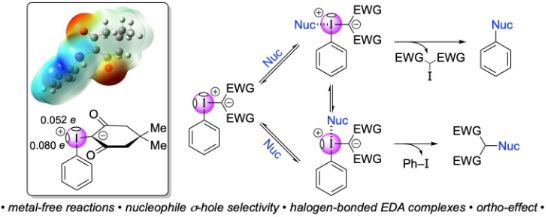
- include nucleophile σ-hole selectivity, and how ylide structural modifications and intramolecular halogen bonding (e.g., the ortho-effect) can improve ylide stability or solubility, and alter reaction outcomes. Keywords: electron donor–acceptor complex; halogen bonding; σ-holes; iodonium ylides; ortho
- as an electron donor–acceptor complex) [121], and this bonding description has recently been used to support proposals for single electron transfer (SET) reaction pathways between iodonium ylides and various halogen bond acceptors. Alternatively, halogen-bonded complexes of iodonium ylides could lead
- to changes in an ylide’s UV–vis absorption profile, or to its overall basicity or nucleophilicity, both of which could lead new and unexpected reactivity. The first example that specifically invoked electron donor–acceptor complexes of iodonium ylides was reported in 2018 by Wang and co-workers [122






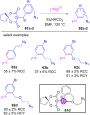


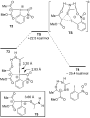
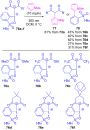
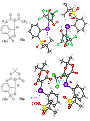
The effect of dark states on the intersystem crossing and thermally activated delayed fluorescence of naphthalimide-phenothiazine dyads
Beilstein J. Org. Chem. 2023, 19, 1028–1046, doi:10.3762/bjoc.19.79
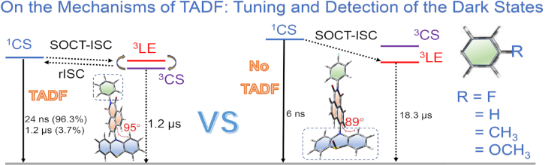
- intersystem crossing (rISC) is slow, without coupling with an approximate 3LE state. These studies are useful for an in-depth understanding of the photophysical mechanisms of the TADF emitters, as well as for molecular structure design of new electron donor–acceptor TADF emitters. Keywords: charge-transfer
- for this kind of emitters is an electron donor–acceptor dyad, and the molecular geometry is usually orthogonal, i.e., the planes of the π-conjugation systems of the electron donor and acceptor are perpendicular to each other. As a result, the highest occupied molecular orbital (HOMO) and lowest
- is far from mature [19][20][21]. Initially a two-state model was used for understanding of the photophysical processes of the electron donor–acceptor TADF emitters [9][22][23][24][25][26]. Soon it was realized this over simplified model is nonsufficient. For instance, the singlet/triplet charge


First synthesis of acylated nitrocyclopropanes
Beilstein J. Org. Chem. 2023, 19, 892–900, doi:10.3762/bjoc.19.67
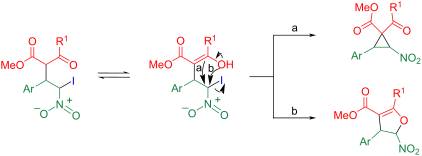
- , but a dihydrofuran, so the cyclopropane 1b’ reported in the literature [12][13][19] is presumably incorrect [22]. In the cases of donor–acceptor cyclopropanes possessing an electron-donating group such as an alkoxy or amino group, ring expansion caused by an intramolecular attack of nitro oxygen


Synthesis, structure, and properties of switchable cross-conjugated 1,4-diaryl-1,3-butadiynes based on 1,8-bis(dimethylamino)naphthalene
Beilstein J. Org. Chem. 2023, 19, 674–686, doi:10.3762/bjoc.19.49
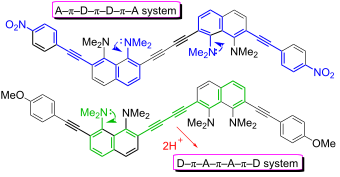
- -conjugation of 1,8-bis(dimethylamino)naphthalene (DMAN) fragments through a butadiyne linker and a donor–acceptor aryl–C≡C–DMAN conjugation path. The conjugation path can be “switched” simply by protonation of DMAN fragments. X-ray diffraction, UV–vis spectroscopy and cyclic voltammetry are applied to analyze
- the extent of π-conjugation and the efficiency of particular donor–acceptor conjugation path in these new compounds. X-ray structures and absorption spectra of doubly protonated tetrafluoroborate salts of the oligomers are also discussed. Keywords: 1,8-bis(dimethylamino)naphthalene; cross-conjugated
- systems; 1,4-diaryl-1,3-butadiynes; donor–acceptor systems; Glaser–Hay reaction; Introduction π-Conjugated oligomers and polymers attracted considerable attention from the very start as a promising class of semiconductors, chemosensors, and various electronic devices [1][2]. Although silicon and



Nucleophile-induced ring contraction in pyrrolo[2,1-c][1,4]benzothiazines: access to pyrrolo[2,1-b][1,3]benzothiazoles
Beilstein J. Org. Chem. 2023, 19, 646–657, doi:10.3762/bjoc.19.46
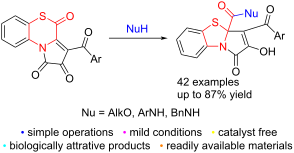
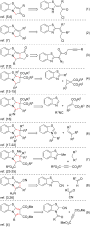
- -aminothiophenol with donor–acceptor cyclopropanes (Scheme 2, entry 10) [27], condensations of o-aminothiophenol with 4-oxo acids or their derivatives (Scheme 2, entry 11) [2][28][29][30][31] and cascade reactions of o-aminothiophenol, furfural and anhydrides of 2,3-unsaturated carboxylic acids (Scheme 2, entry 12




Direct C2–H alkylation of indoles driven by the photochemical activity of halogen-bonded complexes
Beilstein J. Org. Chem. 2023, 19, 575–581, doi:10.3762/bjoc.19.42
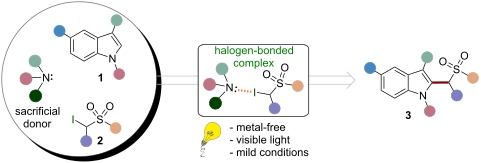
- tool to guide the development of greener and more convenient synthetic protocols [7][8][9][10][11][12]. In this context, photochemical approaches based on electron donor–acceptor (EDA) complexes have been successfully exploited to drive the direct C–H functionalization of a large number of organic
- yield the final products "A–D". This approach is not limited to reagents with appropriate donor–acceptor characteristics [13][19]. Indeed, sacrificial electron donors and electron-deficient radical precursors can be used to form photoactive EDA complexes. Specifically, these aggregates can be employed


Combretastatins D series and analogues: from isolation, synthetic challenges and biological activities
Beilstein J. Org. Chem. 2023, 19, 399–427, doi:10.3762/bjoc.19.31
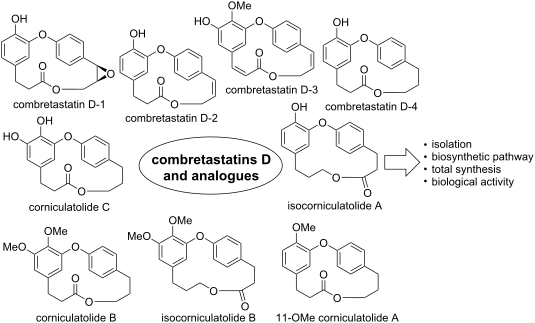
- for synthesis. In general, the synthesis of these macrocyclic compounds can be accomplished by using two distinct disconnections (Scheme 3): one concerns the formation of the macrocycle through macrolactonization reaction from the former seco-acid formed from the Ar–O–Ar coupling from the aryl donor
- /acceptor (route A), while the other corresponds to the intramolecular Ar–O–Ar coupling from the former ester (route B). Both synthetic routes have their advantages and disadvantages. The formation of the Ar–O–Ar bond can be accomplished using different methodologies [20] such as SNAr [21], Ullmann [22], or


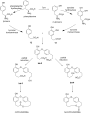


NaI/PPh3-catalyzed visible-light-mediated decarboxylative radical cascade cyclization of N-arylacrylamides for the efficient synthesis of quaternary oxindoles
Beilstein J. Org. Chem. 2023, 19, 57–65, doi:10.3762/bjoc.19.5
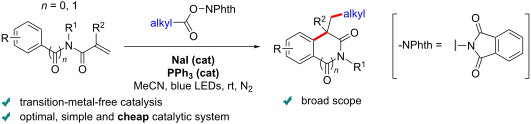
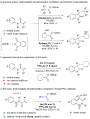
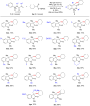
- ethers and N-heteroarenes by using a novel catalytic system based on sodium iodide (NaI) and triphenylphosphine (PPh3), suggested to function as an electron donor–acceptor (EDA) complex [55][56][57][58][59][60]. Compared to previously reported radical reactions, this novel catalytic system has the key




Design, synthesis, and evaluation of chiral thiophosphorus acids as organocatalysts
Beilstein J. Org. Chem. 2022, 18, 1471–1478, doi:10.3762/bjoc.18.154
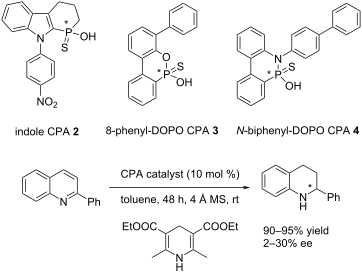
- dual donor–acceptor role, such as P-stereogenic triflamide CPAs P(O)NHSO2CF3, is currently under investigation since BINOL-derived triflamides have been successful [48][49]. Another possibility would be to look at reactions in which the catalyst would not require a Brønsted basic site. Both directions


Naphthalimide-phenothiazine dyads: effect of conformational flexibility and matching of the energy of the charge-transfer state and the localized triplet excited state on the thermally activated delayed fluorescence
Beilstein J. Org. Chem. 2022, 18, 1435–1453, doi:10.3762/bjoc.18.149
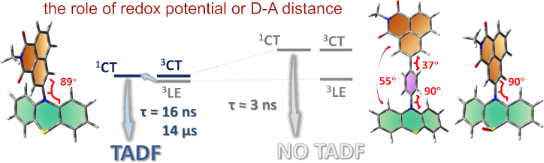
- investigate the joint influence of the conformation flexibility and the matching of the energies of the charge-transfer (CT) and the localized triplet excited (3LE) states on the thermally activated delayed fluorescence (TADF) in electron donor–acceptor molecules, a series of compact electron donor–acceptor
- observed in the nanosecond transient absorption spectra with lifetimes in the 4–48 μs range. Computational investigations show that the orthogonal electron donor–acceptor molecular structure is beneficial for TADF. These calculations indicate small energetic difference between the 3LE and 3CT states, which
- -transfer (CT) and intersystem-crossing (ISC) phenomena [4][5]. Compounds showing TADF are usually presenting an orthogonal electron donor–acceptor molecular structure, i.e., the π-planes of the electron donor and acceptor adopt an orthogonal geometry [6][7]. Such an architecture is beneficial to spatially
Ionic multiresonant thermally activated delayed fluorescence emitters for light emitting electrochemical cells
Beilstein J. Org. Chem. 2022, 18, 1311–1321, doi:10.3762/bjoc.18.136
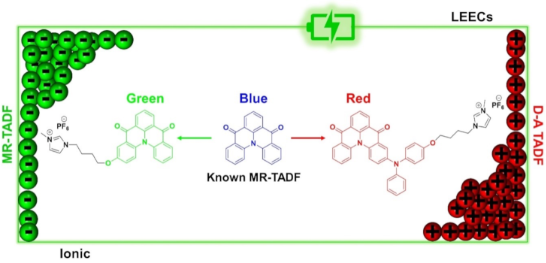
- the non-doped device, at 2.0% demonstrated 100% exciton utilization efficiency in the device and efficient energy transfer from the host to the guest cyanine emitter. Deep blue emission in LEECs is challenging. We also reported a blue-emitting LEEC employing a cationic sulfone-based donor–acceptor
- ). The presence of the DPA group in DiKTa-DPA-OBuIm transforms this compound from one that is MR-TADF to one that is better described as a donor–acceptor TADF, which is reflected in the red-shifted and broadened emission [28]. Results and Discussion DiKTa-OBuIm was obtained in three steps (Scheme 1) in



Thermally activated delayed fluorescence (TADF) emitters: sensing and boosting spin-flipping by aggregation
Beilstein J. Org. Chem. 2022, 18, 1177–1187, doi:10.3762/bjoc.18.122
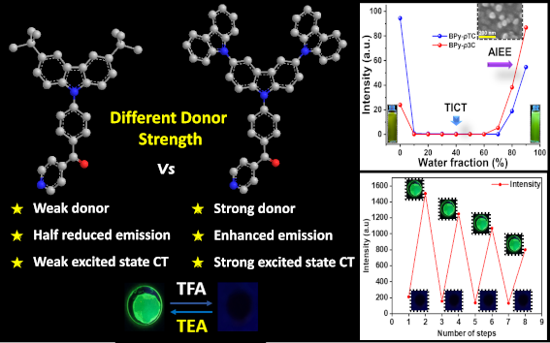
- thermally activated delayed fluorescence (TADF) characteristics are emerging due to the potential applications in optoelectronic devices, time-resolved luminescence imaging, and solid-phase sensing. Herein, we synthesized two (4-bromobenzoyl)pyridine (BPy)-based donor–acceptor (D–A) compounds with varying
- solution and in the solid state and with multicolor tunability by external stimuli are crucial for task-specific applications. Recently, donor–acceptor (D–A)-based organic emitters have shown tunable optical and electrochemical properties due to alteration of the intermolecular charge-transfer (ICT


Reductive opening of a cyclopropane ring in the Ni(II) coordination environment: a route to functionalized dehydroalanine and cysteine derivatives
Beilstein J. Org. Chem. 2022, 18, 1166–1176, doi:10.3762/bjoc.18.121
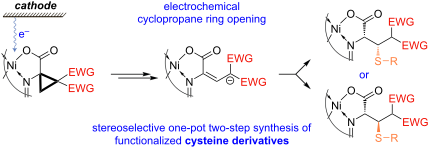
- ) coordination environment in the form of a Schiff base is considered as a route to electrochemical broadening of the donor–acceptor cyclopropane concept in combination with chirality induction in the targeted products. A tendency to the reductive ring-opening and the follow-up reaction paths of thus formed
- provides targeted pharmacophoric properties of the bio-active molecule [23] but also opens a route to its further functionalization, being a building block with wide variety of reactivity. A donor–acceptor cyclopropane concept suggested in the 1980s [24] became extremely popular in the recent decade [25
- ][26]. Donor–acceptor cyclopropanes constitute an easily available equivalent of all-carbon 1,3-zwitter-ions used in targeted synthesis of various alicyclic as well as carbo- or heterocyclic compounds [27][28][29][30]. The reactive synergy of the three-membered ring and the C–C bond polarization due to



Introducing a new 7-ring fused diindenone-dithieno[3,2-b:2',3'-d]thiophene unit as a promising component for organic semiconductor materials
Beilstein J. Org. Chem. 2022, 18, 944–955, doi:10.3762/bjoc.18.94
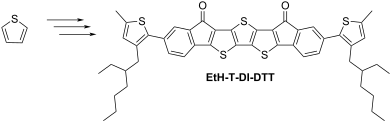
- donor–acceptor interaction [21]. With this strategy, fusing those systems should lead to greater π-delocalisation [15][22]. Moreover, the fused core system is flanked by thiophene groups with ethylhexyl groups which impart solubility [5] in common organic solvents such as tetrahydrofuran, chloroform or


Post-synthesis from Lewis acid–base interaction: an alternative way to generate light and harvest triplet excitons
Beilstein J. Org. Chem. 2022, 18, 825–836, doi:10.3762/bjoc.18.83
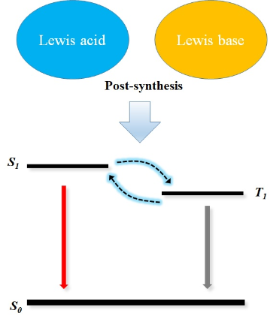
- HCl, TFA, and BBr3 as dopants which were respectively added to the donor–acceptor–donor (D–A–D) molecule 2,5-bis((N,N-diphenylamino)phenyl)thiazolothiazole (compound 2 in Figure 2) containing thiazolothiazole units. As shown in Figure 3b, four different colors ranged from green, yellow, red and NIR


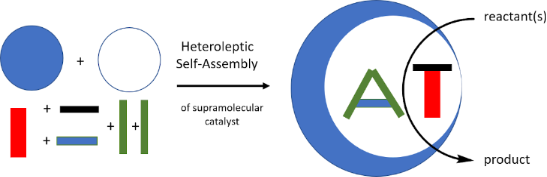
Heteroleptic metallosupramolecular aggregates/complexation for supramolecular catalysis
Beilstein J. Org. Chem. 2022, 18, 597–630, doi:10.3762/bjoc.18.62
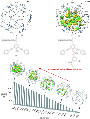
- (26) was chosen as a FRET acceptor as there is a considerable overlap in energy of the donor emission and acceptor absorption. Then, artificial LHSs were constructed with aggregates from 24b or 25b at a donor/acceptor ratio of 5:1 (Figure 6). Finally, the light harvesting materials (24b + 26) and (25b











Syntheses of novel pyridine-based low-molecular-weight luminogens possessing aggregation-induced emission enhancement (AIEE) properties
Beilstein J. Org. Chem. 2022, 18, 580–587, doi:10.3762/bjoc.18.60
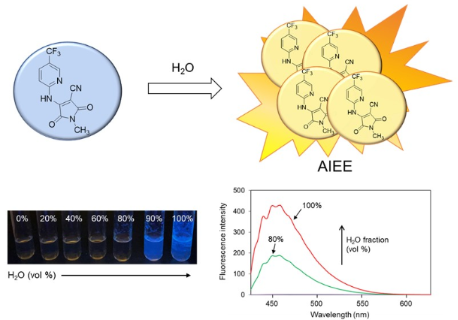
- photophysically and computationally. The photophysical studies revealed that all the synthesized compounds exhibited fluorescence in organic solvents, while N-methyl-4-((pyridin-2-yl)amino)-substituted maleimide derivatives 4a–e, which are based on an acceptor–donor–acceptor (A–D–A) system, exhibited aggregation
- the electronic nature of the compounds with and without AIEE properties. Keywords: acceptor–donor–acceptor; AIEE; low molecular weight; one-pot reaction; ((pyridin-2-yl)amino)maleimide; TD-DFT calculation; Introduction Fluorescent compounds have attracted considerable attention as functional
- aminopyridines based on the acceptor–donor–acceptor (A–D–A) system exhibit AIEE properties in aqueous media, which may be novel candidate molecules for AIEE. Herein, we report the synthesis, photophysical properties, and computational studies of pyrido[1,2-a]pyrrolo[3,4-d]pyrimidines and N-methyl-4-((pyridin-2


Substituent effect on TADF properties of 2-modified 4,6-bis(3,6-di-tert-butyl-9-carbazolyl)-5-methylpyrimidines
Beilstein J. Org. Chem. 2022, 18, 497–507, doi:10.3762/bjoc.18.52
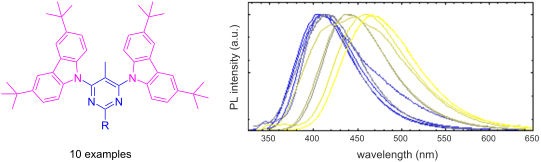
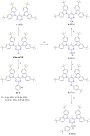
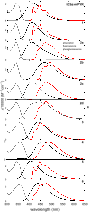
- ; Introduction The first reports on highly efficient thermally activated delayed fluorescence (TADF) mechanism and its successful realization in organic light emitting diodes (OLEDs) by Adachi and co-workers [1][2] have drawn the attention to the design and synthesis of various emissive donor–acceptor organic




Comparative study of thermally activated delayed fluorescent properties of donor–acceptor and donor–acceptor–donor architectures based on phenoxazine and dibenzo[a,j]phenazine
Beilstein J. Org. Chem. 2022, 18, 459–468, doi:10.3762/bjoc.18.48
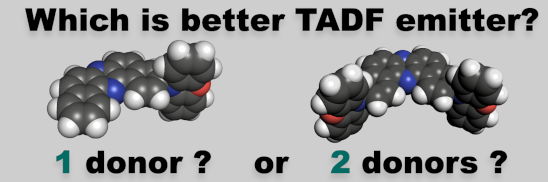
- ) compound based on a donor–acceptor (D–A) architecture (D = phenoxazine; A = dibenzo[a,j]phenazine) has been developed, and its photophysical properties were characterized. The D–A compound is applicable as an emitting material for efficient organic light-emitting diodes (OLEDs), and its external quantum
- thermally activated delayed fluorescent behavior. Keywords: charge-transfer; dibenzophenazine; donor–acceptor; organic light-emitting diodes; thermally activated delayed fluorescence; Introduction Thermally activated delayed fluorescence (TADF), which was firstly reported in 1961 by Parker and Hatchard [1


Tetraphenylethylene-embedded pillar[5]arene-based orthogonal self-assembly for efficient photocatalysis in water
Beilstein J. Org. Chem. 2022, 18, 429–437, doi:10.3762/bjoc.18.45
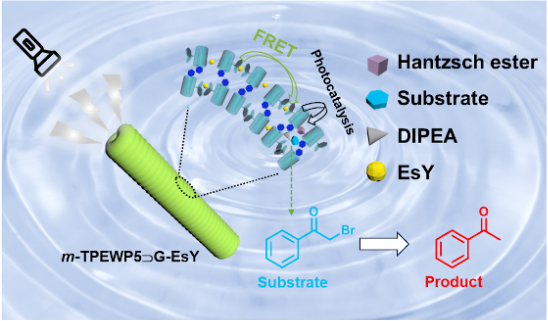
- of solar energy [7]. In general, an effective supramolecular donor–acceptor system was employed to construct a photocatalytic system using FRET [6][8]. To fabricate a successful FRET system, the following key points need to be considered, i) the acceptor absorption spectrum should have good
- to improve the efficiency of chemical reactions in water [26]. Until now, various macrocyclic host-assisted supramolecular donor–acceptor systems have been developed based on the FRET process and further utilized for different photochemical reactions [27][28]. For instance, Yi et al. [29] developed a
- indicating an efficient energy transfer is taking place. This was further supported by the observation, that upon loading of EsY into the m-TPEWP5G assembly, the color of the donor solution changed from sky blue to greenish-yellow under UV light. At a 2:1 donor/acceptor molar ratio, a maximum FRET efficiency


![[Graphic 5]](/bjoc/content/inline/1860-5397-18-45-i7.svg?max-width=637&scale=1.18182) G-EsY self-assembled photocat...
G-EsY self-assembled photocat...
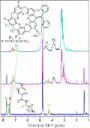


![[Graphic 15]](/bjoc/content/inline/1860-5397-18-45-i17.svg?max-width=637&scale=1.18182) G; (b) m-TPEWP5
G; (b) m-TPEWP5![[Graphic 16]](/bjoc/content/inline/1860-5397-18-45-i18.svg?max-width=637&scale=1.18182) G-EsY. [m-TPEWP5] = 1 × 10⁻⁴ M, [G] = 1 × 10⁻⁴ M, [EsY] = ...
G-EsY. [m-TPEWP5] = 1 × 10⁻⁴ M, [G] = 1 × 10⁻⁴ M, [EsY] = ...

![[Graphic 25]](/bjoc/content/inline/1860-5397-18-45-i27.svg?max-width=637&scale=1.18182) G donor assembly...
G donor assembly...

![[Graphic 43]](/bjoc/content/inline/1860-5397-18-45-i45.svg?max-width=637&scale=1.18182) G-EsY na...
G-EsY na...

![[Graphic 48]](/bjoc/content/inline/1860-5397-18-45-i50.svg?max-width=637&scale=1.18182) G-E...
G-E...



