


Search results
Search for "fluorene" in Full Text gives 54 result(s) in Beilstein Journal of Organic Chemistry.
Synthesis of 5-(2-methoxy-1-naphthyl)- and 5-[2-(methoxymethyl)-1-naphthyl]-11H-benzo[b]fluorene as 2,2'-disubstituted 1,1'-binaphthyls via benzannulated enyne–allenes
Beilstein J. Org. Chem. 2011, 7, 496–502, doi:10.3762/bjoc.7.58
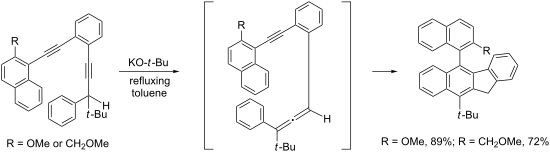
- Yu-Hsuan Wang Joshua F. Bailey Jeffrey L. Petersen Kung K. Wang C. Eugene Bennett Department of Chemistry, West Virginia University, Morgantown, West Virginia 26506-6045, USA 10.3762/bjoc.7.58 Abstract 5-(2-Methoxy-1-naphthyl)- and 5-[2-(methoxymethyl)-1-naphthyl]-11H-benzo[b]fluorene were
- to form 5-phenyl-11H-benzo[b]fluorene (3a) in a single operation (Scheme 1) [5]. It is interesting to note that the newly formed benzo[b]fluorenyl moiety in 3a could also be regarded as a 1-arylnaphthyl derivative with three additional substituents at the 2, 3, and 4 positions. The reaction is not
- -ethynyl-2-(methoxymethyl)benzene (4b). On exposure to potassium tert-butoxide in refluxing toluene for five hours, 9a was transformed to 5-(2-methoxyphenyl)-11H-benzo[b]fluorene 13a along with a small amount (ca. 2%) of 14a in a single operation. Presumably, the cascade sequence involved an initial 1,3


SbCl3-catalyzed one-pot synthesis of 4,4′-diaminotriarylmethanes under solvent-free conditions: Synthesis, characterization, and DFT studies
Beilstein J. Org. Chem. 2011, 7, 135–144, doi:10.3762/bjoc.7.19
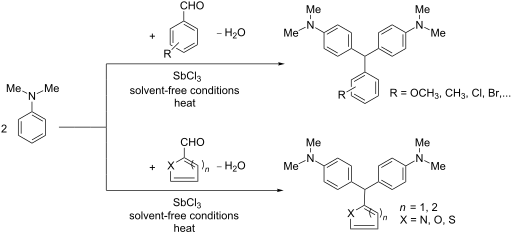
- ) which highlights the application of SbCl3 as useful catalyst in this methodology. Furthermore, the application range of the reaction was expanded to fused aromatic rings such as 9H-fluorene and anthracene: 9H-Fluorene-2-carbaldehyde and anthracene-9-carbaldehyde react with N,N-dimethylaniline under the



Conjugated polymers containing diketopyrrolopyrrole units in the main chain
Beilstein J. Org. Chem. 2010, 6, 830–845, doi:10.3762/bjoc.6.92
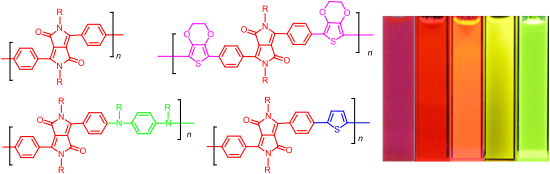
- ]. The polymers consisted of dialkylated DPP units and carbazole, triphenylamine, benzo[2,1,3]thiadiazole, anthracene, or fluorene units in alternating fashion. They were prepared via Suzuki coupling, from the DPP monomers M-1 or DPP-3,6-diphenyl(4,4´-bis(pinacolato)boron ester. A number of readily
- a brightness at 20 V of 50 cd m−2 without much optimization. The maximum emission was at 600 nm, the turn-on voltage was 3.5 V. Cao et al. [33] prepared DPP-fluorene copolymers with a DPP content of between 0.1 and 50%. It was found that absorption and emission spectra, both in solution and thin
- content, the EQE was lowered to 0.14%, and the brightness to 127 cd m−2, similar to the results reported by Zhu et al. [31]. Cao et al. [34] also studied DPP-fluorene alternating copolymers with the fluorene unit being attached to the m-position of the phenyl groups in DPP (in contrast to the usual p




Polar tagging in the synthesis of monodisperse oligo(p-phenyleneethynylene)s and an update on the synthesis of oligoPPEs
Beilstein J. Org. Chem. 2010, 6, No. 57, doi:10.3762/bjoc.6.57
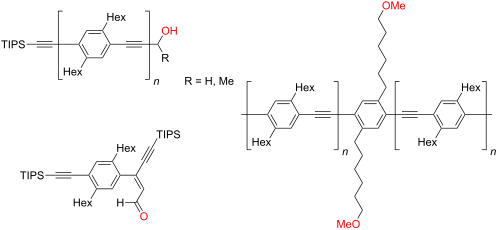
- these methods have been applied to building blocks with additional substituents including functional groups as well as to other aromatic building blocks, such as biphenyl [33], bipyridine [36][42], thiophene [36][43][44], fluorene [45], and triptycene [46], and other shapes, e.g. starlike compounds [2




Other Beilstein-Institut Open Science Activities



