


Search results
Search for "glycosyl donor" in Full Text gives 56 result(s) in Beilstein Journal of Organic Chemistry.
Electrochemical generation of 2,3-oxazolidinone glycosyl triflates as an intermediate for stereoselective glycosylation
Beilstein J. Org. Chem. 2012, 8, 456–460, doi:10.3762/bjoc.8.52
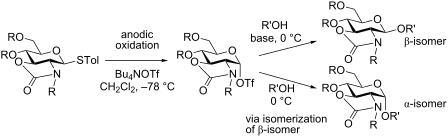
- %) and that only a trace amount of α-isomer 9 (4%) was obtained strongly suggests that the isomerization of thioglycoside donor 1a occurs during the electrolysis at 0 °C. It is noteworthy that the α- and β-glycosides could be selectively prepared from the same glycosyl donor with a 2,3-trans carbamate


Dependency of the regio- and stereoselectivity of intramolecular, ring-closing glycosylations upon the ring size
Beilstein J. Org. Chem. 2011, 7, 1609–1619, doi:10.3762/bjoc.7.189
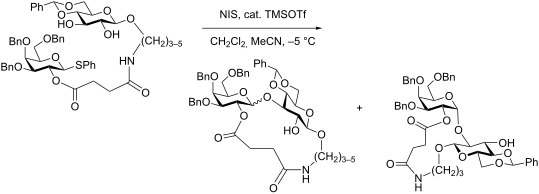
- donors and acceptors (prearranged glycosides) resembles to some extent enzyme-catalyzed glycosylation reactions where the glycosyl donor and glycosyl acceptor are first bound in the active site of an enzyme and thus, the glycosidic bond forms intramolecularly. Three different concepts for the
- intramolecularization of glycosylation reactions have been studied so far. For recent reviews on this subject see [1][2][3][4]. In the “leaving-group-based concept”, the glycosyl acceptor is attached to the leaving group of the glycosyl donor and O-glycosidic bond formation occurs synchronously to the cleavage of the
- concept”, the sole true intramolecular glycosylation approach which was developed in our [18][19][20] and Valverde’s group [21], glycosyl donor and acceptor are linked by a stable tether attached to positions not directly involved in the glycosylation step. Upon activation of the leaving group, an


Convergent synthesis of the tetrasaccharide repeating unit of the O-antigen of Shigella boydii type 9
Beilstein J. Org. Chem. 2011, 7, 1182–1188, doi:10.3762/bjoc.7.137

- thioethyl group acts as an orthogonal anomeric protecting group since it acts as a glycosyl acceptor in the case of compound 4 whereas compound 7 has been used as the glycosyl donor in the next step. Iodonium ion promoted stereoselective glycosylation of the disaccharide thioglycoside donor 7 with the


Synthesis of glycoconjugate fragments of mycobacterial phosphatidylinositol mannosides and lipomannan
Beilstein J. Org. Chem. 2011, 7, 369–377, doi:10.3762/bjoc.7.47

- catalytic NaOMe in MeOH/CH2Cl2 provided 1 and 2 in yields of 99% and 94%, respectively. Our strategy towards the synthesis of the trisaccharide 3 sought to utilize a glycosyl donor possessing a 2-O-acetyl group with benzoyl groups at the remaining positions, anticipating that selective deacetylation post


Benzyne arylation of oxathiane glycosyl donors
Beilstein J. Org. Chem. 2010, 6, No. 19, doi:10.3762/bjoc.6.19
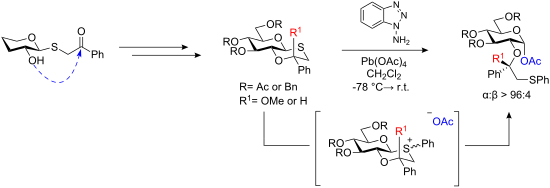
- reported an elegant chiral auxiliary-based glycosylation protocol for the synthesis of 1,2-cis-α-glycosides [12]. Completely stereoselective glycosylation was achieved when a thiophenyl-containing chiral auxiliary was attached to O-2 of an imidate glycosyl donor 1 (Scheme 1a). Low temperature 1H NMR
- spectroscopy studies confirmed the formation of a quasi-stable trans-decalin intermediate 2, which was able to cause glycosylation to take place from the α-face of the glycosyl donor. We sought to improve this strategy and recently reported a novel class of bicyclic oxathiane ketal donors 5 containing an
- synthesis of the key bicyclic intermediate was achieved starting from a simple thioglycoside 4 where the essential β-sulfur linkage was already installed, followed by a regio and stereoselective cyclisation onto the O-2 position to afford oxathiane glycosyl donor framework 5. The oxathiane ketal donor 5 is


Convergent syntheses of LeX analogues
Beilstein J. Org. Chem. 2010, 6, No. 17, doi:10.3762/bjoc.6.17
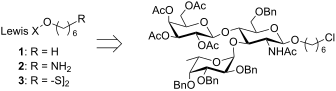
- which was chloroacetylated at O-3 to give the fully protected intermediate 19. Finally, the benzylidene acetal in compound 19 was reductively opened with Et3SiH and TfOH in CH2Cl2 at −30 °C to give acceptor 5. The trichloroacetimidate glycosyl donor 8 was prepared from the p-thiotolyl glycoside 20 [47
- -glucopyranoside (24). BF3·Et2O (150 μL, 1.19 mmol, 2.0 equiv) was added to a solution of the acceptor 4 (300 mg, 0.59 mmol) and glycosyl donor 7 (1.46 g, 2.96 mmol, 5.0 equiv) [39][40][41] in anhyd CH2Cl2 (15 mL) at 40 °C. The reaction mixture was stirred for 1 h at 40 °C. The reaction was quenched with Et3N (170



Other Beilstein-Institut Open Science Activities



