


Search results
Search for "oxirane" in Full Text gives 55 result(s) in Beilstein Journal of Organic Chemistry.
The development and evaluation of a continuous flow process for the lipase- mediated oxidation of alkenes
Beilstein J. Org. Chem. 2009, 5, No. 27, doi:10.3762/bjoc.5.27
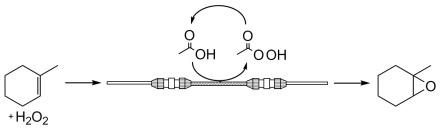
- ), which donates oxygen to the double bond, affording the respective epoxide or oxirane and regenerating the carboxylic acid. Initial investigations illustrated the highest conversions in solvents such as hexane and toluene, with the lowest in dioxane and acetonitrile, following the lipase trend where the





Oxidative cyclization of alkenols with Oxone using a miniflow reactor
Beilstein J. Org. Chem. 2009, 5, No. 18, doi:10.3762/bjoc.5.18
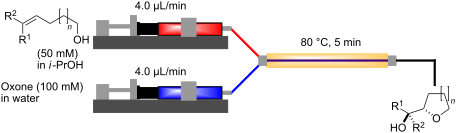
- subsequent oxirane ring opening with the intramolecular oxygen nucleophile (an intramolecular SN2 reaction) to afford the product 2 stereospecifically [44][45]. It should be noted that the miniflow cyclization of 1a was continuously carried out to give a quantitative conversion of 2a over 2 h. Conclusion In


A biphasic oxidation of alcohols to aldehydes and ketones using a simplified packed- bed microreactor
Beilstein J. Org. Chem. 2009, 5, No. 17, doi:10.3762/bjoc.5.17
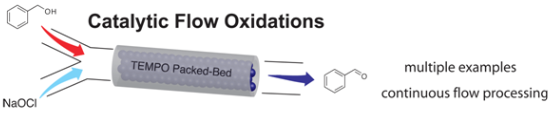
- it enables facile removal and recycling. We recently reported the development of an effective solid support for use in packed-bed microreactors [39], AMBERZYME® Oxirane (AO, 1), a commercially available resin with pendant epoxide functionalities designed for enzyme immobilization. AO is readily
- , then heating samples from 80 to 200 °C at 17 °C/min, and holding at 200 °C for 1.94 min. The MSD temperature was held at 300 °C for 15 min. Azide modified AMBERZYME® Oxirane (AO-N3, 2) Sodium azide (5.26 g, 81 mmol, 8.1 equiv) and ammonium chloride (2.27 g, 42.4 mmol, 4.2 equiv) were dissolved in 500
- mL 90:10 v/v water in methanol. AMBERZYME® Oxirane (10.0 g, 1.0 mmol epoxide/g resin, 10.0 mmol, 1.0 equiv) was suspended in the azide solution and the reaction mixture refluxed overnight with gentle stirring. The resin was filtered using a Buchner funnel, washed with deionized H2O (2 × 50 mL), MeOH




Unexpected degradation of the bisphosphonate P-C-P bridge under mild conditions
Beilstein J. Org. Chem. 2008, 4, No. 7, doi:10.1186/1860-5397-4-7
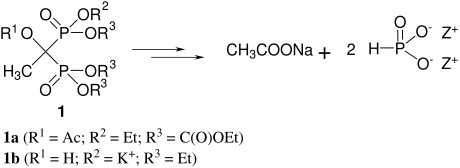
- ) or phosphate buffer, pH 7.4 at 37 °C. Szajnman et. al. [25] has reported loss of two molecules of phosphite in tetraethyl oxirane-2,2-diylbis(phosphonate); however the kind of degradation which we will discuss in this paper has not been previously reported. Results and Discussion As mentioned in the
- phosphite and the oxirane ring containing derivative (route b). In route a, water or hydroxide ion attacks the carbonyl carbon and P-C bond cleavage occurs giving rise to acetic acid and dimethyl phosphite which can undergo a further reaction with water or hydroxide to give methyl phosphite. In route b, the
- attack of water on the carbon of oxirane ring yields hydrate followed by elimination of methyl phosphite and acetic acid. We believe that route a is more probable, since during the reaction with a weaker base, such as triethylamine, only the first P-C bond is cleaved and products 3 and 7 are observed. On


Part 3. Triethylborane- air: a suitable initiator for intermolecular radical additions of S-2-oxoalkyl- thionocarbonates (S-xanthates) to olefins
Beilstein J. Org. Chem. 2007, 3, No. 47, doi:10.1186/1860-5397-3-47

- additions of various S-alkylxanthates to vinyl epoxides and related derivatives using an excess of triethylborane (2 equiv vs xanthate) at room temperature. The mechanism is different from that reported in this note as the radical chain is maintained by the ring opening of the oxirane that produces an



Other Beilstein-Institut Open Science Activities



