


Search results
Search for "rhodamine" in Full Text gives 56 result(s) in Beilstein Journal of Organic Chemistry.
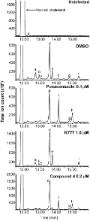
An improved synthesis of a fluorophosphonate–polyethylene glycol–biotin probe and its use against competitive substrates
Beilstein J. Org. Chem. 2013, 9, 89–96, doi:10.3762/bjoc.9.12
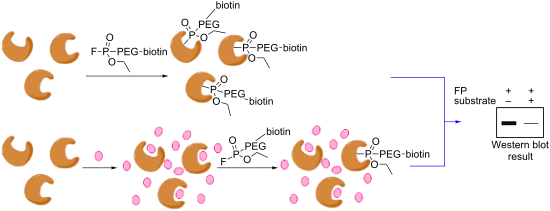
- hydrolase covalent inhibitor and from it have evolved analytical tools in which “handles“, such as biotin, rhodamine, and alkyne have been appended via a variety of linking chains [5][6][7][8]. These FP analogues have proven to be powerful tools in the profiling of complex proteome samples [9] and in the
- –biotin 1, a covalent serine hydrolases probe, to the study of enzyme substrates with high turnover. Discussion Fluorophosphonate probes with different analytical handles, such as rhodamine and alkyne, are being used to identify and characterize the in vivo proteome. Biotin-based probes that bind to


Peptoids and polyamines going sweet: Modular synthesis of glycosylated peptoids and polyamines using click chemistry
Beilstein J. Org. Chem. 2013, 9, 56–63, doi:10.3762/bjoc.9.7
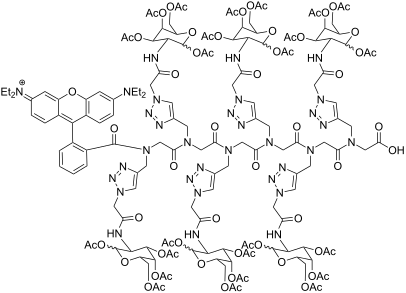
- coupling sequence resulted in the peptoids, which were further modified with rhodamine B (Rho-CO2H) as an easily accessible and versatile fluorescent tag. Rhodamine B was coupled to the N-terminus in order to provide a label for future biological applications, such as the study of the cellular uptake. For


Chemical–biological characterization of a cruzain inhibitor reveals a second target and a mammalian off-target
Beilstein J. Org. Chem. 2013, 9, 15–25, doi:10.3762/bjoc.9.3
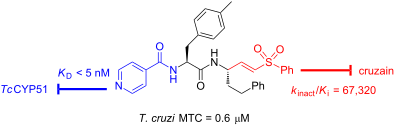
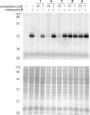
- conducted competition experiments in C2C12 cells. Hence, pre-incubation of cells with competitor compound at either 1 μM or 10 μM for one hour was followed by treatment for one hour with 9, followed by cell lysis, conjugation to 10, separation (SDS-PAGE), and detection by rhodamine fluorescence as before
- adducts of 9 were conjugated to rhodamide-based dye 10. The gel image at the top shows rhodamine fluorescence. The gel image at the bottom is of the coomassie stained gel. A successfully competed band is observed at ≈35 kDa, and this was subsequently identified as cathepsin B. MS/MS spectrum of the




Hydrophobic analogues of rhodamine B and rhodamine 101: potent fluorescent probes of mitochondria in living C. elegans
Beilstein J. Org. Chem. 2012, 8, 2156–2165, doi:10.3762/bjoc.8.243
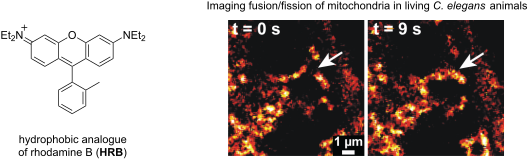
- . To provide new tools for imaging of mitochondria in vivo, we synthesized novel hydrophobic analogues of the red fluorescent dyes rhodamine B and rhodamine 101 that replace the carboxylate with a methyl group. Compared to the parent compounds, methyl analogues termed HRB and HR101 exhibit slightly red
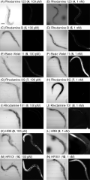
- mitochondrial stains rhodamine 123, rhodamine 6G, and rhodamine B, as well as the structurally related fluorophores rhodamine 101, and basic violet 11, revealed that HRB and HR101 are the most potent mitochondrial probes, enabling imaging of mitochondrial motility, fusion, and fission in the germline and other
- ; fluorescence; fusion; imaging; in vivo; microscopy; mitochondria; model organisms; organelle; rhodamine; spectroscopy; Introduction Fluorescent molecular probes represent critical tools for studies of chemical biology [1]. These compounds allow the creation of sensitive enzyme substrates, sensors of a wide




Chemical modification allows phallotoxins and amatoxins to be used as tools in cell biology
Beilstein J. Org. Chem. 2012, 8, 2072–2084, doi:10.3762/bjoc.8.233
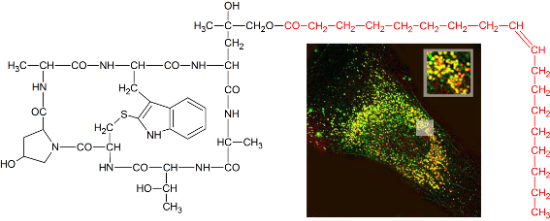
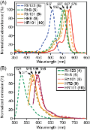
- cells Tetramethylrhodaminyl-phalloidin (Figure 6a) has been used to visualize actin fibers in fixed cells for 30 years. Here we show that the rhodamine residue also strongly enhanced cellular uptake, making this phalloidin derivative a tool for cell biology. With an IC50 value of 11 µM its toxicity is
- , albeit under toxic conditions. Using rhodamine-labeled phalloidin, we could also study how membrane-permeable peptides are incorporated into the cell. Immediately after exposure the toxin was located on the plasma membrane of the cells as shown by fluorescence microscopy (Figure 6c), while after 6 h
- increasing amounts of the toxin were found in endocytotic vesicles. After 24 h most of the rhodamine-labeled toxin was still in endosomes, while some of it had found its target, as concluded from the decoration of filaments. Phalloidin causes apoptosis of cells Under the microscope, cells treated with




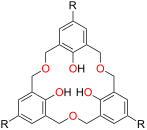
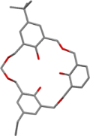
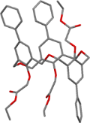
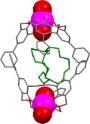
Fifty years of oxacalix[3]arenes: A review
Beilstein J. Org. Chem. 2012, 8, 201–226, doi:10.3762/bjoc.8.22












Other Beilstein-Institut Open Science Activities



