


Search results
Search for "selective reduction" in Full Text gives 57 result(s) in Beilstein Journal of Organic Chemistry.
Synthesis of a novel analogue of DPP-4 inhibitor Alogliptin: Introduction of a spirocyclic moiety on the piperidine ring
Beilstein J. Org. Chem. 2010, 6, No. 71, doi:10.3762/bjoc.6.71

- functionalized cyclopropyl ring (step i, Scheme 1) via a conventional C–C bond forming reaction. The reaction proceeded well to afford the functionalized cyclopropane derivative 1 as a result of the formation of two C–C bonds in a single step. Selective reduction of the cyano group of the resulting cyanoester 1


Synthesis of gem-difluoromethylenated analogues of boronolide
Beilstein J. Org. Chem. 2010, 6, No. 37, doi:10.3762/bjoc.6.37
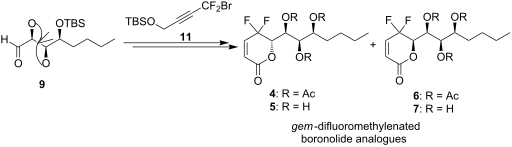
- the key γ,γ-gem-difluoromethylenated α,β-unsaturated-δ-lactone scaffold could be constructed via an oxidation–cyclization reaction of intermediate A according to our published procedures [22]. cis-Selective reduction of homopropargyl alcohol B would provide the homoallylic alcohol A. The alcohol B


Acid- mediated reactions under microfluidic conditions: A new strategy for practical synthesis of biofunctional natural products
Beilstein J. Org. Chem. 2009, 5, No. 40, doi:10.3762/bjoc.5.40
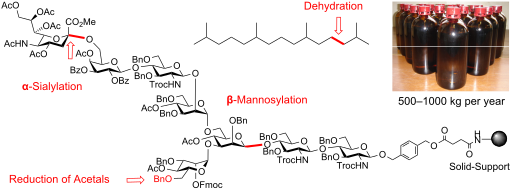
- selective reduction of galactose derivative 10 gave the 6-O-benzyl derivative 16 in 91% yield (entry 6). It is worthwhile mentioning that the established microfluidic reaction reproducibly provided the O-benzylated compounds 11–16 in greater than 90% yields in all cases, out of the three experiments


The first direct synthesis of β-unsubstituted meso- decamethylcalix[5]pyrrole
Beilstein J. Org. Chem. 2009, 5, No. 2, doi:10.3762/bjoc.5.2
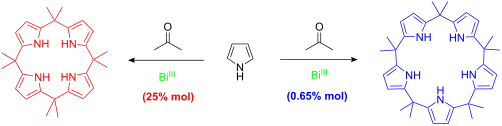
- ) from the sterically hindered diaryldi(pyrrol-2-yl)methane with 25% yield; and b) through the conversion of a calix[6]furan into the corresponding calix[6]pyrrole by an opening process of the six heterocycles, a selective reduction of the double bond and then a Paal-Knorr condensation with ammonium


Recent progress on the total synthesis of acetogenins from Annonaceae
Beilstein J. Org. Chem. 2008, 4, No. 48, doi:10.3762/bjoc.4.48
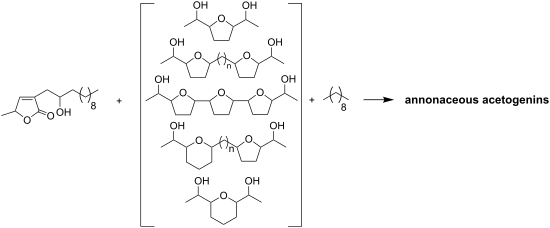
- by conversion to the epoxide 80. Addition of the C3-C13 fragment in a copper-catalyzed Grignard reaction afforded 81. The butenolide ring in 4,5-dehydro-cis-solamin (83) was put in place using a ruthenium catalyzed Alder-ene reaction of 81 with 82. Final selective reduction of the 4,5-double bond
- ) 319 to afford 321. Introduction of the unprotected butenolide (as 323) by epoxide opening with lithiated 322 followed by selective reduction and deprotection afforded bullatacin. Total synthesis of rollidecins C and D Rollidecin C (324) and rollidecin


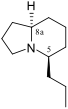
Synthesis of (–)-Indolizidine 167B based on domino hydroformylation/cyclization reactions
Beilstein J. Org. Chem. 2008, 4, No. 2, doi:10.1186/1860-5397-4-2
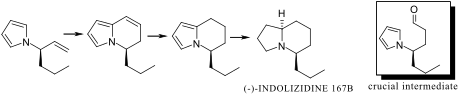
- remains a target compound for many research groups [4][5][6]. We recently reported the synthesis of Indolizidine 167B both in racemic and optically active form [7][8]; the crucial key was the cyclodehydration of 4-carboxyethyl-4-(pyrrol-1-yl)butanal, obtained via selective reduction of pyrrole masked



Hydrogenation of aromatic ketones, aldehydes, and epoxides with hydrogen and Pd(0)EnCat™ 30NP
Beilstein J. Org. Chem. 2006, 2, No. 15, doi:10.1186/1860-5397-2-15
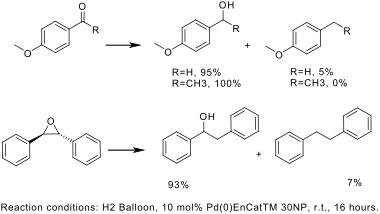
- University described the selective reduction of electron deficient and neutral aryl ketones to benzylic alcohols using Pd(0)EnCat™ 30NP as catalyst and a mixture of HCOOH/Et3N as the source of hydrogen [16]. Under these conditions they also achieved the chemoselective hydrogenolysis of aryl epoxides [17

Other Beilstein-Institut Open Science Activities



