


Search results
Search for "transfer hydrogenation" in Full Text gives 61 result(s) in Beilstein Journal of Organic Chemistry.
Simple synthesis of pyrrolo[3,2-e]indole-1-carbonitriles
Beilstein J. Org. Chem. 2013, 9, 934–941, doi:10.3762/bjoc.9.107

- °C) led to a mixture of the expected product 9a and the product 10a in that the cyano group was reduced to a methyl substituent (Scheme 4). There is a literature precedence [19] for similar transformations of cyanoarenes into corresponding methyl derivatives upon transfer hydrogenation with ammonium


Glycosylation efficiencies on different solid supports using a hydrogenolysis-labile linker
Beilstein J. Org. Chem. 2013, 9, 97–105, doi:10.3762/bjoc.9.13
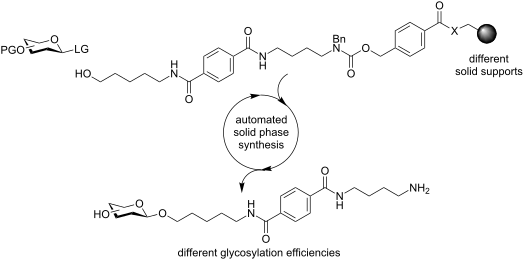
- -transfer-hydrogenation conditions proved to be very efficient for both deprotection and cleavage of the peptide from the solid support [38]. In this context, in situ generation of palladium black by reduction of palladium(II) acetate with ammonium formate in DMF yielded the best results. Although


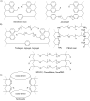


Removal of benzylidene acetal and benzyl ether in carbohydrate derivatives using triethylsilane and Pd/C
Beilstein J. Org. Chem. 2013, 9, 74–78, doi:10.3762/bjoc.9.9
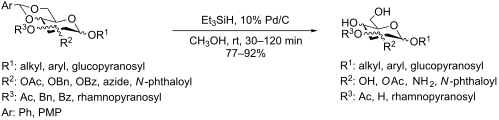
- achieved under catalytic transfer hydrogenation conditions by using a combination of triethylsilane and 10% Pd/C in CH3OH at room temperature. A variety of carbohydrate diol derivatives were prepared from their benzylidene derivatives in excellent yield. Keywords: benzylidene; glycoside; Pd/C; transfer
- development of a mild, neutral reaction condition for the removal of benzylidene acetals would be useful in the derivatization of a carbohydrate framework. Mandal et al. reported the removal of benzyl esters/ethers and the reduction of alkenes/alkynes by catalytic transfer hydrogenation using a combination
- acetal and O-benzyl groups under catalytic transfer hydrogenation conditions has been developed by using a combination of triethylsilane and 10% Pd/C. The efficacy of this methodology is comparable to the conventional hydrogenation involving hydrogen gas and Pd/C, whereas it does not require handling of


Stereoselective synthesis of trans-fused iridoid lactones and their identification in the parasitoid wasp Alloxysta victrix, Part II: Iridomyrmecins
Beilstein J. Org. Chem. 2012, 8, 1256–1264, doi:10.3762/bjoc.8.141
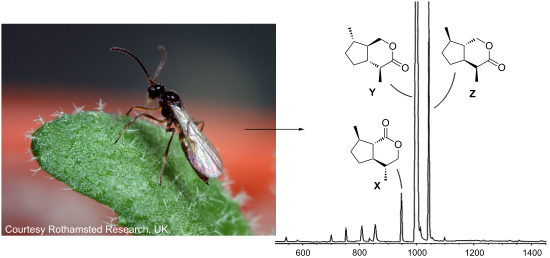
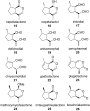
- between the methyl group at C-7 and the substitution pattern at C-7a and C-4a, respectively) configured iridomyrmecins. Key steps were two stereoselective hydrogenations: A transfer hydrogenation for a formal “anti” delivery of hydrogen [14][15], as represented in 5, and the use of Crabtree’s catalyst in
- dihydronepetalactones [1], this key intermediate could be obtained via a highly diastereoselective transfer hydrogenation of the known [19] trisubstituted cyclopentene 7 with ammonium formate over palladium [1][14][15]. Starting from the aldehyde 8, the relative configuration of which had been confirmed by NOE
- hydrogenations: A transfer hydrogenation for a formal “anti” delivery of hydrogen and the use of Crabtree’s catalyst in a directed hydrogenation for a “syn”-addition of hydrogen. Starting from pure enantiomers of limonene [1] these novel synthetic routes provided iridomyrmecins A, A' and B, B' in 2–3% yield over



Continuous-flow catalytic asymmetric hydrogenations: Reaction optimization using FTIR inline analysis
Beilstein J. Org. Chem. 2012, 8, 300–307, doi:10.3762/bjoc.8.32
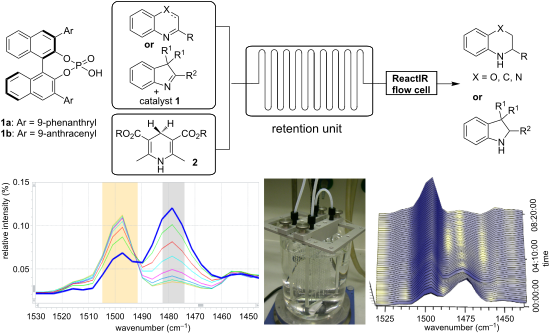
- example of a continuous-flow organocatalytic asymmetric transfer hydrogenation performed in a microreactor. In this work a ReactIR flow cell was coupled with the microreactor and applied as an inline monitoring device for optimizing the reactions. Results and Discussion The continuous-flow microreactor
- to determine the optimum reaction conditions. The IR spectra were recorded at predefined intervals and the raw data were analysed with iC-IR analysis software. The first reaction examined the asymmetric organocatalytic transfer hydrogenation [97][98][99][100][101] of benzoxazine 3a in the presence of
- -withdrawing or electron-donating groups can be reduced in a continuous fashion and the products 4 were isolated in good yields and with excellent enantioselectivities. Encouraged by the results, we next studied the transfer hydrogenation of quinolines 5 [103][104][105][106]. The optimum reaction temperature


α,β-Aziridinylphosphonates by lithium amide-induced phosphonyl migration from nitrogen to carbon in terminal aziridines
Beilstein J. Org. Chem. 2010, 6, 978–983, doi:10.3762/bjoc.6.110

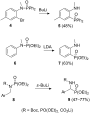
- absence of an N-substituent, cis-β-alkyl-substituted aziridinylphosphonates give β-aminophosphonates [32] and we observed that trans-β-alkyl-substituted aziridinylphosphonate (–)-3k underwent completely regioselective hydrogenolysis under transfer hydrogenation conditions [31] to produce β




Formation of epoxide-amine oligo-adducts as OH-functionalized initiators for the ring-opening polymerization of ε-caprolactone
Beilstein J. Org. Chem. 2010, 6, 938–944, doi:10.3762/bjoc.6.105
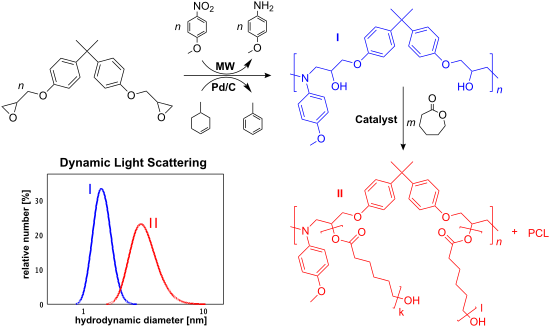
- catalytic transfer hydrogenation. Accordingly, 4-nitroanisole was reduced under microwave conditions to give 4-aminoanisole which reacted immediately with the diglycidyl ether of bisphenol A in an addition polymerization reaction to yield oligo(amino alcohol)s. The hydroxy groups of the new formed oligomers
- were used as the initiator for the ring-opening polymerization of ε-caprolactone to produce a graft copolymer. Keywords: addition oligomerization; epoxide-amine adducts; microwave; ring-opening polymerization; transfer hydrogenation; Introduction In the last decade the use of microwave (MW
- former work on the formation of hyperbranched epoxide-amine adducts via microwave-assisted heterogeneous catalytic transfer hydrogenation [22], we report herein the synthesis of an linear oligo(amino alcohol). The hydroxy groups of the latter were then used as an initiator for the ring-opening


Asymmetric reactions in continuous flow
Beilstein J. Org. Chem. 2009, 5, No. 19, doi:10.3762/bjoc.5.19
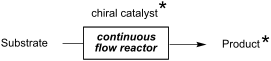
- also been used as a heterogeneous support medium in continuous flow. A ruthenium catalyst complexed to a norephedrine-derived ligand 47 was immobilized onto modified (alkylsilyl-capped) silica and employed to catalyze a continuous asymmetric transfer hydrogenation [50] (Scheme 13). The use of
- unmodified silica lowered the activity of the catalyst system, presumably via adsorption of some of the Ru(II) catalyst. Under optimal flow conditions, the transfer hydrogenation of acetophenone in isopropanol (using a flow-reactor consisting of a column packed with a slurry of the immobilized catalyst
- of asymmetric transfer hydrogenation in flow have also been reported [51][52]. Supported catalysis has been extended to reactions involving the use of continuous flow membrane reactors [19][20][21][22]. For example, the asymmetric epoxidation of a chromene derivative 49, catalyzed by homogeneous


Chemoselective reduction of aldehydes by ruthenium trichloride and resin- bound formates
Beilstein J. Org. Chem. 2008, 4, No. 53, doi:10.3762/bjoc.4.53

- Basudeb Basu Bablee Mandal Sajal Das Pralay Das Ashis K. Nanda Department of Chemistry, University of North Bengal, Darjeeling 734 013, India 10.3762/bjoc.4.53 Abstract A simple, chemoselective transfer hydrogenation of aryl aldehydes with the aid of Amberlite® resin formate (ARF), a stable H
- ® resins; chemoselectivity; hydrogen transfer; reduction of carbonyl group; ruthenium chloride; Introduction Reduction of carbonyl functionality by transition metal-catalyzed transfer hydrogenation (CTH) with the aid of a suitable hydrogen donor is a valuable synthetic tool and has proved to be a viable
- alternative to hydrogenation using molecular hydrogen [1][2][3]. Since hydrogenation using molecular hydrogen is associated with risks and often requires high pressure apparatus, the alternative technique, CTH, has been employed in many laboratories. In transfer hydrogenation, several organic molecules such


The enantiospecific synthesis of (+)-monomorine I using a 5-endo- trig cyclisation strategy
Beilstein J. Org. Chem. 2007, 3, No. 39, doi:10.1186/1860-5397-3-39
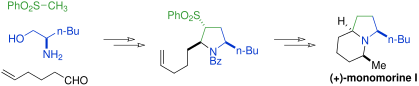
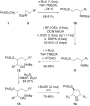
- with DIBAL-H (Scheme 8 and Scheme 9). Wacker oxidation[22] of the isopropyl model compound 16c gave the desired methyl ketone, which was subjected to transfer hydrogenation. [23] The latter reaction precipitated a reaction cascade commencing with deprotection of the N-benzylpyrrolidine followed by
- of 28 under Wacker conditions proved highly capricious and was ultimately abandoned in favour of a more reliable oxymercuration protocol. [24] Under these conditions the methyl ketone 29 was isolated in 70% yield (Scheme 9). Catalytic transfer hydrogenation led to sequential debenzylation and




Hydrogenation of aromatic ketones, aldehydes, and epoxides with hydrogen and Pd(0)EnCat™ 30NP
Beilstein J. Org. Chem. 2006, 2, No. 15, doi:10.1186/1860-5397-2-15
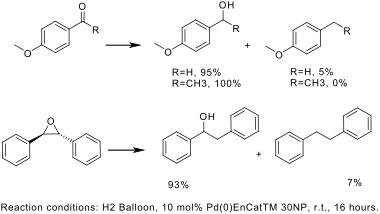
- the case of 4-methoxyacetophenone the same excellent selectivity was achieved and the alcohol was obtained in 100% conversion when using Pd(0)EnCat™ 30NP under our standard conditions (entry 9). It is worthwhile mentioning that, as we expected, transfer hydrogenation conditions did not work so
- conversion of 96% when the catalyst is pre-washed with ethanol (Table 3, entry 2). In this case, transfer hydrogenation conditions using ammonium formate as a source of hydrogen works equally well (entry 4 in Table 3). Finally, different benzylic epoxides were also subjected to the same standard conditions




