


Search results
Search for "enol ether" in Full Text gives 123 result(s) in Beilstein Journal of Organic Chemistry.
Selected synthetic strategies to cyclophanes
Beilstein J. Org. Chem. 2015, 11, 1274–1331, doi:10.3762/bjoc.11.142
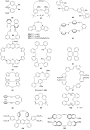
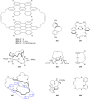
- synthesis of polyunsaturated [10]paracyclophane annulated by two azulene rings by using the McMurry reaction [100][101]. The bis(trimethylsilyl)enol ether 74 was reacted with 3-methoxycarbonyl-2H-cyclohepta[b]furan-2-one (75) in refluxing decaline to generate the 1,4-diazulenobenzene derivative 76. Double






Photovoltaic-driven organic electrosynthesis and efforts toward more sustainable oxidation reactions
Beilstein J. Org. Chem. 2015, 11, 280–287, doi:10.3762/bjoc.11.32
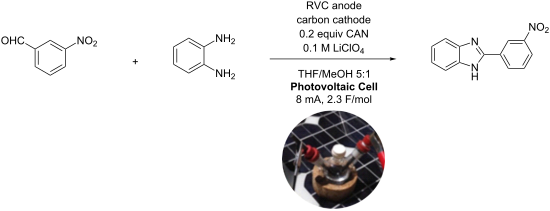
- was generated from the enol ether, it was rapidly trapped by the alcohol nucleophile. This generated a radical that was in turn trapped by an allylsilane. The loss of a second electron and elimination of the silyl group led to the final product. To be successful, the reaction needed to overcome the
- reaction flask (Figure 1a). Alternatively, several 6 V solar photovoltaic cells can be connected in series to generate the equivalent amount of current (Figure 1b). Representative procedure for solar-driven direct electrochemical reactions (Scheme 2a) The enol ether substrate was dissolved in anhydrous


Formal total syntheses of classic natural product target molecules via palladium-catalyzed enantioselective alkylation
Beilstein J. Org. Chem. 2014, 10, 2501–2512, doi:10.3762/bjoc.10.261

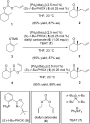
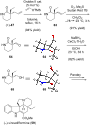
- bromolactonization of 22 to build in the requisite syn relationship between the carboxylate group and the 3-hydroxy group, ultimately leading to quinic acid. Unlike the allylic alkylations in Scheme 1, which form all-carbon stereocenters, we envisioned a unique modification of the silyl enol ether version to access
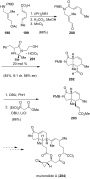
- Novak routes to quinic acid (21). Conversion of dioxanone 25 to a cyclohexylimine enabled alkylation via a metalloenamine. On acidic work-up, imine hydrolysis furnished an alkylated dioxanone in good yield. The targeted silyl enol ether 26 was prepared by thermodynamic silylation in 66% yield [43
- ]. Optimal conversions and enantioselectivities were achieved from triethylsilyl enol ether 26 on exposure to [Pd(dmdba)2] (5 mol %), (S)-t-BuPHOX (5, 5.5 mol %), and diallyl carbonate (1.05 equiv) at 25 °C, in PhMe with an equivalent of Bu4NPh3SiF2 (TBAT) [43]. Recognizing that enantioenriched α,ω-dienes




Synthesis of rigid p-terphenyl-linked carbohydrate mimetics
Beilstein J. Org. Chem. 2014, 10, 1749–1758, doi:10.3762/bjoc.10.182
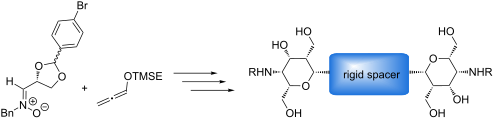
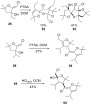
- this case. The mechanism of the rearrangement 4 → 11 can be described as an aldol-type cyclization process. The Lewis acid coordinates to the sterically less hindered oxygen atom of the dioxolane ring of 4 opening this ring and forming a carbenium ion that intramolecularly attacks the enol ether moiety


C–H-Functionalization logic guides the synthesis of a carbacyclopamine analog
Beilstein J. Org. Chem. 2014, 10, 1564–1569, doi:10.3762/bjoc.10.161
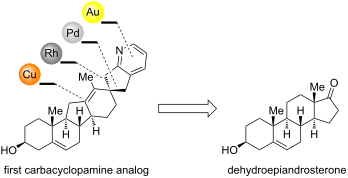
- inexpensive dehydroepiandrosterone (5) by the means of a copper-mediated C–H hydroxylation in the 12-position and a palladium-catalyzed coupling of methyl acrylate to an activated enol ether in the 17-position. In synthetic direction (Scheme 2), dehydroepiandrosterone (5) was protected as its


4-Hydroxy-6-alkyl-2-pyrones as nucleophilic coupling partners in Mitsunobu reactions and oxa-Michael additions
Beilstein J. Org. Chem. 2014, 10, 1159–1165, doi:10.3762/bjoc.10.116

- could find only limited precedent for this procedure being used previously in this way [15][16][17]. In our case, we were able to further modify the resulting pyronyl ether forming a trisubstituted enol ether, which then underwent a Suzuki–Miyaura cross-coupling or direct arylation-type reaction. As
- of pyronyl ethers is useful in itself, the ability to introduce an unsaturated group onto the oxygen, leading to a pyronyl enol ether, would have additional value. This is a highly unusual motif found in some marine polyketide natural products (such as compound 1, Figure 1). Conjugate addition to α,β
- methodology, we explored the addition of hydroxypyrones to both an allene and an internal alkyne to furnish a trisubstituted enol ether. Addition of 4-hydroxy-6-methyl-2-pyrone (3a) to the terminal allene 8 under the optimised conditions proceeded smoothly to give the trans-trisubstituted enol ether 9 in 52


Use of activated enol ethers in the synthesis of pyrazoles: reactions with hydrazine and a study of pyrazole tautomerism
Beilstein J. Org. Chem. 2014, 10, 752–760, doi:10.3762/bjoc.10.70

- enol ether/hydrazine is 1:1, as in the case of the reaction with 3c, the formation of 7-aminopyrazolo[1,5-a]pyrimidine-3,6-dicarbonitrile could be expected as a byproduct [24][25]. When hydrazine hydrochloride is used [14], ethyl 3-ethoxypyrazole-4-carboxylate was obtained in 41% yield and the expected
- ethyl 3-oxo-2,3-dihydropyrazole-4-carboxylate (5c, oxo form) in 37% yield. The first product was obtained as an oil, whereas compound 5c was afforded as a white powder. The reversal of the addition by adding hydrazine hydrate dropwise to the stirred enol ether led to the bis-N,N´-product 6a in 60% yield


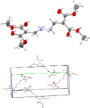

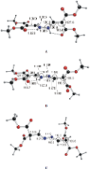
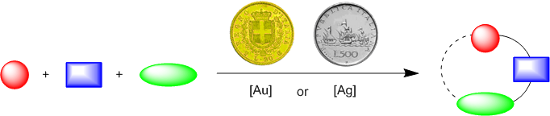
Silver and gold-catalyzed multicomponent reactions
Beilstein J. Org. Chem. 2014, 10, 481–513, doi:10.3762/bjoc.10.46


Synthesis of new enantiopure poly(hydroxy)aminooxepanes as building blocks for multivalent carbohydrate mimetics
Beilstein J. Org. Chem. 2014, 10, 213–223, doi:10.3762/bjoc.10.17
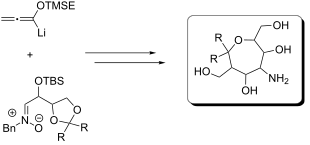
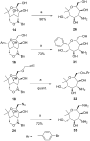
- single diastereomer) which may be due to the stabilized carbenium ion formed at the benzylic position. This rearrangement presents a relatively rare example of an intramolecular aldol-like reaction of an enol ether with an activated acetal (which may also be regarded as a special case of a Prins reaction


Synthesis of the B-seco limonoid core scaffold
Beilstein J. Org. Chem. 2014, 10, 194–208, doi:10.3762/bjoc.10.15
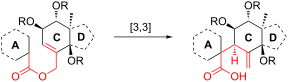
- , entry 1). Intermediary, the silyl enol ether and the silyl ketene acetal are formed. However, after the rearrangement, the keto-functionality can be set free again during an acidic work-up. In terms of yield and diastereoselectivity there was no difference observed between rearrangements with
- alkylation of the lithium enolate of 15 with alkyl halides under several conditions. They incorporated an α-allyl side chain via an α-bromo-enone, which can be obtained from an initially formed silyl enol ether, and subsequent reaction with NBS. Keck allylation of the α-bromo-enone using allyltributyltin and
- the corresponding silyl enol ether 81 followed by esterification with TMSCHN2 furnished the ester aldehyde that was reduced to the primary alcohol and protected to give TBDPS ether 82. After selective cleavage of the acetal group by treatment with perchloric acid, installation of the double bond via




Recent applications of the divinylcyclopropane–cycloheptadiene rearrangement in organic synthesis
Beilstein J. Org. Chem. 2014, 10, 163–193, doi:10.3762/bjoc.10.14
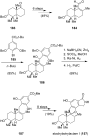
- to give tricycle 111. The enol ether moiety was reduced using NaCNBH3, followed by allylic Riley oxidation and PCC-mediated enone formation. Copper-catalyzed conjugate addition in the presence of TMSCl [105] yielded silyl enol ether 112. Subsequent introduction of the side chain in 113 via a Claisen
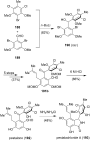
- of silyl enol ether 188 furnished the desired cis-divinylcyclopropane, which underwent smooth DVCPR under mild conditions to give bridged bicycle 189. The alcohol was deprotected and oxidized to aldehyde 190. The aldehyde was transferred into the corresponding cyanohydrin trimethylsilyl ether using


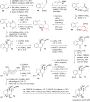


Synthesis of five- and six-membered cyclic organic peroxides: Key transformations into peroxide ring-retaining products
Beilstein J. Org. Chem. 2014, 10, 34–114, doi:10.3762/bjoc.10.6
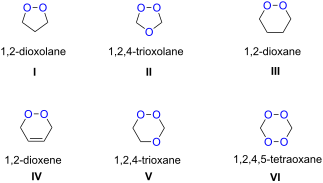


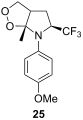


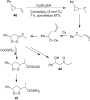








Diastereoselectivity in the Staudinger reaction of pentafluorosulfanylaldimines and ketimines
Beilstein J. Org. Chem. 2013, 9, 2675–2680, doi:10.3762/bjoc.9.303

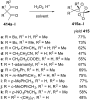
- of SF5Cl to the enol ether 2 instead of the previously described additions to enol acetates [16] (Scheme 1). In earlier studies, it was found that the yield of SF5Cl addition to enol acetates was highly dependent upon the purity of the enol acetate substrate, compounds surprisingly difficult to


Gold(I)-catalyzed domino cyclization for the synthesis of polyaromatic heterocycles
Beilstein J. Org. Chem. 2013, 9, 2625–2628, doi:10.3762/bjoc.9.297
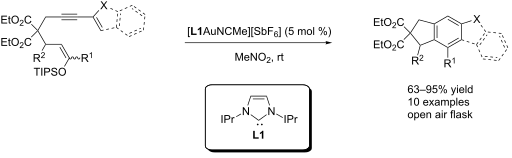
- , the cyclization of cyclic enol ether 1 using σ-donor ligands such as IPr (L1) [19] was exceptionally selective for the 5-exo-dig pathway (1→2) whereas bulky Me4XPhos (L2) [12] gave mainly 6-endo-dig-cyclized product 3. Results and Discussion During the course of our investigation, we examined the
- cyclization of non-cyclic enol ethers. As expected, the cyclization of enol ether 4 using [L2AuNCMe][SbF6] in dichloromethane afforded the cyclohexene 5 in 79% yield (Scheme 2). However, the anticipated 5-exo-dig product 6 was not observed when the catalyst [L1AuNCMe][SbF6] was utilized. Instead, the
- cyclizations of the enol ether 11a (R1 = p-BrC6H4, R2 = H) gave the corresponding benzothiophene 12a in 83% yield. The use of electron-poor silyl enol ether 11b (R1 = p-NO2C6H4, R2 = H) gave the desired product 12b, albeit in lower yield of 63%. Di- and trisubstituted silyl enol ethers 11c (R1 and R2 = H) and


Stereodivergent synthesis of jaspine B and its isomers using a carbohydrate-derived alkoxyallene as C3-building block
Beilstein J. Org. Chem. 2013, 9, 2564–2569, doi:10.3762/bjoc.9.291
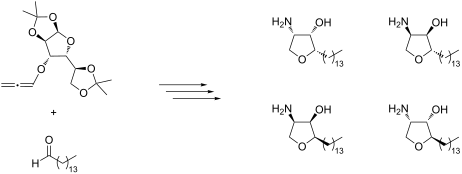
- therefore leads to a stereodivergent approach to the natural product and its enantiomer. The gold-catalyzed 5-endo-cyclization affords the corresponding dihydrofurans, which after separation, azidation of the enol ether moiety and two subsequent reduction steps give the natural product and its stereoisomers


Bidirectional cross metathesis and ring-closing metathesis/ring opening of a C2-symmetric building block: a strategy for the synthesis of decanolide natural products
Beilstein J. Org. Chem. 2013, 9, 2544–2555, doi:10.3762/bjoc.9.289
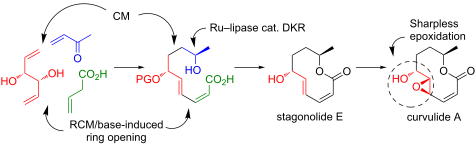
- with silane to regenerate the Cu-hydride. Alternatively, the Cu-enolate might enter a competing catalytic cycle by reacting with silane, furnishing a silyl enol ether and the catalytically active Cu-hydride species. The silyl enol ether is inert to protonation by tert-butanol, and therefore the
- competing secondary cycle will result in a decreased yield of reduction product. This reasoning prompted us to run the reaction in toluene without any protic co-solvent, which should exclusively lead to the silyl enol ether, and add TBAF as a desilylating agent after complete consumption of the starting






Gold(I)-catalyzed enantioselective cycloaddition reactions
Beilstein J. Org. Chem. 2013, 9, 2250–2264, doi:10.3762/bjoc.9.264
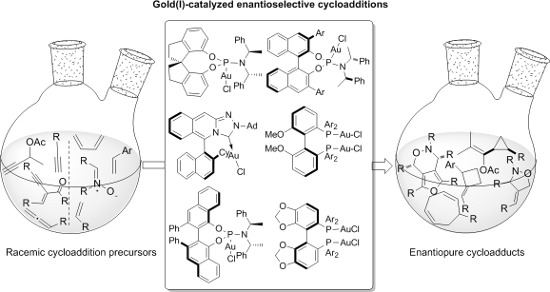
- investigations by the groups of Mascareñas, González and Chen revealed that the gold-catalyzed cycloaddition between an allenamide and an appropriate alkene (e.g., enamide, enol ether or vinylarene) provides a variety of cyclobutanic systems in excellent yields. The optimum catalysts for the racemic processes


The chemistry of isoindole natural products
Beilstein J. Org. Chem. 2013, 9, 2048–2078, doi:10.3762/bjoc.9.243
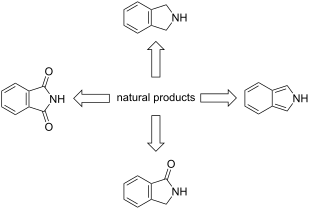
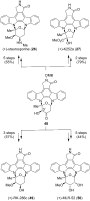
- synthesized (Scheme 8). Strategic bond disconnections revealed the common isoindolinone precursor 73. The synthesis of the latter commenced from N,N-dibenzylphenylalanine (71) to afford the Diels–Alder substrate 72 in four steps. The envisioned intramolecular Diels–Alder cyclization of the silyl enol ether 72
- provided the depicted endo-diastereomer in good yield. Exchange of the N-benzyl for a Boc-protecting group and cleavage of the silyl enol ether gave the corresponding ketone, which was first converted to an enol-triflate and then to the tricyclic alkene 73. At this stage, the syntheses of cytochalasin B






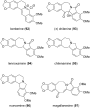

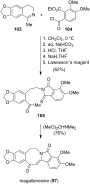


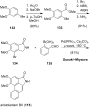


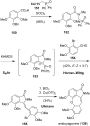





Anodic coupling of carboxylic acids to electron-rich double bonds: A surprising non-Kolbe pathway to lactones
Beilstein J. Org. Chem. 2013, 9, 1630–1636, doi:10.3762/bjoc.9.186
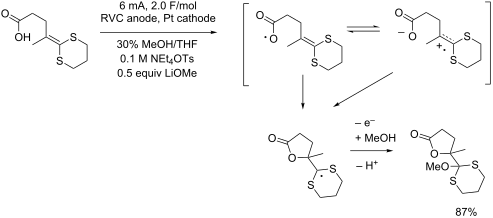
- the ketene dithioacetal in the absence of a trapping group [21]. The anodic coupling of a carboxylic acid group with a vinyl sulfide and an enol ether were also examined (Table 2). As with earlier alcohol and amine based cyclizations, reactions with the vinyl sulfide coupling partner proceeded much
- better than did their enol ether counterparts [21][22]. In the previous cases, the argument was made that less polar radical cations underwent better trapping reactions with heteroatomic nucleophiles [23], and a similar argument can be made here. The oxidation potential for the vinyl sulfide used in
- substrate 17a is +1.08 V versus Ag/AgCl [9] and the oxidation potential of the enol ether in substrate 17b is +1.18 versus Ag/AgCl [9]. Both oxidation potentials are lower than the potential measured for the carboxylate suggesting that both reactions proceed through the olefinic radical cation. While an


Anionic cascade reactions. One-pot assembly of (Z)-chloro-exo-methylenetetrahydrofurans from β-hydroxyketones
Beilstein J. Org. Chem. 2013, 9, 1319–1325, doi:10.3762/bjoc.9.148

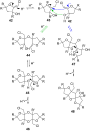
- -exo-methylenetetrahydrofuran 42 is converted into the oxonium cation 43. Subsequent capture of this intermediate 43 by a second molecule of 42 can occur via two different pathways. The first one involves the addition of the enol ether function of 42 onto 43, leading to the creation of a new C–C bond
- enol ether function, followed by 6-exo-trig cyclization, completes this sequence of events and provides the dioxane derivative 46. Interestingly, no reaction was observed when the spirocycle 41 and the dioxanes 35, 36 and 39 were reacted under acidic conditions, indicating that the final step is not





Diastereoselective synthesis of nitroso acetals from (S,E)-γ-aminated nitroalkenes via multicomponent [4 + 2]/[3 + 2] cycloadditions promoted by LiCl or LiClO4
Beilstein J. Org. Chem. 2013, 9, 838–845, doi:10.3762/bjoc.9.96
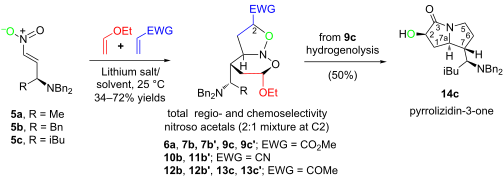
- promoters in Diels–Alder (DA) and HDA reactions [12][13][14][15][16][17]. Regarding enantioselective processes, the majority of them have been associated with the employment of a specific Lewis acid and a selected chiral inductor connected to the enol ether moiety to furnish nonracemic nitroso acetals
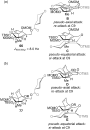
- -deficient C=C bond (Scheme 3). Thus, the approach of the enol ether to the β-nitro carbon was preferred by the less hindered Si face on the opposite side to the largest group. Secondary orbital and Coulombic interactions have been proposed to explain the endo approach of the enol ethers [9][33][41]. In the


Asymmetric synthesis of a highly functionalized bicyclo[3.2.2]nonene derivative
Beilstein J. Org. Chem. 2013, 9, 655–663, doi:10.3762/bjoc.9.74
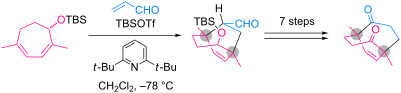
- heptenone 12 [17][18][19][20][21]. The more thermodynamically stable silyl enol ether 13 was regioselectively formed from 12 under Holton’s conditions [22], and DDQ-mediated oxidation of 13 resulted in the formation of α,β-unsaturated ketone 14. Asymmetric reduction of ketone 14 was in turn realized by
- due to the unfavorable interaction of the two proximal TBS groups in TS-B, allowing formation of 8 as the major compound. Having synthesized the optically active 8, the next task was the preparation of C2-symmetric bicyclo[3.3.2]decene 1 from 8 (Scheme 5). The silyl enol ether formation of aldehyde 8
- compounds corresponds to that of the natural products. High-resolution mass spectra were measured on Bruker microTOFII. TMS-enol ether 13: Methylmagnesium bromide (3.0 M in Et2O, 8.5 mL, 26 mmol) was added to a solution of iPr2NH (3.9 mL, 28 mmol) in Et2O (170 mL) at 0 °C. The mixture was stirred at room


End-labeled amino terminated monotelechelic glycopolymers generated by ROMP and Cu(I)-catalyzed azide–alkyne cycloaddition
Beilstein J. Org. Chem. 2013, 9, 608–612, doi:10.3762/bjoc.9.66

- [11]. Chain termination is commonly carried out by using ethyl vinyl ether or cis-butene derivatives, although incomplete end-capping has been reported as a limitation with the former [12]. Notable examples include an enol ether derivative that introduces a β-trimethylsilylethoxy protected carboxylic


Synthesis of a novel chemotype via sequential metal-catalyzed cycloisomerizations
Beilstein J. Org. Chem. 2012, 8, 1338–1343, doi:10.3762/bjoc.8.153

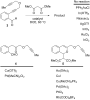
- diynyl benzaldehyde 3 and dimethyl malonate is catalyzed by Cu(I) to afford isochromene 24 [20][21][22]. Pt(II) π-coordination of the pendant alkyne of 24 followed by cyclization of the enol ether affords the seven-membered-ring metal-“ate” intermediate 25. The cyclization occurs at the face opposite the
- 1,2-hydride shift to intermediate 27 followed by elimination of the metal catalyst [25] to afford the observed cyclopropane product 6. An alternative reaction pathway may be invoked for the ethyl-substituted substrate 22 leading to product 23 (Scheme 4). After initial cyclization of the enol ether




Sonogashira–Hagihara reactions of halogenated glycals
Beilstein J. Org. Chem. 2012, 8, 675–682, doi:10.3762/bjoc.8.75
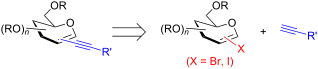
- enynes was achieved by selective reduction of the triple bond by making use of Raney nickel (Table 3). We found that the electron-rich enol ether moiety remains untouched, when reaction times of less than four hours were chosen in the case of the enynes 9e–9h. It should be noted that methanol was a
- , overnight), whereas in the case of enyne 11b, under the same reaction conditions, only the triple bond was reduced to furnish enol ether 14e selectively. In three cases we further functionalized the 1-alkylated glycals by an epoxidation/epoxide-opening sequence [30][31][32][33]. Dimethyldioxirane (DMDO) was
- essential co-solvent in order to execute the Ni-catalyzed reduction. The enol ether double bond could be further hydroxylated by an epoxidation/epoxide opening sequence. Depending on the hydride source α- and β-configured alkyl-C-glycosides were obtained diastereoselectively in moderate yield. These





