


Search results
Search for "isocyanides" in Full Text gives 84 result(s) in Beilstein Journal of Organic Chemistry.
Silver and gold-catalyzed multicomponent reactions
Beilstein J. Org. Chem. 2014, 10, 481–513, doi:10.3762/bjoc.10.46
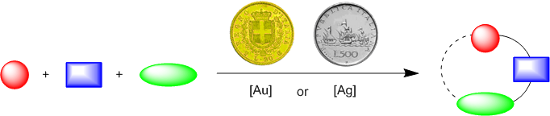
- reactivity, silver(I) salts and complexes have been used to activate either the nucleophile or the imine. Isocyanides have been found to be versatile reagents in heterocyclic synthesis [82][83]. In particular, the α-metallation of isocyanides was accomplished by Schöllkopf [84] and Van Leusen [85] for the
- -protons and thus allowing for an easy α-deprotonation with weak bases (Scheme 32) [86][87]. Recently, Orru’s group successfully translated the stepwise Schöllkopf–Van Leusen synthesis of dihydroimidazoles 65 in a MCR involving isocyanides 61, aldehydes 62 and primary amines 63 [88]. Initial results
- , obtained in the presence of a simple dehydrating agent, were limited to the use of simple aldehydes, amines and α-acidic α,α-disubstituted isocyanides such as methyl isocyano(phenyl)acetate and 9-isocyano-9H-fluorene [89]. The scope of these reactions could be extended to isocyanides with other


Diversity-oriented synthesis of dihydrobenzoxazepinones by coupling the Ugi multicomponent reaction with a Mitsunobu cyclization
Beilstein J. Org. Chem. 2014, 10, 209–212, doi:10.3762/bjoc.10.16

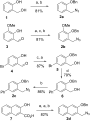
- chromatography at the level of 9. With these optimized conditions in hand, we performed a series of Ugi reactions using azides 2a–d, glycolic acid, various aldehydes and isocyanides (Scheme 2). After a fast purification through a short silica gel column, the Ugi adducts 9a–n were submitted to hydrogenolysis and
- /imines [13][14][15] and isocyanides [16][17]. Experimental Typical procedure for the synthesis of dihydrobenzoxazepinones 10a–n. A solution of benzyl azide 2 (1 mmol) in dry THF (3 mL) was treated with trimethylphosphine (1 M solution in toluene, 1.1 mmol) and stirred for 2 h at room temperature. Then


Studies on the interaction of isocyanides with imines: reaction scope and mechanistic variations
Beilstein J. Org. Chem. 2014, 10, 12–17, doi:10.3762/bjoc.10.3
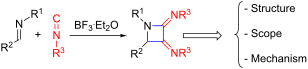
- Barcelona, Spain 10.3762/bjoc.10.3 Abstract The interaction of imines with isocyanides has been studied. The main product results from a sequential process involving the attack of two units of isocyanide, under Lewis acid catalysis, upon the carbon–nitrogen double bond of the imine to form the 4-membered
- ring system. The scope of the reaction regarding the imine and isocyanide ranges has been determined, and also some mechanistic variations and structural features have been described. Keywords: azetidines; heterocycles; imines; isocyanides; multicomponent reactions; Introduction The interaction of
- imines with isocyanides is mainly focused on to the well-known Ugi multicomponent reaction (MCR) [1]. This fundamental process features the participation of a carboxylic acid group which attacks the intermediate nitrilium ion thus leading, after the Mumm rearrangement, to α-amidoamides. However, the


The rapid generation of isothiocyanates in flow
Beilstein J. Org. Chem. 2013, 9, 1613–1619, doi:10.3762/bjoc.9.184
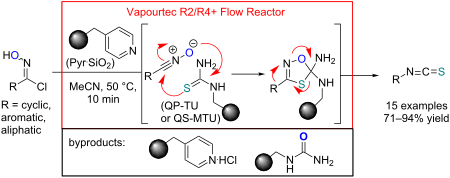
- isocyanides [30][31], guanidines [32][33] and thiosemicarbazides [34]. Due to the limited commercial availability of diversely functionalised isothiocyanates chemists normally pursue a de novo synthesis, which most commonly involves the condensation of an amine with thiophosgene or carbon disulfide [35][36


Novel synthesis of pseudopeptides bearing a difluoromethyl group by Ugi reaction and desulfanylation
Beilstein J. Org. Chem. 2011, 7, 1070–1074, doi:10.3762/bjoc.7.123

- group (PhS) with Bu3SnH/AIBN according to our previous research, and the desired difluoromethyl-containing pseudopeptide was successfully obtained [27]. To demonstrate the scope of the method, several different substituted anilines, substituted benzaldehydes, isocyanides and this novel difluorinated
- difluoromethyl-containing pseudopeptides (3a–m and 4a–m) in good yields (Table 1). Conclusion In summary, we have developed a novel and efficient protocol for the synthesis of CF2H-containing pseudopeptides by Ugi reaction of substituted anilines, benzaldehyde, isocyanides and the novel building block 2,2


Long-range diastereoselectivity in Ugi reactions of 2-substituted dihydrobenzoxazepines
Beilstein J. Org. Chem. 2011, 7, 976–979, doi:10.3762/bjoc.7.109
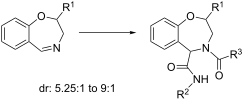
- venerable reaction is the poor diastereoselectivity typically experienced when using chiral inputs. It is well known that chiral isocyanides, aldehydes/ketones and carboxylic acids always bring about no or very little diastereoselectivity, whereas some relative asymmetric induction has been reported only
- noting that the Mitsunobu reaction is not effective on unprotected salicylaldehyde. 2,3-Dihydrobenzo[f][1,4]oxazepines similar to 5a,b have been previously prepared, but through less general routes [22][23][24]. Compounds 5a,b were reacted with a series of isocyanides and carboxylic acids to give, in
- diastereoselectivity (from 5.25:1 up to 9:1) is completely unprecedented for an isocyanide based multicomponent reaction. A slight increase in the dr was observed on passing from R1 = Me to bulkier R1 = iBu. On the other hand the structure and the nature of both isocyanides and carboxylic acids seem to have little


(Pseudo)amide-linked oligosaccharide mimetics: molecular recognition and supramolecular properties
Beilstein J. Org. Chem. 2010, 6, No. 20, doi:10.3762/bjoc.6.20
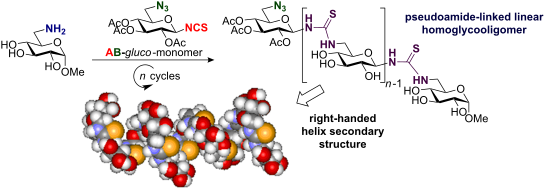
- followed by treatment with yellow mercury (II) oxide [68]. There are two general strategies to access pseudoamide-type oligosaccharide mimics: i) nucleophilic addition of sugar derivatives to carbohydrate isocyanates, isothiocyanates or isocyanides; and ii) conversion of sugar azides into glycosyl
- or sugars, respectively, and glycosyl-isocyanates [73][74] or isocyanides [75]. However, the experimental difficulties in handling isocyanates has led to the preferential use of sugar carbodiimides as key intermediates for the preparation of glycosylureido sugars [76][77][78][79]. From the large



Synthesis of dihydrophenanthridines by a sequence of Ugi-4CR and palladium- catalyzed intramolecular C-H functionalization
Beilstein J. Org. Chem. 2008, 4, No. 10, doi:10.3762/bjoc.4.10
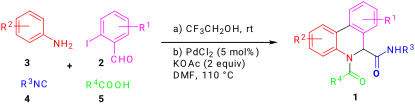
- heterocycles is evidently valuable in diversity oriented synthesis. The scope of this cyclization was next examined. From three aldehydes, eight amines, five carboxylic acids, and three isocyanides, Ugi-adducts were prepared and their subsequent palladium-catalyzed cyclization was investigated. The results are


Aroylketene dithioacetal chemistry: facile synthesis of 4-aroyl- 3-methylsulfanyl- 2-tosylpyrroles from aroylketene dithioacetals and TosMIC
Beilstein J. Org. Chem. 2007, 3, No. 31, doi:10.1186/1860-5397-3-31

- use of some isocyanides for the syntheses of trisubstituted pyrroles prompts us to disclose our efforts in this area. [16] Results and Discussion The cycloaddition of TosMIC 2 to 3,3-di(methylsulfanyl)-1-phenyl-2-propen-1-one 1a was taken as a test case to evaluate the cycloaddition and to arrive at


Other Beilstein-Institut Open Science Activities



