


Search results
Search for "sesquiterpene" in Full Text gives 81 result(s) in Beilstein Journal of Organic Chemistry.
A concise enantioselective synthesis of the guaiane sesquiterpene (−)-oxyphyllol
Beilstein J. Org. Chem. 2013, 9, 2028–2032, doi:10.3762/bjoc.9.239
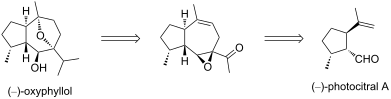
- ; Introduction The hydroazulene framework is present in many natural products that are often associated with interesting biological properties [1][2]. The guaiane sesquiterpene (−)-oxyphyllol (1) has been isolated from the roots of the Thai medicinal plant Phyllanthus oxyphyllus [3]. A recent enantioselective


Flow photochemistry: Old light through new windows
Beilstein J. Org. Chem. 2012, 8, 2025–2052, doi:10.3762/bjoc.8.229
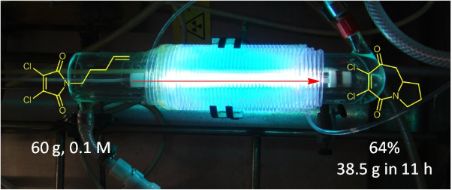
- ] that crystals of the sesquiterpene santonin would literally burst open upon exposure to sunlight can perhaps be considered as the beginning of organic photochemistry. In 1883 Cannizzaro and Sestini [2] investigated this further and reported the formation of photosantonic acid upon irradiation of


The volatiles of pathogenic and nonpathogenic mycobacteria and related bacteria
Beilstein J. Org. Chem. 2012, 8, 290–299, doi:10.3762/bjoc.8.31
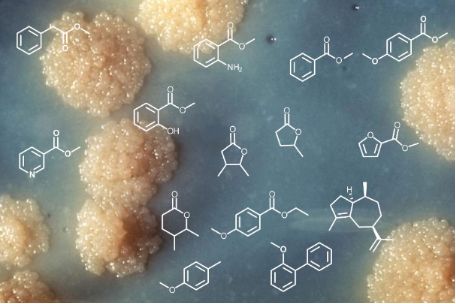
- fatty-acid derivatives were released by pathogenic/nonpathogenic mycobacteria, while the two Nocardia spp. (N. asteroides and N. africana) emitted the sesquiterpene aciphyllene. Pathogenic Mycobacterium tuberculosis strains grown on agar plates produced a distinct bouquet with different volatiles, while
- from M. tuberculosis. While the mycobacteria grown on the 7H11 solid medium emitted a wide variety of volatiles, Nocardia asteroides produced, even in different ages, only 4-pentanolide (10) (Table 3). Additionally, N. africana also released only one compound, the sesquiterpene aciphyllene (19), which


One-pot four-component synthesis of pyrimidyl and pyrazolyl substituted azulenes by glyoxylation–decarbonylative alkynylation–cyclocondensation sequences
Beilstein J. Org. Chem. 2011, 7, 1173–1181, doi:10.3762/bjoc.7.136
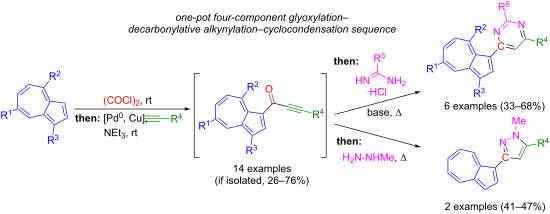
- , such as Friedel–Crafts-type reactions, generally occurs in the 1-position [24]. Interestingly, the azulene motif is also found in terpenoids [27][28]. Guaiazulene (1b) (Scheme 1), a commonly known derivative of azulene (1a), is a naturally occurring sesquiterpene [29]. Guaiazulene (1b) has found entry
- -component approach to heterocyclic derivatives of azulene is well suited for the development of functional chromophores with extended π-conjugation. Selected resonance structures of azulene (1a) and structure of the sesquiterpene guaiazulene (1b). Synthesis of ynones by glyoxylation–decarbonylative


A racemic formal total synthesis of clavukerin A using gold(I)-catalyzed cycloisomerization of 3-methoxy-1,6-enynes as the key strategy
Beilstein J. Org. Chem. 2011, 7, 740–743, doi:10.3762/bjoc.7.84
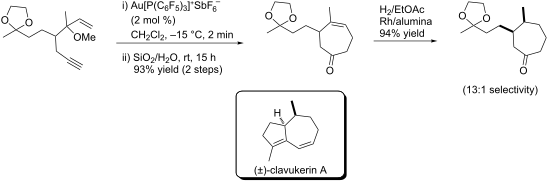
- sesquiterpene natural products. It was first isolated in 1983, by the group of Kitawara, from the Okinawa soft coral Clavularia koellikeri. The structure of clavukerin A was established by CD spectra and X-ray diffraction [1]. The first total synthesis of clavukerin A was reported by Asaoka in 1991, which was


Synthesis of spiroannulated and 3-arylated 1,2,4-trioxanes from mesitylol and methyl 4-hydroxytiglate by photooxygenation and peroxyacetalization
Beilstein J. Org. Chem. 2010, 6, No. 61, doi:10.3762/bjoc.6.61
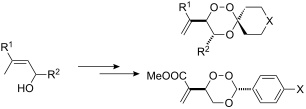
- hydroperoxy alcohol 4 and benzaldehyde derivatives, was investigated by X-ray crystallography. Keywords: ene reaction; peracetalization; peroxides; singlet oxygen; trioxanes; Introduction The antimalaria-active molecule artemisinin (1) is a naturally occurring sesquiterpene peroxide with remarkable


Other Beilstein-Institut Open Science Activities



